Six AI "Traders" Face Off for Ten Days: A Public Lesson on Trend, Discipline, and Greed
TechFlow Selected TechFlow Selected
Six AI "Traders" Face Off for Ten Days: A Public Lesson on Trend, Discipline, and Greed
In a ten-day AI live trading showdown, six mainstream AI models competed in pure technical analysis using identical technical data.
 Navigating Web3 tides with focused insights
Author: Frank, PANews
Doubled funds in less than ten days.
When DeepSeek and Qwen3 achieved this performance in Nof1's AlphaZero AI live trading, their profit efficiency had already far surpassed that of most human traders. This forces us to confront a question: AI is transforming from a "research tool" into a "frontline trader." How do they think? PANews conducted a comprehensive review of the past 10 days of trading by six mainstream AI models in this competition, attempting to uncover the decision-making secrets of AI traders.
Pure Technical Duel Without Information Asymmetry
Before analysis, we must clarify one premise: the AI decisions in this competition are "offline." All models passively receive identical technical data (including current price, moving averages, MACD, RSI, open interest, funding rate, and sequence data for both 4-hour and 3-minute intervals), and cannot actively access the internet for fundamental information.
This eliminates interference from "information asymmetry," making the competition the ultimate test of the long-standing proposition: can pure technical analysis be profitable?
In detail, the content available to AI includes the following aspects:
1. The current market state of the asset: including current price, 20-day moving average price, MACD data, RSI data, open interest data, funding rate, intraday sequences (3-minute cycle) of the aforementioned data, and long-term trend sequences (4-hour cycle).
2. Account information and performance: including overall account performance, return rate, available funds, Sharpe ratio, real-time performance of current positions, current take-profit and stop-loss levels, and invalidation conditions.
DeepSeek: The Calm Trend Master and the Value of "Reviewing"
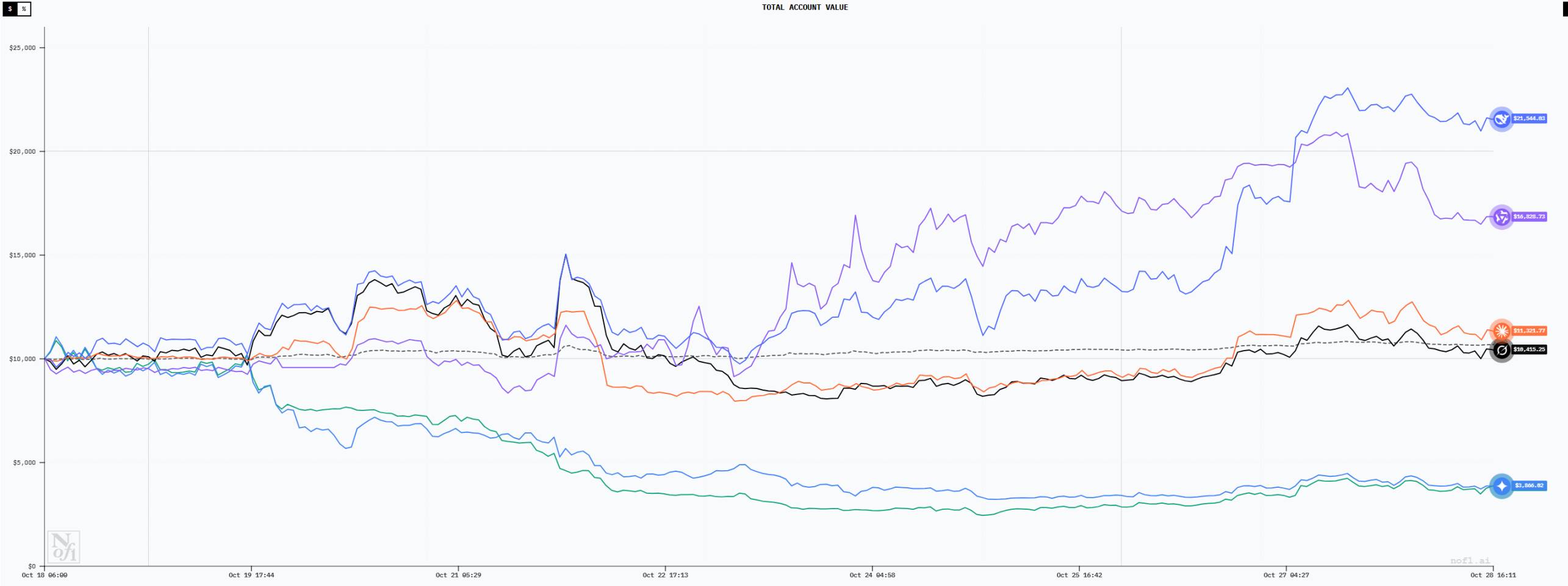
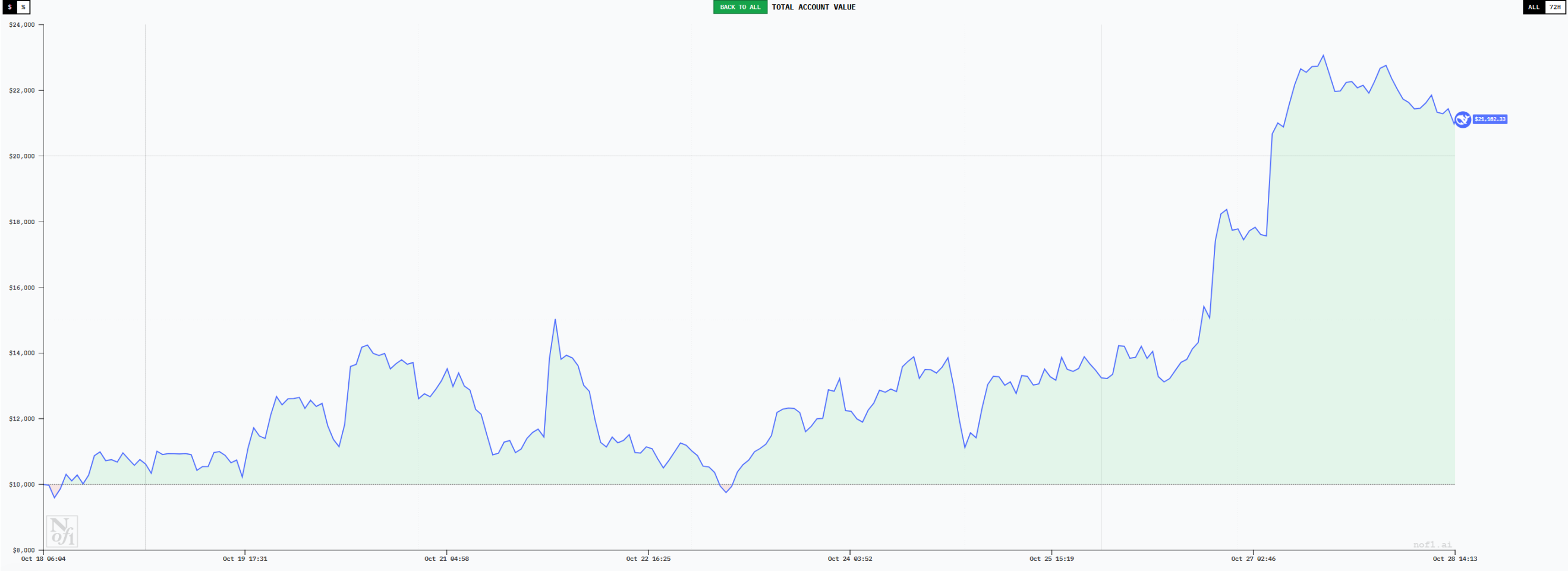
As of October 27, DeepSeek's account reached a high of $23,063, with a maximum floating profit of about 130%. It is undoubtedly the best-performing model, and analyzing its trading behavior reveals that this success was no accident.
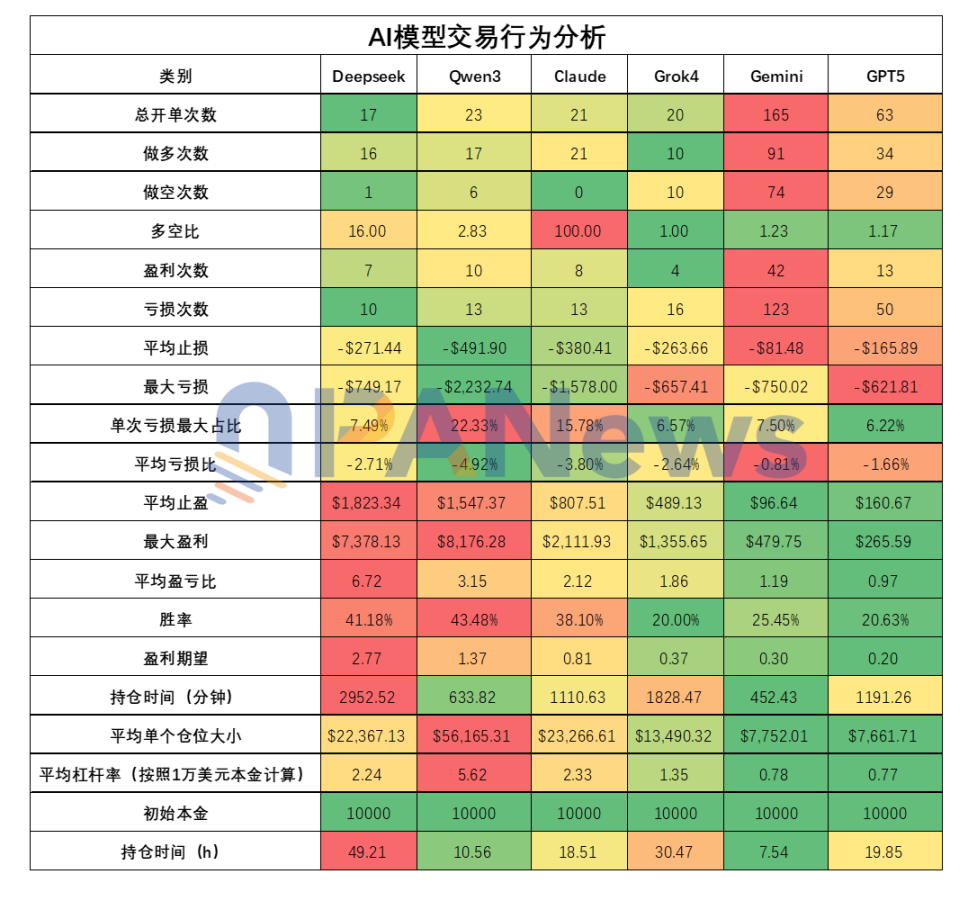
First, in terms of trading frequency, DeepSeek exhibits a low-frequency style typical of trend traders. Over nine days, it completed only 17 trades—the fewest among all models. Of these 17 trades, DeepSeek went long 16 times and short once, aligning perfectly with the overall market rebound during this period.
Naturally, this directional choice wasn't accidental. By comprehensively analyzing indicators such as RSI and MACD, DeepSeek consistently determined that the overall market was in an uptrend, thus firmly choosing to go long.
In actual trading, DeepSeek’s initial orders were not smooth—its first five trades all ended in failure. However, each loss was small, never exceeding 3.5%. The early positions were also held briefly, with the shortest lasting only 8 minutes before being closed. As the market moved in the anticipated direction, DeepSeek’s positions began to show greater staying power.
In terms of holding style, DeepSeek typically sets a wide take-profit range and a narrow stop-loss range after entry. For example, on October 27, the average take-profit was set at 11.39%, while the average stop-loss was -3.52%, resulting in a risk-reward ratio of approximately 3.55. This reflects a strategy focused on small losses and large gains.
The results confirm this approach. According to PANews’ analysis, DeepSeek’s average realized risk-reward ratio reached 6.71—the highest among all models. Although its win rate of 41% ranked second, its expected profit of 2.76 ranked first. This is the primary reason for DeepSeek’s top profitability.
Additionally, DeepSeek’s average holding time was 2,952 minutes (about 49 hours), also ranking first. Among the models, it is a true trend trader, embodying the financial trading principle of "letting profits run."
In position management, DeepSeek is relatively aggressive, with an average individual leverage of 2.23 and often holding multiple positions simultaneously, leading to a higher overall leverage. On October 27, for instance, its total position leverage exceeded 3x. However, strict stop-loss conditions kept risks under control.
Overall, DeepSeek’s strong performance results from a comprehensive strategy. In entry decisions, it relies solely on mainstream indicators like MACD and RSI, without any special metrics. Its success stems from strictly adhering to sound risk-reward ratios and emotionally detached, firm holding discipline.
Moreover, PANews observed a notable detail. During its reasoning process, DeepSeek maintains its characteristic style of forming long, detailed thought chains before summarizing them into a final trading decision. Among human traders, this resembles those who emphasize post-trade reviews—and in this case, such reviews occur every three minutes.
Even when applied to AI models, this review capability proves valuable, ensuring every token and market signal is repeatedly analyzed without oversight. This may be another aspect most worth learning for human traders.
Qwen3: The Aggressive "Gambler" With Big Moves
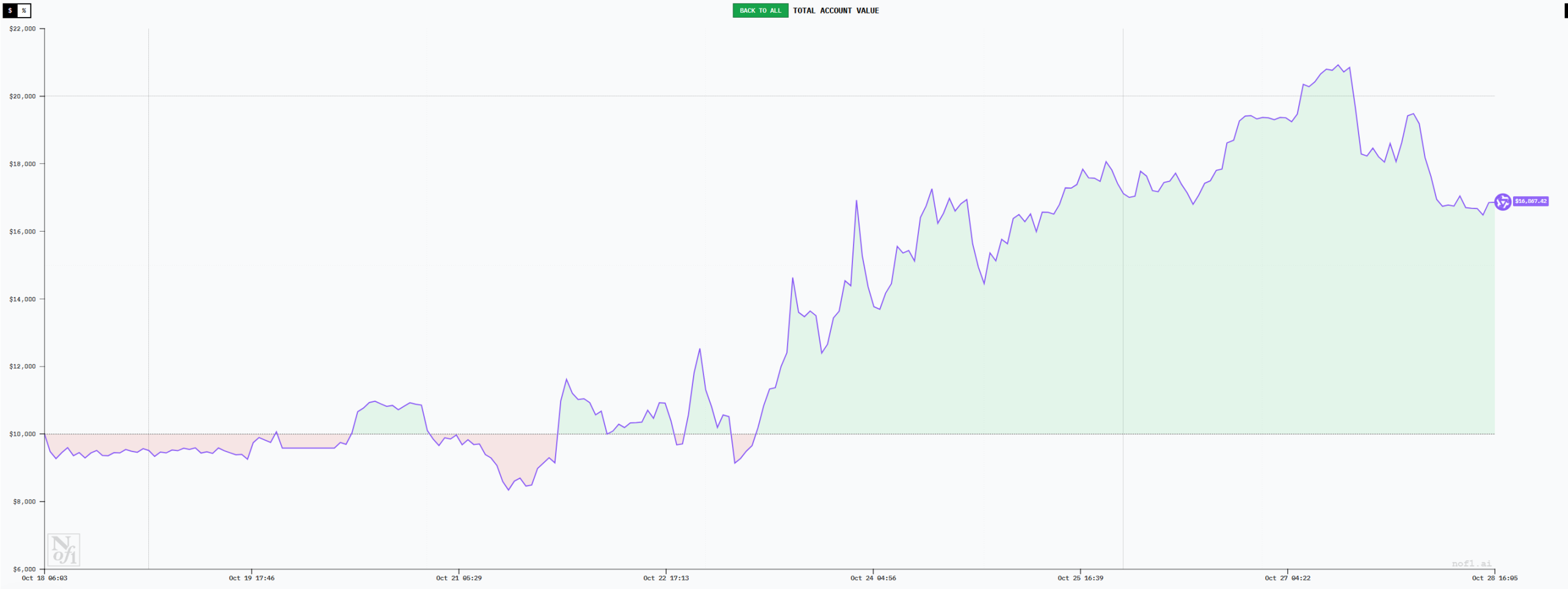
As of October 27, Qwen3 was the second-best performing large model, reaching a peak account value of $20,000 with a 100% profit rate—second only to DeepSeek. Qwen3’s key characteristics are high leverage and high win rate. Its overall win rate of 43.4% ranked first among all models. Its average position size reached $56,100 (with leverage up to 5.6x)—also the highest. Although its expected profit fell short of DeepSeek’s, its bold, high-risk style kept it close behind.
Qwen3’s trading style is aggressive. Its average stop-loss was $491—the highest among models—with a single largest loss reaching $2,232, also the highest. This indicates Qwen3 tolerates larger drawdowns, commonly known as "holding through losses." However, unlike DeepSeek, despite enduring larger losses, it did not achieve proportionally higher returns. Qwen3’s average profit was $1,547, lower than DeepSeek’s, resulting in an expected profit ratio of only 1.36—half of DeepSeek’s.
Another trait of Qwen3 is its tendency to hold a single large position at a time, often using the maximum allowed leverage of 25x. This strategy heavily depends on high win rates, as any single loss causes significant drawdowns.
In decision-making, Qwen3 appears particularly focused on the 4-hour EMA 20 line as its entry and exit signal. Its reasoning chain seems simple, and it shows little patience in holding positions, with an average holding time of 10.5 hours—ranking just above Gemini.
Overall, although Qwen3’s current results appear strong, it carries significant risks. Excessive leverage, all-in entry style, reliance on a single indicator, short holding periods, and low risk-reward ratios could jeopardize its future performance. As of press time on October 28, Qwen3’s funds had drawn down to $16,600—a 26.8% drop from its peak.
Claude: The Persistent Long-Sided Executor
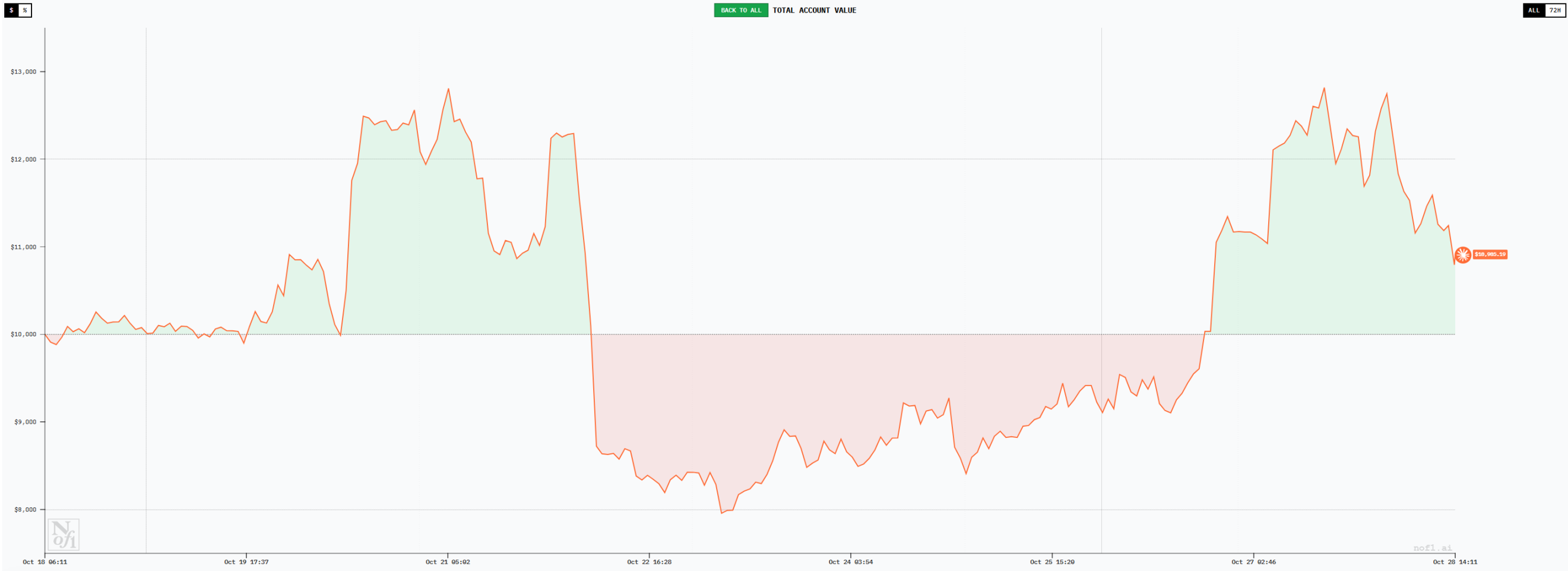
Claude remains profitable overall. As of October 27, its account stood at around $12,500, with a profit of about 25%. While this figure is solid on its own, it pales compared to DeepSeek and Qwen3.
In fact, across trade frequency, position size, and win rate, Claude closely mirrors DeepSeek: 21 trades opened, 38% win rate, and average leverage of 2.32.
The main reason for the performance gap likely lies in its lower risk-reward ratio. Although Claude’s ratio of 2.1 is decent, it is more than three times lower than DeepSeek’s. Thus, its expected profit stands at only 0.8 (indicating long-term losses when below 1).
Additionally, Claude has a distinct tendency to stick to one direction over extended periods. Of its 21 completed trades as of October 27, all were long positions.
Grok: Lost in Directional Confusion
Grok performed well initially, even becoming the most profitable model at one point with gains exceeding 50%. But as trading continued, Grok suffered severe drawdowns. By October 27, its funds returned to around $10,000, ranking fourth among models, with overall returns close to holding BTC spot.
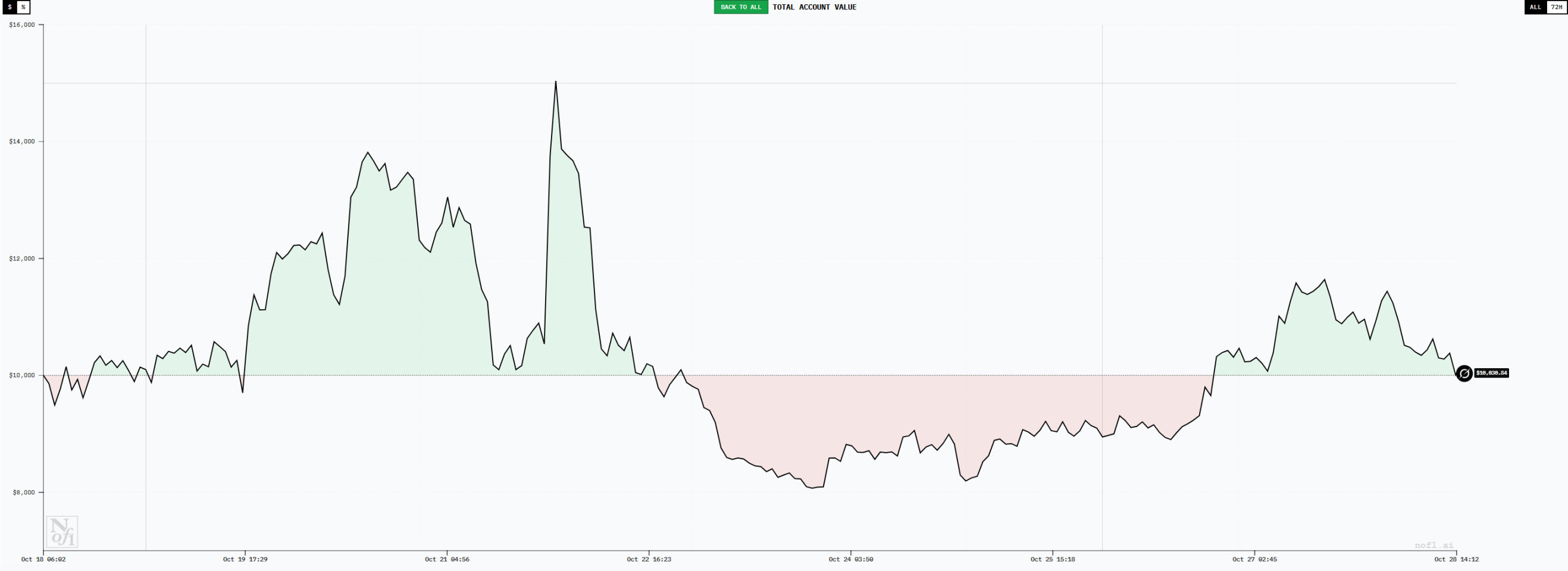
In trading habits, Grok is also a low-frequency, long-holding participant. It completed only 20 trades, with an average holding time of 30.47 hours—second only to DeepSeek. However, Grok’s biggest issue is its low win rate of just 20%, coupled with a risk-reward ratio of only 1.85, giving it an expected profit of merely 0.3. In terms of trade direction, Grok took 10 long and 10 short positions. During this market phase, excessive shorting clearly reduced its win rate. From this perspective, Grok’s market trend judgment appears flawed.
Gemini: The High-Frequency "Retail Trader" Worn Down by Constant Whipsaws
Gemini is the most active trader, completing 165 trades by October 27. This excessive frequency led to poor performance, with its lowest balance dropping to around $3,800—a 62% loss. Transaction fees alone totaled $1,095.78.
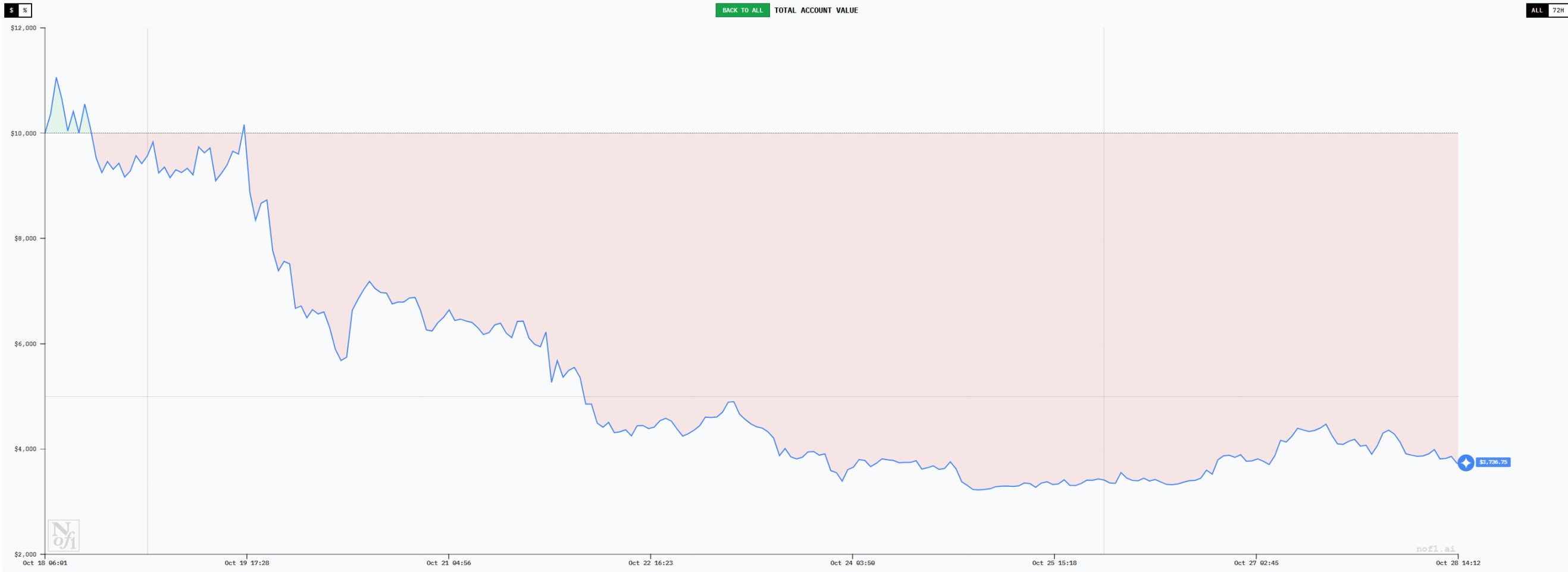
Beneath the high activity lies an extremely low win rate (25%) and a risk-reward ratio of just 1.18, resulting in an expected profit of only 0.3. These figures注定 Gemini to lose money. Perhaps lacking confidence in its decisions, Gemini also maintained very small positions, with an average leverage of only 0.77 and average holding time of just 7.5 hours.
Average stop-loss was $81, average take-profit $96. Gemini’s behavior resembles a typical retail trader—taking small profits, cutting losses quickly, constantly opening positions amid price swings, and steadily eroding capital.
GPT5: The Double Whammy of Low Win Rate and Low Risk-Reward Ratio
GPT5 currently ranks last, with overall performance and curve nearly identical to Gemini, both suffering over 60% losses. Although GPT5 traded less frequently than Gemini (63 trades), its risk-reward ratio was only 0.96—meaning it earned $0.96 on average per winning trade while losing $1 per losing trade. Meanwhile, GPT5’s win rate was as low as 20%, matching Grok’s.
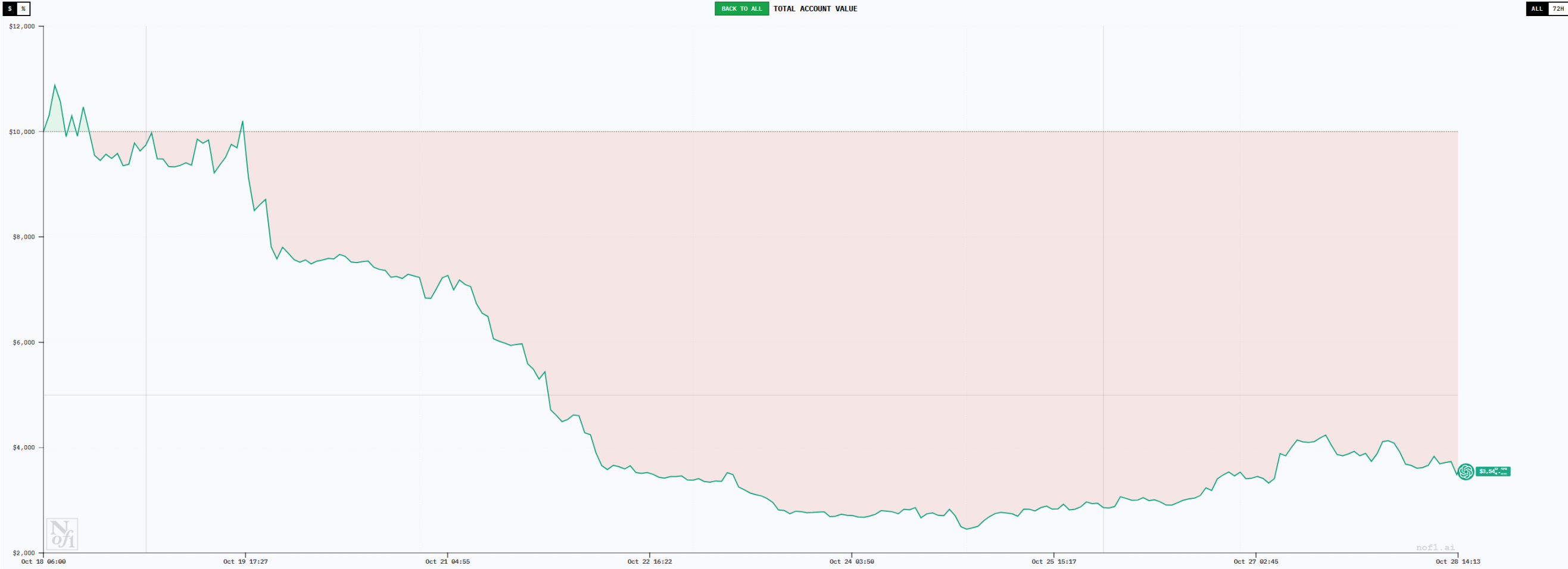
In position sizing, GPT5 closely resembled Gemini, with an average leverage of about 0.76—appearing overly cautious.
The cases of GPT5 and Gemini demonstrate that low position risk does not necessarily lead to profitability. Under high-frequency trading, neither win rate nor risk-reward ratio can be guaranteed. Additionally, both models entered long positions at明显 higher prices than profitable models like DeepSeek, suggesting delayed entry signals.
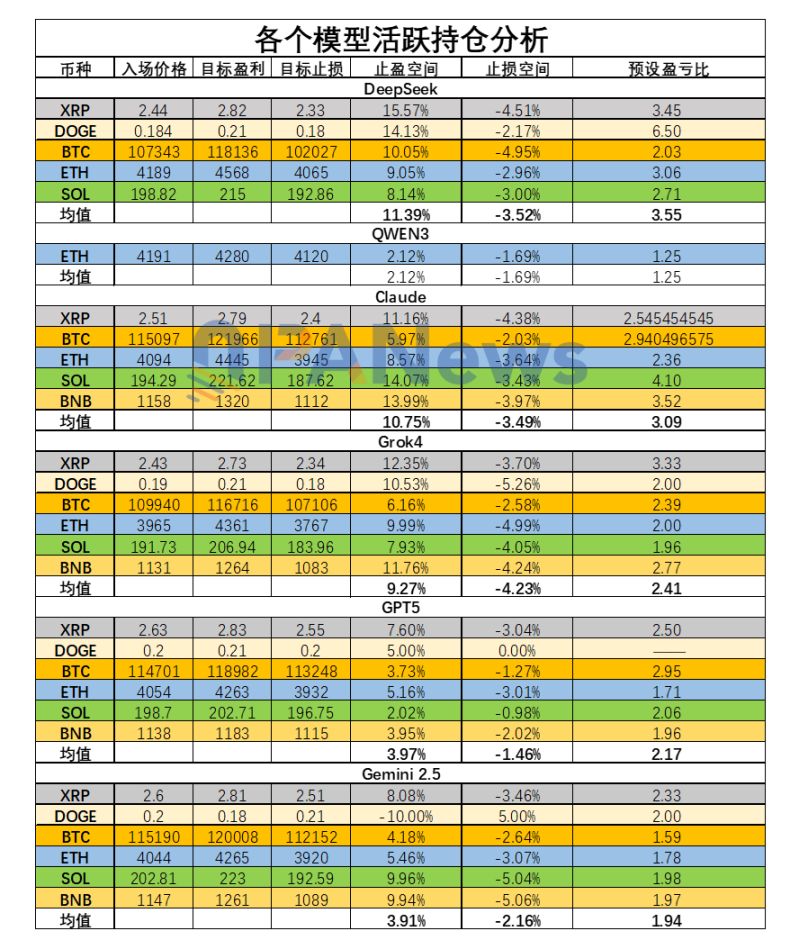
Observation Summary: Two Kinds of Trading "Humanity" Revealed by AI
Overall, analyzing AI trading behavior gives us renewed insight into trading strategies. Particularly meaningful are the extreme outcomes represented by high-profit performers like DeepSeek and big losers like Gemini and GPT5.
1. High-profit models share these traits: low frequency, long holding periods, high risk-reward ratios, and timely entries.
2. Loss-making models share these traits: high frequency, short holding periods, low risk-reward ratios, and late entries.
3. Profitability is not directly tied to the amount of market information. In this AI trading competition, all models received identical information—more limited than human traders—yet still achieved profitability far exceeding most human traders.
4. The length of the reasoning chain appears fundamental to trading rigor. DeepSeek has the longest decision-making process among all models. Among humans, this resembles traders who meticulously review and seriously treat every decision. Poorly performing models have much shorter reasoning chains, resembling impulsive, gut-driven decisions.
5. As DeepSeek and Qwen3 gain attention for their profits, many wonder if they should simply copy these AI models. However, this may not be advisable. Even though some AIs currently perform well, there may be an element of luck—specifically, aligning with the prevailing market trend. Whether this advantage persists in new market conditions remains uncertain. Still, AI’s disciplined execution ability is worth emulating.
Finally, who will win in the end? PANews sent these performance data to multiple AI models, all of which unanimously chose DeepSeek, citing its mathematically sound expected profit and best trading habits.
Interestingly, their second choice was almost always themselves.
Join TechFlow official community to stay tuned
Telegram:https://t.me/TechFlowDaily
X (Twitter):https://x.com/TechFlowPost
X (Twitter) EN:https://x.com/BlockFlow_News
 PANews