The Story of x402 Foundation: From Advancing the x402 Protocol to the Golden Key of AI Payments
TechFlow Selected TechFlow Selected
The Story of x402 Foundation: From Advancing the x402 Protocol to the Golden Key of AI Payments
How does the x402 Foundation turn a line of code into the golden key for AI payments?
 Navigating Web3 tides with focused insights
By: Chain Revelation
How a forgotten status code unlocked a trillion-dollar market.
Imagine your AI assistant wants to check today’s stock price for you, but it gets stuck behind a paywall—no credit card, no account, and no idea how to “pay.” This sounds like science fiction, but in 2025, it's already a real problem.
The solution? A payment revolution built specifically for AI agents to buy things on their own—the x402 protocol.
The neutral organization turning this “golden key” of AI payments from theory into reality is the x402 Foundation, backed by giants like Coinbase and Cloudflare.
I. From Forgotten Archive to Hot Protocol: The Archaeology of x402
HTTP 402: The Internet’s “Unfinished Symphony”
The story begins in 1999.
Back then, the HTTP/1.1 specification defined a status code called "402 Payment Required," meaning “Hey, you need to pay to access this resource.” But the problem was, nobody knew how to securely and conveniently collect money online at the time. So this status code sat unused for over two decades—like a blank check left in a drawer.
The best innovations often aren’t about inventing something new, but reviving old components in a new context.
x402 didn’t emerge from nothing—it cleverly resurrected that long-dormant HTTP 402 status code. This “forgotten tool” has now found its destiny in the age of AI.
The protocol’s mechanics can be understood through a simple scenario:
-
AI requests service: An AI assistant wants to retrieve the latest weather data.
-
Server requests payment: The API server returns a "402" code: “Yes, but please pay $0.001 first.”
-
AI makes automatic payment: The AI assistant instantly sends a micro-payment in stablecoins via blockchain (e.g., Base).
-
Service fulfilled: The server confirms receipt and immediately delivers the data.
The entire process completes automatically within seconds—no redirects, no logins, nearly zero fees. It fixes the internet’s “payment gap,” allowing value to flow as freely as data. For AI agents conducting massive, high-frequency, micro-sized transactions, this is the perfect match.
Why is it gaining traction now?
Because this is a payment revolution for the machine economy—and x402 sits right at the epicenter.
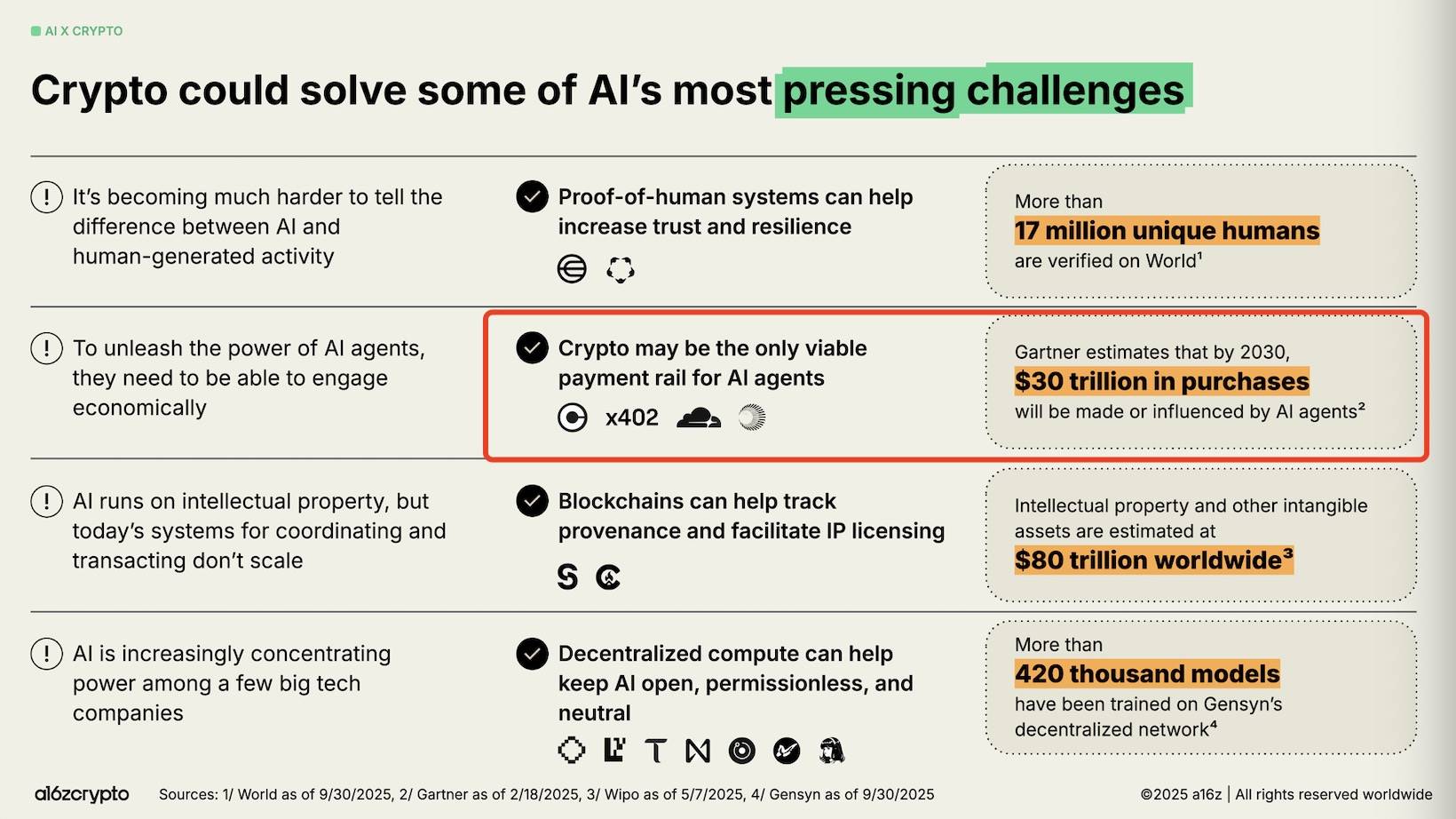
Industry trends are accelerating the rise of the machine economy. This week, a16z’s crypto division stated in its latest State of Crypto report that autonomous transactions could reach $30 trillion by 2030.
Coinbase’s development team also noted that AI agents are ushering the machine economy into a new era: without human intervention, AI agents can autonomously handle everything from payments to data storage. These trends make x402 the leading candidate to solve the payment challenge.
II. The Masterminds Behind the Scenes: The Dual-City Tale of the x402 Foundation
Coinbase + Cloudflare: A Perfect Match or Mutual Benefit?
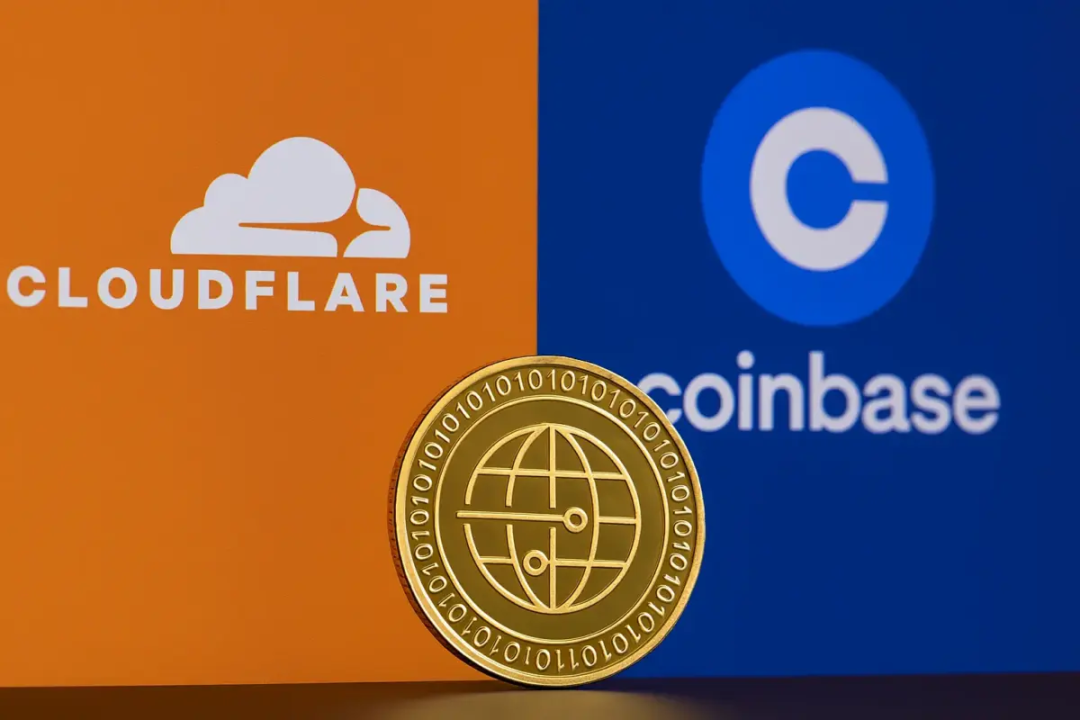
In September 2025, two seemingly unrelated giants joined forces:
-
Coinbase: One of the world’s largest cryptocurrency exchanges, with infrastructure for stablecoin payments
-
Cloudflare: A CDN giant serving 20% of websites globally, controlling critical internet traffic nodes
Why these two?
Coinbase has payment capabilities but lacks distribution; Cloudflare has a global network but needs new business models. x402 perfectly bridges their strengths: Coinbase provides blockchain payment tech, Cloudflare offers a global edge computing network—building infrastructure together for the “machine economy.”
Core Team: The Web2 + Web3 Fusion Squad
The x402 Foundation operates under open governance, with core members including:
1. Dan Kim (Vice President of Business Development at Coinbase): Leading strategic partnerships and ecosystem growth
-
Key Value: A “super connector” from the traditional finance world
-
Highlights: Previously led global payment strategies at Visa, Airbnb, and other giants, with extensive institutional collaboration experience
-
Strategic Significance: Opens doors to traditional financial institutions, ensuring compliance pathways and mainstream adoption
2. Erik Reppel & Nemil Dalal (Coinbase): Co-authors of the x402 whitepaper
-
Division of Labor: Erik leads technical architecture, Nemil focuses on product strategy and regulatory alignment
-
Key Contribution: Co-authored the x402 whitepaper, establishing a complete “technology-market-regulation” triad framework
-
Unique Advantage: Their combined expertise spans from foundational tech standards to market deployment, offering dual assurance on technology and commercialization.
3. William Allen (Cloudflare): Providing network infrastructure support
-
Technical Assurance: Top-tier expert in global network infrastructure, delivering enterprise-grade stability for x402
-
Value Demonstration: Cloudflare handles 20% of global website traffic—its technical endorsement strengthens x402’s credibility
-
Strategic Role: Ensures high availability and security of the protocol worldwide
Team Chemistry: 1+1+1 > 3
Coinbase’s compliance DNA × Cloudflare’s infrastructure power = the perfect gateway for traditional institutions
This combination directly addresses traditional institutions’ biggest pain points: wanting to embrace Web3 innovation while maintaining compliance and security. The team forms a solid “compliance-technology-infrastructure” triangle.
Ultimate Goal: Become the “golden bridge” for Web2 giants entering Web3—gaining policy approval while capturing the payment gateway of the machine economy era.

About 60 contributors from various ecosystems are currently involved in protocol development. It belongs to no single company but functions as a neutral governing body, with the mission to:
-
Promote Standardization: Establish x402 as an official web standard under W3C (World Wide Web Consortium).
-
Build the Ecosystem: Attract global developers to build applications on x402 through funding, tools, and hackathons.
-
Achieve Decentralization: Ultimately transfer full governance of the protocol to the community.
Tangible Results: From Code to Ecosystem
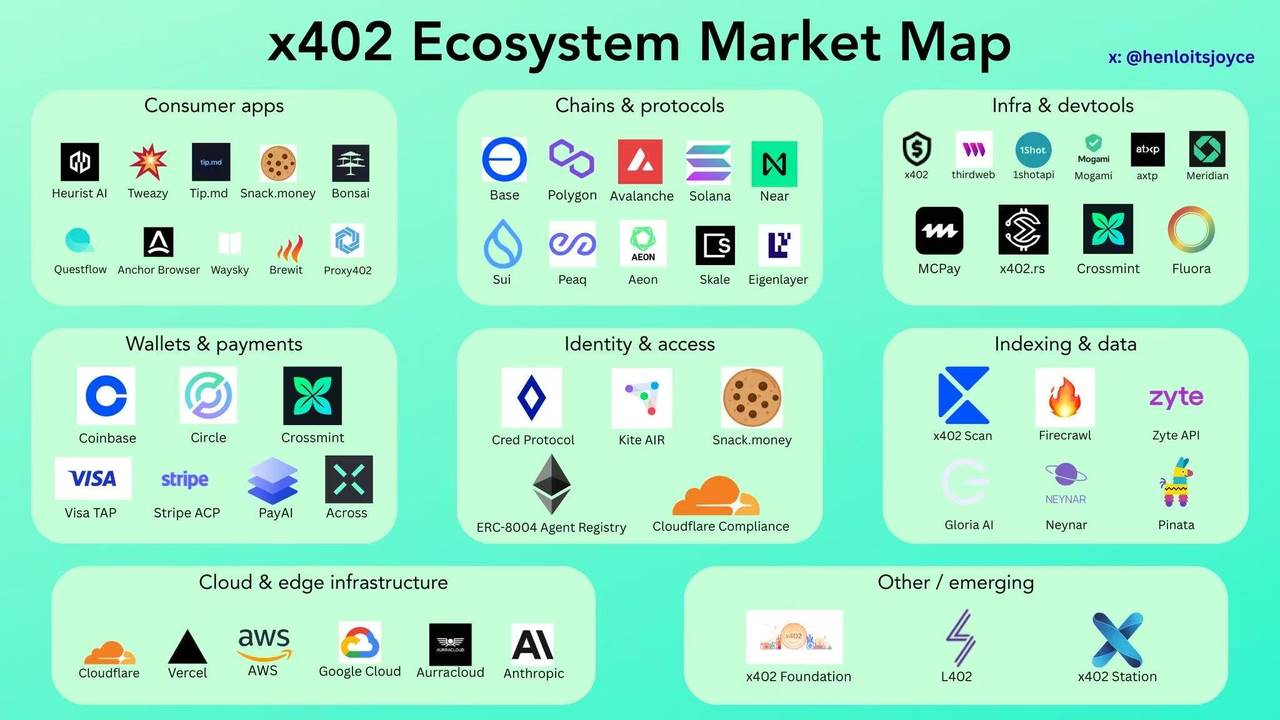
The x402 Foundation isn’t just talking—it’s building. In just a few months, they’ve created a diverse and growing ecosystem:
-
Representative Projects: Questflow (AI agent orchestration), PayAI Network (cross-chain payments), AurraCloud (AI Agent infrastructure).
-
Performance Data: Over the past 90 days, completed 524,000 transactions totaling more than $520,000—with rapid growth.
-
Developer Support: x402.org offers specifications and SDKs; tools from Cloudflare and thirdweb support integration across 170+ chains and 4,000+ tokens.
Hackathons and bounty programs have attracted global developers, with over 200 new projects incubated on x402.
More importantly, the foundation remains neutral, ensuring the protocol is open to everyone—whether a major corporation or an independent developer, all can freely extend it.
Big Players Join: From Pilots to Strategic Partnerships
And industry recognition is growing:
-
Google: Integrated x402 into its A2A and AP2 frameworks
-
Visa: Launched a payment solution combining its Trusted Agent Protocol
-
Circle: Provides USDC stablecoin support
-
thirdweb: SDK supports 170+ chains and 4,000+ tokens
What does this mean? This is no longer a niche experiment in crypto circles—it’s serious investment from both traditional tech and finance giants.
III. Deep Dive: Why x402 Could Change Everything
Economic Principle: The Power of Lowering Transaction Costs
Economist Ronald Coase once said, the fundamental reason companies exist is to reduce transaction costs. x402 essentially does the same thing—it reduces payment transaction costs to near zero:
-
Time Cost: Reduced from minutes to seconds
-
Cognitive Cost: No registration, login, or password management
-
Technical Cost: Developers can integrate with just a few lines of code
-
Economic Cost: Only on-chain gas fees, no protocol fees
When transaction costs drop low enough, previously uneconomical transactions become viable. That’s why concepts like micropayments, pay-per-use, and autonomous AI transactions suddenly feel achievable.
Network Effect: The “Tipping Point” for Payment Protocols
Payment networks have one key trait: the more people use them, the more valuable they become. x402’s brilliance lies in:
-
Open Standard: Anyone can implement and extend it
-
Multi-chain Compatible: Not tied to any single blockchain
-
Backward Compatible: Seamlessly integrates with existing HTTP infrastructure
This design makes it easier for x402 to reach “critical mass”—when enough services support x402, those that don’t will appear outdated.
IV. Challenges and Opportunities: Reality Check
The x402 Foundation’s vision is bold, but the road ahead isn’t smooth.
Challenges:
1. Applying for W3C Standard Status:
To become a global standard, it must win lengthy battles and gain recognition from international bodies like W3C.
How hard is this “passport”? Becoming an international standard is like winning a Nobel Prize: requires technical excellence, peer validation, and surviving a long process. W3C standardization typically takes 3–5 years, involving proposal, draft, testing, and community voting stages.
2. Fierce Competition:
Google is pushing its AP2 protocol (embedding bank cards and transfers into AI apps like APIs), and new models like Model Context Payments (MCP) are emerging. The good news is that Cloudflare has already built x402 support into its Agents SDK and MCP servers—marking the first step toward “multi-track interoperability.”
3. Ecosystem Maturity:
Despite rapid growth, the ecosystem is still very early. As a new protocol, x402 remains in its infancy. While Coinbase has provided a reference implementation and developer toolkit, multi-party implementations and interoperability testing are still lacking. To become an industry standard, x402 must attract more third-party developers and infrastructure providers, and establish a robust interoperability test matrix.
Opportunities:
Yet, the opportunity is historic. With the AI agent economy projected to reach $10 trillion by 2030, a native, decentralized payment layer is indispensable. x402 is well-positioned to become this core infrastructure.
V. How to Join the x402 Ecosystem
The Ecosystem page on x402’s official website lists current participants. Browsing through, one quickly realizes this is still an early journey: many projects link directly to technical documentation, and quite a few redirect straight to GitHub. In short, the narrative comes first—products and applications are still in progress.
But early doesn’t mean directionless. The composition of participants already reveals three clear capital-driven threads:
-
First, Infrastructure Builders: Coinbase is the most obvious beneficiary—not just a participant, but a rule-maker and foundation-layer builder.
-
Second, the First “Residents”—AI Agent Applications. Especially those that have announced integration. AI agent technology is currently a hot topic in crypto, and x402 has already drawn attention from multiple AI agent projects. Their integration will further drive the protocol’s development and adoption.
-
Third, Location and Neighborhood—Base Ecosystem. x402’s focus on Base is no accident. Choosing the battlefield means choosing the growth curve: where developers cluster often determines path dependencies in toolchains, distribution, and mindshare.
Conclusion: From Information Internet to Value Internet
The internet spent thirty years solving free information flow, but has always had a flaw in value transfer. We’re used to getting information for free, yet face friction whenever we need to pay: registering accounts, linking bank cards, remembering passwords, handling refunds…
x402 aims to change exactly that.
It makes payments as simple as sending an email, allows AI agents to conduct transactions autonomously like humans, and lets developers focus on creating value instead of managing payment logic.
This isn’t another grand declaration of a “disruptive technology,” but a pragmatic solution: solving real problems in the simplest way possible.
If successful, x402 could become the HTTP of the value internet. If it fails, at least it proves that even a forgotten status code can create a ripple effect.
Either way, this story deserves our ongoing attention.
Join TechFlow official community to stay tuned
Telegram:https://t.me/TechFlowDaily
X (Twitter):https://x.com/TechFlowPost
X (Twitter) EN:https://x.com/BlockFlow_News