








From hype to widespread adoption, what will enable x402 to break through next?
TechFlow Selected TechFlow Selected
From hype to widespread adoption, what will enable x402 to break through next?
x402 may not remain in the hype phase for long, but is expected to quickly transition to the infrastructure phase.
 Navigating Web3 tides with focused insights
Author: 100y.eth
Translation: TechFlow
Key Takeaways:
-
In the crypto industry, most new concepts typically go through three phases: hype, infrastructure development, and adoption. However, most projects fail to successfully transition from the hype phase to the infrastructure phase, eventually losing market attention.
-
x402 is a protocol developed by Coinbase, specifically designed for AI agent payments. It enables AI agents to easily make blockchain-based payments and access paid resources without human intervention.
-
Judging from recent excitement around x402-related tokens, the protocol has already entered the hype phase. What sets x402 apart from typical crypto narratives is that major companies such as Cloudflare, Google Cloud, and Anthropic are actively adopting this technology, indicating rapid progress in its infrastructure phase.
-
Considering the potential of agentic commerce, x402 has a strong chance of reaching the adoption phase. However, its bottleneck lies in shifting consumer psychology and trust structures. According to Accenture, the biggest barrier to widespread adoption of agentic commerce is consumers’ lack of trust in AI agents.
-
Nonetheless, Gartner predicts that by 2030, transactions controlled by AI agents will reach $30 trillion. Agentic commerce is therefore poised to become an inevitable and massive future market. This could also mark the moment when blockchain finds its second global product-market fit (PMF) after stablecoins.
The Hype, Infrastructure, and Adoption Cycle
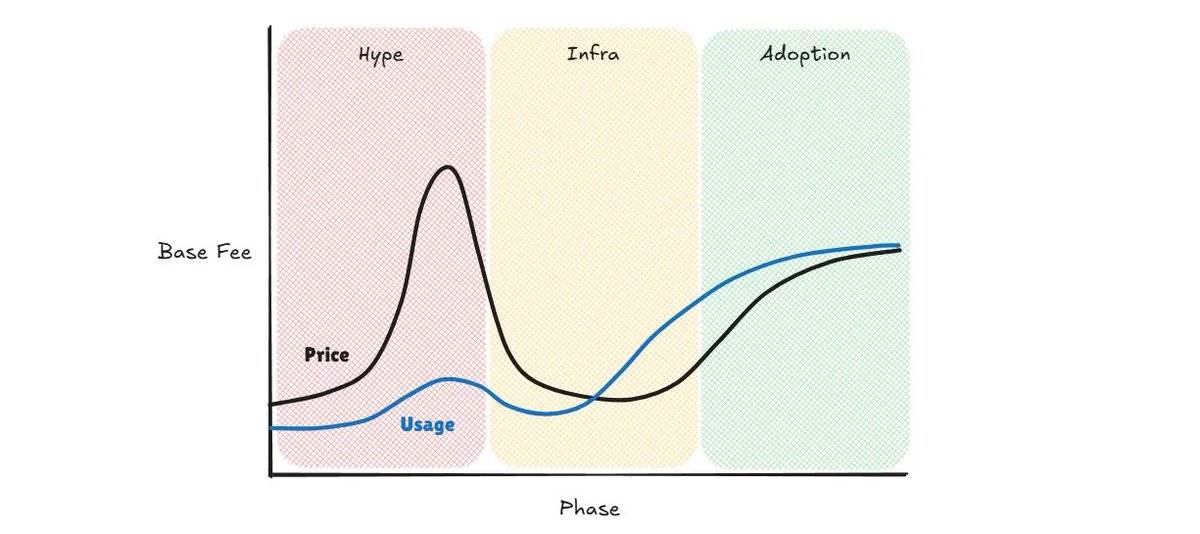
From New Concept to Widespread Application
The crypto industry is a rapidly changing field. The rise and fall cycle of new concepts often lasts only a few months, with attention concentrated and fading more extremely than in other industries. Overall, keywords such as NFTs, gaming, metaverse, and modular blockchains have all gone through similar cycles; locally, recent concepts like "futarchy" briefly attracted market attention before quickly disappearing.
Due to the constant emergence of numerous new concepts in crypto, achieving meaningful adoption requires overcoming many obstacles. I divide this process into three stages:
Hype Phase: This is when a new concept first attracts widespread attention. During this stage, existing projects slightly related to the concept, newly launched small projects, and associated meme coins often experience gains of tens or even hundreds of percentage points. If the concept successfully transitions to the next stage, prices may stabilize, but in most cases, they collapse within weeks or months, and related projects disappear.
Infrastructure Phase: Once the potential and relevance of a new concept are proven, developers begin building meaningful products based on it. Product development takes time—anywhere from several months to over a year—so vague or impractical concepts often die out at this stage. However, if the concept truly holds value, it maintains steady interest, creates real-world use cases, and gradually drives growth across the sector.
Adoption Phase: If a concept reaches this point, congratulations! In crypto, only a handful of concepts have successfully reached the adoption phase, such as automated market makers (AMMs), centralized limit order books (CLOBs), lending protocols, staking-related protocols, and stablecoins. Concepts at this stage have proven their product-market fit (PMF), leading to a continuous emergence of new protocols and attracting large numbers of active users.
Case Studies in Crypto
So where do currently trending topics on Crypto Twitter (CT) stand?
Futarchy: As mentioned above, futarchy briefly entered the hype phase after being referenced by Vitalik, then faded. Recently, with Solana’s ICO platform, the topic re-entered the hype phase. However, it quickly lost traction just weeks later. The reason is that futarchy involves extremely complex governance discussions, making it difficult to achieve broad adoption without generational societal shifts.
Decentralized Energy: Decentralized energy entered the hype phase last year when many companies received funding from top-tier VCs. Recently, Daylight secured $75 million from Framework and a16z crypto, temporarily reigniting hype. However, market interest failed to sustain. The reason is that, as a field requiring physical infrastructure, the infrastructure phase for decentralized energy will inevitably take a long time.
Robotics: Robotics follows a similar pattern. When the convergence of crypto and artificial intelligence (AI) gained attention, Openmind—a project combining crypto and robotics—raised $20 million from institutions like Pantera, sparking market interest in the robotics space. Many mid- and small-sized projects and meme coins surged in price, but the path to adoption remains long. Still, given the vast potential of combining crypto with robotics, many developers including Openmind are actively building related products.
From these cases, the path from birth to adoption for new concepts in crypto appears extremely difficult.
However, a recently trending concept on Crypto Twitter called x402 seems poised to rapidly enter the adoption phase. So what makes x402 different?
Can x402 Succeed?
Overview of x402
x402 is an open payment protocol developed by Coinbase, designed to enable artificial intelligence (AI) agents to autonomously complete payments and transactions without human intervention. x402 allows AI agents to pay for services using stablecoins across multiple blockchains, offering instant settlement while eliminating complex processes such as account creation, subscriptions, or API keys.
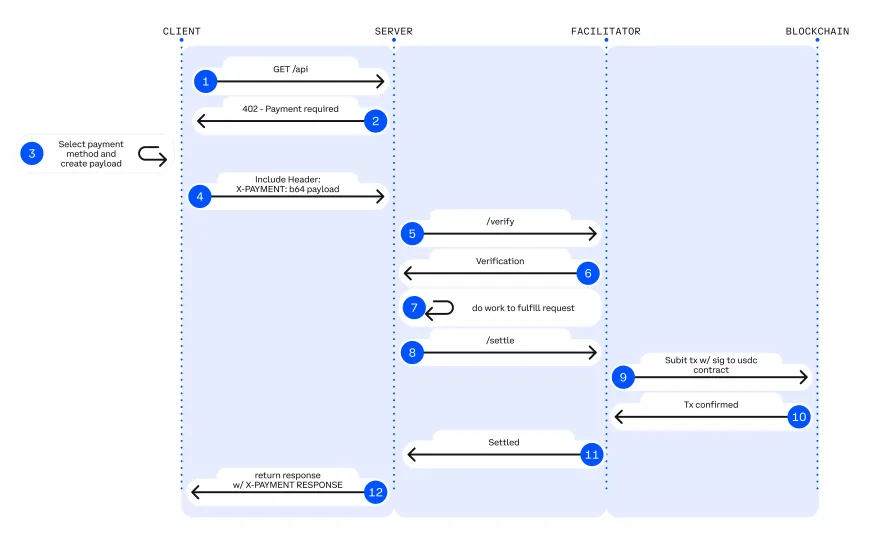
Source: Coinbase
HTTP 402 is a status code meaning "Payment Required," which has remained largely unused for years. x402 leverages HTTP 402 so that when an AI agent sends an API request, the server returns an HTTP 402 status code indicating that payment is required. Upon receiving this response, the AI agent pays the requested amount in stablecoins. The specific flow is as follows:
-
When an AI agent attempts to access a paid service (e.g., news articles, APIs, or data), the server returns an HTTP 402 Payment Required status code. This response not only indicates "payment required" but also includes information such as payment method, amount, and recipient (wallet address).
-
Based on the information provided by the server, the AI agent generates a transaction for the specified amount, adds a digital signature, and sends it back to the server.
-
The server forwards the payment details to a "Facilitator," which verifies the payment and processes the transaction on the blockchain.
-
After payment confirmation, the server grants the AI agent access to the service.
The significance of x402 goes beyond providing a payment standard for AI agents. Since payments are made via stablecoins on the blockchain, it enables microtransactions that were previously impossible, allowing AI agents to dynamically invoke APIs or pay for services in real-time based on usage. Additionally, x402 allows human users to bypass complex processes like API key management or account creation, accessing content directly through micropayments.
2.2 The Hype Phase
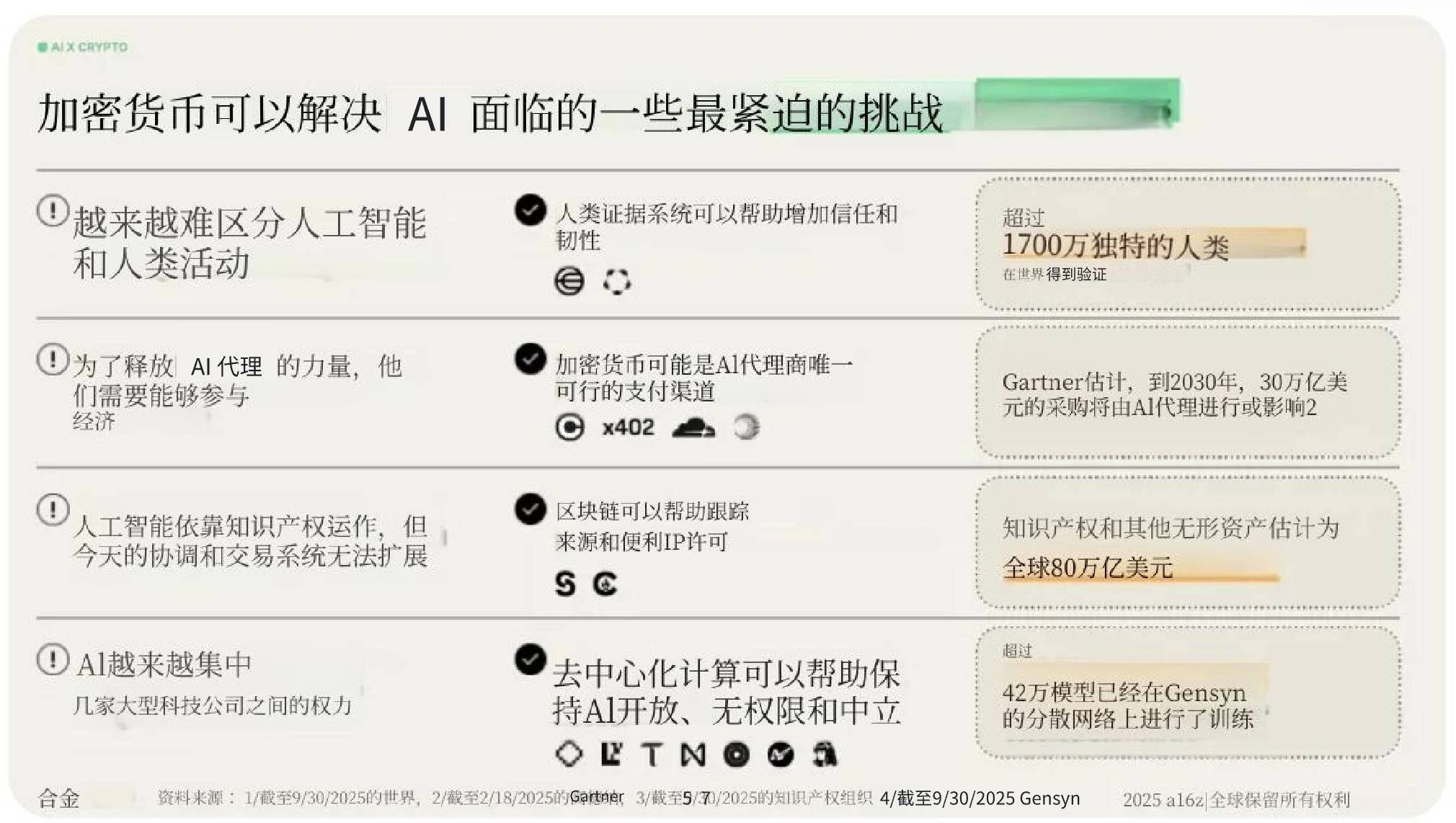
Source: a16zcrypto
x402 was first launched in May 2025, initially receiving limited attention. However, after being featured in a16zcrypto's report "State of Crypto 2025: The Year Crypto Went Mainstream," it began gaining significant visibility. According to Gartner, the agentic commerce market is projected to reach $30 trillion by 2030, and a16z pointed out that x402 could become the primary payment channel for AI agents.
The clearest sign that x402 has entered the hype phase is the sharp rise in related token prices. For example, the token $VIRTUAL—which reacts whenever AI agent topics resurface—surged 40% in just two days. Other related tokens also saw substantial price increases, as shown in the chart below.
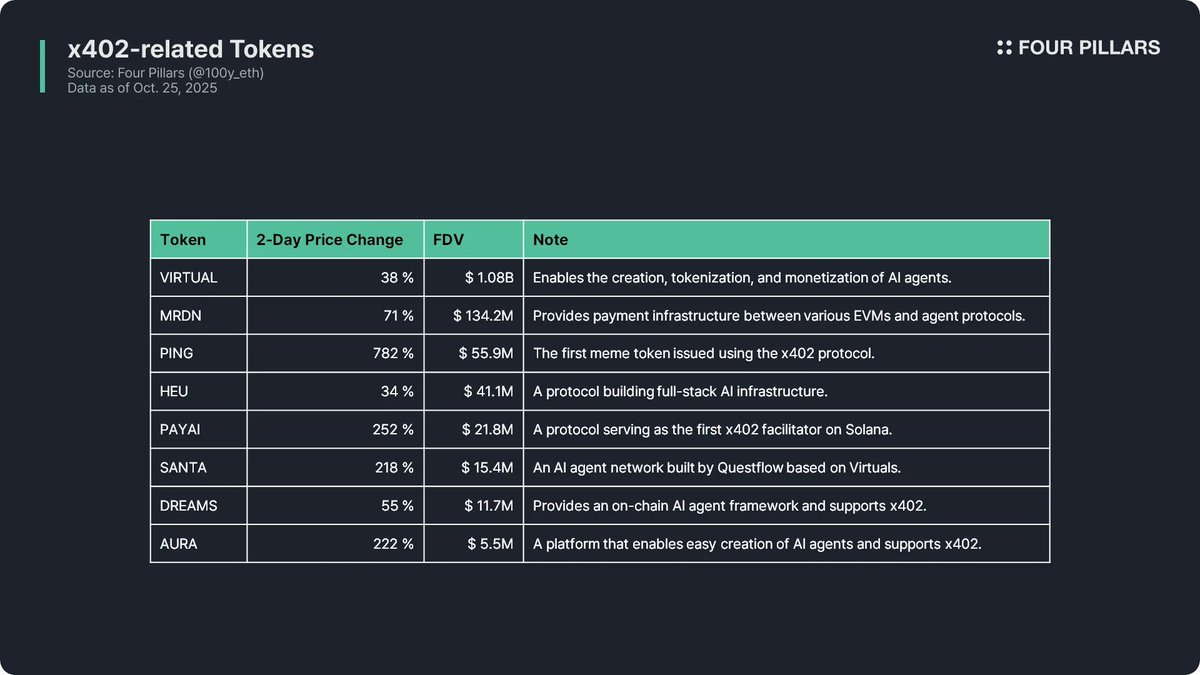
This makes x402 appear like another typical crypto concept—hollow and superficial, driven purely by hype. Indeed, many new crypto concepts emerge this way: causing short-lived price surges in small projects and meme coins before vanishing.
However, what sets x402 apart from other topics is:
-
High Relevance of the AI Agent Payment Theme: This concept is not only significant within crypto but also highly relevant in the broader AI industry, giving it immense potential.
-
Active Interest and Adoption by Major Web2 Companies: These factors suggest that x402 may not remain in the hype phase for long but could rapidly transition into the infrastructure phase.
Infrastructure Phase
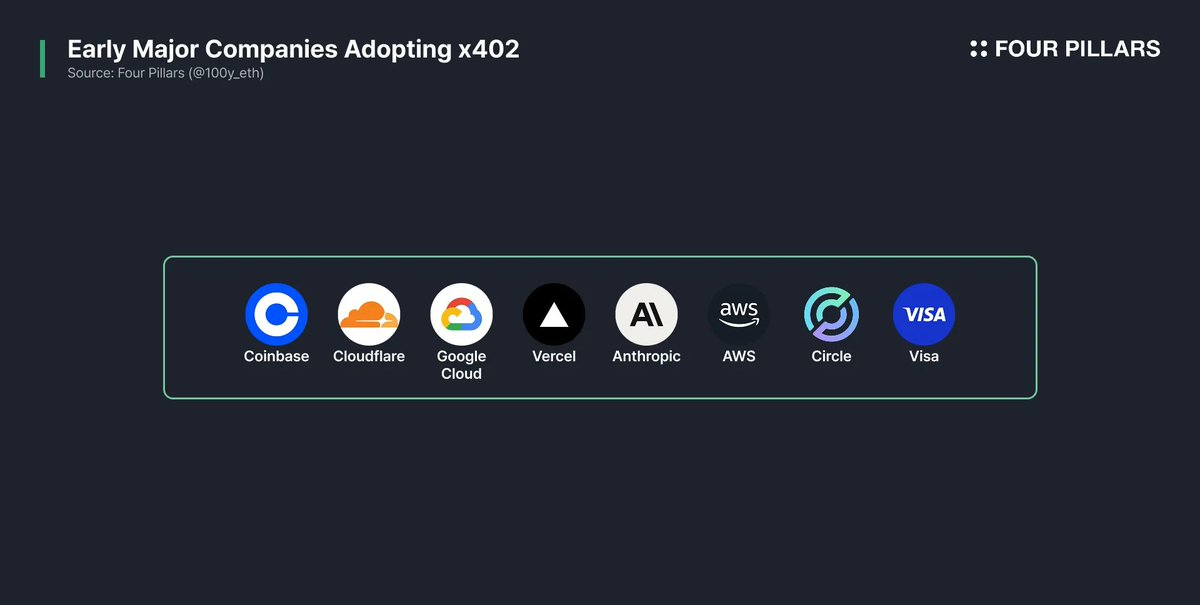
Currently, x402 is both in the hype phase and the infrastructure phase. In fact, even before entering the hype phase, many Web2 and Web3 companies had already started building infrastructure for x402 and actively integrating it into their services. Therefore, more accurately, x402 began at the infrastructure phase.
Interestingly, unlike typical crypto narratives, x402 has attracted attention from numerous large Web2 tech companies, many of which are actively adopting the protocol. This cross-boundary phenomenon between Web2 and Web3 makes x402 particularly unique within the crypto industry.
Cloudflare
Cloudflare is a company providing internet infrastructure and security solutions. Recently, it launched the "Agents SDK" service to help developers easily create and deploy AI agents, along with "Workers AI," an environment for running AI model inference.
Cloudflare co-founded the x402 Foundation with Coinbase and is highly active in the x402 ecosystem. Cloudflare supports x402 in its "Agents SDK" service, enabling AI agents to conduct online payments effortlessly.
Notably, Cloudflare recently launched a dollar-pegged stablecoin called NET Dollar, specifically designed for AI agents. AI agents built through the "Agents SDK" are expected to use x402 and NET Dollar for agentic commerce activities.
Vercel
Vercel is a cloud platform company focused on helping developers quickly build and deploy web applications. Vercel recently introduced services such as "Vercel AI SDK" and "Vercel MCP," enabling developers to easily build and deploy AI agents and access projects via MCP.
In September this year, Vercel released x402-mcp, allowing AI agents to automatically handle payment transactions when accessing paid APIs or resources via MCP.
Google Cloud
Google Cloud previously launched the A2A protocol, enabling AI agents to communicate and collaborate with each other. The A2A protocol includes an extension feature called AP2 (Agentic Payments Protocol), which allows agents to autonomously make payments. x402 is integrated into this system as the payment engine enabling real transactions for AI agents.
Anthropic
Anthropic is a well-known artificial intelligence company whose Claude LLM allows users to build AI agent services. Anthropic has also launched an open-source standard protocol called MCP, which defines how AI models access external tools and data. Claude MCP supports x402, enabling Claude to automatically handle payments when accessing paid MCP tools.
Visa
As the world's largest card payment network, Visa recently announced the launch of the "Trusted Agent Protocol," co-developed with Cloudflare. This protocol verifies whether requests from AI agents in agentic commerce are trustworthy and supports payments via x402.
Others
According to Coinbase’s announcement, other companies such as Circle and AWS are also collaborating with x402.
Besides companies and protocols adopting x402, recently developer-friendly tools have emerged, such as x402scan. This exploration tool visualizes servers, transactions, and payment flows using x402, allowing users to see which services are paid for, through which payment intermediaries, and on which networks.
As the x402 ecosystem continues to expand, more companies and tools are expected to join, further enriching and developing the entire ecosystem.
Can x402 Reach the Adoption Phase?
3.1 Challenges to Adoption
Source: x402scan
Judging from the sharp rise in related token prices and widespread adoption by major companies, x402 appears to have entered both the hype and infrastructure phases. However, whether x402 can advance to the adoption phase remains an open question.
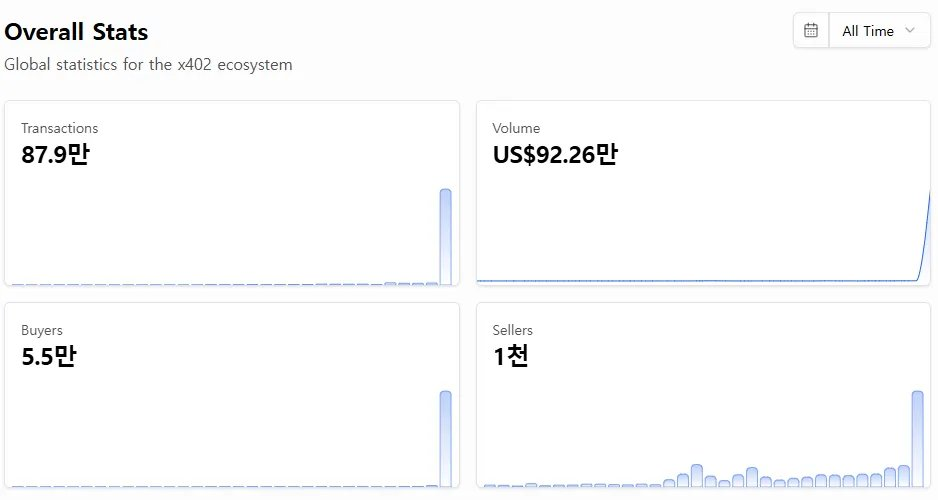
According to data from x402scan, approximately 55,000 buyers have sent 879,000 transactions to about 1,000 sellers. These numbers seem impressive, but the total transaction volume is only around $923,000. This suggests that x402 still has a long way to go before reaching mass adoption.
Conditions for Adoption
What conditions must be met for x402 to enter the adoption phase? One frequently cited factor is consumer psychology and trust structure. Even someone like me, who writes articles about x402, can accept AI agent recommendations in commerce but still hesitates to fully trust them with handling my money.
Even the latest LLMs (large language models) sometimes provide incorrect or suboptimal answers. Psychologically, it is difficult for consumers to trust AI agents based on these models to handle payment transactions. In fact, according to Accenture’s survey of financial institutions, 87% of respondents view customer distrust of AI payments as a problem, and 78% express concern about unauthorized payments or fraud by AI bots.
A second factor is the current state of enterprise infrastructure. According to Accenture, 85% of financial institutions report that their existing legacy systems are unsuitable for handling large-scale agent payments. In particular, the lack of systems to combat fraudulent transactions in agent payments is one of the main barriers to entry.
Overall, for x402 to reach the adoption phase, companies need to build systems optimized for agentic commerce and cultivate consumer trust in these systems. However, developing such infrastructure and shifting consumer psychology will take considerable time, meaning x402 may require longer than expected to achieve widespread adoption.
What Does This Mean for the Blockchain Industry?
According to Gartner’s forecast, by 2030, AI agents will influence $30 trillion in purchasing behavior. While the AI agent payment market is still in its early stages, it is encouraging that x402 appears to be establishing itself as an industry standard. This aligns with the fact that major IT companies such as Google, Anthropic, and Cloudflare are adopting x402 for AI agent payments.
So what can the crypto market expect as x402 becomes more active? A highly likely prediction is that the recent surge in prices of x402-related tokens may be difficult to sustain long-term. Since the rise of crypto-AI, this concept has gradually evolved into a meaningful domain with multiple new projects emerging, but many small project tokens and meme coins that surged during the initial hype phase have delivered disappointing performance over time.
Source: x402scan
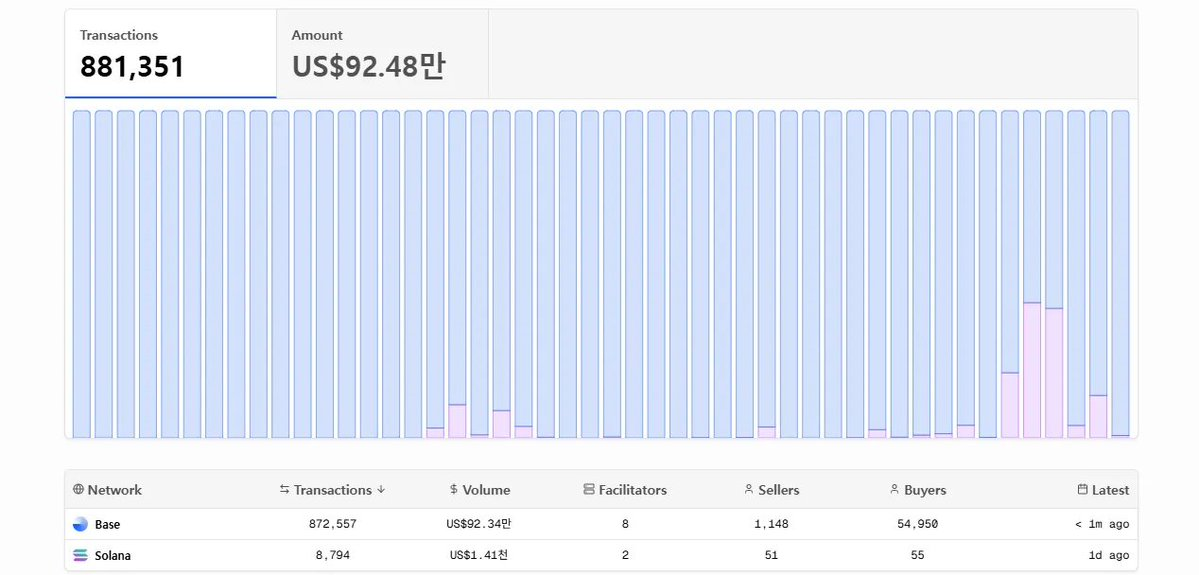
One clear added value x402 brings to the blockchain industry is that all AI agent payments will occur on blockchain networks. Currently, most transactions happen on the Base network, with some on Solana, but x402 is designed to be blockchain-agnostic, meaning it can operate on any network. This implies that as the x402 ecosystem expands, payments will span multiple networks—not just Base and Solana—but will be driven by supply and demand from buyers and sellers.
Agentic commerce represents an inevitable and massive future market, and all payments will ultimately flow through x402 on blockchains. This would mark the moment when blockchain finds its second global product-market fit (PMF) after stablecoins.
Join TechFlow official community to stay tuned
Telegram:https://t.me/TechFlowDaily
X (Twitter):https://x.com/TechFlowPost
X (Twitter) EN:https://x.com/BlockFlow_News
 @100y_eth






