Six Years in the Crypto World: 12 Lessons Learned from Millions of Dollars
TechFlow Selected TechFlow Selected
Six Years in the Crypto World: 12 Lessons Learned from Millions of Dollars
Cash flow determines everything; narratives always run ahead of fundamentals.
 Navigating Web3 tides with focused insights
Author: Miles Deutscher
Translation: AididiaoJP, Foresight News
I've been in the crypto market for over six years. I've made millions and lost millions, launched crypto projects, and frankly, I've ridden every imaginable emotional rollercoaster this space has to offer.
My goal with this article is simple: break down the 12 hard-earned lessons I paid millions of dollars to learn. By reading this and applying these lessons to your own crypto journey, I hope you become a better trader, avoid massive drawdowns, and increase your chances of changing your life through crypto.
Part One: The Fundamentals
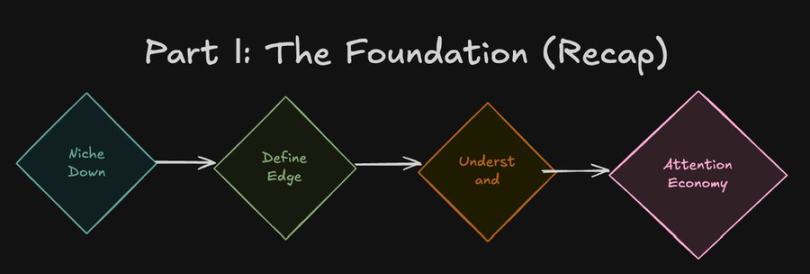
Lesson One: The Power of Niche Focus
There are many ways to make money in crypto; your job is to find the one that suits you best and become an expert in that niche.
In 2020 and 2021, I dove deep into DeFi. I farmed across multiple chains, explored various DeFi ecosystems, and ran yield/governance strategies.
This gave me deep knowledge—from risk management and position sizing to game theory and flywheel effects.
If I had also been doing contract trading, on-chain sniping, airdrop farming, etc., I doubt I would have accumulated the same level of expertise.
In crypto, being a specialist beats being a generalist.
Lesson Two: Edge Is Everything
The best crypto traders I know clearly define their edge and focus 99% of their energy on maximizing it.
Your edge might be speed, precision, patience, risk management, network access, or a combination—but you need a differentiator.
Your market edge largely depends on your personality, existing skill set, time in the space, and other variables.
Define your edge, master it, then execute.
Lesson Three: Only Play What You Understand
If you don't understand something, don't buy it until you do.
Many people buy tokens due to hype or FOMO without truly understanding the project or its business model.
Never invest in anything you don't fully understand.
In crypto, if you lack strong logic or a solid foundational belief, you won't survive the volatility.
Lesson Four: Narrative > Fundamentals
Capital flows rule everything.
Narrative always precedes fundamentals.
You might research a project with the best team, best business model, etc., but if there's no community, no narrative, and no capital flowing in, it doesn't matter.
Conversely, many "poor-fundamental" tokens and sectors skyrocket because they capture attention.
Study the hype, study the community, study the narrative—this is an attention economy.
Part Two: Execution
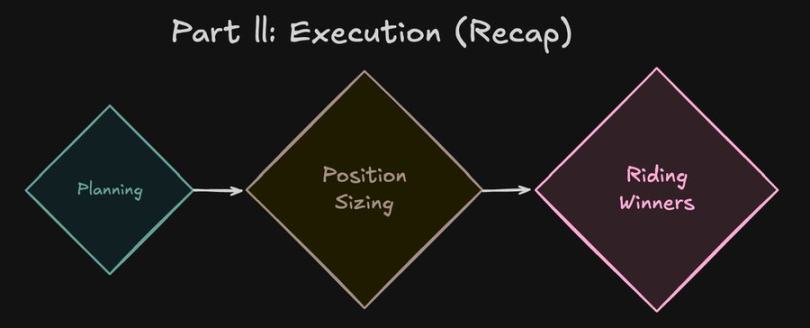
Lesson Five: Markets Punish Unplanned Traders
Always trade with a plan—never enter blindly.
Define whether it's a long-term hold or short-term trade.
Before entering, define your profit-taking zones and invalidation points (both technical and fundamental).
Trading without a plan is planning to blow up.
In crypto, managing drawdowns is key to long-term survival.
Lesson Six: Position Sizing
This is probably the #1 mistake retail traders make.
You might pick the right coin at the right time, but if you size your entry incorrectly, it doesn't matter.
Conversely, you might pick the wrong coin at the wrong time—and if you're too heavily positioned, it could devastate your portfolio.
Based on your risk tolerance and portfolio size, you should set a percentage of capital to risk per trade (and this should be determined by predefined criteria: conviction level, market conditions, market cap, liquidity, etc.).
Lesson Seven: Let Winners Run, Cut Losers Fast
I see this mistake all the time.
People sell strong coins and rotate into weaker ones, trying to catch up trades.
You should let winners run as long as possible and cut losers as quickly as possible.
Crypto trading is all about momentum—ride the wave as long as you can, and avoid getting crushed by it.
Part Three: Mastering Portfolio Management
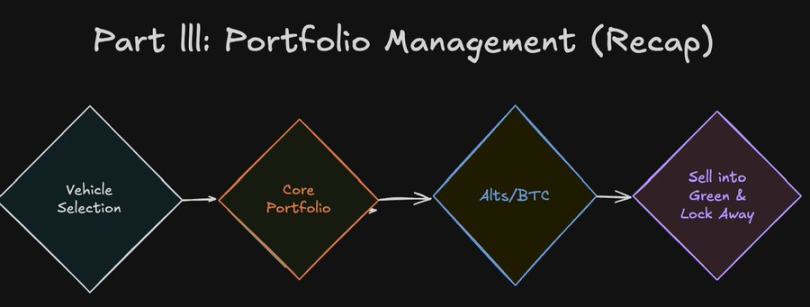
Lesson Eight: Tool Selection
Depending on where you are in your journey, you'll use different tools to achieve your goals.
The tools I used to make my first $10K in crypto are completely different from those I now use to manage millions.
Smaller capital can actually be an advantage—it allows you to trade low-liquidity tokens. There are plenty of mispriced opportunities to exploit. For large whales, playing these games isn't worth it, but you can.
Examples include airdrop farming, arbitrage, low-cap on-chain tokens, etc.
Lesson Nine: Concentrate, Don’t Diversify
Diversification makes sense for wealth preservation.
But for achieving success, over-diversification often does more harm than good.
I strongly recommend most people hold only 5–10 positions as their core portfolio.
This ensures you have enough time to manage them, stay updated, and adjust regularly. Bloated portfolios slow down your response time.
During bubble markets, you can go beyond this range to capture opportunities, but what you really need is a core group of 5–10 high-conviction bets.
I broke this rule with my "degen" portfolio, but it only accounts for 10–20% of my total. If you want to cast a wide net, do it in isolation—keep the bulk of your capital focused on high-conviction plays.
Lesson Ten: From Altcoins to Bitcoin
Remember: your goal is to accumulate Bitcoin.
Use altcoins as a source of profit, then convert into Bitcoin.
Then you start viewing your trades differently (e.g., charting against Bitcoin, analyzing risks relative to Bitcoin, studying macro trends affecting Bitcoin and thus altcoins).
This is a powerful mindset that alone can significantly improve your risk management.
Lesson Eleven: Sell Into Strength, Then Lock In Profits
In the last cycle, I re-gambled away much of my profits simply because stablecoins sat on exchanges, tempting me to keep trading.
My framework should have been:
-
Step 1: Always take profits during strong altcoin rallies.
-
Step 2: Convert stablecoins to fiat to “lock in” gains. Alternatively, withdraw to a cold wallet that’s hard to access, preventing over-trading.
Part Four: Modern Secrets
Lesson Twelve: Let AI Do the Heavy Lifting
You should document your entire crypto journey to gather data about yourself and improve.
You can do this by posting on X, integrating MCP with a Notion database, using a private Google Doc, or whatever works for you.
After recording and collecting data, share it with AI to help uncover blind spots in your edge.
Not using a journal + AI system puts you at a huge disadvantage—and since crypto is a zero-sum game, you need every edge you can get.
Join TechFlow official community to stay tuned
Telegram:https://t.me/TechFlowDaily
X (Twitter):https://x.com/TechFlowPost
X (Twitter) EN:https://x.com/BlockFlow_News
 Miles Deutscher