Interview with Coinbase CBO: Why Did We Acquire Cobie's Echo Platform?
TechFlow Selected TechFlow Selected
Interview with Coinbase CBO: Why Did We Acquire Cobie's Echo Platform?
"This acquisition aligns closely with Coinbase's mission to create more economic freedom for the world."
 Navigating Web3 tides with focused insights
Compiled & Translated: TechFlow
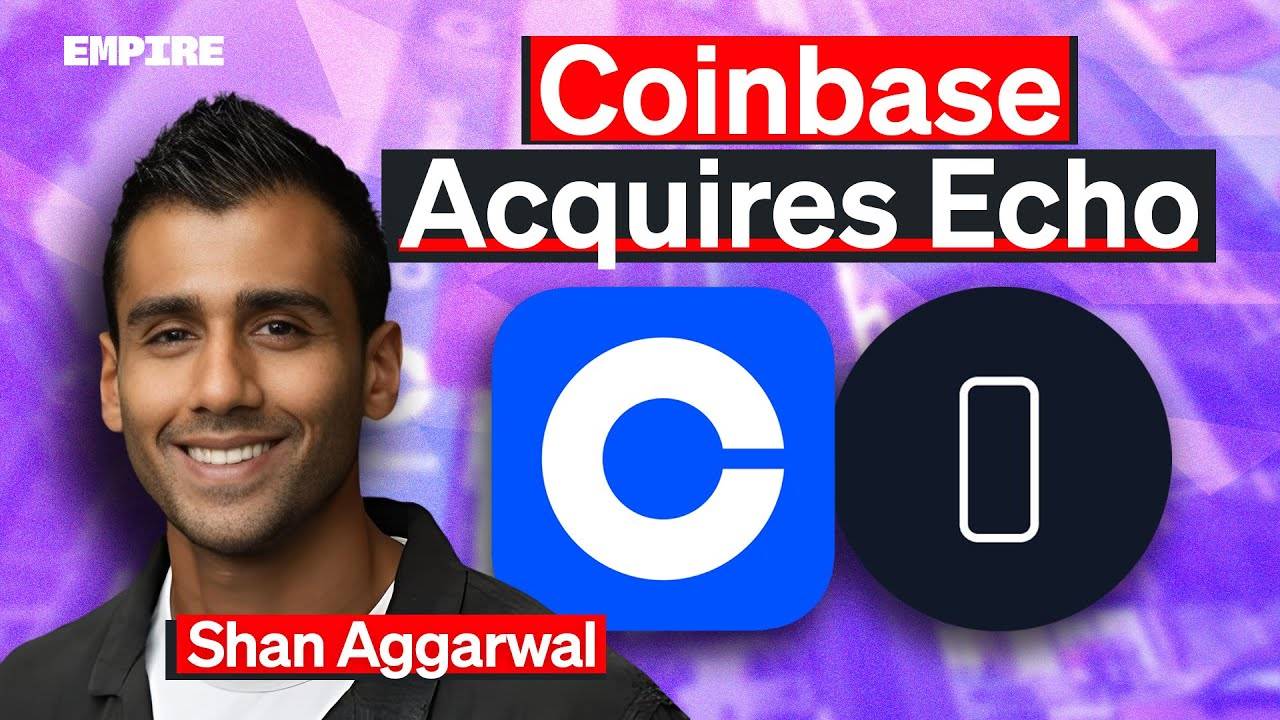
Guest: Shan Aggarwal, CBO of Coinbase
Host: Yano
Podcast Source: Empire
Original Title: Inside Coinbase’s $375m Acquisition of Echo | Shan Aggarwal
Air Date: October 21, 2025
Key Takeaways
Coinbase Chief商务官 Shan Aggarwal explains the acquisition of Echo. This episode features Coinbase's Chief商务官 Shan Aggarwal discussing the company's acquisition of Echo. The conversation dives deep into Coinbase’s strategy of moving capital markets on-chain, Echo’s role in compliant on-chain fundraising, team integration post-acquisition, tokenized stocks, prediction markets, and Coinbase’s broader ambition to become a full-stack financial platform.
Highlights Summary
-
Coinbase’s ultimate goal is to fully migrate capital markets onto the blockchain.
-
When seeking partnerships, Coinbase takes initiative by directly expressing interest. Overall, I’d say about 75% are proactive moves, 25% are reactive.
-
Although Echo isn’t currently profitable, we focus more on future potential than present performance. Often, acquisitions are primarily for technology and talent—we approach these deals with forward-looking vision.
-
In the future, once tokens are issued, they could be listed directly on Coinbase Exchange or launched via Base and traded across blockchain infrastructure—effectively filling the missing “pre-IPO” phase in traditional capital markets.
-
If you ask me which protocol we regret not acquiring, Phantom is a great example. They’re now very successful with an excellent team. We were highly interested in acquiring Phantom but ultimately didn’t reach an agreement.
-
We were actually early investors in Polymarket, and invested in both Polymarket and Calcium—both outstanding companies pursuing different strategies. Polymarket focuses on international markets and operates entirely on-chain from day one, while Calcium targets the U.S. market and strives to achieve regulatory compliance breakthroughs.
-
Opting for both on-chain and traditional IPOs might be a better strategy, like Galaxy did. This way, you serve both on-chain users and mainstream audiences interested in crypto.
-
Coinbase aims to offer comprehensive asset services—from cryptocurrencies and stocks to prediction markets, and potentially tokenized private securities and presale tokens in the future.
-
Will there be another bear market? Yes, it’s possible—but future downturns may not be as severe or painful as those in 2018 or 2022.
Shan’s Background
Yano: Many people know about Coinbase’s executive team—Emily, Paul, or Brian—but I think of you as a key behind-the-scenes leader driving many important initiatives around venture investments,M&A, and corporate development. Today I’d especially like to learn about your professional background and experiences over the past few years.
Shan:
I joined Coinbase in May 2018 when the company was still small—around 150 employees—with a modest office in San Francisco. I had already been deeply interested in crypto before joining. Prior to that, I worked at Greycroft, an early-stage growth venture firm focused on fintech and media investments. I’ve always paid close attention to emerging technologies. In early 2017, I first read the Ethereum whitepaper, which struck me—it reminded me of the early days of the App Store, where developers could build innovative apps on a new platform. Ethereum was ushering in the ICO era, so I spent a lot of time engaging with the community.
In 2018, I decided to go all-in on crypto and joined Coinbase. At the time, there wasn’t yet a dedicated corporate development team. Emily had just joined and was building out our M&A capabilities. I helped launch Coinbase Ventures and gradually scaled it up.
One of my first major milestones was leading the Series E round in 2018, raising funds at an $8 billion valuation. That was my first real taste of crypto market volatility—Bitcoin was trading around $20,000 during fundraising, but soon crashed to about $3,000. I saw many investors trying to pull back their commitments. It was a unique experience, but we managed to close the round successfully. After that, I led investor relations through to the IPO. I personally contributed to drafting most of our S-1 filing and experienced the entire direct listing process firsthand. Interestingly, we attempted to tokenize Coinbase’s own stock during the listing and designed a dual-track plan, but due to regulatory hurdles, we eventually had to abandon it to ensure a smooth traditional listing. That experience was particularly special because we became the first crypto company to go public—and we drafted our S-1 before the AI era.
It was completely built from scratch using traditional processes. Recently, I’ve mainly focused on partnerships, investments, and strategic business operations. Overall, my role is to help shape the company’s strategic direction and ensure efficient execution.
Yano: You mentioned trying to tokenize Coinbase’s stock—I hadn’t heard about that before. Could you elaborate?
Shan:
Yes, we did try. Internally, we had a project called Clementine. Our goal was to have Coinbase listed on Nasdaq while simultaneously creating a digital twin on-chain, allowing the stock to be traded on-chain via the Coinbase platform. However, the regulatory environment and level of market education at the time were far behind today’s standards. We held many deep discussions and healthy debates trying to push this forward, but ultimately couldn’t find a viable regulatory path. To avoid delaying the traditional direct listing, we chose to proceed with a conventional listing in April 2021.
Acquiring Echo
Yano: You’re acquiring Echo—can you walk us through this deal?
Shan:
We’re thrilled to complete the acquisition of Echo—thecore objective is to make capital markets more open and accessible. With Echo, we can offer a full-stack solution enabling developers, blockchain protocols, and asset issuers to conduct compliant on-chain fundraising, drawing capital directly from their most loyal and active user base—the actual users of their products—rather than relying solely on traditional institutional investors.
This acquisition aligns closely with Coinbase’s mission of creating greater economic freedom globally. We believe blockchain and crypto can deliver more open and inclusive financial services, and Echo gives us a critical tool to enable compliant on-chain fundraising, better connecting capital with investment opportunities.
Yano: How did this deal come together? Echo was founded by Cobie—was he the one who reached out, or did you approach him? What was the process like?
Shan:
It was the result of long-term interaction. We’ve collaborated with Echo for a long time—their project initially launched on Base. Earlier this year, we supported Echo Group’s development through the Base Ecosystem Fund. Investors in the fund wanted to support companies we’ve backed while helping grow the Base ecosystem. Many companies within the Base ecosystem are also seeking additional funding opportunities. This collaboration was a strong starting point. As we got to know Echo better, we realized this was a bigger opportunity—to help projects in the ecosystem conduct community sales and public token offerings, accelerating overall ecosystem growth.
The total value of the deal isn’t fully fixed yet—it’s roughly between $350 million and $400 million, depending on Coinbase’s stock price. It’s a cash-and-stock hybrid transaction, and due to stock volatility, the final amount may fluctuate slightly, but generally falls within this range.
Yano: I remember when you acquired Deribit, the initial valuation was $2 billion, then rose to $3 billion a week later, and eventually to $4 billion. Clearly, the founders benefited by choosing Coinbase stock. As the acquirer, how do you structure these deals? I’m sure many entrepreneurs dream of being acquired by Coinbase someday. Can you share some insights?
Shan:
Great question. Since I joined Coinbase, we’ve completed 40 acquisitions—we’re quite active in M&A. This Echo acquisition is our eighth deal this year.When evaluating M&A, we typically develop plans based on product strategy and long-term priorities. These directions stem from customer feedback and the needs of investors and developers. Once we define our goals, we assess the best way to achieve them. While we could build teams from scratch, that often leads to delays and lacks domain expertise.
So we scan the market for standout companies already making progress in relevant areas. If we find a company excelling in technology and product, whose team culture aligns well with ours, we’ll confidently acquire them, bring them into Coinbase, and give them access to a much larger platform for growth.
Our starting point is always our strategic objectives. Many founders proactively reach out wanting to sell their companies, but Coinbase already has positions across multiple market segments. So we must stay focused, ensuring every M&A investment and integration effort aligns with our long-term direction. Without clarity, resources get scattered, things become complex and hard to manage.
Yano: How do you determine acquisition pricing? The valuation here is reportedly between $3–4 million, clearly tied to Coinbase’s stock price. But how do you arrive at that number? I assume it’s not based on revenue multiples, since Echo likely isn’t profitable yet.
Shan:
It really depends case by case. For mature businesses like Deribit with stable revenue and profits, we can use traditional financial analysis. But for companies like Echo, we focus more on future potential than current performance. Often, we’re acquiring primarily for technology and talent—because we believe these assets will accelerate our growth and success. We take a forward-looking view, assessing what outcomes might look like in the next 12–24 months and the eventual revenue impact, then base the price accordingly.
Yano: What impresses me most about Coinbase’s M&A track record is your integration capability—especially retaining founders beyond their earn-out periods. Your custody business came from Zapo, prime brokerage from Tagomi, derivatives from FedEx, staking evolved from Bison Trails, asset management from One River—the list keeps growing.
How do you integrate these businesses and retain founders and teams? Can you walk us through the integration process?
Shan:
This is something I’m particularly proud of. In fact, three key members of our leadership team joined through acquisitions. For example, Greg Tusar, founder of Tagomi, now leads our institutional business. Rob Witoff, an early engineering leader at Coinbase, was involved with Unit 410. And Jesse Pollak, who now leads Base, also joined through an acquisition.
During integration, we don’t just focus on product and tech alignment—we prioritize cultural fit and team cohesion. We want teams to embrace Coinbase’s mission as true “missionaries,” not short-term “mercenaries” motivated purely by compensation. In traditional M&A, many teams care only about earn-outs and pay packages. That model isn’t wrong, but it can hurt long-term retention and goal alignment.
We place heavy emphasis on long-term cultural alignment during screening. When teams match our culture, they tend to stay long-term and grow with us. That’s why we achieve the outcome you mentioned—team members often stay at Coinbase for three, five, or even more years after joining. We invest heavily in cultural integration and team collaboration, which I believe is key to M&A success.
Coinbase’s Ultimate Goal
Yano: You recently acquired another relatively unknown company—Liquifi. With this acquisition, it seems you’re building out a full capital stack? Over the past decade, Coinbase primarily served traders and investors, but now you seem to be moving into enterprise financial services. Can you talk about how Liquifi and Echo fit together? What’s your endgame? What exactly are you building?
Shan:
Our ultimate goal is to fully migrate capital markets onto the blockchain. Currently, Coinbase primarily serves as a secondary market for crypto tokens. With Liquifi and Echo, we can now offer token issuers a full end-to-end solution—from company formation and token management to fundraising—enabling projects to launch and scale. While our initial focus is on crypto tokens and blockchain projects, we see traditional finance and crypto increasingly converging, with tokenization acting as the bridge. Through tokenization, traditional assets can be digitized and moved onto blockchains. The infrastructure provided by Liquifi and Echo supports not only crypto tokens but other asset types too. These modular components allow us to rebuild capital markets from the ground up and integrate these capabilities into Coinbase’s product suite.
Yano: So what’s Echo’s core objective? Is it about scaling project fundraising? Attracting more issuers? Or boosting liquidity and community engagement in secondary markets? How do you measure success?
Shan:
Right now, our focus is driving capital flow through project fundraising. This provides funding for companies in need while giving everyday investors access to investment opportunities they previously couldn’t reach.
Yano: So your vision is that my Coinbase account won’t just hold Bitcoin, Ethereum, and Solana—but will also let me participate in a startup’s Series A round or join a public token sale. I could invest directly from my USD balance in the account—is that right?
Shan:
In the future, once these tokens are issued, they could be listed directly on Coinbase Exchange or launched via Base and traded across blockchain infrastructure. This effectively fills the missing “pre-IPO” gap in existing capital markets.
Yano: What’s still missing from this capital architecture? Liquifi offers cap table management, Echo enables fundraising—what else is needed?
Shan:
I think the next critical piece is regulatory compliance. The on-chain infrastructure from Liquifi and Echo can support any type of token, but the key question is: which tokens are legally allowed to be issued? Are they commodity tokens or security tokens? What’s the difference? We need to clarify these issues before this vision becomes reality.
Beyond that, we also need to consider where these tokens will trade. While they can be listed on Coinbase’s centralized exchange, we believe over time they should also be tradable on decentralized exchanges (DEXs) on-chain. Ensuring permissioning and compliance in such trades presents a significant challenge.
We’ve already laid groundwork in this area—for example, Coinbase Verifications. This project allows users to tokenize their KYC information and store it in their wallets, enabling us to verify who is trading on DEXs. With tools like this, we aim to efficiently operate securities and capital markets on-chain, offering users more open and transparent financial services.
Coinbase’s Listing Strategy
Yano: What’s your view on the final form of token listings? What do you think the future of token listings looks like? Also, I noticed you launched “The Blue Carpet” initiative—can you share your vision for the ultimate state of token listings?
Shan:
I think we’ll see many more tokens created. Historically, listings are major marketing events. We believe in listing and supporting as many crypto tokens as possible. The real challenge is curation—how to filter or highlight quality. We don’t want to impose our judgment telling people what’s good or bad—that feels too paternalistic. Instead,we prefer to provide full disclosure and in-depth research, empowering users with accurate information they can trust and rely on to make their own decisions.
There’s a lot of misinformation and misleading content in this space. That’s why institutions like Blockworks play a crucial role in improving industry transparency and authenticity. We’re also exploring whether prediction market mechanisms could further enhance information accuracy and credibility.
In the future, you’ll see more and more tokens available to users. We’re continuously working to improve educational resources and information support to help users make informed investment decisions.
Yano: Let’s talk about launchpads. You’ve acquired Echo, while another major player is Legion. I know Legion partners with Kraken and possibly other exchanges. How do you see this space evolving? Will every exchange launch its own launchpad and ICO service? Will this become standard for exchanges?
Shan:
I can’t speak for others, but for us, this is a natural strategic move. Others may follow similar paths. We’re very bullish on Echo because we believe they lead in on-chain capital formation. To date, Echo has helped raise over $200 million across 300+ investments, including high-profile successes like Plasma and MegaETH. We see Echo holding a clear competitive edge in attracting high-quality issuers and supporting protocol development, along with a broad investor base.
Yano: Is there any acquisition you passed on that you regret?
Shan:
Good question—Phantom is a great example. They’re now very successful with an outstanding team. We were very interested in acquiring Phantom but didn’t reach an agreement. They seized the market opportunity and grew rapidly. Seeing their achievements since then is truly admirable.
Coinbase Ventures
Yano: Let’s shift to Coinbase’s venture investing. The Coinbase Ventures team is clearly performing exceptionally well—I believe you’re among the most active venture firms in the industry, perhaps even leading in deal volume.Are you ranked #1 or top 3? I’m sure you have the data. Can you discuss your venture strategy and how it ties into marketing and advertising (MMA)?
Shan:
Great question. Since 2018, we’ve completed over 500 crypto investments, making us one of the most active venture firms in the space. Our portfolio continues to expand, especially with the launch of the Base Ecosystem Fund. We remain committed to investing consistently across market cycles. During bull markets, many jump in, but in bear markets, capital access often becomes harder.
We started venture investing because we noticed many talented developers wanted to build protocols and apps outside Coinbase, yet lacked dedicated crypto-focused investors. So we asked: can Coinbase support broader ecosystem growth in some way? That was the genesis of our ecosystem fund. Initially, we made small bets on promising founders, especially innovators in areas we believed had strong potential. Over time, the fund scaled up, now focusing on backing the industry’s best companies while aiming for solid financial returns.
This not only supports innovation but gives us a front-row seat to observe ecosystem evolution. Predicting trends in crypto is notoriously hard, but I’ve found that watching what the smartest people are building is often the best signal. For instance, in certain areas—like social apps or stablecoin issuance—we might see two or three companies launching almost simultaneously, one leading, another following fast. These patterns often foreshadow future industry trends. By observing this, we can inform Coinbase’s long-term strategy. Once we identify a direction, we decide whether to build in-house, acquire, or partner. We’ve succeeded with all three approaches.
Yano: So what’s the primary goal of Coinbase Ventures? Pure financial return, or strategic value for Coinbase?
Shan:
Currently, our main goal is financial return. Of course, we also hope to build strong relationships with top founders across the industry.
Yano: Any other unique aspects to your venture approach? For example, does someone ever message you: “Hey Sean, this company has huge potential—should we consider acquiring them?”
Shan:
Yes, that happens. I usually participate in those discussions, which helps me understand how our portfolio is performing—which companies are thriving, which face challenges. But more often, we start from Coinbase’s strategic needs, looking at the best companies in the space to see who’s doing truly interesting work. This approach gives me confidence—we’ve had a strong success rate in venture. Many companies we eventually targeted for acquisition were actually prior investments. Of course, it’s not a rule—we’ve also acquired companies we didn’t invest in. But having established trust with founders definitely makes the acquisition process smoother.
Advice for Founders
Yano: We know many crypto founders, and I’d say at least half of them are thinking, “One day, I’ll sell my company to Coinbase.” It seems to be a common exit plan. If you could give direct advice to these people, what would you say?
Shan:
First, I think understanding Coinbase and building key relationships is crucial. Whether through Coinbase Ventures or business development, establishing contact early is very helpful for the future.
Second, I advise founders to carefully consider strategic alignment with Coinbase. Many founders say, “Here’s our product” or “Here’s what we’ve achieved.” These matter, but from our perspective, the key question is: “If we acquire you, what value can we create together?” In other words, can combining our resources unlock new opportunities?
Past achievements matter, but our most successful acquisitions have been where external innovation meets Coinbase’s resources to create entirely new value. Take Tagomi, for example. Tagomi was focused on institutional trading, built top-tier trading infrastructure, and established a standalone premium brokerage business in crypto. Meanwhile, Coinbase was expanding its custody business, with a strong asset base and balance sheet.
To truly scale a premium brokerage, you need several things: world-class trading infrastructure, a balance sheet capable of supporting lending and large trades, and reliable custody to securely hold funds and enable efficient trading.
So combining Tagomi’s tech with Coinbase’s resources was a natural fit. After integration, we discovered massive market demand. In 2021, many companies approached us wanting to buy $1 billion worth of Bitcoin, but no other solution existed to meet such large-scale trading needs. By combining Tagomi’s trading tech with Coinbase’s brand and custody strength, we built Coinbase Prime—the leading premium brokerage in crypto today. A textbook case of strategic integration success.
The Acquisition Process
Yano: You’ve done 40 deals. What’s the ratio of proactive vs. reactive outreach? In other words, how many came to you first, and how many did you initiate?
Shan:
Great question—I haven’t specifically tracked the numbers. Sometimes it’s hard to define, as relationships often evolve over time. It’s more like a “long-term two-way dialogue.”
Yano: For example, with Echo, you’d already built a relationship. But eventually there’s a clear moment—someone asks: “Are you interested in acquiring us?” or “Would you consider partnering?”
Shan:
In most cases, we take the initiative and directly express interest. Because we have a clear view of Coinbase’s long-term roadmap, when we decide to pursue a specific area, we proactively reach out to leading players. Of course, exceptions exist—sometimes we discover an opportunity unexpectedly, realizing its importance even if it wasn’t a top priority. Overall, I’d sayabout 75% are proactive, 25% are reactive.
Yano: There’s an old saying: “Companies are bought, not sold.”Regarding investment banks—when acquiring companies like Tagomi, Zapo, Liquifi, and Echo—do you rely on traditional banks, crypto-native banks, or not use banks at all?
Shan:
We appreciate the professionalism of investment banks, but in most cases, we find going bankless is more efficient and preferred. Our deals are typically done through direct conversations with founders. Deals involving investment banks are extremely rare—maybe countable on one hand. As for buy-side advisors, we’ve never used them because Coinbase has built an internal team capable of handling this work. That said, in recent years, some high-quality crypto-native investment banking services have emerged.
Usually, we have a clear understanding of our target’s needs and positioning and have already built relationships. These deals feel more like brainstorming sessions between Coinbase and the founder—discussing how to create future value together. Plus, we place great importance on cultural fit, because these founders could play key leadership roles at Coinbase for five to ten years. Ensuring cultural alignment is therefore central to our acquisition process.
Yano: Do you have a standard playbook for deal structuring? Some are all-stock, some all-cash, some include earn-outs or other metrics. How do you balance these factors?
Shan:
We don’t have a fixed formula or rigid script—I think that’s part of the art of dealmaking. The tools you mentioned are simply means to an end. The key is knowing what outcomes we want, where we have conviction, and how to evaluate risks.
In most cases,we prefer to avoid overly complex structures. I don’t like complicated earn-outs or multiple milestones—they can misalign incentives between Coinbase and the acquired company. The acquired team might focus narrowly on hitting targets, while Coinbase needs to pursue broader strategic goals. We’d rather both sides collaborate toward a shared vision rather than work in silos. Of course, there are exceptions where earn-outs make sense, but the premise is preserving team independence and autonomy so they can focus on driving their goals.
Yano: How quickly can you tell, when talking to a founder, whether you’d acquire them?
Shan:
Typically,I can quickly judge whether there’s sufficient rationale for an acquisition. Of course, closing a deal requires multiple conditions aligning. The founder needs to be willing to sell, and we need enough motivation and urgency to act. As you said, it’s “companies being bought,” not “sold.” Many factors need to align, and timing often determines success.
Sometimes I believe a company is a perfect fit for Coinbase, but if the timing is off, a deal won’t happen. For example, if they just raised a round at a valuation beyond our comfort zone, we may have to pass. Sometimes I think, “If only this happened six months earlier.” But that’s business—you miss some, and you keep moving forward.
Yano: Has there ever been a case where due diligence went smoothly, your team loved it, leadership approved it, but Brian ultimately vetoed it?
Shan:
That hasn’t happened. But we have encountered cases where due diligence uncovered issues that overturned our initial assessment. That’s exactly why due diligence exists. We want everything to go well, but after signing the term sheet, we conduct deep dives into the company’s core operations—not just finances and team, but compliance, legal risks, and how they’ve managed employee matters throughout their lifecycle.
Also, crypto markets are highly volatile, so accurately assessing pricing is difficult, especially in the short term. We usually evaluate companies on a 3–5 year horizon, sometimes longer, rather than focusing on near-term 12-month performance. 2022 was a classic example—global markets shifted dramatically, and everyone had to adapt to a new reality.
Views on Prediction Markets
Yano: Let’s talk about prediction markets. You recently invested in Calcium. What role do prediction markets play in Coinbase’s strategy? What’s your take on Polymarket and Calcium?
Shan:
We were actually early investors in Polymarket—we’re very interested in prediction markets. We believe one of crypto’s core values is injecting liquidity into illiquid assets, thereby creating new markets. Prediction markets are a great example—showing how people can bet on important life events like sports or elections. Broadly speaking, the “financialization” of daily life is accelerating, and people want greater participation through these markets.
We see strong synergies between prediction markets and Coinbase’s business, so we plan to integrate them into our product suite. We’ve invested in both Polymarket and Calcium—both excellent companies taking different approaches. Polymarket focuses on global markets and operates entirely on-chain from the start. Calcium targets the U.S. market and works hard to achieve regulatory compliance breakthroughs. Especially in sports betting, we expect more legal rulings in the next year to advance this market—we’re excited.
Yano: Will it be possible to engage in sports betting via Coinbase a year from now?
Shan:
Possibly. We expect users to be able to participate in sports betting via Coinbase within 12 months.
Yano: Do you think Polymarket and Calcium will compete, or is the market big enough for both? Have you considered acquiring one of them?
Shan:
I believe the market is large enough for both to succeed. Just like traditional finance, where futures and options exchanges each have specialties. I expect prediction markets to develop similarly—some platforms focusing on live streaming, others specializing in sports like NFL, NBA, or soccer. The market is still early, but as regulations clarify, we see massive growth potential.
Yano: How much time did prediction markets take up in your recent executive meetings?
Shan:
We’ve listed it as one of our key priorities for the end of this year and next. We believeprediction markets can attract a much broader user base than traditional crypto trading, which is highly valuable for our business. It’s also significant for crypto as an asset class—prediction markets could draw in many people who’ve never touched crypto before. Some may find crypto too cutting-edge or niche, but they’d happily bet on an NFL game.
Yano: When I think of Coinbase and prediction markets, I recall your investment in Calcium. There’s a view that every battle between startups and incumbents comes down to whether the startup can gain distribution before the incumbent launches a similar innovation. In this case, Coinbase is the “incumbent,” and companies like Polymarket and Calcium are the “startups.”
While you’re investing in and partnering with them, why not just build your own prediction market? As the incumbent, you have vast resources—you could launch your own instantly and reach over 100 million users, instead of lettingstartupscompete for this space.
Shan:
You’re absolutely right—we could do that. But some core capabilities these companies have built aren’t easily replicable. For example, Polymarket and Calcium hold key licenses that can’t be obtained quickly. Also, their ability to resolve market outcomes with discretion—even without real-time data feeds—is a unique skill. So yes, it’s a trade-off we weigh.
We already operate a designated contract market—a CFTC-regulated derivatives exchange approved in 2022.Going forward, we’ll choose between “build, buy, or partner” to deliver the best products to users while optimizing our business.
Yano: Can we circle back to tokenized stocks and your own equity tokenization? I’d love to hear your thoughts on this market—tokenizing your own equity, tokenizing stocks, and the feasibility of bringing them on-chain.
Shan:
I think we’re still in the early stages. The biggest hurdle today is regulation, not technology. In fact, the technical foundation for tokenized stocks is already mature. I believe most equity capital markets—and eventually entire capital markets—could move on-chain. But this must happen within regulatory boundaries. Traditional equity markets function reasonably well overall, though not everyone participates equally. For example, people in certain regions lack fair access. Mechanisms like T+2 settlement could be vastly improved if moved on-chain.
But there’s still much work to do—enhancing market transparency and integrity so users have confidence in the security and participants of on-chain markets. Some of the most promising companies today are those bridging traditional and on-chain capital markets. Superstate, for instance, is fascinating because it enables interoperability between exchange-traded securities and on-chain securities. I’m confident such markets will emerge.
But for now, the utility of on-chain securities remains limited. Questions like how to transfer them, where to trade them, and whether lending markets can be built on them still lack clear answers.
Yano: You can see that compared toGalaxy’s stock, this market isn’t really functioning yet. I hope it opens up, but current results aren’t ideal.
Shan:
True, but I see it as an important step forward. I admire their efforts—it’s very similar to what we tried in 2021. They’re setting an example for many companies, showing that traditional and on-chain markets can coexist.I believe we’ll see more assets move on-chain, especially innovative applications like perpetual stock contracts. Since stock spot markets aren’t 24/7, achieving round-the-clock trading is hard today—but once assets are on-chain, perpetual markets become feasible. Similar applications could extend to private securities, even if they’re not freely tradable. I’ve noticed Hyperliquid recently running interesting experiments, especially after HIP 3—aiming to make perpetual contracts available for all assets. That’s very compelling. But the prerequisite is that underlying assets must be tokenized and held on-chain to minimize market imbalances from price discrepancies.
Yano: I want to pose a hypothetical: I think Blockworks is a traditional equity business—no token, not on-chain like a protocol. So by tradition, we’d do a Nasdaq IPO, the classic path for startups over decades. But our audience lives mostly on-chain and holds substantial capital there.
Seeing what Superstate is doing, we wonder: should Blockworks do an on-chain IPO instead of a traditional one? Would an on-chain IPO mean issuing a token? If you were us, what would you think?
Shan:
I think an on-chain IPO is a strong option because it better aligns with your core audience.If you go on-chain, you can use tools like Liquifi for cap table management and Echo or Sonar for on-chain fundraising. This direction is definitely worth exploring. But you need to weigh trade-offs: while an on-chain IPO fits your audience better, the size of on-chain capital markets is still far smaller than traditional ones—especially in terms of capital pools and available funding. So while on-chain may better suit your business, the overall market is smaller.
I think a hybrid approach—doing both on-chain and traditional IPO—might be better during transition, like Galaxy did. This way, you serve both on-chain users and mainstream audiences interested in crypto.
Yano: That’s a great idea—we should explore it further. In Coinbase executive meetings, what topics surprisingly take up a lot of time? Besides prediction markets and perps, anything else worth noting?
Shan:
Yes, we spend a lot of time debating the pace of transition from off-chain to on-chain, because it directly impacts our decisions. You know, in Coinbase’s early days, we had to secure regulatory approvals and bank accounts in each market to bridge users to crypto assets. That was incredibly tedious and complex. But once assets are on-chain, they become more flexible and portable, enabling easier creation of new financial markets. We’re heavily investing in our on-chain future, ensuring robust infrastructure supports this shift—Base, Base apps, and even integrating on-chain protocols into the Coinbase platform.
Based on our expectations for transition speed, if this shift accelerates, we’ll adjust resource allocation to prioritize on-chain market development; if it’s slower, we’ll balance resources to continue supporting off-chain operations. So in setting priorities and allocating resources, we’re constantly finding that balance.
Yano: Shan, is there anything else we haven’t covered—especially regarding Coinbase’s vision to become the “everything exchange”?
Shan:
I think we’ve covered a lot. The “everything exchange” vision is essentially a summary of the tokenization journey. Traditionally, people distinguish crypto assets from traditional financial assets, but once financial assets are tokenized, that line blurs.We want to offer comprehensive asset services—whether it’s crypto, stocks, prediction markets, or future tokenized private securities and presale tokens. Acquiring Echo is a major step toward that goal. More broadly, it marks significant progress in our mission to move capital markets on-chain.
Do Market Cycles Still Exist?
Yano: Before we wrap up, Shan, I’d love your take on market cycles. Where do you think we are in the cycle? Do market cycles still exist? Eager to hear your latest thoughts.
Shan:
Great question—one we just discussed deeply in our executive meeting. I believemarket cycles still exist, but their volatility and extremes have diminished compared to the past. Today’s crypto cycles are influenced not just by internal industry factors, but significantly by macroeconomic conditions.
As for whether anotherbear marketis possible, yes—but compared to 2018 or 2022, future downturns may be less severe or painful. The reason is we’re starting to see more stable real-world use cases emerge—ones less tied to crypto price swings. Stablecoins are a prime example. They’re arguably the earliest form of tokenized assets. Since 2018, stablecoin market size has grown astonishingly—now exceeding $300 billion in total market cap.
Beyond that, we’re seeing continuous innovation around stablecoins. Globally, many emerging stablecoin banks are rising fast, delivering more efficient and convenient financial experiences. These services used to require massive capital and time. So I believe such innovations are gradually reducing overall market volatility and dampening the impact of crypto price swings.
Yano: If you felt the market was nearing a “top,” would you slow down investments orM&A?
Shan:
We wouldn’t deliberately slow down. Our focus remains on identifying the best investment opportunities that strongly align with our strategy.
Join TechFlow official community to stay tuned
Telegram:https://t.me/TechFlowDaily
X (Twitter):https://x.com/TechFlowPost
X (Twitter) EN:https://x.com/BlockFlow_News
 深潮TechFlow
Related Articles
Working for Coinbase: Stablecoin Leader Circle's Profit Dilemma
For every additional USDC dollar minted, Coinbase receives it first.
Coinbase CEO Admits Base Content Token Strategy Failed, ZORA Down 95%, "Turning the Page" to Shift to Trading and AI
Mistakes can be admitted, but going to zero won't rebound.

Crypto Morning Brief: ICE and OKX Establish Joint Venture OKXICE; Coinbase to Launch OpenAI and Anthropic Pre-IPO Perpetual Contracts
Micron and Anthropic sign multi-year storage product supply agreement.

Coinbase Tokenized Stocks Face Scrutiny: Is the Promoted “Real Equity” Merely a Gimmick?
Galaxy’s Head of Research Warns of Fatal Flaws in Coinbase’s Token U.S. Equity Listing; SpaceX’s Past Setback Still Fresh in Memory.

Crypto Morning Brief: Coinbase Announces Launch of Crypto and Stock Options Trading, as Well as Tokenized Stocks; U.S. Senate and House Reach Agreement to Ban CBDCs Until 2030
China is accelerating the establishment of the World Artificial Intelligence Cooperation Organization.

Competing in the AI Payment Sector: Traditional Card Networks vs. Coinbase
The Two Major Approaches to AI Agent Payments Go Head-to-Head.

Machines Pay, Humans Reap: Coinbase, Stripe, Google, and Visa Battle for AI-Payment Dominance
Who Pays for AI Agents? Four Payment Protocols Are Dividing the $73-Billion Machine Transaction Market.

Trump Signs Executive Order, Kraken, Coinbase, and Others Expected to Access Federal Reserve Payment Channels
Ripple, Coinbase, and Circle are the most direct beneficiaries of this policy relaxation.

Bear Market Earnings Comparison: Pure Crypto Exchanges vs. Multi-Asset Platforms—Robinhood Is More Resilient Than Coinbase
The $12 Billion Gap in Coinbase’s and Robinhood’s Earnings Reports: Can Exchanges Survive the Bear Market?

AI Is Triggering a Wave of Layoffs at Crypto Companies; Coinbase Says “The Greatest Risk Is Inaction”
Yet, as trading volume cools and valuations come under pressure, is this a harbinger of an efficiency revolution—or merely a cyclical contraction wrapped in the guise of artificial intelligence?