Crypto Morning Brief: Gold Drops Below $4,100, Limitless Announces Tokenomics
TechFlow Selected TechFlow Selected
Crypto Morning Brief: Gold Drops Below $4,100, Limitless Announces Tokenomics
The Federal Reserve has proposed introducing a "streamlined master account" to provide fintech companies and stablecoin issuers with direct payment access.
 Navigating Web3 tides with focused insights
Author: TechFlow
Yesterday's Market Dynamics
Zelenskyy: Ukraine is ready to end the Russia-Ukraine conflict
On the evening of the 21st local time, Ukrainian President Zelenskyy stated in a speech that Ukraine had completed preparations for upcoming talks with European partners and would sign a new agreement on defense capabilities this week. Zelenskyy said the agreement would effectively become part of Ukraine's long-term security assurance, providing lasting protection for the country and its people. He noted that Ukraine maintains consistent positions with partner countries on diplomatic issues. Zelenskyy reiterated that Ukraine is ready to end the Russia-Ukraine conflict. He revealed that during his meeting with U.S. President Trump, both sides agreed to attempt negotiations based on the current front lines.
Spot gold plunges $100 intraday, now at $4,025.22/oz
Spot gold dropped $100 intraday, currently trading at $4,025.22 per ounce, down 2.43%. Spot silver fell 2.00% intraday, now at $47.66 per ounce.
Fed proposes "streamlined master account" to provide direct payment access for fintech firms and stablecoin issuers
According to crypto journalist Eleanor Terrett, Federal Reserve Governor Chris Waller announced at the Federal Reserve Bank’s Payment Innovation Conference that the central bank is proposing a new type of restricted master account—called the “streamlined master account”—that would allow all legally compliant institutions direct access to the Fed’s payment systems without relying on correspondent banks.
The streamlined master account does not offer all services of a full master account, such as borrowing from the Fed, but any legally compliant entity can apply, and eligibility rules under law remain unchanged. This move would open the door for innovative banks, fintech companies, stablecoin issuers, and other payment firms to gain access.
Eleanor Terrett said this is significant for companies like Custodia Bank and Kraken, which have spent years trying to obtain a Fed master account—Custodia even sued the Fed. Additionally, Ripple and Anchorage, which applied this year, may also see faster approval.
South Korean banks freeze over 91 billion KRW in assets tied to Cambodia's "太子集团"
According to Red Star News, after joint sanctions by the U.S. and UK on Cambodia's "太子集团" and its founder Chen Zhi, five South Korean banks have frozen over 91 billion KRW in assets linked to the group, including 56.7 billion KRW frozen by branches of KB Kookmin Bank.
Due to the sanctions, "太子银行," operated by the group, has faced a bank run, with large numbers of customers queuing to withdraw funds. Multiple branches suspended transactions due to "insufficient liquidity," and the bank's website and app were temporarily inaccessible. The Financial Services Commission of South Korea said it will impose financial sanctions on the group within this month.
Earlier reports indicated the U.S. Department of Justice seized nearly 130,000 bitcoins worth about $15 billion from a Cambodian telecom fraud network, with the "太子集团" identified as the mastermind, while founder Chen Zhi remains at large.
Limitless reveals tokenomics: 1 billion total supply, 24.37% allocated to airdrops and incentives
According to official news, prediction market platform Limitless has unveiled the LMTS tokenomics. A total of 1 billion tokens will be issued on the Base network, distributed as follows: investors 25%, Kaito presale 1.37%, Echo round 1.26%, team 25%, ecosystem rewards (airdrops and incentives) 24.37%, treasury 13%, liquidity 10%. Unlocking and vesting schedule:
1. First-season airdrop: 100% unlocked at TGE, no lockup.
2. Kaito presale: 50% unlocked immediately, remaining 50% unlocked after 6 months.
3. Investors and Echo round: No unlock at TGE, 6-month lockup, then linear unlocking over 24 months.
4. Team: No unlock at TGE, 12-month hard lock, followed by 24-month soft lock.
5. Treasury: No unlock at TGE, 6-month lockup, then linear unlocking over 24 months.
Ethereum core developer Péter Szilágyi publishes letter sent last year to EF leadership
Ethereum core developer Péter Szilágyi has published a letter he sent last year to EF leadership, sharply criticizing serious problems within the Ethereum ecosystem and its foundation. He pointed out that Ethereum has evolved into a system controlled by a small "ruling elite," contrary to its original decentralized ideals, and criticized the foundation's long-standing low-pay policy, which creates conflicts of interest and risks protocol control by major players.
He specifically mentioned that although Vitalik Buterin did not intend to do so, he indirectly controls Ethereum's development direction in practice, making project success dependent on relationships with Vitalik and his inner circle.
Study Times: Digital currencies are becoming key strategic tools in geopolitical competition
The Study Times WeChat account, hosted by the Central Party School, published an article titled "The Wartime Military Function of Digital Currencies," pointing out that digital currencies are gradually becoming important strategic tools in geopolitical competition. Leveraging blockchain’s decentralization, digital currencies offer advantages such as rapid fund mobilization, anonymous transactions, and sanctions evasion during wartime, having already demonstrated military value in multiple geopolitical conflicts.
Globally, three main models of military applications for digital currencies have emerged: resource-backed tokenization by resource-rich nations (e.g., Venezuela's Petro), decentralized crowdfunding by small and medium-sized countries, and "on-chain sanctions" by developed nations. The "Defense Blockchain Internal Testing Program" mentioned in the U.S. "National Defense Authorization Act for Fiscal Year 2025" could become a key strategic tool for future "financial defense."
Experts believe that despite challenges like market adoption and regulatory policies, the militarization of digital currencies will continue evolving, potentially transcending conventional functions to become multifunctional strategic platforms integrating security assurance, combat support, and digital warfare.
Citibank rates Strategy Buy, with a target price of $485
According to BitcoinTreasuries.NET, Citibank has assigned a Buy rating to bitcoin treasury firm Strategy (MSTR), with a target price of $485.
Wall Street Journal: Coinbase acquires crypto investment platform Echo for $375 million
According to the Wall Street Journal, Coinbase has reached a deal to acquire crypto investment platform Echo for $375 million.
YZi Labs leads $25.5 million strategic funding round for Sign, bringing total fundraising across three rounds to over $55 million
According to Blockworks, YZi Labs led a $25.5 million strategic funding round for Sign, with IDG Capital also participating. Sign has raised over $55 million across seed, Series A, and strategic funding rounds.
Sign focuses on building digital infrastructure. CEO Xin Yan said the company plans to use the funds to expand its technical team, actively recruit top talent in Hyperledger Fabric, zero-knowledge proofs, and interoperability, and establish local teams globally. Funds will also support expanding partnerships to advance sovereign blockchain infrastructure.
Galaxy Digital Q3 Earnings: Q3 Net Profit reaches $505 million, digital asset trading volume hits record high
Galaxy Digital released its third-quarter 2025 earnings report. The report shows Galaxy Digital achieved a net profit of $505 million in Q3, with diluted EPS of $1.01 and adjusted EPS of $1.12. As of September 30, total company assets reached $11.523 billion, shareholder equity stood at $3.172 billion, and cash and stablecoin holdings totaled $1.91 billion.
Digital asset trading volume hit a quarterly record high, up 140% from Q2, including facilitating client sales of over 80,000 Bitcoin. Platform total assets reached a historic high of approximately $17 billion.
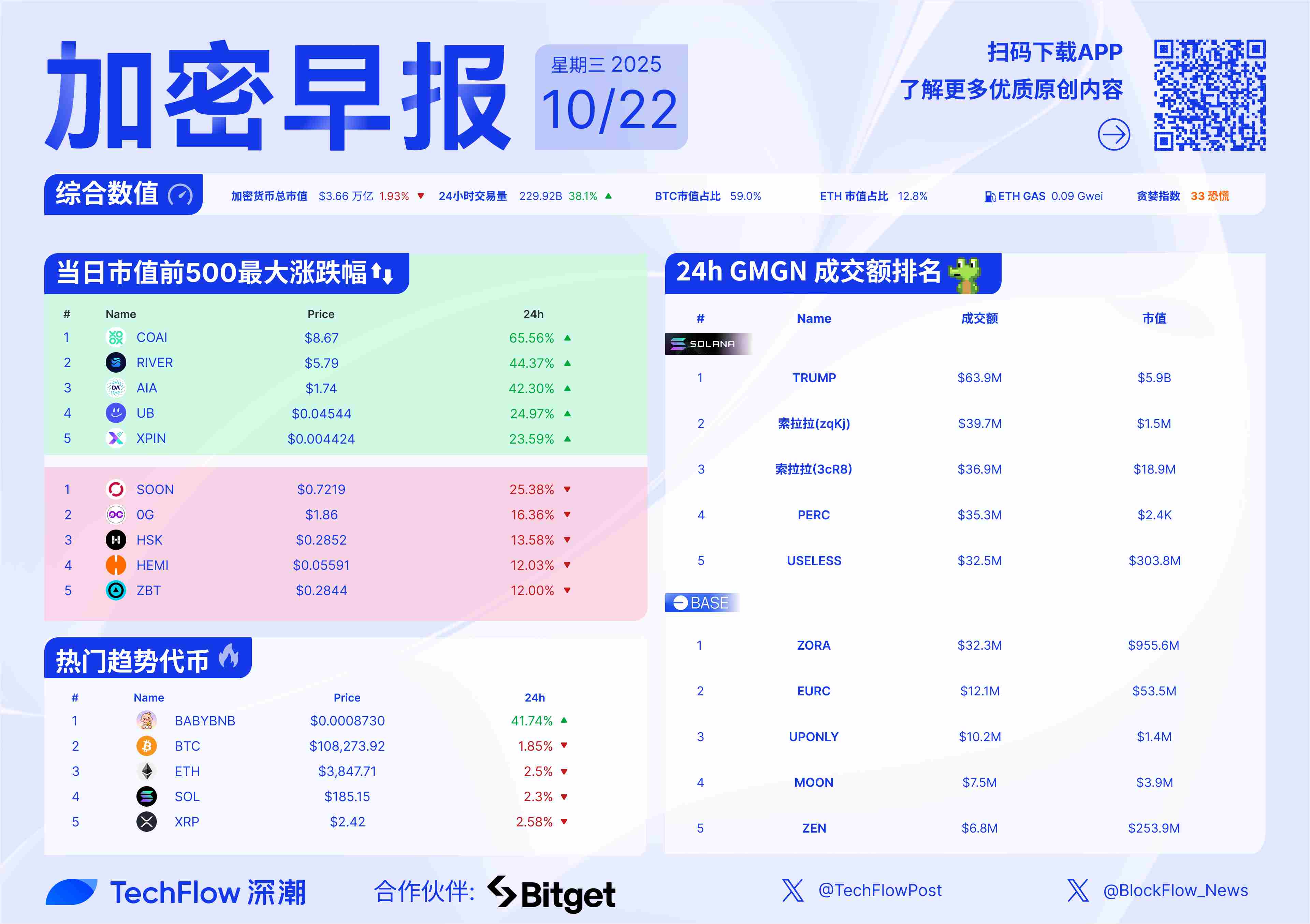
Market Updates
Suggested Reading
An old letter sparks a crisis of loyalty, reigniting criticism against the Ethereum Foundation
This article discusses how a public letter triggered collective backlash from the Ethereum community toward the Ethereum Foundation, exposing internal governance issues such as opaque resource allocation, a low-pay culture, and power concentrated within a small circle. Written by core developer Péter Szilágyi, the letter expresses disappointment with the foundation and a commitment to Ethereum’s founding ideals. Several contributors to the Ethereum ecosystem have also voiced concerns, questioning the foundation’s inadequate support for core developers and highlighting highly centralized decision-making behind the facade of decentralization.
Sonic DeFi leader Shadow: Superior "LP protection + fee capture" during market crashes
This article details the performance and innovations of Shadow Exchange, the leading DeFi project on Sonic, particularly its x(3,3)-based liquidity incentive model. Shadow Exchange performed exceptionally well during market downturns, achieving efficient liquidity protection and yield capture through unique ecosystem design, while promoting long-term sustainability.
Who controls stablecoin deposits controls the future of banking
This article explores how stablecoins are transforming traditional banking’s deposit and operational models, analyzing the rise of crypto-native banks and their impact on the global financial system. Through on-chain storage and transparent operations, stablecoins are replacing traditional bank deposits and enabling more efficient, borderless capital flows. The article highlights key platforms and protocols like KAST, Tria, and Plasma as central hubs for stablecoin liquidity, arguing that whoever controls on-chain payment networks will dominate the future of banking transformation.
Ray Dalio: My AI clone and our expectations for AI clones
This article covers Ray Dalio’s launch of his AI clone, “Digital Ray,” sharing insights on the concept, development process, and future vision for AI clones. He believes AI clones can integrate individual values and wisdom to become super thought partners, enhancing decision-making. The article also distinguishes AI clones from AI agents and large language models, offering a detailed analysis of their potential.
Crypto × AI: Deconstructing the project landscape of this cycle
This article examines recent developments and potential applications in crypto, artificial intelligence (AI), and robotics, covering agent types, agent infrastructure, multi-agent systems, and robotics. It also mentions relevant projects and emerging trends.
Join TechFlow official community to stay tuned
Telegram:https://t.me/TechFlowDaily
X (Twitter):https://x.com/TechFlowPost
X (Twitter) EN:https://x.com/BlockFlow_News
 深潮TechFlow