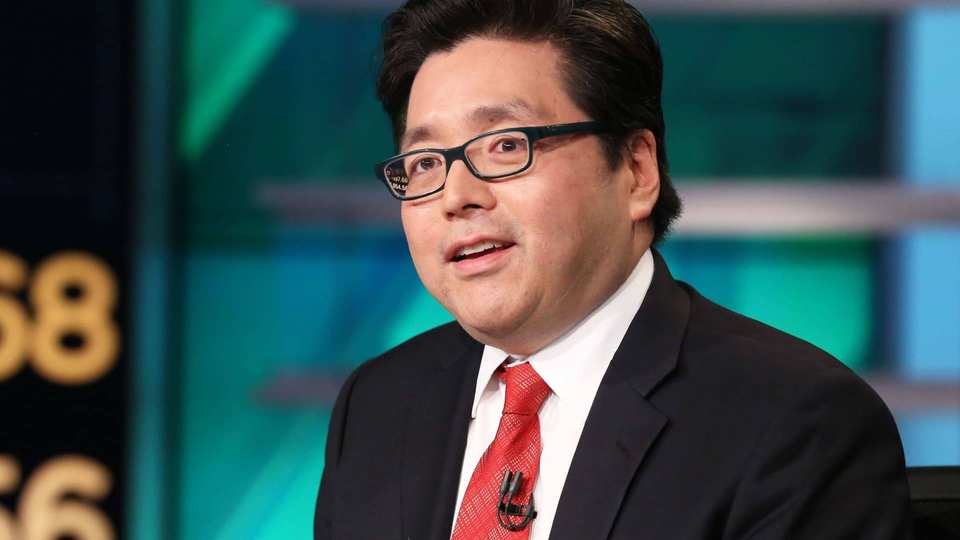
Tom Lee & Arthur Hayes on Dialogue: We Still Forecast BTC and ETH to Reach $250,000 and $10,000 by Year-End
TechFlow Selected TechFlow Selected
Tom Lee & Arthur Hayes on Dialogue: We Still Forecast BTC and ETH to Reach $250,000 and $10,000 by Year-End
BTC reaches new highs, ETH rebounds strongly, and institutional capital flows in, along with rapid development of tokenization and stablecoin payment networks.
 Navigating Web3 tides with focused insights
Compiled & Translated: TechFlow

Guests: Tom Lee, Chairman of BitMine; Arthur Hayes, Co-Founder and Former CEO of BitMEX
Host: David Hoffman
Podcast Source: Bankless
Original Title: Tom Lee & Arthur Hayes: How Crypto Flips Wall Street
Air Date: October 14, 2025
Key Takeaways
In this episode, Tom Lee and Arthur Hayes explore how cryptocurrency is disrupting Wall Street, covering topics such as BTC reaching new all-time highs, ETH's strong rebound, institutional capital inflows, and the rapid development of tokenization and stablecoin payment networks.
During the discussion, Tom shared BitMine’s large-scale Ethereum (ETH) holding plans, forecasting a Bitcoin (BTC) price target of $200,000–$250,000 and an ETH target of $10,000–$12,000. Meanwhile, Arthur analyzed the cyclical patterns of crypto markets, market liquidity, and why perpetual contracts outperform traditional leveraged ETFs. He also suggested potential conflict between prediction markets and traditional finance (TradFi). Additionally, both discussed how banks are gradually transforming into on-chain tech companies and the profound impact of Tether’s rise on the emerging banking system.
Highlights Summary
-
By the end of 2025, Bitcoin will reach $250,000 and Ethereum will hit $10,000.
-
The so-called "four-year cycle" doesn't fundamentally exist. We're in a new cycle driven by the U.S. Treasury's reverse repo program.
-
One of BitMine’s goals for 2026 is to further increase its Ethereum holdings and participate in staking; Tom Lee hopes BitMine will hold 5% of ETH.
-
Arthur Hayes hopes to see 24/7 perpetual contracts covering the stocks of the seven major U.S. tech companies by 2026.
-
ETFs are the worst investment tools—never buy leveraged ETFs. If you need leverage, trade futures directly.
-
We’re in an extended cycle that could last until 2027 or 2028, when a U.S. regime change may bring new market shifts.
-
Bitcoin and Ethereum are complementary: Bitcoin is money, while Ethereum represents computing power.
-
Ethereum should aim to surpass companies like Nvidia or TSMC and become a more valuable part of internet and AI infrastructure.
-
Tether is a classic growth company—its $500 billion valuation might even be conservative.
-
Centralized platforms face higher risks. The more public blockchains are used to ensure process transparency and transaction finality, the safer the system becomes.
BTC Reaches All-Time High
David Hoffman:
The current market is truly exciting. You've just returned from Token 2049, the world-renowned blockchain industry summit, where everyone is digesting and reflecting on the event. But today, as we record this episode, Bitcoin has reached a new all-time high—$126,000! Tom, seeing Bitcoin climb steadily and break new records, what are your thoughts on the current market?
Tom Lee:
It's genuinely exhilarating to see Bitcoin hit a new all-time high, especially at this point in Q4. This upward trend is much healthier than a pullback around $90,000. We're entering a seasonally strong period, and the Fed is gradually easing monetary policy. Bitcoin's new high isn't just a market signal—it's confirmation. Since it's only early October now, I believe there's still significant upside potential before year-end.
David Hoffman:
Bitcoin's market dominance peaked last quarter but has since pulled back. Yet Bitcoin now appears to be capturing the majority of market liquidity. Many other tokens remain flat or have declined in dollar terms. In other words, Bitcoin's strength seems to be 'squeezing' space from other tokens. Arthur, how do you view the current market state, particularly the relationship between Bitcoin and other tokens?
Arthur Hayes:
Yes, that's typically how it goes. Bitcoin usually leads the way, with other tokens following later. Of course, everyone hopes their tokens bought in 2013 will surge again, but the market needs time. If the broader rally picks up momentum quickly, I believe many quality tokens will also see significant gains. So I remain optimistic about the coming market trends.
DATs Market
David Hoffman:
Arthur, what’s your overall take on the current market? Not just Ethereum’s internal dynamics, but I’d also like your perspective on the entire Debt Asset Tokens (DATs) market. For instance, MicroStrategy is performing strongly, and BitMine’s MNAV is positive. But when we look deeper, other firms’ MNAV shows signs of compression. While I wouldn’t necessarily call it a trade yet, I sense some market vitality is fading.
Arthur Hayes:
As investors, when we examine these charts, it's clear these products are no longer 'sure bets.' As a result, the market has grown cautious toward heavily subscribed offerings. This follows a power law distribution—roughly 80% of trading volume is dominated by a few top-tier companies, while others struggle to keep up. I believe future projects using these financing tools will carry higher risk as market risk appetite shifts. But for traders like me, this is attractive—I enjoy trading complex derivatives.
Overall, the market will stratify. Companies like BitMine are well-positioned because they can attract capital through simple equity financing, directly boosting stock prices and increasing per-share ETH holdings. Others may issue highly complex or obscure products—high-leverage financial instruments with management fees as high as 20%. Such products often disappoint investors late in the market cycle.
I launched various leveraged ETFs in Asia and maintained them for five years. When my boss explained their construction and underlying math, I thought: Why would anyone trade these? They’re the worst investment tools—never buy leveraged ETFs. If you need leverage, trade futures directly.
ETFs suffer from 'negative gamma effect,' meaning their structure gradually erodes investor capital. Layering options on top further weakens returns. That’s just how U.S. equities work—somewhat like a casino. Similar issues exist in crypto, where some product designs are even more flawed.
David Hoffman:
Tom, should we be surprised by this evolution, or is it a natural outcome of DATs market development?
Tom Lee:
If we ignored the past four years, I might feel differently. But over the last four years, crypto was largely excluded from traditional capital markets—many firms couldn’t even establish banking relationships. By 2025, I believe massive pent-up capital is ready to deploy. This year, some of the most successful IPOs were crypto-related—Circle, Figment, Bullish—all achieved huge success.
Moreover, stablecoins are far more profitable than traditional banking. Crypto-native business models achieve higher profits with fewer employees. Investors clearly want exposure to these new asset classes. But as Arthur said, leveraged ETFs aren’t ideal for crypto. These tools are designed to exploit volatility, and we hope they don’t make investor profits harder to achieve. We want investors to earn positive returns in crypto—not lose due to overly complex products.
The 4-Year Cycle
David Hoffman:
Bitcoin has seen modest gains over the past three years, without forming a typical 'parabolic' pattern or showing bubble-like signs. If we follow the so-called 'four-year cycle' theory, the market peak might occur in the coming months—November, December, or January next year.
I’d like your thoughts—especially yours, Tom. Does the four-year cycle concept still hold? If the market has shifted from a four-year to a longer cycle, why still use the term 'cycle'? How do you view crypto market cycles?
Arthur Hayes:
I’ve been pondering this lately. Fundamentally, I believe the so-called 'four-year cycle' doesn’t exist. Market cycles depend on multiple factors and persist until certain conditions change. We did observe three clear cycles: 2009–2013, 2013–2017, and 2017–2021.
I analyzed the Fed’s effective funds rate and created a proxy indicator for dollar credit, reflecting deposits, liabilities, and reserve changes in the U.S. banking system. This effectively captures QE or QT impacts. I also examined Chinese credit data, as U.S. and Chinese policies often interconnect—sometimes complementing, sometimes opposing each other. I referenced Bloomberg’s China Credit Impulse Index.
In the first cycle (2009–2013), Bitcoin emerged as a response to the global financial crisis. Its launch coincided almost exactly with the Fed’s announcement of unlimited QE, while China initiated its largest-ever infrastructure and credit expansion. Data shows dollar credit expanded nearly infinitely in 2009, gradually pushing Bitcoin prices up to a peak in 2013. Then, as the Fed tightened policy, triggering a 'taper tantrum,' China’s credit growth slowed. Though credit still grew, the pace weakened, ultimately bursting the first crypto bubble.
The second cycle was the 2017 ICO bubble. In 2015, China reignited massive credit expansion, fueling a Shanghai stock boom and laying the groundwork for Bitcoin’s rise. But by 2017, the U.S. began hiking rates, and China’s credit growth slowed again, leading to Bitcoin’s bubble burst.
The third cycle closely tied to the COVID-19 pandemic. During the pandemic, the U.S. government distributed massive stimulus checks, and China increased credit issuance. Together, these drove Bitcoin to a new all-time high in 2021. But as the Fed began discussing balance sheet tapering and rate hikes by year-end, the market topped out in November.
Now we’re in a new cycle centered on the U.S. Treasury’s reverse repo program. In 2022, Yellen injected $2.5 trillion in liquidity—but that program has largely ended. If you believe in the 'four-year cycle,' you must consider current liquidity. Now, the Fed has started cutting rates, and figures like Trump are discussing economic stimulus, suggesting further monetary expansion. Moreover, American households have accumulated substantial home equity—Trump plans to release this capital via lower mortgage rates for spending or investing.
China’s credit policy has fluctuated recently but now signals real estate revitalization. While not as aggressive as in 2015, nor as weak as post-pandemic, the shift differs from prior cycles. Looking at U.S. and Chinese credit data, there’s no clear 'four-year cycle' pattern. More likely, we’re in an extended cycle, possibly linked to global economic shifts. I believe this could last until 2027 or 2028, when a U.S. regime change may trigger new market dynamics. Then, investors may reassess risk and adjust strategies. That’s my view—and a preview of my upcoming paper.
David Hoffman:
Tom, what’s your take on the current market? Do you agree with Arthur?
Tom Lee:
I fully agree with Arthur—he’s synthesized many key factors. Let me add two points. First, market sentiment in 2017 was far more euphoric than in 2021. This applied not only to crypto but also equities. I think this relates to the divisiveness of the Trump administration and the February-to-April stock market dip this year, which kept sentiment subdued. Our Fundstrat research confirms this.
Second, Arthur highlighted a crucial point: the crypto market must send clear signals to different political factions in the coming years. We don’t want regulatory whiplash from regime changes. This is a critical policy issue.
David Hoffman:
Yes, crypto is technology, not a partisan battleground, just as the internet isn’t a partisan issue—neither should crypto be. At the same time, Tom, our industry has made huge strides in the past two years. BlackRock has aggressively entered crypto, launching two major ETFs and tokenization solutions. Many institutions are building crypto products. Compared to the Biden era, these changes are dramatic.
So while I worry about congressional policy swings, I also believe the industry has built a solid foundation. What’s your view?
Tom Lee:
I agree. I also believe crypto can contribute to issues important to Democrats—like universal basic income (UBI) or social policy. Implementing UBI may actually require blockchain, as it ensures transaction transparency and finality. Thus, I believe crypto holds appeal beyond Republican constituencies.
ETH Performance & BitMine
David Hoffman:
Tom, when you last joined us, BitMine held 0.5% of Ethereum’s total supply. Today, that’s grown to 2.25%. How did you achieve this?
Crypto-wise, Bitcoin had a three-year head start over Ethereum, but Ethereum’s recent surge owes much to BitMine’s efforts. How were you able to accumulate so much ETH in such a short time?
Tom Lee:
Since our founding, it’s been 12 weeks. We closed our first funding round on July 8—about 12 weeks ago. BitMine received strong support from both retail and institutional investors, making it today the 28th most traded stock on the market, possibly entering the top 15 in trading volume.
First, the stock generated massive public interest and attracted heavy institutional buying. This fueled BitMine’s growing ETH holdings. Notably, Cathie Wood’s ARK fund is now among the top 10 holders—a massive asset manager. Also, due to high volatility, it’s now the eighth-largest options chain. Recently, leveraged ETFs launched—like a 2x leveraged BitMine ETF—further boosting liquidity.
Liquidity feels abundant. Alongside MicroStrategy, BitMine has become a flagship treasury company in crypto. MicroStrategy has long been the OG in crypto treasuries. Together, we account for 86% of trading volume across hundreds of crypto tokens globally.
David Hoffman:
Ethereum’s ecosystem appears to be reviving, especially within the crypto community. Before BitMine’s large-scale purchases, Ethereum’s ecosystem had gone through a slump.
What role do you think BitMine played at this moment? Now Ethereum’s momentum is building, prices are rising—the whole ecosystem feels renewed. Tom, how much credit do you take? Is this luck or strategy?
Tom Lee:
I believe it’s a confluence of factors. First, the new U.S. administration has shown greater friendliness toward crypto, creating a favorable policy environment. Second, widespread stablecoin adoption has greatly boosted activity and interest on the Ethereum network. Third, the Ethereum Foundation’s strategic shift has been pivotal—they’ve become more attuned to market demands. For example, at Token 2049, we had in-depth talks with the Ethereum Foundation, confirming their efforts to upgrade Ethereum for capital markets and AI applications. Finally, I believe BitMine’s involvement helped elevate Ethereum’s narrative and confidence. So, I see these four factors driving today’s outcome.
BitMine Targeting 5%
David Hoffman:
Tom, you’ve already achieved nearly half your goal—holding close to 2.5%, with a final target of 5%. Your progress has exceeded expectations. When I first heard about your plan to allocate 5% to BitMine, I thought, “Sure, that makes sense.” But it’s astonishing you’re halfway there. No one doubts your intent or ability to reach this goal.
So let’s say you do hit 5%—this year or next—will you stop there? What’s your next strategy?
Tom Lee:
5% is a symbolic goal. When setting it, we considered a level that wouldn’t harm the ecosystem while providing meaningful benefits. We see 5% as balanced. We consulted other researchers, analyzing competition dynamics through power law distribution. In some cases, raising holdings to 10% might be feasible without materially harming the ecosystem.
As you know, DATs (Digital Asset Treasuries) are designed for long-term ETH holding. This mechanism inherently provides stability and balance to the network. So, exceeding 5% is possible—we just need to reach 5% first.
David Hoffman:
Arthur, what’s your take? Do you think Tom can achieve this?
Arthur Hayes:
I believe it’s entirely possible if Tom attracts institutional investors interested in DATs—especially in today’s market. Many investors have become 'momentum investors,' chasing top-performing assets across capital market phases, especially during active trading periods. After all, job security often depends on investing in last month’s winners.
Recently, Ethereum’s price performance has been strong, and DATs as a new investment vehicle are gaining attention. I suspect Tom’s team is extremely busy now, promoting DAT products through various channels and raising capital from clients who’ve regained interest. These clients may have been uninterested two months ago due to flat performance, but their stance has changed.
Tom’s Engagement with Ethereum
David Hoffman:
Tom, you’re now BitMine’s largest Ethereum holder, and the 5% target is forging a closer link between BitMine and Ethereum’s ecosystem. You mentioned BitMine becoming Ethereum’s 'keel weight,' and I noticed your recent photo with Vitalik—that struck me as interesting.
Given your position in the Ethereum ecosystem, have you met with other key figures—like Ethereum Foundation members or other stakeholders? How are you integrating into Ethereum’s ecosystem?
Tom Lee:
We’ve had deep discussions with the Ethereum Foundation. It’s an excellent organization—our dialogue went smoothly, especially with Tomasz impressing me. We aim to bridge traditional finance and capital market needs while helping the Foundation better understand these demands and norms.
As a major ETH holder, we have the opportunity to be central to these conversations—which matters. We’ve spoken with many core developers and had good meetings with Vitalik. While I don’t want to overstate this role, BitMine’s large ETH holdings give it real influence in liquidity and scale. Some in the community even call us 'kingmakers.'
We’re also exploring ways to advance DeFi projects and making selective investments. We plan to allocate about 1% of our balance sheet—currently ~$130 million—to investments, whether in crypto-native or traditional ventures, like our small investment in Eightco (Worldcoin reserve).
I believe BitMine is increasingly seen not just as a DApp, but as digital infrastructure. This aligns with our original thesis—staking ETH to provide network security. But a large ETH holder’s role extends beyond that. Informally, we help optimize and promote Ethereum’s narrative, aiding traditional finance in understanding blockchain and choosing partners. In a way, BitMine acts as a non-foundation entity bridging traditional finance and blockchain.
David Hoffman:
There’s been speculation that BitMine might get involved in Ethereum governance—core developer meetings or protocol design. Would you consider engaging in such technical work, or do you prefer focusing on advocacy, liquidity, and capital formation?
Tom Lee:
That’s a great question. Best practice suggests BitMine should play a consulting and supporting role in technical development—helping identify priorities. Even as diplomats or liaisons bridging traditional finance and blockchain, that fits our strengths. We have extensive contacts in traditional finance and relevant infrastructure. So, protocol design isn’t our forte—we shouldn’t overextend.
ETH’s Market Position
David Hoffman:
Arthur, I’d love your take on Ethereum’s market standing in 2025. You once wrote an article titled 'The $200 Billion Shitcoin'—was that figure accurate? In 2025, should Ethereum be compared to Bitcoin, or to other smart contract platforms? After all, there are many similar platforms in crypto. What should Ethereum be benchmarked against?
Arthur Hayes:
Philosophically, I see Bitcoin as money and Ethereum as computing power. That’s how I differentiate them. Both are vital in crypto and are my portfolio’s largest positions. So, they should be compared under this framework. Ethereum is the reference asset in computing—you can compare it to tech giants like Nvidia, Apple, or Amazon. Ethereum should strive to surpass companies like Nvidia or TSMC, becoming a more valuable component of internet and AI infrastructure. That’s Ethereum’s direction. Other crypto tokens may benchmark themselves against Ethereum, but I believe Ethereum should rise above this clutter.
David Hoffman:
Tom, does this framework make sense to you—Bitcoin as money, Ethereum as computing power? Is it reasonable?
Tom Lee:
Yes, it’s reasonable. Bitcoin and Ethereum are complementary, not substitutes, which aligns with our fundamental understanding of crypto. When discussing digital currency and digital gold, Bitcoin is digital gold—widely accepted, and that’s why many hold it. Ethereum is a network architecture—we see Wall Street building applications on Ethereum and integrating it with AI.
This resembles 1971, when two branches emerged: gold and the dollar. Gold became the store of value center, while the dollar turned into a synthetic asset, around which an entire economic system formed, establishing the dollar as the new standard. That’s exactly what Wall Street did. From value creation, both generate value. Gold is now a $2 trillion network, while the equity market built around synthetic dollars is a $40 trillion asset.
I believe both originate from crypto but serve different markets. So, Ethereum can grow without competing or replacing Bitcoin.
Financial Computing Power
David Hoffman:
I strongly agree with viewing Ethereum as financial institutions’ computing power—financial firms are actively using these resources. With improving regulation, we see more financial institutions, especially innovative and forward-thinking ones, entering blockchain. For example, BlackRock launched blockchain-based ETFs and tokenized funds; Fidelity is actively involved. Stripe even developed its own EVM blockchain. Today, many leading financial firms are building apps on blockchain.
Tom, looking ahead, could blockchain technology eventually transform finance into a tech industry? After all, finance increasingly relies on technological infrastructure. What’s your view?
Tom Lee:
This is exactly our long-held view and thesis. Take JP Morgan as a case study from our Funstrat research. JP Morgan currently has about 313,000 employees, but if fully migrated to blockchain, it might operate more efficiently with just 20,000 employees, clearer goals, and a grander vision. So, JP Morgan could evolve into a tech company, especially with AI. They can replace human labor with tech investment and use blockchain for transaction finality and security.
Banks’ valuation multiples should change. Traditionally valued based on tangible assets, they may soon be valued like tech firms—on P/E ratios. Cathie Wood recently noted this shift is already happening in retail. Costco and Walmart once had P/Es around 15–16, similar to consumer goods firms. But through tech-driven operational optimization, their P/Es have risen to 35–50, even surpassing Nvidia’s 30. This shows tech-driven business models can dramatically boost market value.
Tether Valuation Hits $500 Billion
David Hoffman:
Recent reports suggest Tether is seeking funding at a $500 billion valuation. If viewed as a crypto asset, this would make Tether the third-largest after Bitcoin and Ethereum. Arthur, when you heard Tether’s valuation reached $500 billion, what was your reaction?
Arthur Hayes:
My immediate thought was, “Of course, I’d go public.” Otherwise, they wouldn’t need fundraising. I suspect Tether founders Giancarlo Devasini and JL van der Velde are already immensely wealthy—possibly rivaling Binance’s CZ—given their vast crypto holdings and equity stakes. But as Tom said, Tether is one of history’s most successful banks—just 150 employees generating over $10 billion in net income annually. I’d rather pay my ski instructor in Argentina via Tether than use traditional banks, whose cumbersome processes are exhausting. With Tether, I simply log in and transfer funds.
Clearly, Tether’s role is growing ever more critical. Future banking may either adopt Tether-like models—keeping only a few banks per major market—or fade into obsolescence. Banks, as extensions of national governments, will fight politically to delay this, but technological progress is inevitable. Like cars replacing horse-drawn carriages—despite coachmen resisting—technology prevails. In the next five to ten years, we may see global bank numbers shrink drastically, leaving only one or two tech-savvy banks capable of competing with fintech or social media firms. This would be a huge leap forward, freeing vast human intellect from traditional banking constraints.
David Hoffman:
Tom, does Tether’s $500 billion valuation surprise you, or do you find it justified? What’s your take?
Tom Lee:
I find it justified. Note that this valuation refers to Tether the issuing company’s equity—not the USDT token’s market cap. Tether has long acted as a 'central bank' in crypto. Back in 2017, their model was novel and forward-looking—they weren’t just Bitcoin holders but built a central bank-like business. In fact, many crypto platforms, like Binance, might not have thrived without Tether.
Recently, Tether’s circulating supply keeps growing. As the crypto ecosystem expands, Tether’s utility grows in tandem. Even amid improving regulation, Tether’s growth remains astonishing. Thus, Tether is a classic growth company—its $500 billion valuation might even be conservative.
We should ask: Could Tether surpass JP Morgan, one of the world’s largest banks? While I don’t fully grasp Tether’s finances, judging from their multi-year growth—as Arthur said—Tether may already be among the world’s best banks.
Could USDT Surpass BTC?
David Hoffman:
When visiting CoinGecko, a crypto data platform, you’ll see stablecoins listed in market cap rankings. Currently, Tether’s stablecoin market cap is $177 billion—meaning $177 billion worth of USDT circulates across blockchains. Bitcoin’s market cap is $250 billion. Arthur, could Tether’s circulation surpass Bitcoin? Is this a realistic possibility?
Arthur Hayes:
I believe it’s entirely possible. If U.S. policy stays the course, and America keeps issuing debt, Tether or similar stablecoins will expand further. This is exactly what the U.S. wants—using the dollar to dominate global finance while weakening other currencies. So, Tether’s supply surpassing Bitcoin is achievable. Tom, what’s your view?
Tom Lee:
I agree. A simple calculation—from 100 billion to 200 billion, or even 2 trillion in circulation—shows Tether capturing massive market value. This growth potential is enormous and may explain why crypto assets surprise us. They’re transitioning via blockchain into more efficient business models, gradually reshaping global finance.
Hacks & Vulnerabilities
David Hoffman:
Typically, when people hear about fund losses from hacks or vulnerabilities, they associate it with crypto events—like a protocol hack, a cross-chain bridge breach, or North Korea stealing up to $20 billion this way. These stories were once common, but we haven’t heard such news in a long time.
Vitalik recently published an article stating capital loss in DeFi is less than 0.3%. This indicates hacks and vulnerabilities occur very infrequently.
Arthur Hayes:
Looking back at recent major hacks—like Bybit’s case—it wasn’t due to public blockchain flaws. It stemmed from insecure centralized entity designs and operational errors. This supports Tom’s point: centralized platforms face greater risks. The more public blockchains are used for process transparency and transaction finality, the safer the system becomes.
Of course, public blockchains do carry technical risks. Choosing less secure chains—those inferior to Ethereum or Bitcoin—could lead to issues, whether PoW or PoS. However, centralized firms remain the primary source of risk. Moving more operations onto public blockchains enhances overall security. This trend benefits not only crypto but traditional finance too. Senior executives are gradually recognizing this—though I doubt they fully grasp the details. Perhaps young innovators in tech teams must push these legacy firms to change.
Tom Lee:
If we assess traditional finance—JP Morgan’s case reveals many issues. Around 6% of transactions may involve illegal or non-compliant activities, plus merchant fraud. Retail sector hacks and identity breaches cause losses far exceeding crypto’s scale. More importantly, Bitcoin and Ethereum blockchains have never been successfully hacked—proving public blockchain security.
Financial Entertainment
David Hoffman:
On financial entertainment—this phenomenon centers on prediction markets, including platforms like Pump.fun, a live-streaming platform where users create tokens linked to Twitch-style content. Many creators produce rich content around Polymarket contracts—like “Will Taylor Swift get engaged?” While trading volumes are relatively small, content creation around these markets is exceptionally vibrant.
Tom, I don’t know if you’ve followed this space or your thoughts. On blockchain’s rising financial entertainment trend—what’s your view?
Tom Lee:
I believe the term 'financial entertainment' may underestimate prediction markets’ true value. For example, the 2024 presidential election and Trump-related Polymarket contracts show these markets aren’t just entertainment—they reflect the wisdom of crowds. As long as these betting markets don’t reflexively influence outcomes, I believe they’re vitally important. As we move toward tokenized stocks and real-world assets, combining them with prediction markets can enhance financial system liquidity and ease capital raising. This trend could even be called financial 'alchemy.'
Arthur Hayes:
Global inflation has indeed spawned a new class of speculators—often lacking sufficient financial assets, comprising 95% to 99% of the population, whose wages barely meet living costs. Everyone intuitively knows this, even without hard data. So they seek new income streams—entering stocks, gambling, or now, increasingly popular crypto investing. I can use my modest savings to invest in emerging trends—crypto, bubble funds, or even Memes—things hot today, hotter tomorrow. I join hoping to earn enough through trading—like those on social media—to buy a house, a car, or pay bills. Because realistically, no matter what I do now or plan for the future, I can’t afford what’s deemed 'normal life'—homeownership, family, debt-free living.
This isn’t just a U.S. issue—it’s global. It sounds bleak, but that’s our world. Market transparency is something many governments fear—it reveals people’s real needs, often conflicting with government policies and services. Projects like Pump.fun and Polymarket embody market transparency. I believe in free markets, but the U.S. isn’t truly a free-market economy—it’s tightly controlled. Progress varies by country, but markets send vital signals. If Pump.Fun sees intense trading and fervent betting on a token, it reflects not just monetary value but also global governments’ failure to uphold human dignity. This phenomenon is a philosophical critique of the global financial system—people have no choice but to turn to these new markets.
Perps
David Hoffman:
Perpetual contracts emerged as a neutral financial tool in crypto. Do you think perps will 'reverse-infiltrate' traditional finance (TradFi) and get adopted, or will they remain confined to futures in the financial world? Do you have a clear view on this?
Tom Lee:
We’ve already seen crypto innovations permeate traditional finance and gain rapid adoption—stablecoins being the prime example. I believe perpetual contracts offer many potential advantages. While this is slightly outside my research focus—since I usually concentrate on cash-settled products or spot trading—I’m confident innovation will flow bidirectionally between crypto and traditional finance.
We know crypto products emerge and infiltrate traditional finance, gaining swift adoption. Stablecoins are the most widely adopted example. I believe perpetual contracts offer many benefits. Though somewhat outside my domain—I usually focus on cash-settled or spot trading—there’s no doubt innovation will move in both directions.
Arthur, what’s your view? Will traditional finance adopt your beloved perpetual contracts?
Arthur Hayes:
When people say 'traditional finance,' they usually mean U.S. capital markets, not the global financial system. I’ve talked to many founders trying to improve perpetual contracts and enter the U.S. market. My advice? Reassess your path. You can apply for licenses to operate an exchange in the U.S., but that’s not why CME and CBOE are powerful.
The U.S. clearing system still relies on an outdated model designed for 1930s stock trading—not modern financial markets. No exchange offers real-time settlement today. Regarding CBOE and CME risk, these institutions are far less capitalized relative to the volatility of their listed products and collected margin. So, if a founder wants to bring perpetuals to the U.S., they face a huge challenge—obtaining a 'Designated Clearing Organization License.' Such licenses have rarely been granted in decades—only 14 entities currently hold them in the U.S.
If founders succeed in obtaining these licenses and continue using centralized socialized loss insurance funds, they could issue high-leverage perpetual products without exposing exchanges to extra risk from outdated clearing mechanisms. These mechanisms often introduce unnecessary volatility, threatening exchange stability. Though complex, I hope founders building decentralized perpetual exchanges focus here. If you truly want to enter the U.S. market and even challenge CME’s dominance, that’s real innovation in traditional finance.
Price Targets
David Hoffman:
Today is October 6—two months and three weeks left in the year. Bitcoin just hit a new all-time high of $126,000. What about Ethereum? I hope it breaks $5,000 this month. Arthur, what’s your year-end price range for Bitcoin and Ethereum?
Arthur Hayes:
My forecast remains unchanged—Bitcoin will reach $250,000, Ethereum $10,000.
Tom Lee:
Our year-end target for Bitcoin is $200,000–$250,000. For Ethereum, I forecast $10,000–$12,000.
David Hoffman:
Tom, don’t you think such a surge might be too fast? If Ethereum truly doubles 2.5x in two months, that’s no longer steady growth—it feels like nearing a market peak. I don’t want that. I’d prefer slow, sustained growth over many years.
Tom Lee:
Actually, Ethereum has essentially been range-bound over the past four years—and it’s only now breaking out of this long-term range. So I don’t see this as a peak, but rather entering a new price tier. To me, this is price discovery. Based on my assessment, numerous positive fundamentals may drive Ethereum higher next year. So this isn’t a peak, but a significant price level—one very promising for the market.
2026 Vision List
David Hoffman:
Looking toward 2026, can you share a vision list—key focus areas the crypto industry should prioritize? Or discuss your goals at BitMine, or Arthur’s trading and writing plans. What short- and medium-term goals do you hope to see by 2026?
Tom Lee:
For BitMine, one goal is to further increase Ethereum holdings and participate in staking, while progressing toward phase two and three expansions. We expect to engage in key projects that significantly advance BitMine. For the broader crypto industry, I hope to see more innovation in betting markets and tokenized stocks—areas that may shine in 2026.
I personally have little interest in tokenizing BitMine—I believe corporate tokenization is more important, allowing partial extraction and identification of corporate value. For example, I’d love to see Nvidia tokenized—so we can trade its revenue in China or sales of its Blackwell chips. We could also use prediction markets to hedge these risks. To me, this is tokenization’s true potential—something truly exciting.
Arthur Hayes:
My 2026 macro vision list includes: I hope France exits the eurozone, the European Central Bank expands its balance sheet to inject tens or hundreds of billions—even trillions—of euros in liquidity; China re-evaluates its real estate market; USD/JPY reaches 200; the Bank of Japan (BOJ) finally yields and begins massive money printing; Trump takes over the Fed and implements yield curve control.
On the crypto product front, I hope to see 24/7 perpetual contracts covering the stocks of the seven major U.S. tech companies. I know some projects are working on this market—I hope to see them launch successfully. This won’t just pressure traditional traders but let investors access more asset types.
Join TechFlow official community to stay tuned
Telegram:https://t.me/TechFlowDaily
X (Twitter):https://x.com/TechFlowPost
X (Twitter) EN:https://x.com/BlockFlow_News
 深潮TechFlow