Tom Lee Token2049 Keynote Speech: Wall Street's Biggest Macro Shift Since the Gold Standard
TechFlow Selected TechFlow Selected
Tom Lee Token2049 Keynote Speech: Wall Street's Biggest Macro Shift Since the Gold Standard
"If Ethereum becomes the primary payment/settlement rail in the future and its network value reaches parity with Bitcoin, that would correspond to approximately $62,000."
 Navigating Web3 tides with focused insights
Author: Tom Lee
Compiled by: Zen, PANews
On October 1, at TOKEN2049 in Singapore, Tom Lee, co-founder and CIO of Fundstrat, chairman of BitMine, and Wall Street strategist, took the main stage at OKX to deliver a keynote speech titled "Wall Street's Biggest Macro Shift Since the Gold Standard."
In recent months, he has returned to the center of public debate with a series of bold predictions: Bitcoin could reach $200,000 amid monetary easing and seasonal tailwinds in Q4, while Ethereum’s year-end target stands at $10,000–15,000, earning him the title of Ethereum’s foremost “bull.”
In this talk, he sought to explain why Wall Street, AI, and blockchain are converging into a “new inflection point,” through a narrative stretching from 1971 to 2025.
A New Inflection Point for Wall Street: 2025 as the Next Structural Moment
Lee began with a “level-set.” He noted that his team has been systematically researching crypto assets since nine years ago, when Bitcoin was around $963. Nine years later, Bitcoin as an asset class has “evolved,” delivering over 100x cumulative returns. Over the same period, Nvidia gained about 65x, gold roughly tripled — while Ethereum’s long-term appreciation, in his view, has “surpassed Bitcoin.”
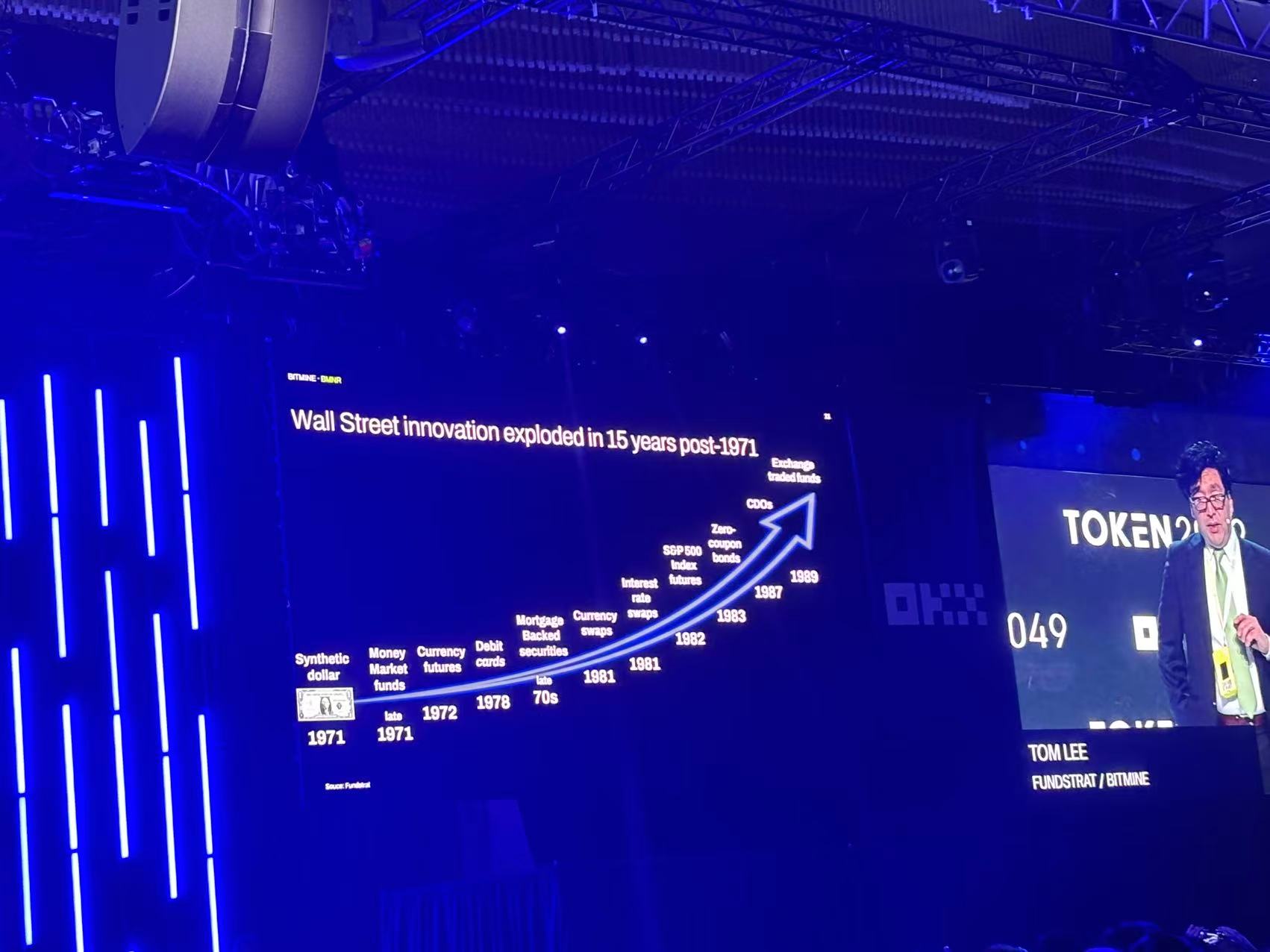
From this “relative return curve,” he quickly zoomed back to 1971: Nixon’s announcement ending the dollar’s convertibility into gold, marking the end of the gold standard. After that, the real opportunity wasn’t simply “going long gold,” but rather the wave of financial engineering unleashed by Wall Street to maintain dollar dominance — money market funds, futures, debit cards, currency and interest rate swaps, index futures, zero-coupon bonds, and more. These tools enabled finance to grow into a dominant sector, with financial institutions making up a significant portion of today’s top 30 global market cap companies.
He used this to make his central argument: 2025 will see another structural moment akin to 1971.
Along this “New 1971 Pathway,” the key variable is “Wall Street × AI × Blockchain.” He believes U.S. regulation and legislation have already laid several foundational elements — including the GENIUS Act setting a framework for stablecoins, the SEC’s “Project Crypto,” and proposals like the “Bitcoin Strategic Reserve Act.”
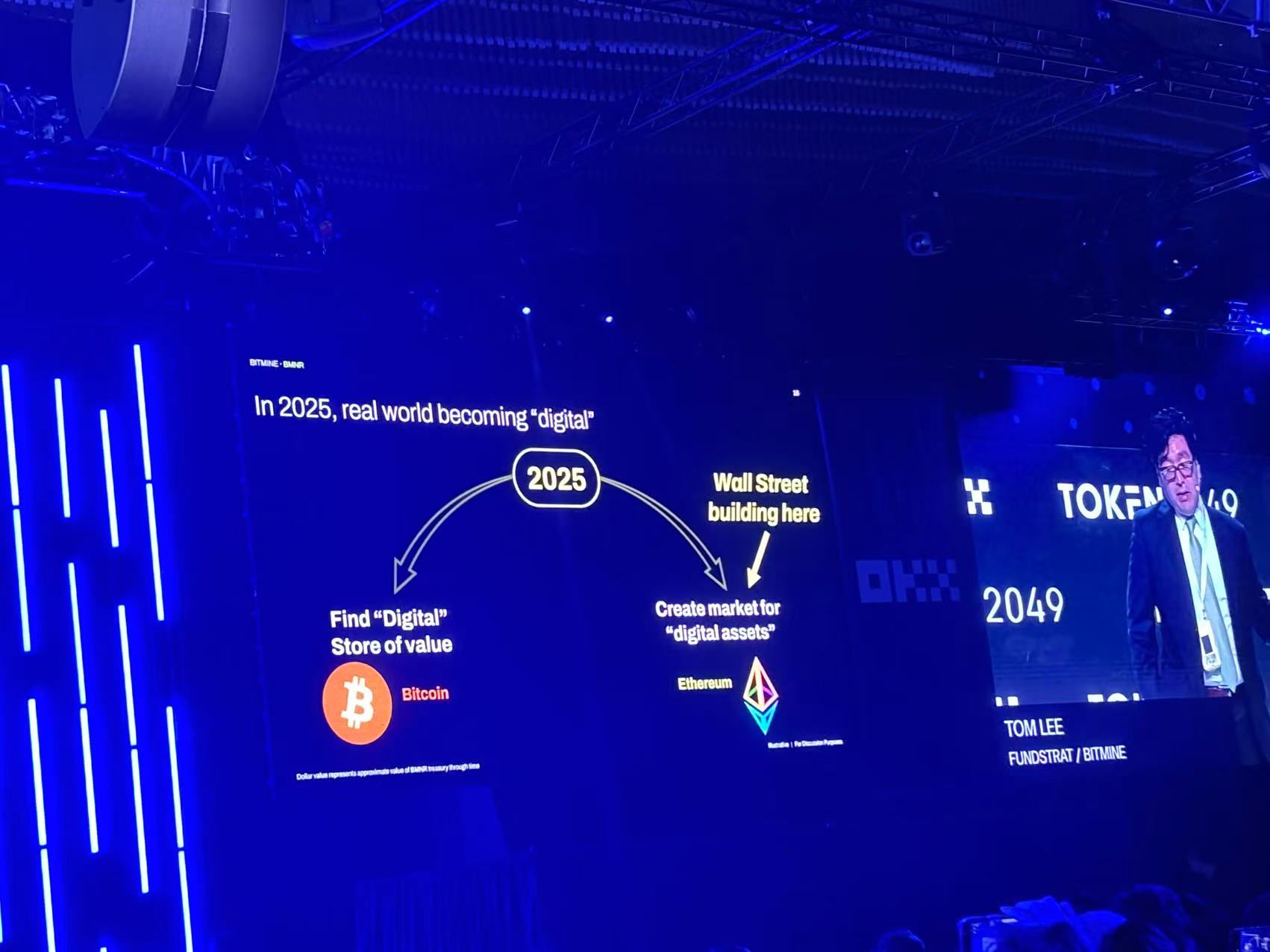
Together, these point toward one goal: using financial engineering to “synthesize” desired returns, then tokenize real-world assets for on-chain circulation. In this context, Bitcoin remains the “OG” digital store of value, but from the “other side of the ledger,” Wall Street will deeply engage to create massive markets for digital assets — with Ethereum standing to benefit the most.
Compared to Gold, Bitcoin Still Has Significant Upside
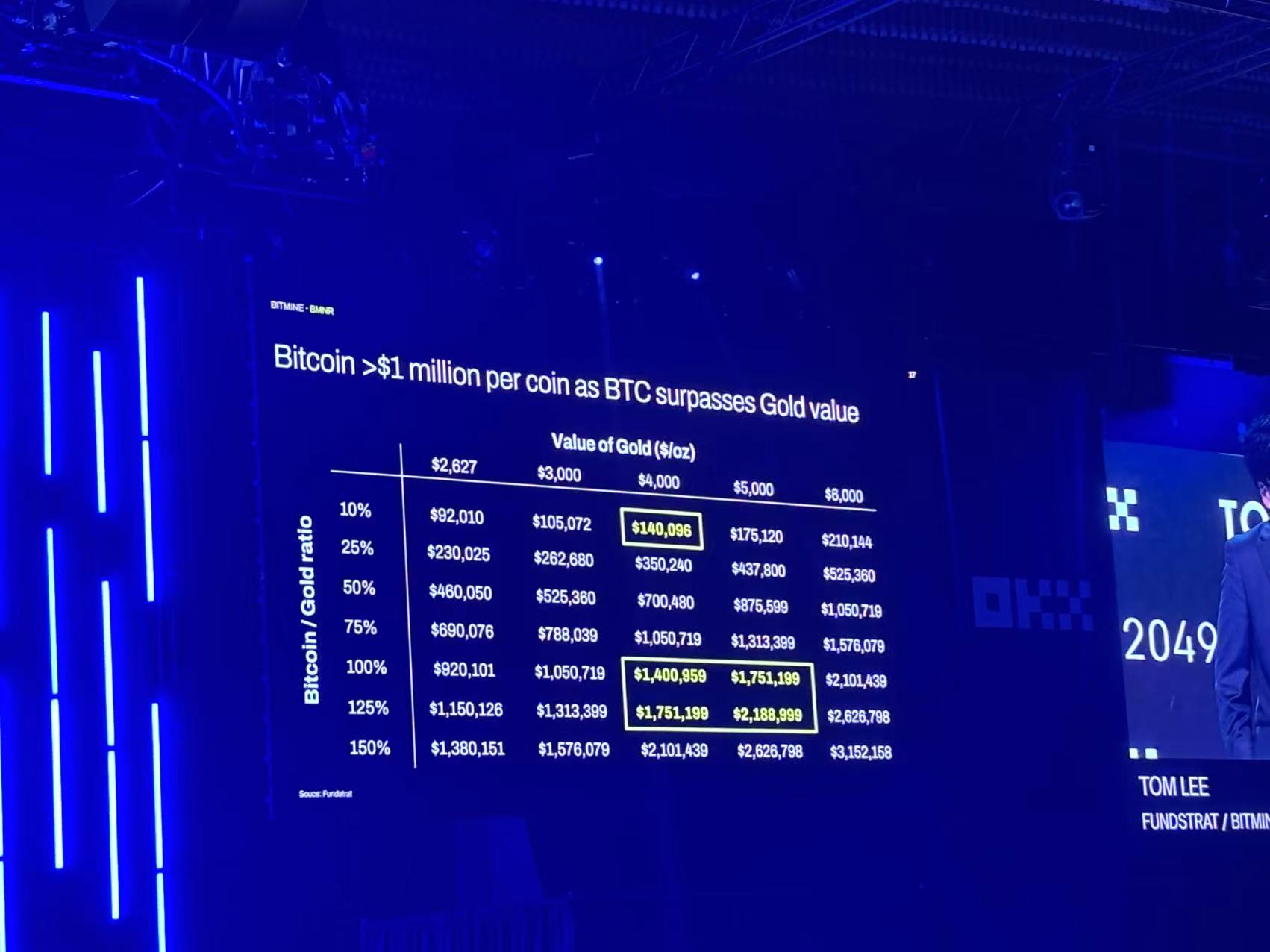
On asset valuation, he first offered a reference frame for Bitcoin: if gold reaches $4,000 (or even $5,000) per ounce, and Bitcoin captures just 10% of gold’s network value, its target price would be around $140,000. But he considers this conservative; if Bitcoin matches or exceeds gold’s share, that implies a range of $1.4 million to $2.2 million per coin. Based on this, he remains bullish on Bitcoin’s current level of ~$110,000.
Yet his primary focus was on how “tokenization will expand from stablecoins to encompass every measurable element of the economy.” In his view, stablecoins are the starting point of “tokenized dollars,” eventually extending to equities, credit, real estate, reputation, and intellectual property. Even more “invisible” metrics will be brought on-chain and monetized — data collection, royalty distribution, memberships and loyalty points, Agent AI, and “Proof of Human,” among others.
Why does the U.S. government care about stablecoins? Lee’s answer mirrors the “dollar defense” post-1971: the dollar accounts for 27% of global GDP, 57% of central bank foreign reserves, and 88% of financial market transactions — while stablecoins are nearly 100% dollar-denominated.
Today’s stablecoin supply is about $280 billion, with some in the Treasury considering potential growth to $4 trillion. If the stablecoin ecosystem collectively holds over $1 trillion in U.S. Treasuries, it could become the “largest holder of U.S. debt globally.” Meanwhile, businesses that “rebuild operations on-chain” gain real economic benefits from improved settlement and process efficiency — a core commercial driver behind tokenization.
He then reinforced the feasibility of “rebuilding Wall Street on-chain” with a comparison of profitability between native blockchain firms and traditional institutions: Take Tether, the stablecoin issuer, valued at $500 billion with about 150 employees — translating to far higher “market cap per employee” than legacy banks. JPMorgan, despite a $869 billion market cap and 317,000 employees, has significantly lower “market value per employee.”
Lee concluded: companies built natively on public blockchains demonstrate superior capital efficiency and profit elasticity.
The Biggest Winner: Institutional Preference for Ethereum
Returning to his identified “biggest winner”: Ethereum. Lee’s logic is that Wall Street needs a “neutral public chain” to build on, and in practice, more and more institutions are choosing Ethereum. He noted Ethereum currently holds about 68% of total value locked (TVL), and TVL has historically acted like a “floor” supporting ETH’s valuation. He also mentioned SWIFT’s recent announcement to test migration on Ethereum’s Layer 2.
On price structure, he sees Ethereum as having undergone an extended consolidation since 2018: peaking in 2021, followed by four years of sideways movement, now attempting a breakout. The current ETH/BTC ratio is around 0.036, versus a long-term average of 0.047 and a 2021 high of 0.087. “2025 is Ethereum’s ‘1971 moment,’” he said, adding that returning to 0.087 is not out of the question.
In scenario modeling, he applied this ratio under the assumption of “Bitcoin reaching $250,000 by year-end”: if the ratio returns to the long-term mean of 0.0479, Ethereum would be ~$12,030; at the 2021 peak of 0.087, ~$22,000; and if Ethereum becomes a primary payment/settlement rail with network value matching Bitcoin’s, that implies ~$62,000.
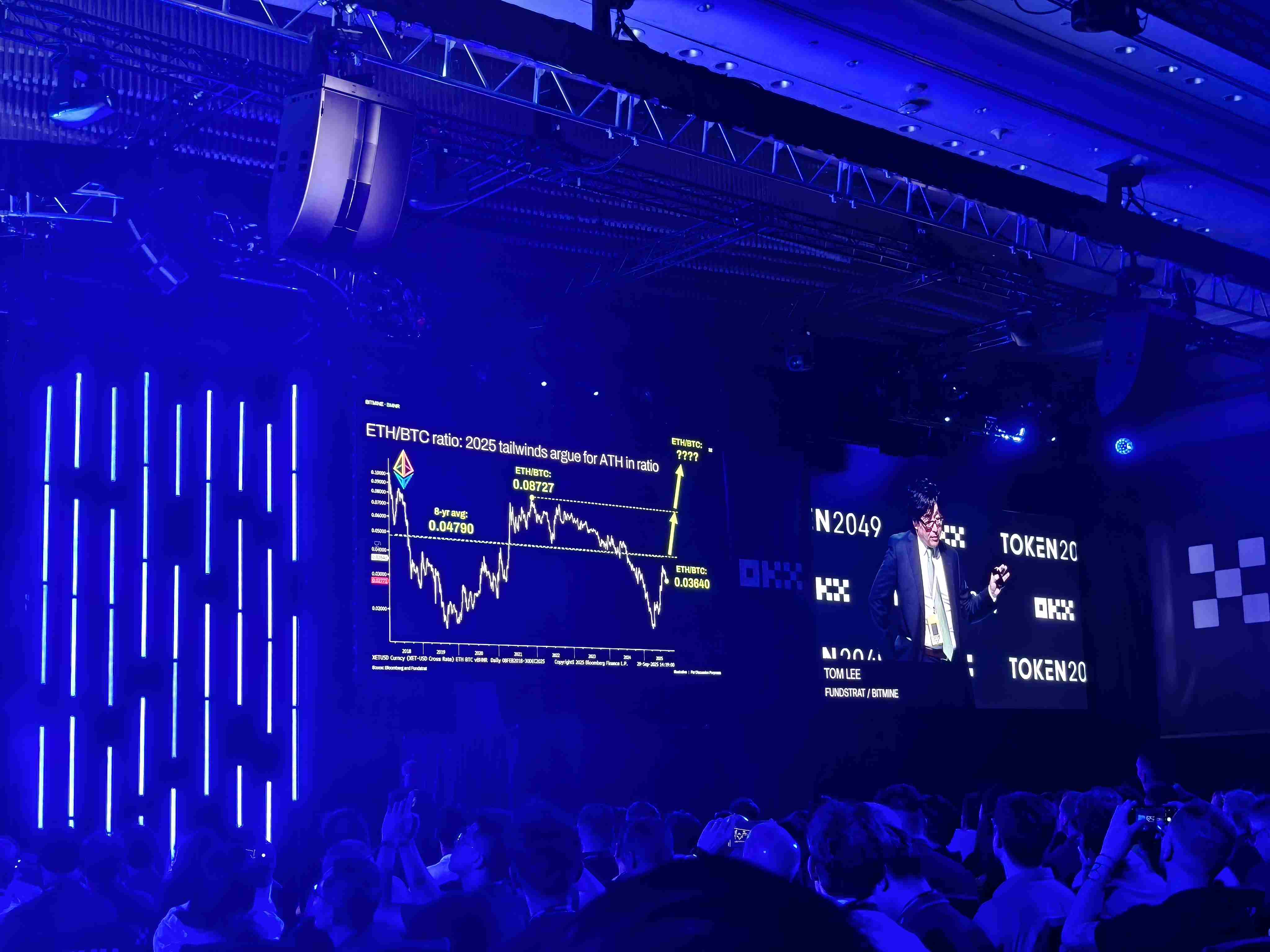
“That’s not the ceiling,” he added. “Overall, we’re even more optimistic about Ethereum.”
To ground the “long Ethereum” investment thesis, Lee turned to the capital markets strategy of “digital asset treasury companies”: using MicroStrategy as a model, which since launching its “equity issuance to buy Bitcoin” five years ago, has seen Bitcoin rise ~10x (from ~$11k to ~$108k), while MSTR stock surged ~25x — significantly outperforming the underlying asset.
Multi-Chain Landscape: Solana and Others Still Have Room to Shine
Following this logic, he detailed the approach of BitMine, where he serves as chairman: calling itself the second-largest Ethereum-holding treasury company globally, raising capital faster than MSTR, with strong liquidity, and increasing its “ETH per share” by about nine times over the past nine weeks. In his vision, such treasury companies do more than just “accumulate”; they become crypto infrastructure players — providing network security through staking, earning yields, and driving “Wall Street–Crypto” integration via ecosystem investments.
During the live Q&A, the first question asked whether “only one chain will survive,” and if Solana still has a chance. Lee replied there’s no need to fall into “single-chain destiny.” Real-world infrastructure and market structures are naturally diverse — so too will be blockchains.
With global GDP at $80 trillion, about half of which is already financial transactions, and adding on-chain royalties and other elements, on-chain economic activity could easily scale to $100 trillion. Putting all of that solely on Ethereum “would send its price to an unimaginable level.” Clearly, the market will leave ample room for other L1s with specialized strengths — Solana and others still have major roles to play. “Don’t be too tribal,” he emphasized. “The pie is big enough.”
How Can DATs Survive Bear Markets?
The second question focused on “how digital asset treasury companies can survive bear markets.” Lee outlined two disciplines: first, maintaining a clean balance sheet — no debt, no complex capital structures, with ample cash buffers to weather downturns; second, continuously increasing “ETH held per share.”
Even if a 12-month winter arrives, as long as the company steadily accumulates intrinsic value per share day after day, even if the stock price drops 50% during the bear market, it may not be lower than today’s level. This method of “continuously增持 core assets on a per-share basis” is, in his view, the fundamental way to withstand cycles.
In closing, Lee returned once more to his opening analogy: 2025 resembles a new 1971. Bitcoin will serve as the reserve and value anchor, while Ethereum becomes the hub of innovation and tokenization. Wall Street will “rebuild finance” on public chains.
This is both his macro outlook and his directional bet as Ethereum’s foremost “bull.”
Join TechFlow official community to stay tuned
Telegram:https://t.me/TechFlowDaily
X (Twitter):https://x.com/TechFlowPost
X (Twitter) EN:https://x.com/BlockFlow_News
 PANews