From crypto to finance, and from finance back to crypto
TechFlow Selected TechFlow Selected
From crypto to finance, and from finance back to crypto
Crypto, fintech, and AI are converging to form a new financial operating system.
 Navigating Web3 tides with focused insights
Author: 0xJeff
Translation: AididiaoJP
Blockchain is a permissionless global rail where people can hold, transfer, buy, lend/borrow, and utilize their assets anywhere in the world and in any way they want.
Holding funds oneself (self-custody), while still maintaining control of those funds when interacting with services or applications.
This contrasts with traditional financial systems, where banks (physical/digital) custody user funds and provide banking services.
The liquidity nature of blockchain rails makes it an ideal setup for institutions seeking to move capital, businesses aiming to expand payment rails via stablecoins, or retail users looking to invest/optimize their assets.
In this article, we will explore the shift from DeFi to fintech and Web2/Web3, the role of AI, transformations within the industry, and the opportunities that follow.
Let’s dive in
Let me tell you about Grab's fintech strategy—Grab being one of Southeast Asia’s most dominant ride-hailing or super app players.
Grab initially launched ride-hailing services in Malaysia with the goal of making taxis safer and more reliable. The platform gained popularity in Malaysia and expanded into the Philippines, Thailand, Singapore, and Vietnam.
Grab didn’t just build a taxi app—it built a trust layer in a region with limited infrastructure and fragmented transportation systems.
Then, Grab expanded its offerings to include private cars, motorbikes, food delivery, package delivery, and an in-app payment system (wallet). All services operate through the same app, driver network, and payment rail, forming a super app ecosystem.
Grab realized that the wallet/payment rail (GrabPay) was the glue—the financial infrastructure connecting everything (users pay for rides and deliveries, store value and transact with merchants; drivers and riders use it to store/spend; financial data and transaction behavior are captured).
This payment infrastructure became the foundation for Grab to partner with lending and insurance startups to offer financial products (small loans, insurance) to drivers.
Today, GrabPay has evolved into a major regional e-wallet with deeper integrations and financial services (more embedded finance, merchant loans, driver loans using in-app credit scoring, partnerships with banks and telcos to deliver financial products).
Grab’s strategy:
-
Build a trusted platform with massive user bases on both demand and supply sides (users, drivers, merchants/suppliers).
-
Connect everything with a payment rail/wallet infrastructure and capture financial and consumption data.
-
Build embedded financial products for the user base based on this data.
-
Grab is now a fintech company, going deeper into finance: savings, investments, insurance, BNPL (buy now, pay later), and digital banking.
From ride-hailing and food delivery to fintech.
Crypto and Fintech
We’re seeing similar strategies like Grab’s emerge across both Web3 projects and Web2 companies—crypto becoming fintech, and fintech becoming more crypto-native.
Why?
The TAM (total addressable market measured by revenue from services/apps) of crypto is tiny compared to fintech, so bringing crypto’s value propositions (DeFi, tokenization, stablecoins, lending/borrowing, yield) to broader consumers makes perfect sense.
Traditional rails still have friction in investing, saving, and accessing banking services—and in many cases, users must trust service providers to hold their funds. Blockchain is the perfect solution to this problem.
Two case studies
EtherFi (Crypto ➔ Fintech)
@ether_fi started in 2023 during @eigenlayer’s restaking season as a liquid restaking provider, offering restaked ETH and composable DeFi vault strategies that deploy eETH, weETH, and stablecoins into DeFi strategies to maximize returns. The team focused on growth strategies around liquidity and composability.
In 2025, EtherFi announced it would shift toward offering bank-like services and fintech features, combining DeFi with everyday financial use cases: spending, saving, earning, bridging crypto and fiat, bill payments, and payroll services.
A key feature enabling mainstream adoption is the Visa cash card, allowing users to spend their crypto directly or use their crypto as collateral to borrow stablecoins for spending (without selling assets). With ~3% cashback, token incentives, Apple Pay/Google Pay support, and non-custodial nature, the card attracted significant users and transaction volume to its platform (and vault products)—more people depositing funds into EtherFi vaults.
EtherFi is positioning itself as a digital bank, bringing DeFi value to ordinary, mainstream users. Who wouldn’t want seamless stablecoin borrowing for spending or earning over 10%+ yield on their stablecoins?
Stripe (Fintech ➔ Crypto)
@stripe began in 2010, providing simplified payment infrastructure for developers and online businesses. Stripe offers merchants clean APIs to accept payments, manage subscriptions, handle fraud, disburse funds, and embed financial services (solving numerous pain points for any merchant).
Over time, Stripe evolved into a full-stack financial infrastructure platform, offering modular APIs and products that allow any company to build, embed, and scale financial services without becoming a bank.
-
Stripe Connect: Enables marketplaces to pay third-party sellers, drivers, creators globally, handling complex KYC and compliance in the background.
-
Stripe Billing: Automated subscription system/backbone for SaaS.
-
Stripe Treasury: Embedded finance (fund storage, banking services).
-
Stripe Issuing: Instant creation and management of physical or virtual cards.
-
Stripe Radar: Integrated machine learning-driven fraud detection.
Stripe tested crypto rails and acquired key infrastructure players—acquiring Bridge (stablecoin payment infrastructure) and Privy (crypto wallet/onboarding infrastructure)—then announced a full push into building its own blockchain via a payments-first L1 (Tempo).
Stripe aims to become the foundational layer for next-generation global payments, unifying fiat, stablecoins, and on-chain rails under a single developer platform—programmable, borderless money.
What does all this mean?
Beyond these two players, many others are stepping in to claim a share.
This essentially means DeFi and TradFi, Web2 rails and Web3 rails, are converging—blockchain is becoming the backbone infrastructure powering real-world economies.
DeFi TVL could grow tenfold from $174 billion to $1.74 trillion in the next five years. Wealth management holds $140 trillion—allocating ~1% to DeFi seems highly plausible.
Stablecoins may ultimately power consumer apps and platforms behind the scenes while delivering yield to users.
Spot, perpetual contracts, and prediction markets are becoming more mainstream, as the value proposition of trading crypto, tokenized stocks, on-chain commodities, and any asset (events, politics, macro, Taylor Swift) is enormous. Every company wants access to these user bases.
Due to industry convergence, enterprise sales and strategies targeting average retail users will become essential.
Crypto “projects” will need to become “startups.” Less geeky hype, more professionalism—and trust-building will be critical.
Builders must sell DeFi platforms to enterprises, integrating DeFi vault products into fintech apps or wealth management platforms. Enterprise sales teams will be needed, understanding how to sell to them—risk, compliance, and security will be key in their decision-making.
We’re already seeing early examples—crypto-native teams expanding far beyond CT.
-
@Polymarket received investment from the parent company of the New York Stock Exchange (valuing Polymarket at $9 billion), expanding prediction markets into TradFi and laying the foundation for the entire prediction market industry.
-
@flock_io partners with governments, banks, international institutions, and public companies to deliver privacy-preserving, domain-specific AI. Flock’s dedicated team is tackling traditional industries/capital markets.
-
@pendle_fi focuses on bringing TradFi/Wall Street onto on-chain interest rate products—KYC-based, permissioned pools.
-
@Mantle_Official launched UR Global digital bank—“the world’s first blockchain-based digital bank.” Unified multi-asset accounts (via Swiss-backed IBAN), Mastercard debit card with SWIFT, SEPA, SIC, and L1/L2 support for easy on/off ramps, self-custody, and upcoming DeFi integration (yield on idle balances, Mantle-native DeFi products).
-
@useTria started as BestPath—an AI-optimized solver network finding optimal swap paths across EVM, SVM, and other VMs (already integrated Sentient, Talus, Polygon, and Arbitrum Orbit chains). Tria has expanded into digital banking/fintech services, starting with a cash card (users earn yield on assets and can directly spend altcoins).
Exchanges are building embedded finance within on-chain wallets, acting as discovery layers for all things DeFi (and soon TradFi), such as OKX Wallet, Binance Wallet, etc.
More crypto teams are launching crypto cards.
It seems @CelsiusNetwork was originally on the right track—delivering native yield on Bitcoin, ETH, and stablecoins, offering services like deposit yields, mortgages, payments, and debit cards. The vision was correct, but failed due to poor execution, risk management, and lack of transparency.
How does Web3 AI fit in?
For simplicity, three main aspects:
-
Getting tasks done
-
Ensuring you can trust the AI doing the task
-
Finding talent to make the AI do the task
Getting tasks done
Since crypto is primarily financial use cases, AI systems enhancing DeFi, prediction, and trading experiences are the primary use cases Web3 AI builders are focusing on.
-
Trading agents, AI-driven dynamic DeFi strategies, personalized DeFi agents—e.g., @Cod3xOrg, @Almanak, @gizatechxyz
-
Prediction AI/ML teams forecasting asset prices, outcomes, weather, etc.—e.g., @sportstensor, @SynthdataCo, @sire_agent
AI and ML systems are being built atop existing crypto verticals (mainly DeFi) to improve accessibility, reduce complexity, and enhance yield and risk management.
Ensuring you can trust the AI doing the task
You can’t blindly trust AI—just like you can’t trust anyone. You also can’t trust the infrastructure and people behind the AI. So who do you trust?
Yourself. You verify everything.
This is where verifiable infrastructure comes in.
Ethereum ERC-8004 acts as a trust layer—the AI’s passport + Google’s AP2 + Coinbase x402 serves as the payment system/rail (stablecoins and traditional rails), enabling agents to transact with each other or with Web2 services.
Like AWS cloud, @eigenlayer is providing verifiable cloud infrastructure for everything. Instead of hosting/running everything on centralized servers, Eigen enables off-chain computation with on-chain verification of results/inference.
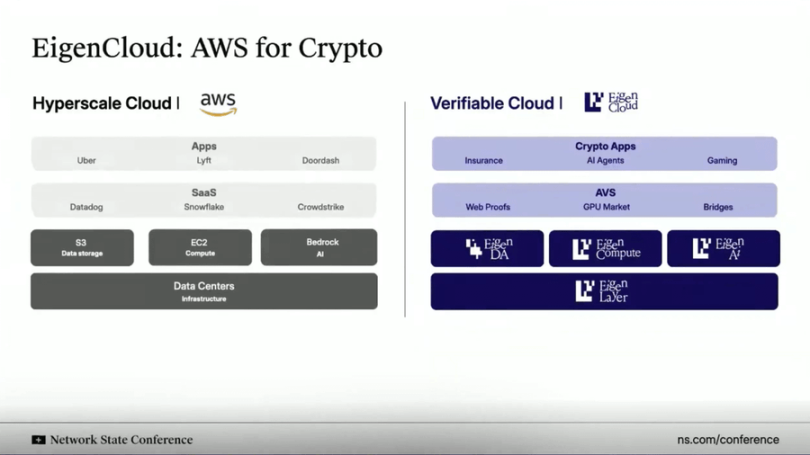
This solution (EigenAI and EigenCompute) fits perfectly for AI agent/application use cases like trading agents and DeFi applications.
Eigen has a primitive called deterministic inference, ensuring LLMs produce identical outputs for identical inputs upon repeated execution—ensuring they don’t hallucinate, i.e., they become deterministic.
Just as restaked ETH secures smart contracts, EIGEN secures/proves AI agents/applications. Anyone can re-run the exact same inference to verify it and check if outputs match.
This ensures:
(i) Trading agents won’t go rogue;
(ii) Recommendation engines on social media remain consistent/immutable;
(iii) Autonomous agents can safely hold funds since their reasoning can be audited/verified.
Finding talent to make AI do the task
AI/ML engineers are among the most sought-after resources. If you're truly good, you’ll be poached by centralized frontier AI labs. If you’re exceptionally good, you’ll start your own.
Or you can choose to join a Darwinian AI ecosystem.
These ecosystems offer KPI-based incentives to “miners,” “trainers”—those running AI or ML models to contribute/solve specific tasks. If your output is good and aligned with goals, you earn substantial rewards.
Bittensor and @flock_io are two of the most well-known Darwinian AI ecosystems, where miners or trainers can earn six to seven figures annually based on performance or stake within the ecosystem.
The goal of Darwinian AI ecosystems is to attract talent through incentives, form active developer communities contributing to specific tasks, and ultimately reach a stage where revenue generated exceeds incentive costs.
Prediction models on Bittensor subnets outperform market benchmarks, or Flock delivers privacy-preserving, domain-specific AI use cases to large institutions and governments like UNDP and Hong Kong.
Tying it all together
Crypto, fintech, and AI are converging to form a new financial operating system.
At its core is infrastructure convergence.
Crypto rails are becoming the programmable, borderless settlement layer of the internet.
Fintech is providing the UX, compliance, and trust layer required for mainstream adoption.
AI is becoming the decision-making and automation layer optimizing liquidity, personalization, and user experience.
Stablecoins become the direct layer powering consumer apps, on-chain identity + verifiable computation underpinning trust between AI agents/applications, traditional institutions and fintech integrate DeFi to unlock new yield opportunities, and millions of new users gain direct ownership, transparency, and global access to capital and intelligence.
Join TechFlow official community to stay tuned
Telegram:https://t.me/TechFlowDaily
X (Twitter):https://x.com/TechFlowPost
X (Twitter) EN:https://x.com/BlockFlow_News