








Post-Disaster Recovery Guide: Finding the 1% of Tokens That Can Survive in the Market
TechFlow Selected TechFlow Selected
Post-Disaster Recovery Guide: Finding the 1% of Tokens That Can Survive in the Market
Stories come and go, but the ecosystem endures.
 Navigating Web3 tides with focused insights
Author: MΞRCY DΞ GRΞAT
Compiled by: TechFlow
Most of the tokens I once believed in and bought no longer exist from the previous cycle.
Each crypto cycle births thousands of tokens, each claiming to bring disruptive change. But when the bull market recedes, only a few survive.
By the next cycle, most tokens are dead: charts turn flat, Discord communities fall silent, and teams vanish without a trace.
What actually happened?
The truth is simple: Tokens die because they never move beyond the stage of "speculation."
They are born fast, grow quickly, and die even faster.
But tokens that build ecosystems become permanent.
The harsh reality is, you can't live without them.
The Death Trap of Most Tokens
Most tokens don’t die from lack of hype—they die from lack of an economy.
Their launches are typically plagued by:
-
No native demand drivers;
-
No token burn mechanisms;
-
No identity or user retention systems;
-
No real reason for users to stay after rewards end.
Every cycle follows the same pattern: "Develop → Dump → Exit → Desert".
Liquidity mining attracts "mercenaries," not "citizens";
Points and airdrops attract "hunters," not "believers".
When incentives stop, the community stops.
The brutal truth is: You cannot build an economy on fleeting greed.
Three Pillars of Token Survival
The difference between a dying token and a thriving ecosystem boils down to three core layers:
→ Incentive loops;
→ User retention;
→ Real economic layers.
Let’s dive deeper.
-
Incentive Loops: The Internal Engine of Survival
Incentive loops are the core engine of a sustainable ecosystem.
They create feedback cycles: user participation → network growth → increased token utility → driven demand → more users.
When well-designed, value compounds naturally. For example:
-
GMX rewards stakers with traders' actual earnings, tightly aligning users with protocol growth;
-
Berachain links liquidity provision directly to consensus, creating a self-reinforcing "proof-of-liquidity" loop;
-
Ronin allows players to earn, spend, and reinvest, turning gamers into micro-economies.
Enduring tokens don’t just "reward holders"—they turn users into part of the ecosystem's engine.
Every user action strengthens the entire ecosystem, not just the token price.
-
User Retention: Turning "Farming" into "Citizenship"
This is where most projects fail.
They confuse user acquisition with user retention.
They can attract people with rewards, but can’t make them stay.
The 1% that survive understand a deeper truth: People don’t stay for yields—they stay for identity.
When a protocol gives users a sense of belonging, status, or reputation, it transforms from a "platform" into a "nation." For example:
-
idOS is building cross-ecosystem identity infrastructure;
-
Base turns developers into citizens through culture and recognition;
-
Friend.tech shows how reputation, social status, and emotional belonging create massive on-chain stickiness.
The strongest retention systems aren’t based on farming—they’re based on belonging.
Your users should feel like they’d lose a part of themselves if they left.
That’s when you’ve built a real network.
-
Real Economic Layers: Where Tokens Gain Meaning
Speculation creates attention, utility creates gravity.
When tokens integrate into real economic layers, they cease to be chips—and become coordination currencies.
This is where the 1% truly stand out:
-
Solana’s meme coins and payment systems create a self-sustaining user economy;
-
Arbitrum’s DAO funding cycles nurture builders, not beggars;
-
BNB becomes a passport for trading, gas fees, and launching projects.
These economic layers connect: Speculation → Utility → Coordination → Sustainability.
When tokens can transfer value, access networks, manage funds, and support payments, they’re no longer just projects—they become "nations" with economies.
Lifecycle of a Long-Lived Token
Let’s visualize this process:
-
Narrative Phase: Token launches with a clear story;
-
Utility Phase: Early users don’t just trade the token—they actually use it;
-
Retention Phase: Community forms loops around the token (staking, governance, identity);
-
Expansion Phase: Ecosystem begins generating demand for new projects, integrations, or use cases.
At this point, the token no longer depends on hype to survive—it becomes self-sustaining.
The 99% Death Spiral
The other 99% of tokens follow this death path:
Hype launch → Everyone rushes in;
No utility → Token becomes pure speculation;
Liquidity exits → Holders dump, whales move;
Community dies → Silence; Token fades → Next narrative replaces it.
Their charts all look the same: one peak, followed by endless decline.
This isn’t bad luck—it’s poor design.
Action Guide for the 1%
Here’s the framework every founder and investor should memorize:
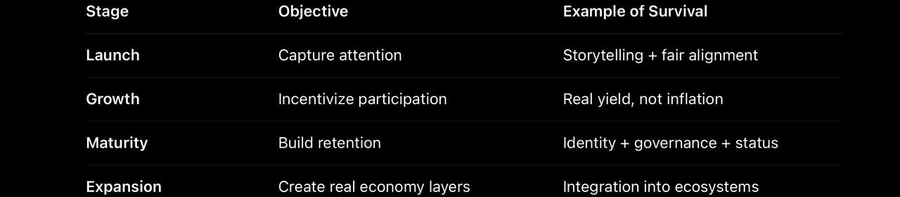
Stage: Launch → Growth → Maturity → Expansion
Goal: Attract attention → Incentivize participation → Build retention → Create real economy
Survival keys: Storytelling + fair alignment → Real yield, not inflation → Identity + governance + status → Integration into ecosystem
Summary
Each cycle eliminates the weak and elevates the strong.
Narratives come and go—ecosystems endure.
Here are data on emerging bullish trends for tokens to watch.
Join TechFlow official community to stay tuned
Telegram:https://t.me/TechFlowDaily
X (Twitter):https://x.com/TechFlowPost
X (Twitter) EN:https://x.com/BlockFlow_News
 @MercyDeGreat


