Exclusive Interview with a Blockchain Enthusiast: How an Ordinary Person Can Profit from Airdrops in the Crypto World?
TechFlow Selected TechFlow Selected
Exclusive Interview with a Blockchain Enthusiast: How an Ordinary Person Can Profit from Airdrops in the Crypto World?
Professionalized crypto farming is not just a game of luck, but a comprehensive test of information acquisition, risk management, and execution capability.
 Navigating Web3 tides with focused insights
Author: TechFlow
On September 17, 2025, $Aster's TGE launched, officially going live on Binance Alpha. CZ publicly promoted it on X, and within 24 hours, $Aster’s price surged to a peak of 1650%, with trading volume reaching $310 million and the platform’s total trading volume exceeding $1.5 billion.
After the airdrop distribution, prices continued to climb. The current $Aster price is stable around $2.10, with a 7-day gain surpassing 2000%.
As the $Aster TGE reignited the entire market, many KOLs热议ed it as the "largest farming event in history," with not a few achieving seven-figure returns on a single token.
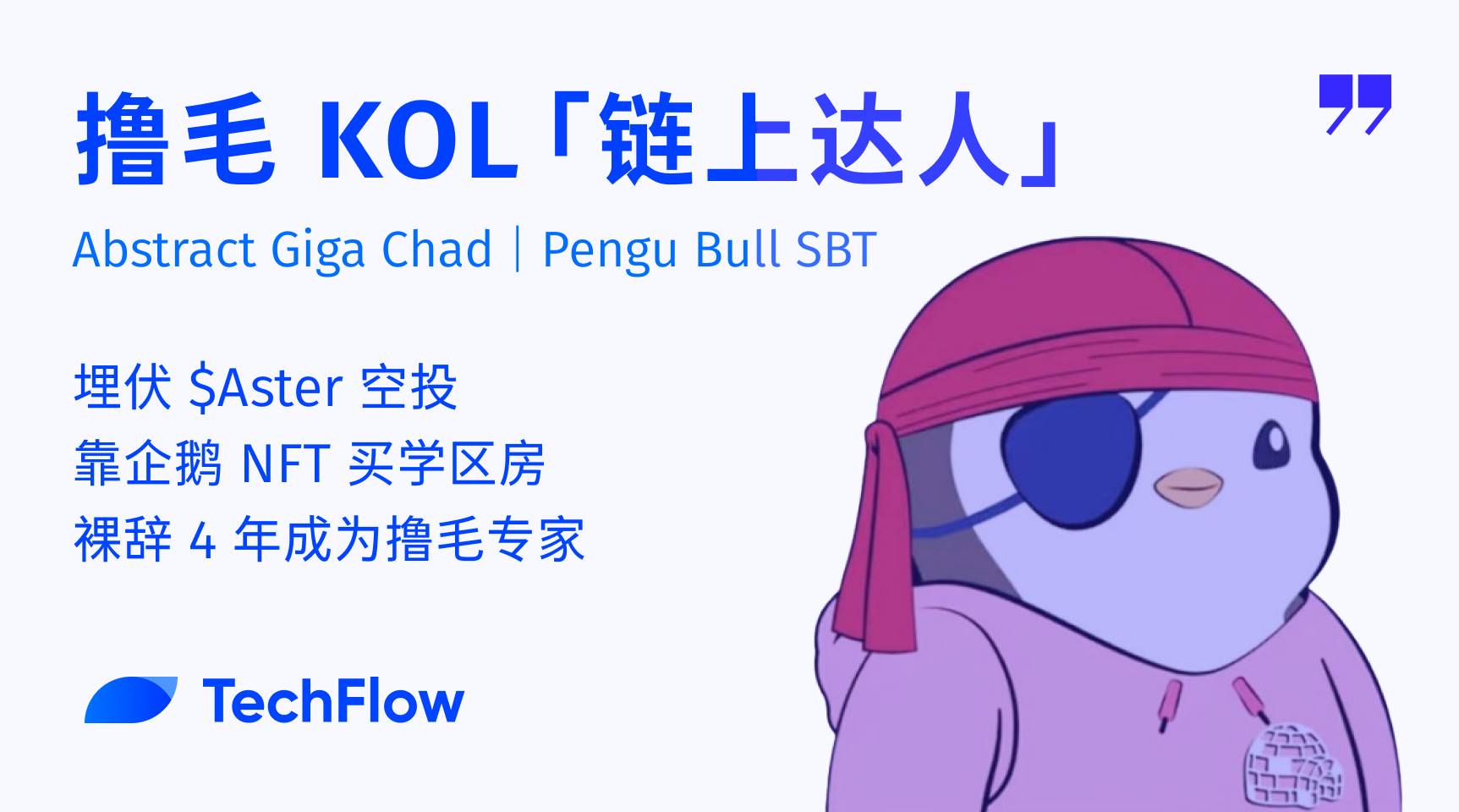
Crypto farming KOL literature @wenxue600 (On-chain Expert) also achieved impressive results—regretting selling 98,000 $Aster tokens at 0.11 U—but this move still brought him substantial returns.
Even more striking was his investment legend on Pudgy Penguins: in 2021, he bought one penguin NFT for 0.7 ETH (about 2800 U), then earned unexpectedly high returns through various external project airdrops. In an interview, Literature mentioned, "I used the money from these airdrops to buy a school district house—it really gives me a tremendous sense of achievement."
From entering the crypto space in 2018 after Xu Xiaoping’s call to “embrace blockchain,” to quitting his job in late 2021 to become a full-time farming blogger, Literature has witnessed the industry’s complete evolution—from frenzy to calmness, from simplicity to complexity. In this highly speculative niche sector, he has spent over three years proving one thing: professionalized farming is not just a game of luck, but a comprehensive test of information acquisition, risk management, and execution capability.
Now, as more and more studios flood into the farming scene and retail investors’ survival space shrinks, how did this KOL, who transitioned from traditional media, achieve results? How does he view industry changes? And how does he filter truly valuable opportunities among countless projects?
Key Takeaways
-
Transition from venture capital media to farming blogger: The best way to enter an industry is still through media. After hitting a career bottleneck at an exchange, he spotted a market gap due to the scarcity of high-quality overseas content creators and decided to quit and launch his own media channel.
-
Fat Penguin investment legend: In 2021, he bought a Fat Penguin NFT for 0.7 ETH (2800 U) simply because he liked it and held it. Later, through various external airdrops, he earned 70,000–80,000 U in returns, directly using airdrop proceeds to buy a school district home—a deeply satisfying achievement.
-
Rational exit from the $Aster project: His expected price was 0.1 U; earning 10x return (e.g., acquiring 2,000 tokens at a cost of 20 U and selling at 0.1 U for 200 U) was already great. Missing out doesn’t bother him—farming mindset is about quickly securing gains, cashing out, and moving to the next project.
-
Multidimensional due diligence for project screening: Evaluate based on sector热度, funding amount, investor background, and team origins. Blindly follow projects exclusively funded by Binance; Western funds are better than domestic Chinese ones; most wary of Indian and Chinese teams.
-
Biggest change in the farming space: The most obvious shift is increasing competition—large players dilute small retail scores. But farming will persist long-term because projects need users and users seek returns—a lasting supply-demand relationship. Projects, exchanges, VCs, and farmers engage in mutual博弈 yet symbiotic coexistence, all indispensable.
-
Retail survival strategy: Recommend diversified approaches—farm interactions yourself, contribute to communities, and convert output into other roles. Solo farming is dead; professional team collaboration is now mainstream.
-
Lessons from BTC ecosystem: Participated in numerous inscriptions, runes, and assets, hoping to strike it rich, but most went to zero. Emotional assets have a 99.9% chance of collapsing—set expectations and take profits timely.
-
The importance of mindset management: No one is perfect—no one can always sell at the top, not even Buffett. What matters is meeting your own expectations and building multiple sources of fulfillment.
-
Future directions I favor: More bullish on StandX in the Perp DEX space—founded by former Binance and OKX team members—with bigger early-stage opportunities. Most excited about Abstract Chain (Pudgy Penguins’ L2), whose mechanics resist mass farming by studios. Pudgy Penguins’ parent company may list on US markets, and its ETF application could be approved.
-
Satisfaction as a farming blogger: Greatest satisfaction isn’t personal gains, but receiving gratitude from fans who profited from my project discoveries and tutorials—an indescribable feeling.
Leaving Internet Industry, Quitting Exchange, Entering Farming Space
TechFlow: How did you enter the crypto industry?
On-chain Expert: I previously worked in traditional internet as a venture capital media reporter during 2016–2017, when startups were booming—bike-sharing, O2O, B2B, B2C models were all hot.
In early 2018, Xu Xiaoping’s message in a founder group went viral, urging everyone to embrace blockchain, saying things like “those who follow prosper, those who resist perish.”
I was already in VC media and had encountered some blockchain projects, so from that point on, I started seriously learning about it. I realized compared to traditional internet sectors, blockchain offers far greater opportunities. During 2017–2018, ICOs grew wildly, and many people got rich overnight.
At the time, I thought the best way to enter an industry is through media.
In mid-2018, I joined a leading crypto media outlet, learning everything from scratch—blockchain concepts, technologies—and researching while producing content.
During my media tenure, I experienced major industry events: EOS mainnet launch in 2018, DeFi yield farming, Bitcoin halving, BCH fork, exchange wars, etc. Although the market wasn’t strong, the industry was incredibly vibrant.
Two years in media gave me deep insight into the entire sector, but as you know, media jobs pay little despite heavy workload (laughs). I identified two promising paths: one was joining a VC firm to get direct access to projects and insider info; the other was joining an exchange. Both are near the top of the industry.
Later, I joined a top-tier exchange, mainly doing copywriting. But after some time there, I hit a clear career bottleneck.
First, as a newcomer, rapid promotion in a large exchange is difficult and slow. Copywriting isn’t core business, so it felt like “seeing my whole future laid out.” I realized that if I wanted big results in this industry, I couldn’t progress step-by-step.
Second, I enjoy exploring new things. During the first wave of DeFi Summer in 2021, most in the marketing department didn’t even have wallets, didn’t participate in mining, and didn’t understand LP impermanent loss. I found the information flow too isolated, though there were actually many opportunities in the industry.
The third catalyst was spotting an industry pain point. In 2021, China tightened regulations, leading to bans on major financial bloggers who then moved from Weibo to Twitter. However, high-quality overseas content creators were scarce. We had budgets but no suitable channels to spend them. I joked with colleagues, “Why don’t we just do it ourselves?”
That year, my child was born, and I wanted to spend more time with family. Given the favorable market conditions, I asked myself: “Should I go independent and start something?”
TechFlow: After resigning, how did you enter the farming space?
On-chain Expert: When I quit in late 2021, I had experienced early airdrops like Uniswap, but there wasn’t yet a dedicated “farming” concept—it was more about being an active on-chain participant. At the time, I only knew I wanted to do自媒体, but not exactly what.
Back then, GameFi was hot. I deeply engaged in the Wolf Game community, acting like a news anchor—posting updates instantly, chatting and attending meetings in the community. Since my own assets were involved, I was super motivated. That’s how I gained my first batch of followers.
After GameFi cooled down, I turned to overseas channels. Using nighttime baby-feeding breaks to browse Twitter, I translated Vitalik’s articles and foreign research reports immediately and posted them on WeChat. Coming from media, I understood the value of “original + first release.” Some viral posts published at night led to white-list requests from other media outlets the next day.
In 2021, Chinese Twitter users were rare, and almost no bloggers focused on farming info—top influencers mostly covered secondary markets. Later, I moved from WeChat to Twitter, sharing “wealth code” content like NFT whitelists and ways to join funding rounds. With just a few thousand followers, each “wealth code” tweet reached tens of thousands of views, showing me this was a blue ocean market.
After that, I focused on farming, participating in projects like Arbitrum, and gradually built my audience with endorsements from top farming KOLs.
Investment Review: Sold $Aster Early, But I Don’t Regret It
TechFlow: Can you share your experience and results with the $Aster project?
On-chain Expert: My gains from $Aster were quite good. My main account received 98,000 tokens, and my side accounts about 1,500–2,000. At peak value, it was worth $200K, but I sold too early.
I actually knew about this project early because a VC friend introduced it to me, and I was aware of its ties to Binance. I even had a chance to join the private sale, but since the allocation wasn’t as much as I hoped, I refused out of frustration—truly missed out (laughs).
Since I didn’t invest, I could only join their activities. There were two parts: depositing funds to earn deposit points and trading to earn transaction points. Because I understood the project well, I started depositing early and kept it up, then stopped paying attention after depositing, just waiting for the airdrop.
TechFlow: Were there any key operational milestones?
On-chain Expert: Two key tips. First, they ran a referral campaign targeting only new users, with thresholds of 10K, 100K, and 1M U in trading volume to unlock corresponding points. After evaluating, I found this activity extremely cost-effective—much more profitable for new users than existing ones.
To be honest, existing users protested, but protests mean it hurt their interests, so new users should definitely rush in. I shared the full analysis on Twitter, with the strategy being to farm 100 accounts, each hitting 100K in volume, and reminded others in the group chat.
The second key tip: after the event ended, I advised everyone to stay active, as loyalty rewards might come. Sure enough, I guessed right—the airdrop included extra rewards for those who kept trading post-event, guaranteeing several hundred per account, up to nearly 1,000.
TechFlow: What were your profit expectations for this project? Do you regret selling early?
On-chain Expert: Yes, I expected the price to be 0.1 U—0.5 U would’ve been beyond expectation. Based on our cost, getting 2,000 tokens for ~20 U meant 200 U at 0.1 U—a 10x return, which is already excellent for farming.
I learned the private round valuation was $200M; at 0.1 U, that’s an $800M market cap, which seemed reasonable. I didn’t expect it to keep rising past 0.5 U, but I’d already sold.
No real regret about selling early, since I met my target. Our farming mindset differs from secondary market traders. Farming is about quickly securing results, cashing out, and moving to the next project—rolling capital forward. Secondary market players often focus on long-term holds because they entered later; with large capital, buying tens of thousands means doubling yields huge returns.
TechFlow: Due to $Aster’s surge, many now focus on the perps DEX sector. What’s your take?
On-chain Expert: The whole sector is heating up, so participation is necessary, but replicating $Aster’s straightforward massive gains will likely be very hard now.
I’m currently farming several popular projects, but expectations are lower than for $Aster. Competition is too fierce now—many large players trade constantly, diluting small retail scores. Joining now is already late unless you’re willing to put in multiples more effort—otherwise, big gains are unlikely.
In contrast, I’m more bullish on StandX, founded by ex-Binance staff. This project is still very early—currently only allowing deposits, providing liquidity (LP), or swapping. The derivatives product hasn’t launched yet and won’t before October.
So everyone starts from the same line when contracts launch—then farm aggressively. Early projects offer bigger opportunities.
Farmers don’t care much about a sector’s long-term future. Our thinking is practical: either invest time and effort, or invest money early, and get decent returns at token launch.
Whether the sector or project is good—most farmers honestly don’t care (laughs). Earning money within my knowledge and ability is fine. Big picture stuff doesn’t concern me—I just follow the rhythm to make money.
TechFlow: What’s your most memorable or successful farming experience?
On-chain Expert: Definitely Fat Penguins (Pudgy Penguins)—this counts as both farming and investing.
I started following NFTs at the end of 2021 when they were hot—Fat Penguins, Bored Apes, and many celebrity projects emerged.
I loved Fat Penguins from the start but missed the mint, so I had to buy on the secondary market.
They launched explosively, quickly jumping to several ETH. Back then ETH was expensive—$3K–$4K each—so it was pricey.
I didn’t buy immediately but kept watching. Then one day I saw it drop below 1 ETH, so at 0.7 ETH I started buying heavily. Just because I liked it, I held without selling—even if it went to zero, I thought it looked cool.
Never imagined the returns would be so big.
When I bought, the penguin community was chaotic. The first team performed poorly, causing community splits and scandals, looking for someone to take over. Then Luca Netz took charge, and the project stabilized and began rising.
It kept growing even in bear markets, and later launching a token was completely unexpected. Simply holding allowed me to catch this series of lucky breaks.
Later, Fat Penguins received many project airdrops—one penguin’s external airdrops alone were estimated at $70K–$80K. After issuing their own token, holders got generous airdrops—truly unprecedented.
Only Apes might compare, but for Fat Penguins to achieve this in last year’s market is already amazing. I directly used these airdrop earnings to buy a school district home for my child—truly a huge sense of achievement.
TechFlow: Conversely, any particularly regretful farming experiences? What lessons did you learn from failures?
On-chain Expert: The biggest regret is the BTC ecosystem. I participated in many inscriptions, runes, mini-cards—basically every hot asset I held significant amounts.
The BTC ecosystem was crazy back then—assets could multiply many times on launch day. I fantasized about getting rich off these holdings.
But the boom faded fast. On the downturn, I hesitated to cut losses, and eventually most assets went to zero. The losses were massive—so much I don’t even want to calculate.
To me, trading must have boundaries. Believe that 99.9% of emotional assets will eventually collapse. Only rare exceptions survive—don’t imagine your inscription is the next ORDI. Anything called “the next” usually fails.
Once I understood this, I set profit targets—e.g., once I earn X, I exit. If I want to speculate further, I keep a portion, but never aim to get rich overnight—that’s nearly impossible.
Multidimensional Due Diligence, Stay Calm-Minded
TechFlow: Facing the flood of new projects, how do you filter those worth watching?
On-chain Expert: It’s similar to VC due diligence—I evaluate from multiple dimensions.
First, assess the sector: either currently hot or with strong future potential. Then check funding amount—higher funding suggests greater necessity to participate.
Investors matter too—I look at two aspects: one, their past investment track record—if they backed successful projects, they’re worth following; two, institutional background—Western funds vs. domestic Chinese funds. Western funds take priority, as Chinese VCs and projects frequently rug-pull.
Team background also matters—Indian and Chinese teams currently have the worst reputation.
For example, $Aster’s biggest draw was Binance. From the earliest stage, it was a key project supported by Binance. Given Binance’s undisputed leadership, blindly following its supported projects makes sense.
But caution is needed—Binance Labs invests in many projects, but they differ. Some are exclusively funded by Binance, others have Binance as just one participant—the value differs. Projects solely funded by Binance carry stronger strategic intent, and full backing by Binance opens future possibilities.
TechFlow: What channels do you use to gather quality project info and conduct due diligence?
On-chain Expert: As a web-based blogger, the accounts you follow form your database from day one. I follow exchange founders, VC firms, project teams—these provide first-hand information. Twitter delivers the absolute freshest news.
For funding data, I often use Chain Catcher and RootData. RootData fits Chinese users best, with comprehensive and timely coverage—perfect for beginners.
For project materials, AI search now covers everything. I usually use Grok, input the project’s Twitter ID, and find whatever I need—sufficient for farming decisions.
Farming Will Persist—Retail Must Diversify
TechFlow: What noticeable changes have occurred in the farming space in recent years? Will farming exist long-term?
On-chain Expert: The most obvious change is increasing competition. In the past, casual participation yielded solid returns. Now, it demands more strategy, earlier positioning, and systematic execution.
More large players are entering, using big capital to dilute small retail scores. So to earn good returns now, you must either act earlier or study and execute more diligently than others.
But I believe farming will persist because projects need users and users seek returns—a lasting supply-demand dynamic. Only the mechanics will grow more complex and entry barriers higher.
Projects, exchanges, VCs, and farmers are in mutual博弈 yet symbiotic coexistence—none can be missing.
TechFlow: Any farming advice for retail investors?
On-chain Expert: My advice is to diversify.
I’m a good example: initially, I farmed on-chain activities while contributing to communities. For instance, after discovering a project, I’d continuously produce and share follow-up content in community channels.
After posting enough, I’d approach the project team: “I’ve been consistently contributing—would you give me a senior role? Let’s collaborate long-term.” Later, such roles often come with airdrops.
The ideal state is farming a project while simultaneously producing content, converting that output into other roles—not just mindlessly farming interactions or lurking in communities.
If you farm well, it’s easy to grow your account from zero to one and build a personal IP.
For a farming blogger, the greatest satisfaction isn’t personal gains, but receiving thanks from fans who profited from your project finds and tutorials—this feeling is indescribable.
TechFlow: Do you plan to transition personally in the future?
On-chain Expert: Not really transitioning—maybe shifting toward more collaborations with studios or researchers. Pool resources—your strengths, my strengths—we farm together and split the rewards.
Going forward, professional teams and collaboration will dominate. Solo farming maxes out at single-account returns, but achieving multi-account supernormal gains is hard.
I have limited energy and don’t manage many accounts myself—now most are handled by studios. Some require scripts, others manual work—each project differs, requiring tailored strategies based on project and activity type.
This field requires deep immersion—it’s genuinely hard otherwise.
TechFlow: Can you share a few unbuilt projects you’re currently bullish on?
On-chain Expert: I’m involved in countless projects now, but most期待ed is Abstract Chain, the L2 project in the Pudgy Penguins ecosystem. I have high hopes because its mechanics resist mass studio farming—deeply involved veteran players should see strong returns.
Pudgy Penguins’ resources are ace-level—they can access virtually anything imaginable, including connections to the U.S. government.
Based on my estimates, Pudgy Penguins’ parent company could potentially list on U.S. markets. Combined with their previously filed ETF application, assuming no issues arise, approval seems likely. If approved, it’ll be a major boost not just for the project but for the entire industry.
TechFlow: How do you maintain balance amid farming’s monotony and psychological swings?
On-chain Expert: Stay focused. Research new things daily—new projects, new mechanics, new events—and keep producing content consistently.
Build multiple sources of achievement—don’t obsess over perfect timing. Even gods can’t do it. Find satisfaction promptly—a tweet with good views and engagement is already an achievement.
I’m a seasoned veteran—seen many ups and downs. Things that feel life-or-death at the moment often turn out to be trivial later—no need to burn out mentally.
Selling too early is unavoidable. Set a target, exit when satisfied. Keep a portion if worried about missing upside. The main goal is participation, result, and secure gains.
No one is a god—no one can always sell at the peak, not even Buffett. Meeting your own expectations is enough.
Truthfully, opportunities abound. The more you farm, the more common such situations become—you can’t perfectly time every exit. 100% perfection is impossible. Mindset is what matters.
Join TechFlow official community to stay tuned
Telegram:https://t.me/TechFlowDaily
X (Twitter):https://x.com/TechFlowPost
X (Twitter) EN:https://x.com/BlockFlow_News
 深潮TechFlow