








How to master Crypto?
TechFlow Selected TechFlow Selected
How to master Crypto?
Every book you read, every script you write, every friend you make, adds a brick to your competitive advantage.
 Navigating Web3 tides with focused insights
Author: Tulip King
Translation: Chopper, Foresight News
If you're not good at trading, or want to take it to the next level, you need to develop a broader set of skills. In crypto, most people overlook self-investment—an obvious yet fixable gap—and you can absolutely build your own competitive edge.
Learn to Think Independently
One of the most unsettling realities in crypto is realizing you don’t have original thoughts. You constantly refresh Twitter, waiting for someone with more followers to tell you what to buy; you’re not trading, you’re just following the crowd, and followers are inherently late to every market party.
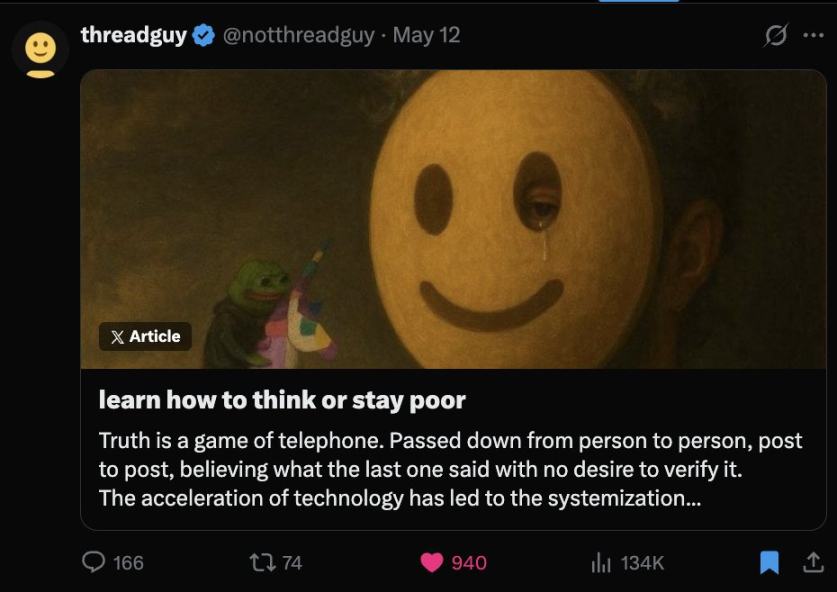
After reading this article, check out threadguy’s writing on thinking
This reliance on borrowed beliefs leads not only to poor returns but deeper issues. When you trade based on others’ arguments, you’re trying to copy their entire mental model without understanding its foundation. You don’t know what factors drove their decision, their risk management approach, or when they’ll change their mind. They might be dumping the asset as you buy, and you won’t realize until they post profit screenshots—this scenario repeats itself hundreds of times.
For example, someone with unique insight proposes a thesis combining AI and crypto. They quietly accumulate, perhaps sharing early ideas to test their framework through criticism; once confident, they go public—but their position is already established. Then followers rush in, driving up the price of their holdings, conveniently providing exit liquidity. The original thinker profits not because their technical analysis was right, but because they understood how information spreads.
The solution isn’t finding better people to follow—it’s developing your own independent thinking. This sounds abstract, but there’s a clear path.
Read More
Original thinking in markets comes from exposure to unconventional information sources, processed through your own analytical framework.
We all read the same viral tweets, the same Substack posts, shared across identical Telegram groups. This creates an echo chamber where everyone has identical information. When everyone knows the same thing, no one holds an advantage.
Real opportunities hide in niche corners. Take Jacob’s 2022 piece “Hyperstructures”—most never read it, yet it nearly predicted DeFi’s full recovery. Or Pierre Rochard’s 2014 article “Speculative Attack,” explaining Bitcoin adoption through game theory, still influencing markets a decade later. These aren’t just good articles—they’re analytical frameworks that let you anticipate future trends.
Read books like *Reminiscences of a Stock Operator*. I guarantee broadening your reading scope and types will pay off. And I’d add: no matter how much you read now, it’s not enough. Pack your mind with as much information as possible—it only helps, never hurts.
Also, don’t limit reading to crypto. Read Semi Analysis on TSMC’s competitive moat to understand tech-crypto interplay; Luke Gromen’s research on dollar dynamics explains Bitcoin rallies better than any on-chain analyst; if you want to gauge what Trump can or cannot achieve in office, read Curtis Yarvin on U.S. power structures.

Kel reads 1960s books to find opportunities
The compounding effect of diverse reading is astonishing. Understanding how yen carry trades work suddenly explains why crypto drops at certain times; studying how luxury brands create artificial scarcity lets you see through NFT mechanics before they trend; knowing how Nvidia allocates H100 chips helps distinguish AI tokens with real compute backing from pure marketing hype.
Also, always read project documentation—know what you’re buying.
Write More
Writing is thinking made visible. Your seemingly brilliant trading ideas expose flaws when you try to write them down clearly. Writing forces you to confront "logical gaps," "untested assumptions," and "missing connections."
I started writing long-form analyses not to attract readers, but to clarify my own thinking. When you must explain why you’re bullish on an asset, vague excuses like “it feels right” or “community vibes are strong” no longer suffice. You must identify specific catalysts, assess real risks, define clear stop-loss points. Just this process alone avoids 90% of bad trades.
Stick with writing, and magic happens. Your brain starts processing information differently, actively seeking meaningful patterns and connections, gradually forming what I call “thesis thinking”—spotting tradable narratives before they become consensus. It’s a pattern recognition skill built through repeated practice.
Learn to Use Data
Blockchains are the most transparent financial systems ever created—every transaction, wallet transfer, smart contract interaction is publicly verifiable. Yet most traders claim they’ve done research after glancing at three charts on CoinGecko.
Information asymmetry in crypto isn’t about access (everyone sees the same data), but interpretation and integration—asking better questions and knowing where to find answers.

Check Average Joe’s Twitter profile to see how relentlessly he hunts data to back his theses
Take yield analysis: DeFi protocols generate real fees, real yields, real returns—but most traders wait for others to calculate and display them on dashboards. Anyone who can write basic SQL queries on Dune can compute a protocol’s yield before it appears on DeFi Llama, spotting shifts weeks before they trend on Twitter.
Learn to Code
The realization that everything in crypto is programmable should fundamentally change how you interact with markets. We’re not trading on the NYSE—we don’t need Bloomberg Terminals or institutional access. Every protocol has APIs, every contract can be called directly, every strategy can be automated.
Start simple: write a script checking mining yields hourly, build a tool alerting you when a specific wallet trades, create a basic market-making bot providing liquidity near your spot positions. None require complex code—ChatGPT can write most of it. But they transform you from a manual clicker into a trader operating at internet speed.
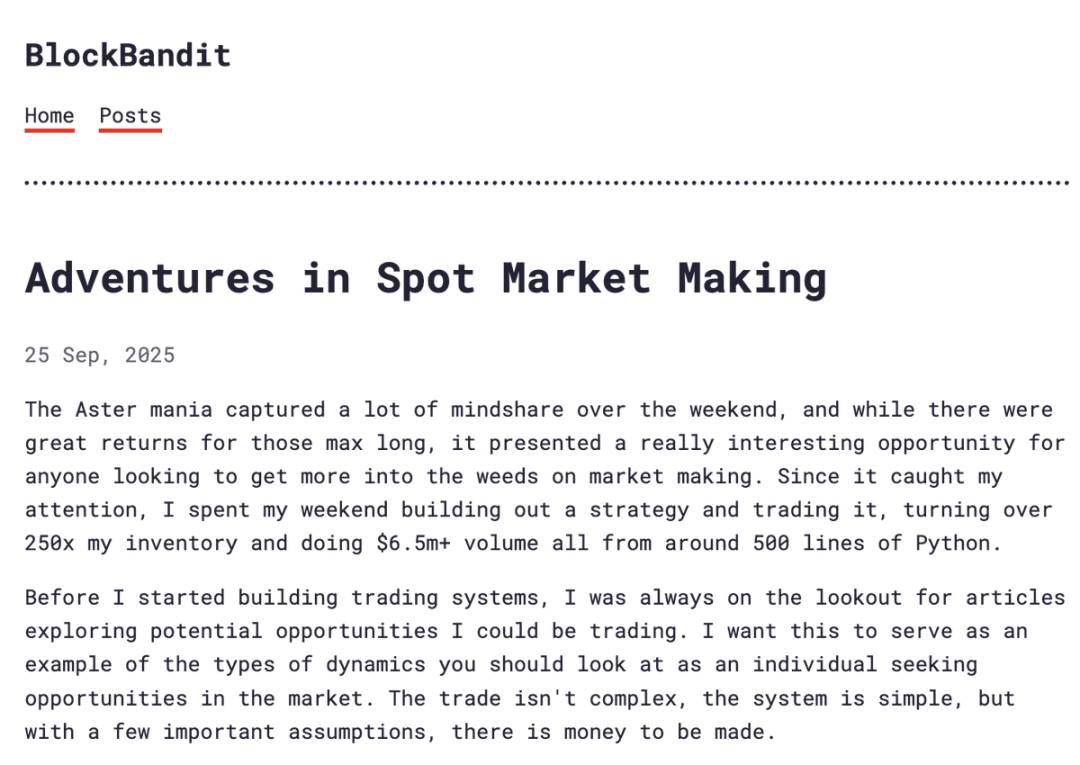
Have you seen someone earn 40% overnight on ASTER using market-making strategies?
The compounding effect of coding can be staggering. Imagine earning 1% extra per trade via targeted market making, gaining 2% more from each yield farm via auto-compounding tools, topping every points program with farming scripts, optimizing airdrop gains using sybil attack scripts.
More importantly, coding forces systematic thinking. Code has no emotions; programs don’t panic sell or FOMO buy. Converting a trading strategy into code demands precise parameters, defined conditions, and clear logic—this very discipline elevates your trading.
Learn to Trade
You should try trading everything. Try NFTs? Maybe you’re actually good at sports betting? Seen those new prediction markets? Know Logan Paul owns a $5M Pokémon card?
If you can’t predict market direction, learn spread trading; if you crave excitement, open a 1-minute chart. I know a New Yorker who made six figures a year reselling restaurant reservations.
The core idea: everything is a market, and every market offers multiple ways to trade. You won’t know your edge until you try. Yes, you’ll lose money—truthfully, you can’t expect to make millions without first losing hundreds of thousands. Markets don’t teach for free—you must accept paying tuition.
If that’s not for you, that’s fine. Just store Bitcoin in cold storage and let your 401k run automatically. But if you aim for exceptional results, you must learn to face inherent market risks.

Alexander Good also trades gemstones—that’s why he’s better than you
Another benefit of broad trading: with so many markets and strategies, you may discover natural talent in unexpected areas. To me, this diversity is key to long-term success. No market lasts forever: sometimes there’s no profitable strategy in Solana’s ecosystem, but “when one door closes, another opens.” You need adaptability to shift with changing market cycles.
Cross-market fluency makes you antifragile: when crypto enters a deep bear market, trade election prediction markets; when NFTs cool down, move to collectibles; when DeFi yields compress, provide liquidity in sports betting. The game continues—just on a different field.
Learn to Network
Crypto is inherently network-friendly because it’s internet-native. Geography doesn’t matter, credentials don’t matter—only the quality of your thinking and value you provide matter. Done right, it’s an exceptionally equal space.
The key to networking is give before you get. Share tools you’ve built, explain complex concepts simply, make introductions, answer questions without expecting anything back. Altruism works. The value you inject into the ecosystem multiplies and returns to you.
You don’t need to hate private circles—if you make friends and gain invites to a few high-quality Telegram groups, that’s enough. Build a personal brand, don’t fear posting opinions online, post authentically. Most importantly, never close your DMs—you never know who might reach out.
If you master networking, you don’t need to be right all the time or always online. Build a core group of trusted allies—believe me, having support makes everything easier.
Conclusion
Most people will finish reading this and return to endlessly refreshing Twitter for the next hot tip—and that’s fine, the market needs exit liquidity. But for those who truly get it, who understand that crypto rewards the prepared, the opportunity is immense.
The infrastructure you build now—intellectual, technical, social—compounds forever. Every book read, every script written, every friend made adds another brick to your competitive advantage.
These are the skills you need to win in this market. I know I’m building them consistently—so unless you do too, you definitely won’t beat me.
Join TechFlow official community to stay tuned
Telegram:https://t.me/TechFlowDaily
X (Twitter):https://x.com/TechFlowPost
X (Twitter) EN:https://x.com/BlockFlow_News
 @mikeykremer






