The Shanghai Composite Index breaks through 3,900 points, hitting a ten-year high, as gold and AI dual main themes ignite post-holiday market momentum
TechFlow Selected TechFlow Selected
The Shanghai Composite Index breaks through 3,900 points, hitting a ten-year high, as gold and AI dual main themes ignite post-holiday market momentum
This October is destined to be extraordinary.
 Navigating Web3 tides with focused insights
Author: Jinshi Data
On Thursday morning, the Shanghai Composite Index broke above the 3900 level for the first time in ten years, rising over 1% at the time of writing; the ChiNext Index rose more than 2%, while the Shenzhen Component Index gained over 1.6%, with nearly 3,000 stocks advancing across the two exchanges. On the market front, sectors including precious metals, nuclear fusion, and nonferrous metals led the gains.
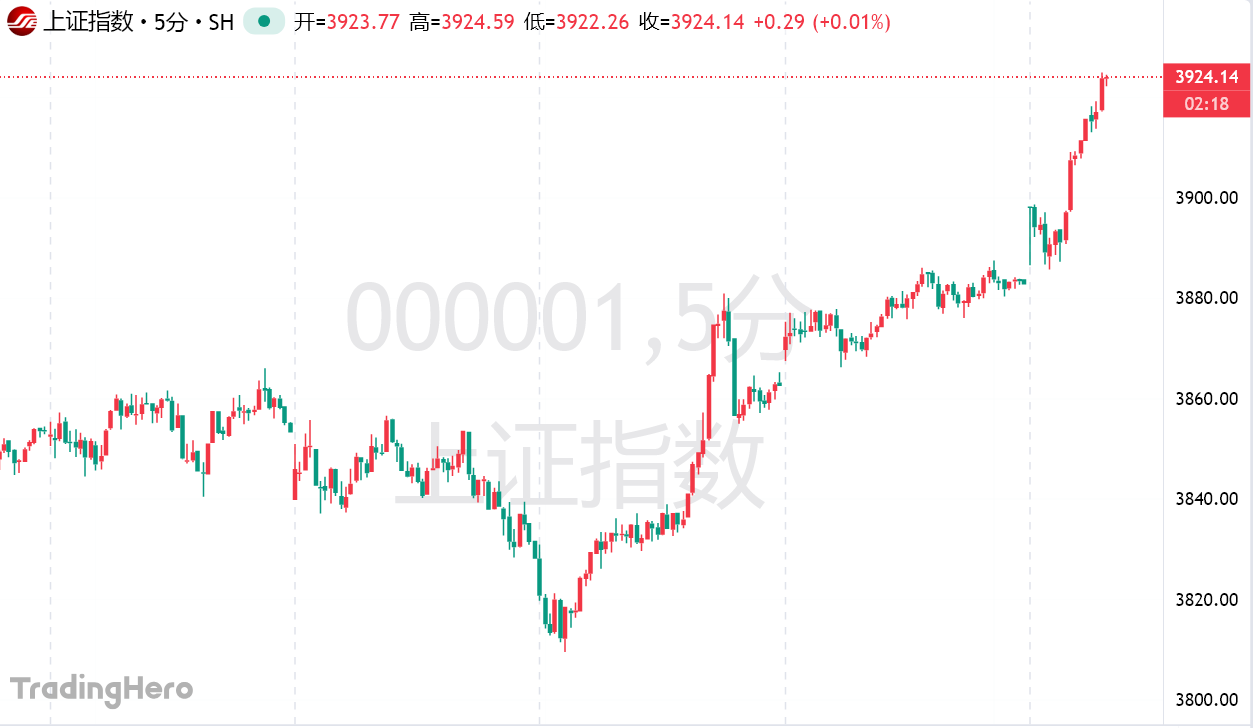
The recent National Day holiday saw a flurry of global market highlights, with notable performances in nonferrous metals, semiconductors, and AI-related sectors. COMEX gold futures rose 4.45% during the holiday, driving a sharp rally in gold equities; AMD surged over 40% on its partnership announcement with OpenAI. Sora 2 also went viral, generating strong momentum that has invigorated post-holiday markets, making these related sectors focal points of investor attention.
Brokerage research reports broadly agree that overseas market news during this extended holiday was generally positive, with major global risk assets moving upward in tandem. U.S. and Japanese equities, along with gold, all hit record highs, creating a favorable macro backdrop for A-share performance post-holiday. Structurally, market interest during the holiday centered on resources and AI, particularly with frequent catalysts emerging in the AI industry, which could further drive technology-led growth trends throughout October.
Dongwu Securities noted that historically, markets tend to see more gains than losses following long holidays. Moreover, in the two trading days before the holiday, there were signs of funds positioning early for a rebound, suggesting that future index movements should be assessed with close attention to volume-price dynamics. During the holiday, both domestic and external developments were largely positive—especially rising expectations for Fed rate cuts and significant AI industry catalysts—indicating that market preferences may lean toward sectors with strong forward-looking growth potential, fewer valuation constraints, and visible catalysts. Additionally, pro-cyclical sectors supported by policy stimulus and pricing power may perform well.
Huatai Securities highlighted three key changes to watch after the National Day holiday: 1) Domestically, September’s PMI showed marginal improvement, holiday travel data hit record highs, outbound and inbound tourism performed strongly, and high-frequency data for dining, cinemas, and real estate also rebounded; 2) Overseas,避险 demand rose due to the U.S. government shutdown and Japan's election, pushing gold prices to new highs, yet expectations for Fed rate cuts and Japanese fiscal expansion strengthened the narrative of global liquidity easing; 3) Industrially, OpenAI launched Sora 2 and announced partnerships with multiple companies, accelerating AI investment and application rollouts. Post-holiday, both calendar effects and new information from the break are likely to support risk appetite overall, and investors are advised to continue focusing on relatively undervalued segments within main themes.
Changjiang Securities stated that October will bring dual catalysts of earnings season and policy windows, potentially allowing A-shares to extend their current structural uptrend. Strategically, three main themes are recommended: first, "high-growth + high-flexibility" sectors such as communications, nonferrous metals, gaming, and Hong Kong internet stocks; second, "event-driven expectation" areas like low-altitude economy and embodied intelligence—representing new productive capacities; third, value-oriented sectors such as non-bank financials showing fundamental improvement.
BOC International expects the current A-share rally to broaden in three phases. The first phase features a structural rally in core tech sectors, led by high-conviction AI hard tech areas such as AI computing power and edge AI that have strong earnings visibility. The second phase sees the rally spread to broader tech growth styles after the semi-annual earnings releases, extending into泛growth areas like robotics and innovative pharmaceuticals. Finally, once signs of macroeconomic improvement emerge, the rally is expected to expand further into "anti-overcompetition" concepts and large consumer sectors. Currently, the A-share market remains in the first phase, and investors are advised to stay focused on core technology themes.
Guotai Junan Securities pointed out that in the past, global investors viewed the U.S. dollar as the sole payer under fiscal expansion and technological boom, making continued dollar weakness the dominant theme in asset trading over recent periods. However, historical experience shows that Chinese bull markets often rely on a compelling “China story.” Overreliance on the weak-dollar narrative implies that the bull market will eventually need a gear shift. Investors are advised to prepare accordingly, considering both global drivers and domestic shifts.
China Galaxy Securities stated that October may mark a critical policy window for A-shares, with market risk appetite likely improving further. Meanwhile, market liquidity continues to trend positively, margin financing balances are on an upward trajectory, and the shift of household deposits into financial assets remains in its early stages. Fed rate cuts provide support for global liquidity. The A-share market is expected to maintain a volatile upward trend. From a portfolio perspective, a series of recent events are supportive of upside momentum in the nonferrous metals sector. Additionally, amid policy expectations, the market may begin positioning around the upcoming "15th Five-Year Plan." Investors may focus on themes including new productive capacities, "anti-overcompetition" concepts, large consumer sectors, and the "two priorities" ("Liang Zhong") areas.
Join TechFlow official community to stay tuned
Telegram:https://t.me/TechFlowDaily
X (Twitter):https://x.com/TechFlowPost
X (Twitter) EN:https://x.com/BlockFlow_News