From the Emergence of Pulse, Discussing the "Execution Flywheel" and "Agency Economy"
TechFlow Selected TechFlow Selected
From the Emergence of Pulse, Discussing the "Execution Flywheel" and "Agency Economy"
We may be bidding farewell to the "attention economy," where "traffic" is the core asset, and moving toward an "agency economy" where "trust" is the core asset.
 Navigating Web3 tides with focused insights
Author: Zhang Peng
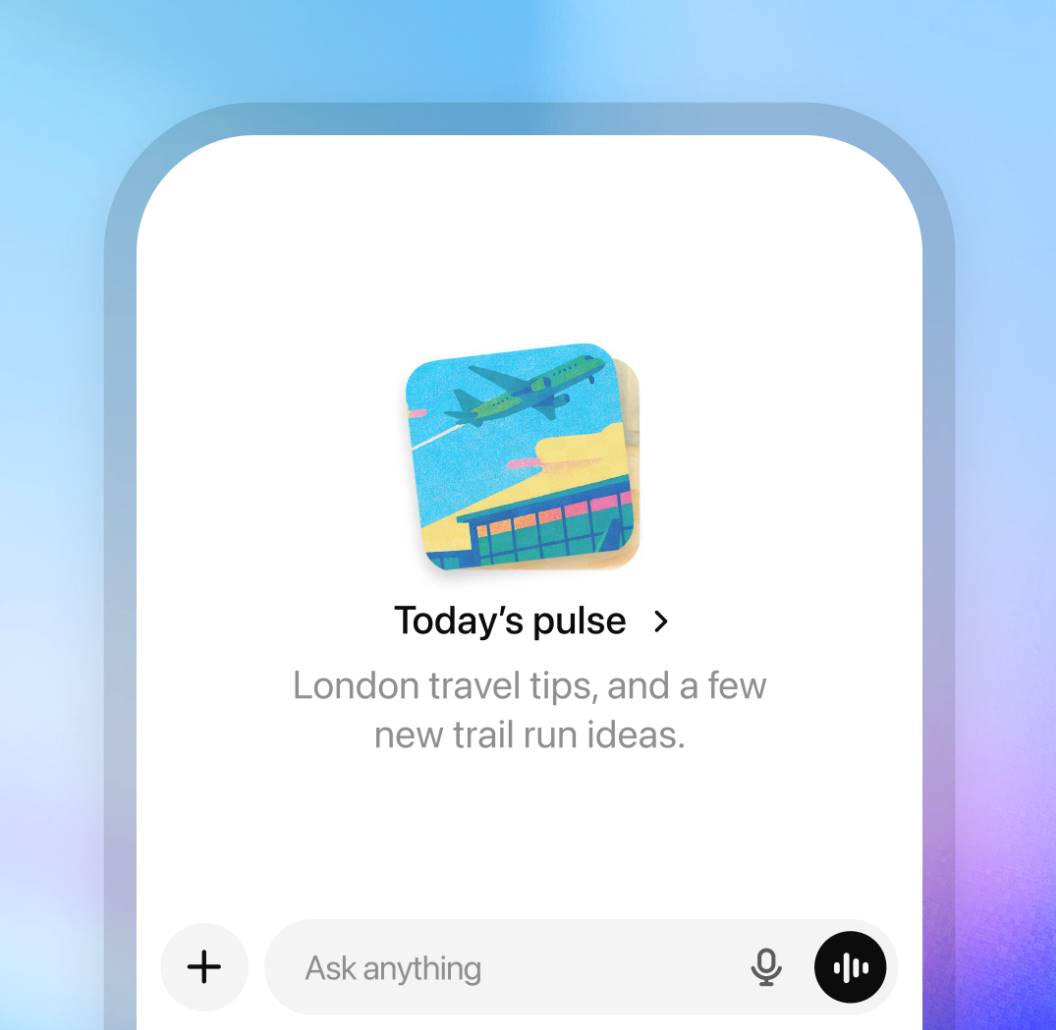
Recently, OpenAI's release of the ChatGPT Pulse feature has sparked considerable discussion within the tech community. Sam Altman’s description is clear: an AI that works for you at night, continuously thinking about your interests, related data, recent conversations, and more, preparing things you might care about by morning. If you tell ChatGPT what matters to you, it can perform exceptionally well.
Here, the term "more" Sam used, according to OpenAI’s official ChatGPT Pulse page, refers to Pulse’s ability—upon user authorization—to connect with Gmail and Google Calendar, “to provide additional context and thus offer more relevant suggestions. Once connected to your calendar, ChatGPT may draft sample meeting agendas, remind you to buy birthday gifts, or recommend restaurants for upcoming trips.” It’s foreseeable that Pulse will integrate with even more applications in the future, accessing richer user context.
On the surface, this resembles a smarter good-morning greeting. But if we view it merely as a new feature, we might miss some of the deeper shifts it represents.
The emergence of Pulse, in my view, is highly significant. It marks OpenAI’s attempt to define an entirely new and deeper human-AI relationship. It challenges the human-computer interaction paradigm we’ve taken for granted over the past decade. And beneath this lies a new possibility: the business model centered on “traffic” may finally begin to loosen.
01 From Passive to Active
To understand Pulse, we must move beyond thinking of it as just a “feature” and recognize its shift in underlying paradigms.
First, it represents a meaningful effort to transition from a “passive tool” to an “active partner.” While proactiveness as a trait of this generation of AI is widely acknowledged, OpenAI has successfully implemented it with Pulse. Previously, our interactions with ChatGPT followed a “question-and-answer” model. We were the initiators; the AI was reactive. It was like a powerful magic box—but one that required you to know exactly what you wanted and actively use it. Pulse attempts to reverse this dynamic, positioning the AI as a partner capable of “proactive thinking” and “proactive service.” This shift from passive to active marks a critical leap in the evolution of human-computer interaction.
We can analyze this new entity, Pulse, using the “Three Questions of AI Native” framework I introduced during my keynote at this year’s FounderPark AGI Playground conference:
What is Pulse’s new goal? Pulse no longer aims to “accurately answer individual user queries,” but rather to “continuously optimize the user’s overall experience and efficiency.” This is a dimensional upgrade—from solving isolated, point-like problems to enhancing holistic states.
What is Pulse’s new pipeline? Its data processing workflow has fundamentally changed. It’s no longer a simple “query → process → response” loop. Instead, it operates a continuous, background cycle: “multi-dimensional data input → autonomous integration and reasoning → proactive value package generation → user feedback → reinforcement learning.” This creates a “data flywheel” on the product side—one that can continuously “push forward” on its own.
What is Pulse’s new value model? Its value is no longer measured solely by the quality of individual responses, but by the depth of data you entrust to it and the strength of the relationship formed. The more you authorize, the deeper your investment in this “relationship,” the more unique the value it generates for you, and the higher your switching cost becomes.
These shifts also signal another evolution in information services. If Google’s search represents the 1.0 era of “humans seeking information,” and ByteDance’s recommendation engine the 2.0 era of “information seeking humans,” then Pulse may mark the beginning of a 3.0 era—“value generated for me” (Value Generation). What it offers isn’t pre-packaged information, but real-time, newly generated value tailored to your unique context.
02 From “Attention Economy” to “Agency Economy”: A New Possibility
As the human-AI relationship is redefined, so too are the values and business models it can support. Pulse sketches a prototype of a “personal operating system” centered entirely on “you,” along with a new economic model.
First, innovation in agency: “Agent of Platform” vs. “Agent of You.”
All current recommendation algorithms that claim to “understand you” are essentially “agents of the platform.” No matter how personalized they appear, their core KPIs serve platform interests—retention, time spent, conversion rates, GMV, etc. The algorithm acts like a top salesperson planted beside you by the platform; its kindness toward you exists to benefit the platform.
The emergence of products like Pulse signals a revolution in alignment. The ultimate form of an AI agent should be a true “agent of you”—fully dedicated to serving your interests. Its sole KPI should be your success and satisfaction. Every calculation and recommendation it makes must withstand one ultimate question: “Is this truly in your best interest?”
This shift—from working for the platform to working for you—may seem minor, but it fundamentally moves the pivot point of the entire business logic.
Second, upgrading the value chain: from “information distribution” to “service orchestration.”
A shift in role inevitably brings a qualitative change in value delivery.
Currently, platforms have built data silos on your phone, only able to push information within their own walled gardens (e-commerce, content, social). A true “personal operating system,” however, would tear down these walls and become the central orchestrator of all your digital services.
A genuine “Personal OS” has network-like capabilities. It transcends app boundaries, becoming the central command center for all your digital services—not delivering “information,” but “services.” It won’t just recommend a travel guide; it will design and execute a full travel plan: checking your availability via your calendar app, querying and booking flights through travel apps, mapping routes via maps apps, and even integrating with budgeting apps to manage expenses.
Within this “you-centered personal OS,” each isolated app on your phone becomes a “capability block” that the AI agent can invoke at will. It compresses complex workflows—previously requiring users to manually switch between multiple apps, copy, paste, and coordinate—into a single natural language conversation. Its theoretical upper limit equals the sum of all available digital services. It doesn’t perform “information distribution,” but “service orchestration,” thereby opening up a “new bandwidth” for creating user value.
Third, evolution of the business model: from “attention economy” to “agency economy.”
When AI aligns with the user and delivers value through services, a business model disruption becomes inevitable. We may be leaving behind the “attention economy,” where “traffic” is the core asset, and moving toward an “agency economy” where “trust” is the core asset.
The old model revolves around “monetizing traffic”—platforms attract user attention with free content and resell it to advertisers. The fundamental conflict here is that advertiser goals often clash with user needs. In contrast, the “agency economy” enables a purer, more aligned business model: Subscription: You pay to hire the AI to work for you—this is the most direct form of agency. Alternatively, there could be outcome-based revenue sharing: When the AI creates measurable value for you through “service orchestration”—such as securing cheaper flight tickets or generating excess returns on your investments—it and the chain of agents it orchestrates take a pre-agreed commission or share, which is then internally distributed. Ultimately, you’ll only keep paying if the AI consistently proves it serves your best interests.
In this model, “delivering results” replaces “free usage,” and “trust value” replaces “traffic value,” fundamentally altering the nature of the product-user relationship and the essence of user value.
03 Are Only Giants the Winners?
So here’s an interesting question: Why haven’t Apple or WeChat—companies with vast user data—launched something like Pulse first? Will they eventually do it?
I’ve discussed this with some insiders at both companies, and the answer is: “extremely cautiously.” This caution stems not only from compliance risks around user data, but from a deeper challenge—the establishment of what I call the “Trust-Delivery Flywheel.”
User data authorization is the input of “trust”; AI delivering unexpected value is the output of “delivery.” This is a crucial yet extremely fragile positive feedback loop.
This explains the dilemma giants face. First, their scale is so massive that any “delivery failure” could affect millions at once. For large products at big companies, the cost of “trial and error—correction” is far higher than for startups. Hence, they tend to be cautious, adopting a “wait-and-see” approach.
But a deeper reason lies in the risk of “cross-domain trust arbitrage.” Even with good intentions, leveraging user trust earned in Business A to deliver services in Business B easily triggers user suspicion and backlash against giants—and potentially antitrust scrutiny.
OpenAI, as a new challenger, can be seen as using a non-essential service like Pulse to initiate broader user data access—a bold move, especially among major players today.
However, OpenAI’s entry likely doesn’t spell the end of the personal agent space for startups. On the contrary, OpenAI’s move has ripped open a market previously sealed shut by giant platforms due to caution, while also helping educate users.
Where lies the opportunity for entrepreneurs?
The opportunity may lie in “deep delivery” within vertical domains.
Pulse’s “non-essential” and “generalized” nature is precisely its weakness. An assistant trying to do everything struggles to achieve peak expertise in any single domain. And this may be the entrepreneur’s breakthrough point.
In many specific life domains—fitness, nutrition, budgeting, scheduling, note-taking, etc.—startups can enter through scenarios where users have clear needs and are most willing to “commit.” By building a “delivery capability” ten times better than general models, they can become the most knowledgeable and reliable vertical agent—an endeavor still deeply meaningful.
Once you get the “Trust-Delivery Flywheel” spinning in a specific domain, you gain the strongest moat. I believe the future landscape may not be a centralized AI empire, but a “federation of trust”—a network of countless trusted, specialized vertical agents.
Pulse’s arrival can be seen as pointing the way toward the AI agent era. The opportunities still belong to innovators who deeply understand and solve the core challenge of “trust and delivery,” ultimately creating irreplaceable value for users.
Join TechFlow official community to stay tuned
Telegram:https://t.me/TechFlowDaily
X (Twitter):https://x.com/TechFlowPost
X (Twitter) EN:https://x.com/BlockFlow_News
 极客公园
极客公园