Will the US SEC's crackdown on crypto treasury companies halt the DAT narrative?
TechFlow Selected TechFlow Selected
Will the US SEC's crackdown on crypto treasury companies halt the DAT narrative?
DAT hits the brakes—what should investors pay attention to?
 Navigating Web3 tides with focused insights
Author: kkk, Lawo
On September 24, the U.S. Securities and Exchange Commission (SEC) and the Financial Industry Regulatory Authority (FINRA) jointly announced an investigation into more than 200 publicly traded companies that had previously declared crypto treasury plans, citing "abnormal stock price fluctuations" commonly observed just before these companies released related announcements.
Since MicroStrategy first added Bitcoin to its balance sheet, "crypto treasury" has become a sensational "financial alchemy" in the U.S. stock market—newcomers like Bitmine and SharpLink have seen their stock prices surge tens of times due to similar moves. According to data released by Architect Partners, since 2025, 212 new companies have announced plans to raise approximately $102 billion to purchase major crypto assets such as BTC and ETH.
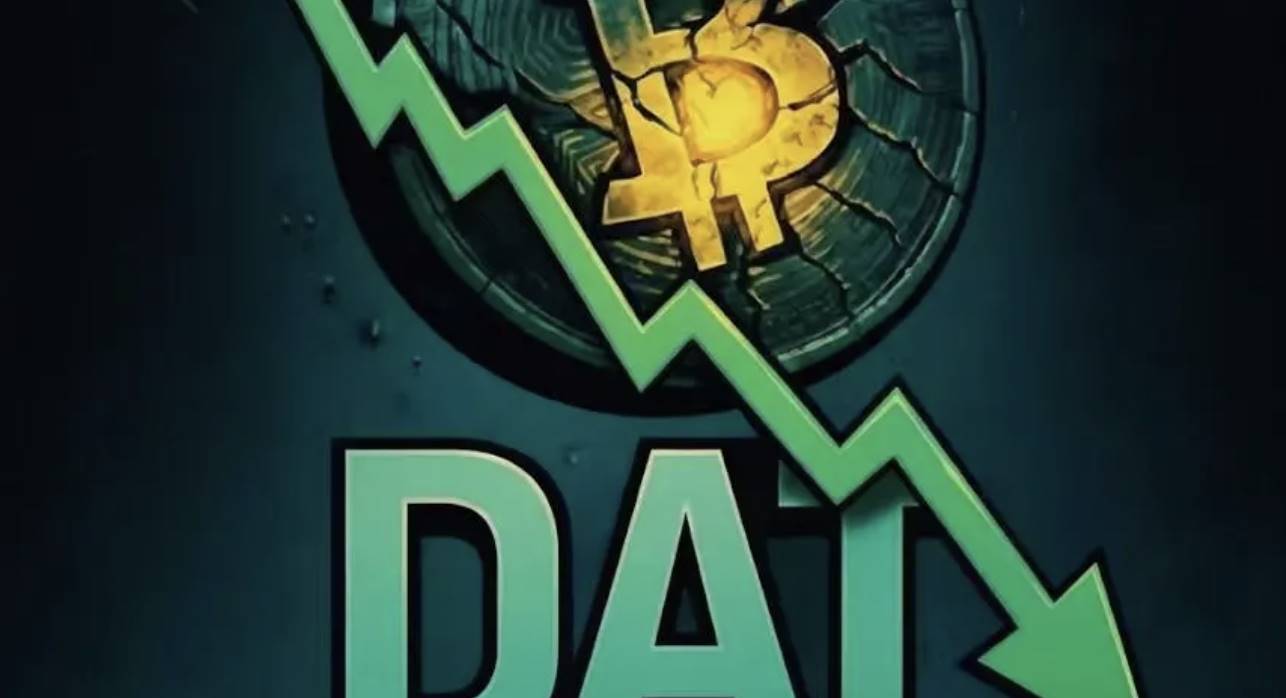
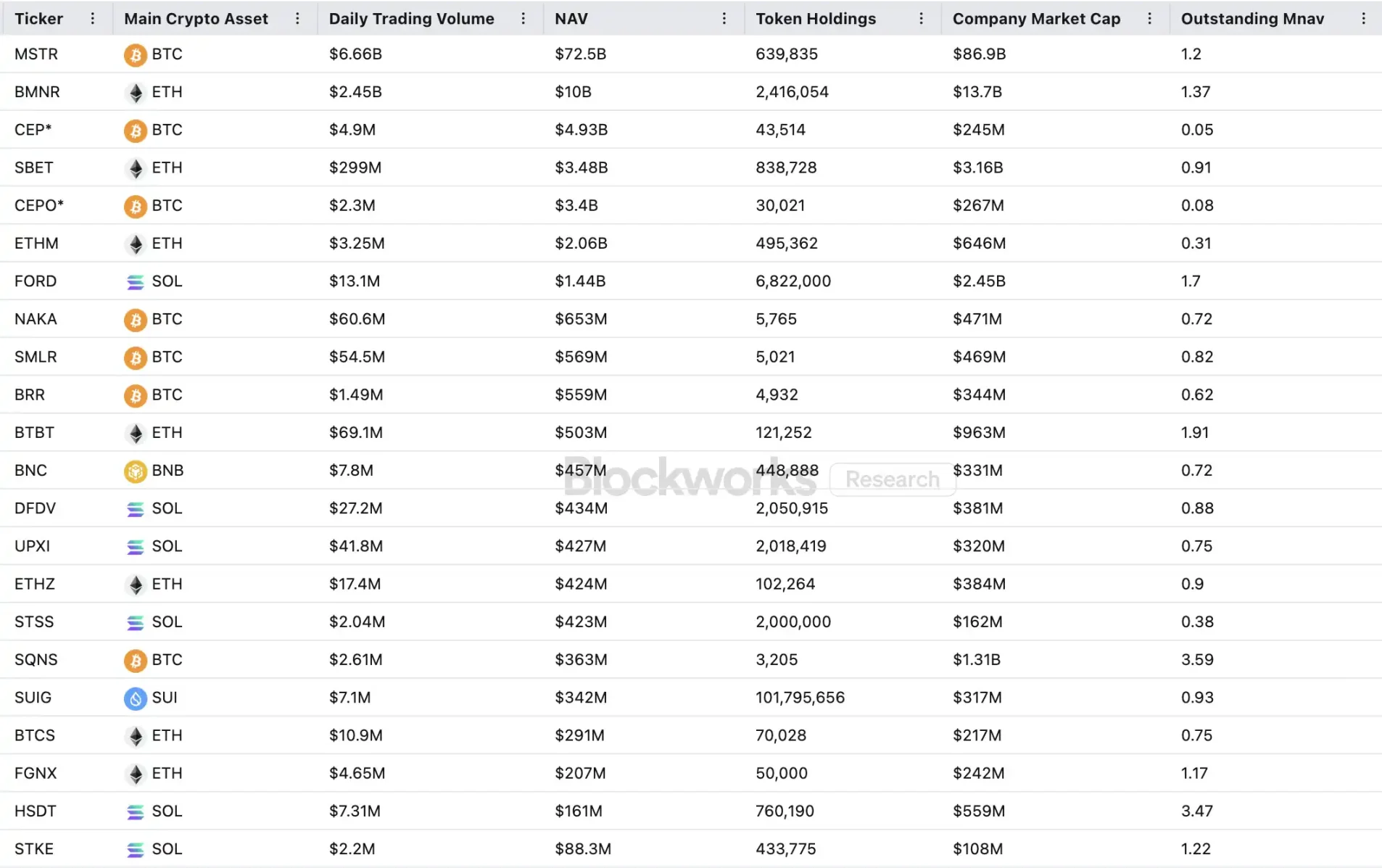
However, while this capital frenzy has driven up prices, it has also triggered widespread skepticism. MSTR's mNAV (market value to net asset value ratio) dropped from 1.6 to 1.2 within a month, and two-thirds of the top twenty crypto treasury companies have mNAVs below 1. Accusations regarding asset bubbles and insider trading continue to mount, and this emerging asset allocation trend now faces unprecedented regulatory scrutiny.
How the Crypto Treasury Flywheel Works
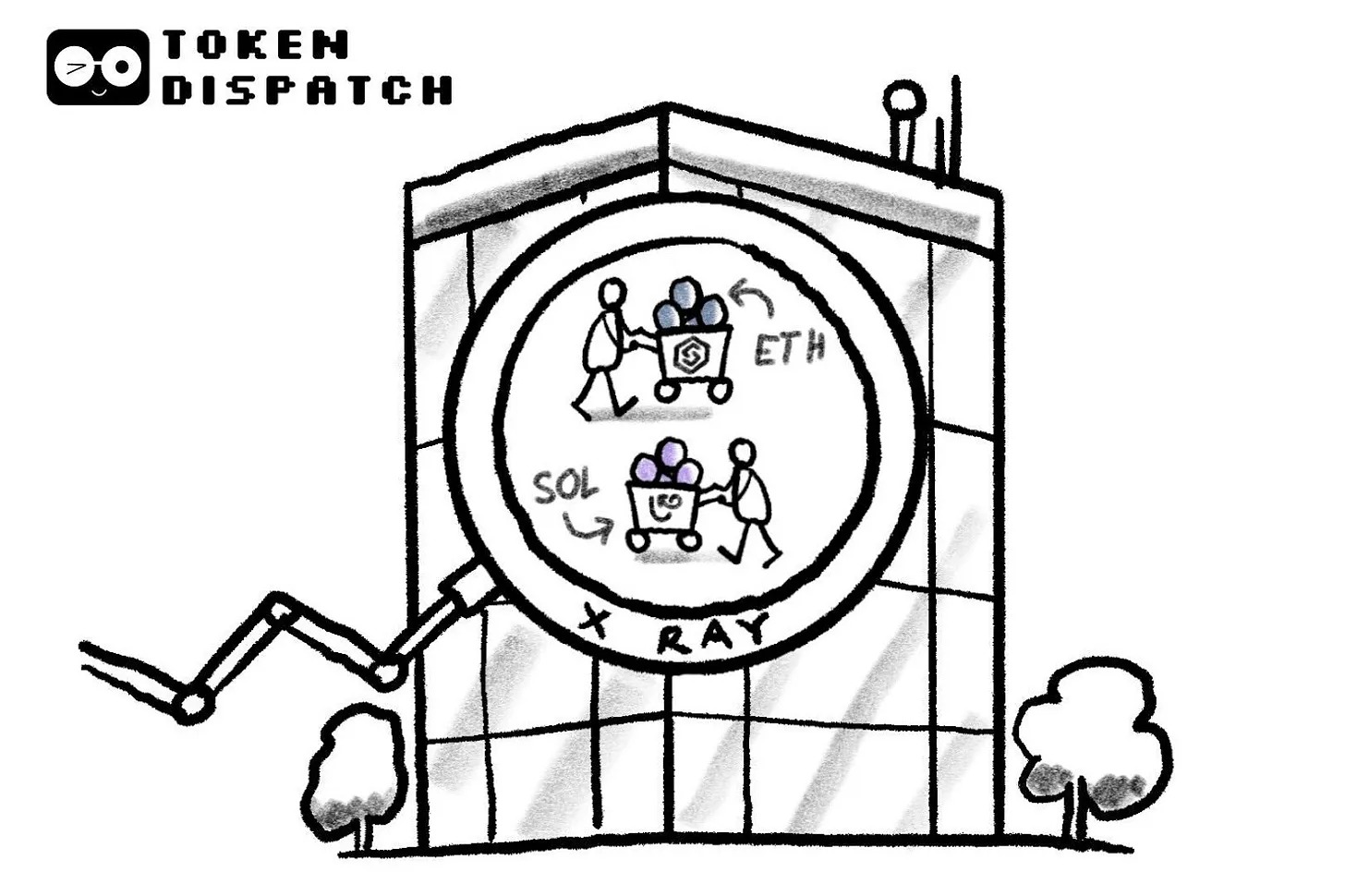
The financing flywheel of treasury companies is built on the mNAV mechanism—an inherently reflexive logic that gives these companies seemingly "infinite ammunition" during bull markets. mNAV refers to the market-to-net-asset-value ratio, calculated as a company’s market capitalization (P) relative to its per-share net asset value (NAV). In the context of crypto treasury firms, NAV represents the value of their digital asset holdings.
When the stock price P exceeds the per-share net asset value NAV (i.e., mNAV > 1), the company can continuously raise funds and reinvest them into digital assets. Each round of fundraising and subsequent purchases increases per-share holdings and book value, further strengthening market confidence in the company's narrative and driving the stock price higher. Thus, a closed-loop positive feedback cycle begins: rising mNAV → equity issuance → buying digital assets → increased per-share holdings → stronger market confidence → higher stock price. It is precisely through this mechanism that MicroStrategy has been able to continuously raise capital to buy Bitcoin over the past few years without severe share dilution.
Once the stock price and liquidity rise sufficiently, the company unlocks a full suite of institutional funding mechanisms: issuing debt, convertible bonds, preferred shares, and other financial instruments, converting market narratives into tangible assets on the balance sheet, which in turn pushes the stock price even higher—a self-reinforcing flywheel. The essence of this game is a complex resonance among stock price, story, and capital structure.
Yet mNAV is a double-edged sword. A premium may reflect strong market trust—or merely speculative hype. Once mNAV converges to 1 or falls below it, the market shifts from a "value accretion" logic to a "dilution" logic. If digital asset prices fall at this point, the flywheel reverses into a negative feedback loop, causing simultaneous erosion of market cap and investor confidence. Moreover, treasury companies' ability to raise funds depends on the mNAV premium; when mNAV remains at a discount for prolonged periods, fundraising avenues are blocked. For small-cap shell companies already facing business stagnation or delisting risks, their entire business model collapses instantly, and the constructed flywheel effect disintegrates. Theoretically, when mNAV < 1, a more rational choice would be to sell holdings and repurchase shares to restore balance—but this should not be generalized, as discounted companies may simply be undervalued.
During the 2022 bear market, even when MicroStrategy’s mNAV briefly fell below 1, the company chose not to sell Bitcoin to repurchase shares, instead holding onto all its BTC through debt restructuring. This "hold-at-all-costs" logic stems from Saylor’s faith-driven vision, treating BTC as a core collateral asset that will “never be sold.” But not all treasury companies can replicate this path. Most altcoin treasury stocks lack stable core businesses—the shift to becoming “crypto-buying companies” is merely a survival tactic, devoid of ideological conviction. Once market conditions deteriorate, they are more likely to sell off holdings to cut losses or realize profits, potentially triggering a cascade of selling.
Related reading: “First Sale, Delisting: Crypto-Treasury Stocks Are No Longer Cryptocurrency Pixiu”
Is Insider Trading Happening?
SharpLink Gaming was one of the earliest cases to shake the market during this wave of crypto treasury enthusiasm. On May 27, the company announced it would acquire up to $425 million worth of Ethereum as reserve assets. On the day of the announcement, its stock price surged to $52. Strangely, however, trading volume had already spiked significantly on May 22, with the stock jumping from $2.70 to $7.00—days before any official announcement or SEC disclosure.
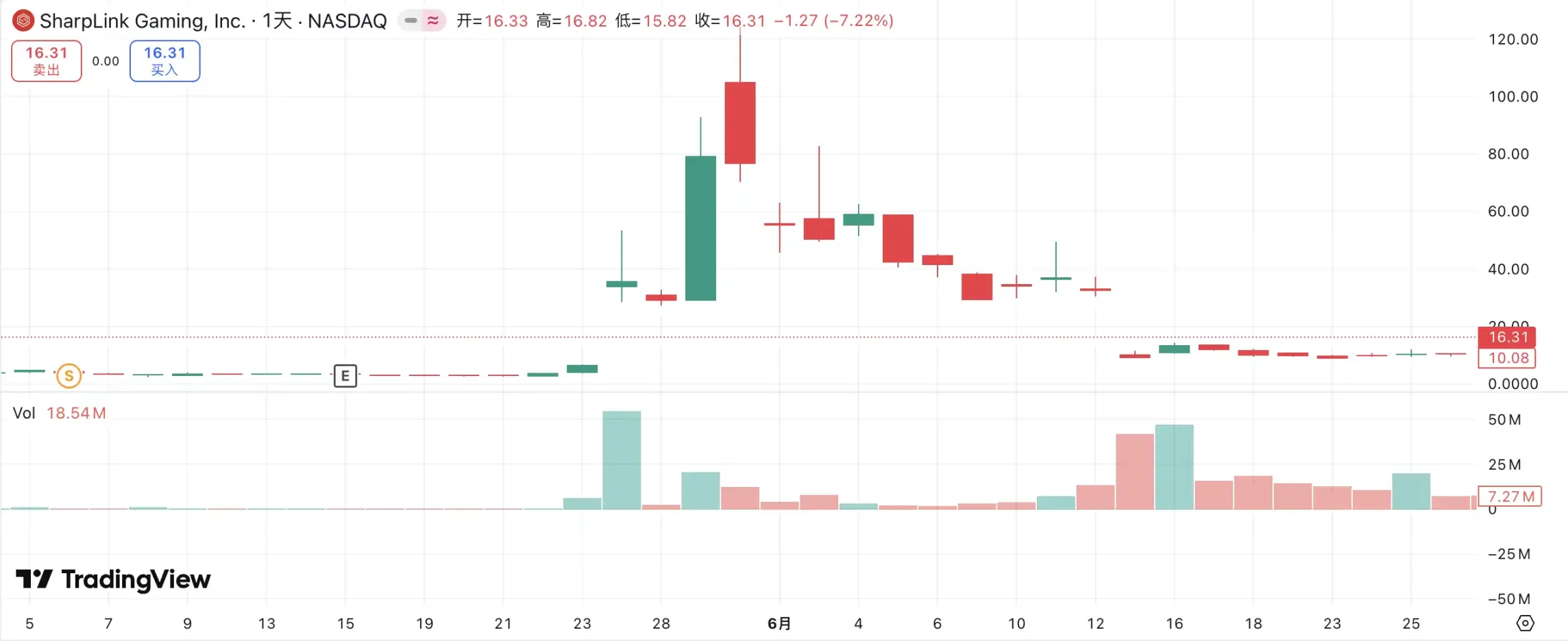
This phenomenon of “price moving before news” is not isolated. MEI Pharma announced a $100 million Litecoin treasury strategy on July 18, but its stock had already risen for four consecutive days prior, climbing from $2.70 to $4.40—nearly doubling. The company had filed no material updates nor issued press releases, and its spokesperson declined to comment.

Similar patterns occurred at Mill City Ventures, Kindly MD, Empery Digital, Fundamental Global, and 180 Life Sciences Corp, all of which experienced varying degrees of abnormal trading activity before announcing their crypto treasury plans. Whether this reflects information leaks or pre-release trading has drawn regulatory attention.
Will the DAT Narrative Collapse?
Arthur Hayes, advisor to Upexi—the so-called “Solana MicroStrategy”—points out that crypto treasuries have become a new narrative in traditional corporate finance. He believes this trend will continue evolving across multiple mainstream asset sectors. However, we must recognize clearly: on each blockchain, at most only one or two winners will emerge.
Meanwhile, a winner-takes-most effect is accelerating. Although over 200 companies have announced crypto treasury strategies in 2025, spanning BTC, ETH, SOL, BNB, TRX, and others, capital and valuations are rapidly concentrating around a select few companies and assets—BTC and ETH treasuries dominate the DAT landscape. Within each asset category, only one or two companies can truly succeed: MicroStrategy in BTC, Bitmine in ETH, perhaps Upexi in SOL, while the rest struggle to achieve meaningful scale.
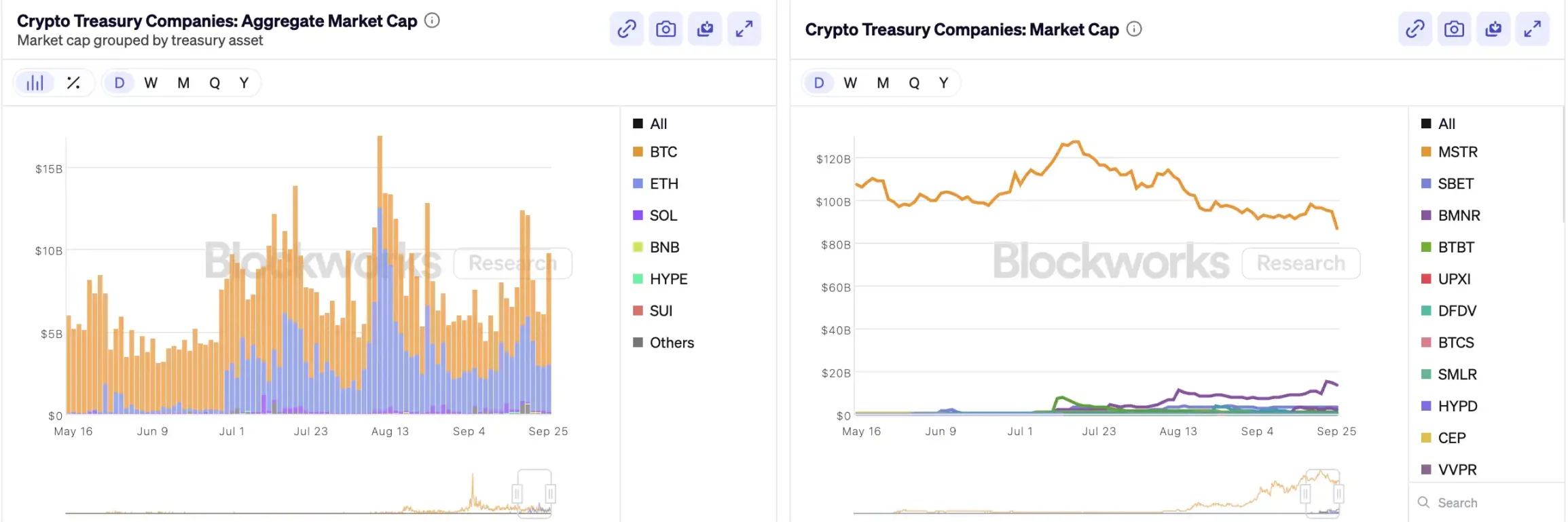
As Michael Saylor has demonstrated, there exists abundant institutional capital eager for Bitcoin exposure that cannot directly buy BTC or hold ETFs—but they can buy MSTR stock. If you can package a crypto-holding company into their “compliant basket,” these investors are willing to pay $2, $3, or even $10 for assets worth only $1 on paper. This isn’t irrational—it’s institutional arbitrage.
In the latter half of the cycle, newer issuers will emerge, employing increasingly aggressive corporate finance tools to chase higher stock elasticity. When prices decline, these tactics will backfire. Arthur Hayes predicts this cycle will witness a major DAT collapse akin to the FTX implosion. When that happens, these companies will fail, and their stocks or bonds could plunge into deep discounts, triggering significant market turmoil.
Regulators are also aware of these structural risks. In early September, Nasdaq proposed enhanced scrutiny of DAT companies; today, the SEC and FINRA have launched a joint investigation into insider trading. These regulatory moves aim to reduce information asymmetry, raise issuance thresholds, and increase financing difficulty—thereby limiting manipulation opportunities for new DAT entrants. For the market, this means “pseudo-leaders” will be purged faster, while true leaders may survive and even thrive on the strength of their narrative.
Summary
The crypto treasury narrative persists, but higher barriers, stricter regulation, and bubble deflation will unfold simultaneously. Investors must understand the underlying financial mechanics and arbitrage pathways, while remaining vigilant about accumulating risks behind the stories—this “on-chain alchemy” cannot go on indefinitely. Winners take all; losers exit the stage.
Join TechFlow official community to stay tuned
Telegram:https://t.me/TechFlowDaily
X (Twitter):https://x.com/TechFlowPost
X (Twitter) EN:https://x.com/BlockFlow_News
 BlockBeats