How can marketers avoid being replaced by AI within the next 5 years?
TechFlow Selected TechFlow Selected
How can marketers avoid being replaced by AI within the next 5 years?
When AI can optimize everything, the only thing that matters is knowing how everything is connected in the strategy.
 Navigating Web3 tides with focused insights
Author: rosie
Translation: AididiaoJP, Forsight News
The industry has undergone massive changes over the past five years.
The traditional concept of the "T-shaped marketer" is dead—killed by artificial intelligence, automation, and many other factors.
If you still believe that one deep skill plus broad knowledge equals job security, you're more likely to be replaced by large language models (LLMs) within the next 5 to 10 years. This isn't fearmongering—it's simply how replacement will unfold in the coming years.
Today’s marketers aren’t the deepest specialists, but those who can excel across multiple areas.
This is the π-shaped marketing revolution.
A framework predicting this shift
@emilykramer first introduced "π-shaped marketing" at MKG, and Emily has been incredibly accurate about where the industry is headed.
In cryptocurrency, fintech, tech startups, and beyond, we see the same pattern. Companies are tired of hiring five experts who don’t communicate, which is expensive—and early-stage startups rarely have that kind of budget. Even if they do, experts require coordination and clear workflows, which most startups lack.
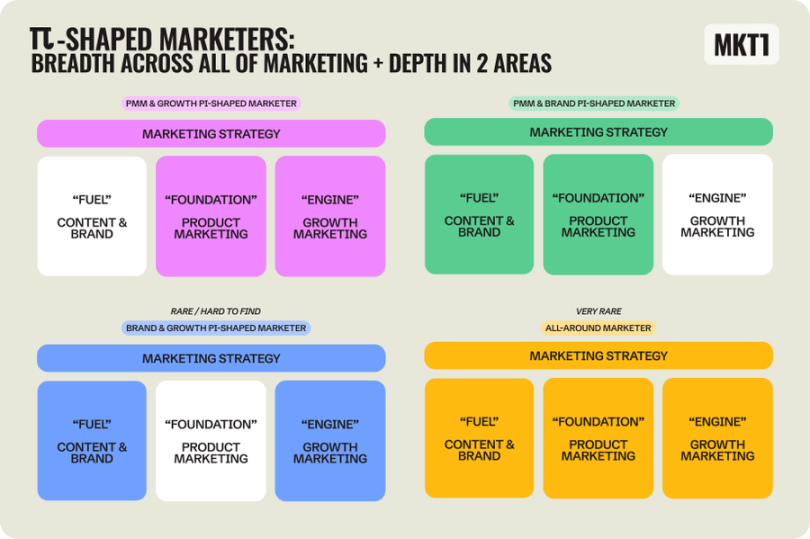
π-shaped marketing means having multiple deep expertise areas. Picture the Greek letter π: multiple vertical pillars of deep knowledge, supported by a horizontal base of general marketing understanding.
The reality of expert displacement
Companies still post jobs for "community managers" or "social media experts," though founders often aren't sure what type of marketer to hire first—though that's another topic entirely. If your resume says "community manager" or "social media expert," there's a strong chance you'll be obsolete in 5–10 years.
Not because you’re bad at your job—but because AI can now do what you do.
AI can:
-
Write copy better than most native speakers
-
Optimize ad campaigns 24/7
-
Analyze data faster than humans
-
Create genuinely high-quality content at scale (Claude excels here)
-
Automate email sequences that outperform manually written ones
But AI cannot seamlessly switch between growth marketing, ecosystem partnerships, and community building while also understanding how the product actually works and the dynamics of the industry.
This still requires human judgment across multiple domains.
Why this is happening
Three forces make π-shaped marketing inevitable:
-
AI democratizes individual skills: Every marketer now has access to tools that once required years of training. The entry barrier for any single marketing skill has vanished.
-
Role boundaries are dissolving: Growth marketers need to understand ecosystems. Community managers must grasp tokenomics, social media, and growth marketing. Social media experts need product marketing and KOL experience.
-
Speed demands versatility
How I discovered this
I didn’t plan to become π-shaped. It happened because I kept being pulled into problems requiring multiple skills:
Pillar 1: Paid acquisition + SEO
-
Run ad campaigns across all platforms for projects
-
Drive organic growth through content and search optimization
-
Understand which channels bring real users, not just traffic
Pillar 2: KOL marketing + social media
-
Manage influencer relationships and partnership deals
-
Build brand presence on Twitter, Telegram, Discord
-
Translate between technical teams and retail audiences
Pillar 3: Positioning + storytelling
-
Explain complex DeFi/infrastructure to everyday people
-
Build narratives that drive adoption and investment
-
Position projects within trending markets
The magic happens when these skills reinforce each other. Your KOL campaigns improve paid targeting; your technical understanding elevates social content; your growth data shapes partnership strategies.
Web3 π-shaped combinations that actually work
In Web3, many marketers already operate in a π-shaped way—they just haven’t named it yet. Teams are lean, budgets tight, and the space moves absurdly fast. Here are Web3-specific π-shaped combinations I’ve observed:
Community marketing + product marketing
In Web3, community is the product's distribution engine. If you know how to position a product and activate communities (memes, incentives, feedback loops), you become highly competitive. Many "community leads" have quietly become de facto product marketing managers (PMMs), testing product narratives, crafting messaging via Twitter/Telegram, and feeding insights back to product teams.
Growth marketing + tokenomics
Growth in Web3 isn’t just ads or SEO. Token design is a growth engine. If you understand lifecycle events and token incentives, you can create loops that retain users instead of buying them. Marketers running campaigns or airdrops on Galxe, Zealy are already combining growth with token mechanisms.
KOL marketing + community building + social media
Why it works: KOLs provide initial distribution, but community drives retention. Someone who can close KOL deals and foster grassroots engagement creates compounding effects. By 2025, many "KOL managers" are actually community builders who keep KOLs engaged and integrated into the community ecosystem.
Business development (BD) + product marketing
Why it works: In Web3, partnerships (integrations, co-marketing, liquidity deals) are marketing. If you can close partnerships and frame them with strong positioning, you amplify credibility and reach. Many "BD people" write copy, thread tweets, or draft newsletters—quietly developing PMM skills.
Data analytics + growth marketing
Web3 offers open data. A marketer who can read on-chain analytics and run growth loops can build campaigns based on real user behavior.
Why this happens: Teams are small, with no separate tokenomics and growth departments. Web3 distribution relies on incentives, community, KOLs, integrations—not Google and Facebook ads. So marketers are forced to blend disciplines to survive. The most critical Web3 π-shaped combinations revolve around community + another domain (product marketing, growth, KOLs, tokenomics). Community is the constant; the second pillar defines your edge.
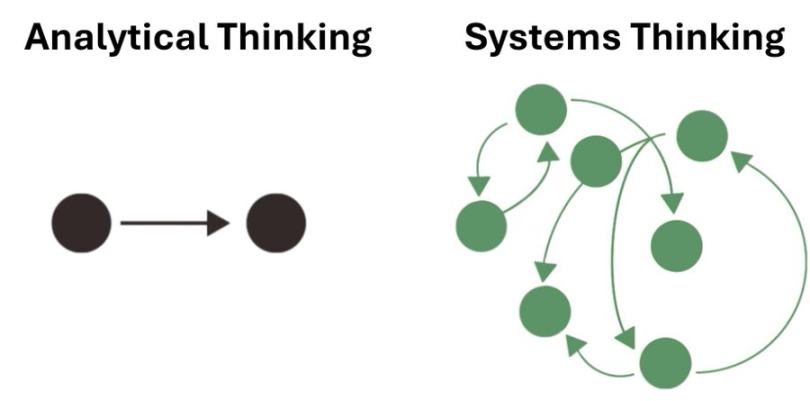
“Systems thinking” emerges naturally
"A system’s performance depends not on the performance of its parts taken separately, but on how they interact: how they interrelate, not how they act alone. Thus, improving the performance of each part separately can destroy the system." — Russell L. Ackoff
When working across multiple crypto marketing domains, you start seeing patterns experts miss:
-
How community sentiment affects token price, which impacts marketing budgets, shifting growth strategy.
-
How partnership announcements affect user behavior, changing conversion rates, shaping campaign optimization.
-
How protocol updates affect user onboarding, impacting retention metrics, influencing community engagement.
Systems thinking is the strategic intuition that naturally develops when you understand multiple parts of marketing and product strategy.
AI as an advantage
AI won’t replace π-shaped crypto marketers—it will enhance them.
Experts worry about AI taking their jobs; π-shaped marketers use AI across all their capabilities:
-
AI generates content variants; humans select based on community insights
-
AI analyzes on-chain data; humans interpret through multiple marketing lenses
-
AI optimizes campaigns; humans strategize based on ecosystem understanding
The broader your crypto expertise, the better you can leverage AI tools across functions.
Building your crypto π-shaped skills
Step 1: Assess your current depth
In which crypto marketing function are you truly excellent? If none, pick one and go deep.
Step 2: Identify adjacent skills
Which recurring problems require different knowledge? Struggling with user acquisition? Learn paid media. Can’t explain technical concepts? Develop content skills.
Step 3: Learn through practice
Don’t just take courses. Find crypto projects that force you to grow new abilities while leveraging existing strengths.
Step 4: Connect the dots
Actively seek connections between skill areas. How can on-chain analysis improve community management? How does KOL experience help manage social channels?
Key takeaways
AI cannot integrate insights across community, growth, partnerships, content, and technical marketing while also understanding how crypto actually works.
Start building your second pillar now, then your third. Become someone who solves complex crypto marketing problems requiring expertise across multiple domains.
Because when AI can optimize everything, the only thing that matters is knowing how everything connects in your strategy.
Join TechFlow official community to stay tuned
Telegram:https://t.me/TechFlowDaily
X (Twitter):https://x.com/TechFlowPost
X (Twitter) EN:https://x.com/BlockFlow_News
 @therosieum