On-Chain AI Trench Observation: Narrative Shift, Who's the Next Hotspot?
TechFlow Selected TechFlow Selected
On-Chain AI Trench Observation: Narrative Shift, Who's the Next Hotspot?
Interestingly, the biggest winners often appear "boring" in the early stages, until they suddenly become the market's focus.
 Navigating Web3 tides with focused insights
Author: 0xJeff
Translation: TechFlow
Since the release of the first "AI Trends in the Trenches" article back in May, many things have changed:
-
Market sentiment has declined, and the number of fairly launched AI agent tokens has decreased
-
Narratives have shifted dramatically
-
New ecosystem players have replaced older ones
-
The value proposition of Web3 AI systems has become clearer
-
Institutional and whale opportunities in AI investments have increased
-
A shift from hype to products and real-world impact
-
And much more…
In this article, we’ll review key developments over the past few months, analyze current trends, identify market leaders, explore future directions, and discuss how to prepare for upcoming opportunities.
Let’s dive in.
The trenches of the market aren’t easy
First: There are too many tokens in the market, leading to fragmented liquidity and attention.
Second: Meaningless discussions on Crypto Twitter (CT) and an overflow of low-quality AI content distract focus from high-value content.
Third: Market热度 is no longer as intense as before, and this trend will persist.
Fourth: Narrative shifts happen extremely fast—if you’re not constantly monitoring or relying on reliable information sources, it’s hard to keep up.
Looking back at Q1 and Q2 this year, meme coins tied to the Trump family, celebrity tokens, and other attention-grabbing projects like ICM (Intelligent Creator Coin), creator coins, and Pump ICOs captured most of the active liquidity, leaving only residual funds for the AI trenches.
AI Agent Ecosystem: From Hype to Productization
Due to changing market conditions, opportunities have become scarcer. As one of the largest AI agent ecosystems today, @virtuals_io, with the largest number of developers, has emerged as a highly anticipated platform. Its Genesis Launches performed decently, occasionally delivering 5–20x returns during hype cycles.
However, this momentum lasted only 1–2 months. Ultimately, the ecosystem relied too heavily on hype-driven new project launches. When no exciting new projects were released, market attention and enthusiasm quickly faded, causing the ecosystem's "points" to lose value.
This shift in sentiment has made investors and speculators more selective, prioritizing actual product value over pure hype.
Two Major Current Trends in AI Agents
Investors shifting from Virtuals’ initial launches to hand-picking high-quality teams
Some early-launched team tokens faced massive sell-offs but are now recovering and planning to roll out significant new products or features.
Meanwhile, some new teams are choosing to launch on the Virtuals platform at a more mature product stage. Instead of spending 2–3 months building an MVP under the traditional model, these teams launch fully built products immediately after their token generation event (TGE).
Here are some notable teams (but not limited to):
-
@ArAIstotle: Focused on AI fact-checking
-
@PredictBase: Decentralized prediction markets
-
@Mamo_agent: Personal finance assistant (built by Moonwell team)
-
@AskBillyBets: Sports prediction agent/engine/aggregator
-
@useBackroom: AI-powered SocialFi platform
Looking ahead: High-quality projects will remain scarce
This trend is likely to continue—while top-tier projects are limited in number, closely tracking promising agent teams on the Virtuals platform could uncover the next 10–50x investment opportunity.
Investors turning to other ecosystems: Seeking more attractive opportunities
As the market evolves, investors are gradually shifting attention from Virtuals to other ecosystems offering more compelling opportunities. For example, @CreatorBid has attracted investor interest through its highly curated project launch strategy. At its core, it leverages Bittensor subnet inference technology to launch AI products with clear utility. This utility-driven launch model, combined with the team’s focus on product support, partnerships, and marketing for existing projects, positions CreatorBid as a standout in the AI agent ecosystem.
Another similar player is @HoloworldAI, which introduced a lottery-based launch mechanism (HoloDraw). Users participate by purchasing lottery tickets (each representing 0.5 SOL in purchasing power). 35% of the token supply is reserved for HoloDraw, while unsuccessful participants still have a chance to receive tokens via a consolation prize pool (5% of supply). $HOLO successfully listed on Upbit with a $1.5 billion fully diluted valuation (FDV), capturing broad community attention and momentum.
In addition, @openservai adopts a more conservative approach, focusing on incubating teams and helping them launch products, acquire users, and generate revenue before any token issuance. OpenServ is also developing its own decentralized n8n product for consumer markets.
Looking ahead: Key trends and ecosystem observations
-
CreatorBid: Its top agent projects continue seeking product-market fit (PMF) in the PredictionAI space, while CreatorBid works to enhance value accrual for $BID—the current main bottleneck.
-
Other ecosystems: Continuing with a “product-first” strategy, though tokens may face short-term pressure, valuations could recover once flagship use cases, products, or teams emerge.
-
Ecosystems to watch: CreatorBid, OpenServ, Holoworld, Arc, Loomlay, ElizaOS.
Moreover, capital is concentrating around a few key narratives and verticals beyond just AI agents.
Decentralized AI: From raw intelligence to intelligent products
Decentralized AI (DeAI) remains one of the top areas of concentration for whales and institutional capital. Below are key trends and innovation directions in this space:
-
Decentralized computing: The highest-revenue segment
Decentralized computing continues to lead in revenue. @AethirCloud reports eight-figure annual revenue, while @chutes_ai serves over 500–1000 billion tokens daily via openrouter, demonstrating immense market potential.
-
Privacy-preserving AI: Enabled through federated learning
Privacy-preserving AI has become a critical solution for Web2 enterprises and government agencies. The @flock_io platform has achieved both product-market fit and token-market fit in privacy and domain-specific AI use cases. Recent collaborations include UNDP (United Nations Development Programme), Hong Kong’s official AI provider (HKGAI), and CIMG.
-
Rise of Darwinian AI
Bittensor has expanded to 128 subnets. @SentientAGI announced GRID (the world’s largest intelligent coordination network) and plans to launch a Darwinian AI ecosystem via the “artifact” subnet. Other players like @FractionAI_xyz apply Darwinian AI in gaming—for Polymarket predictions, AI agent battle forecasts, tic-tac-toe, soccer, etc.
-
Prediction AI nearing productization
Multiple Bittensor subnets have demonstrated scalable advantages in decentralized intelligence creation and contribution, significantly improving intelligence levels. For instance, SN18 Zeus, SN44 Score, and SN50 Synth outperformed benchmarks and state-of-the-art (SOTA) models. Notably, SN44 successfully monetized signals through @sire_agent's sports betting strategies, with top-tier sports hedge funds already deploying $300 million using these strategies.
The newest emerging segment within DeAI is data, including data labeling, reinforcement learning with human feedback (RLHF) services, and evaluation. These tasks are costly and labor-intensive in Web2, but Web3 enables global participation in annotation, scoring, and feedback via token incentives, effectively reducing costs.
Key Players
Leading teams in data labeling and RLHF include: SapienAI, FractionAI, PerleAI, PublicAI, SN52 Dojo, Synesis One.
DeFi x AI (DeFAI): From proof-of-concept to fully autonomous financial agents
The DeFAI sector has evolved rapidly over just a few quarters—from abstract layers and GPT-like interfaces (which underperformed in Q1), to POCs of personalized agents managing user funds in Q2, to fully autonomous financial agents in Q3 equipped with highly scalable and verifiable infrastructure.
Key Developments and Representative Players
A prime example of rapid iteration is @gizatechxyz, which has led the entire field with nearly $2 billion in cumulative agent trading volume and $20 million in agent assets under management (AuA) running 24/7. The newly launched Swarm Finance and Pulse (Pendle agent) mark the beginning of a new era, where agents help users optimize yields on idle capital. @Almanak__ follows closely, introducing a highly scalable and verifiable infrastructure that uses smart contracts (asynchronous tokenized vaults) and multiple coordinated agents to create a system where AI does not directly manage user funds. This design completely avoids risks associated with AI hallucinations or exploits, providing institutions and whales a secure environment to hold large amounts of capital. Additionally, Almanak’s quantitative strategy creation platform allows users to design quant strategies in minutes instead of weeks.
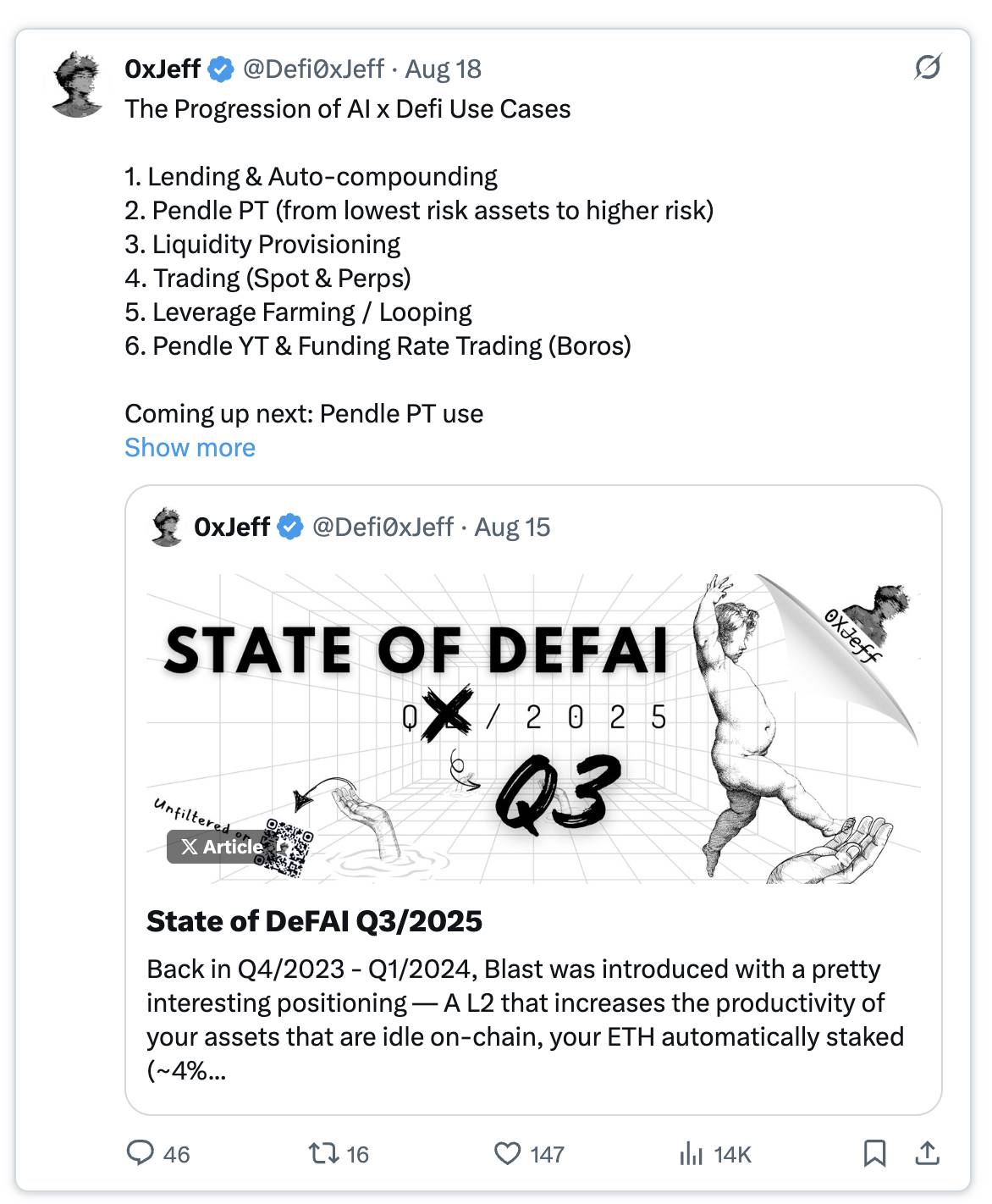
Evolution of DeFAI Use Cases
The rapid advancement of DeFAI highlights its vast potential in decentralized finance, evolving from optimizing idle capital to delivering fully autonomous asset management solutions, attracting increasing capital and attention.
Progress in AI x DeFi Use Cases 1. Lending and auto-compounding 2. Pendle PT (from lowest-risk to high-risk assets) 3. Liquidity provision 4. Trading (spot and perpetual) 5. Leveraged mining/cycling 6. Pendle YT and funding rate trading (Boros)
Key players to watch: Giza, Almanak, Cod3x, Theoriq
Future Trend Predictions
-
Prediction AI: The most asymmetric investment opportunity The total addressable market (TAM) for prediction markets far exceeds Web3, with users from all walks of life participating in topics they care about via platforms like Polymarket and Kalshi. AI systems and tools built atop prediction markets stand to capture massive value from this growth. Consumer-facing applications with user traffic and alternative prediction markets/agents will particularly stand out. Challenges & Breakthroughs: Liquidity remains the biggest hurdle for prediction markets, but AI market makers and vault products may improve market liquidity.
-
Data: The next focal point in Q4 As “useful” data becomes increasingly scarce, Web3 data players will face rising demand from both Web2 and Web3 AI labs. Data will become the biggest moat and bottleneck in the future.
-
AI agents and ecosystems: Continued attention magnets AI agents and their ecosystems remain attractive to on-chain players and the crypto community due to their simplicity and fair launch structures. While high-performance opportunities will be rarer, standout projects could still deliver 10–50x gains. However, liquidity may remain low, so investments should be approached with caution.
-
DeFAI: Driving TVL and trading volume across DeFi protocols DeFAI will enter a new phase, with top players becoming major drivers of TVL and trading volume for leading DeFi protocols (such as AAVE, Pendle, Fluid, Uniswap, Aerodrome, etc.). Future developments will cover more DeFi use cases, employ more complex strategies, offer superior execution, and build more secure infrastructure and safeguards.
Core Takeaways
Competition in the crypto industry will remain fiercely intense:
Many tokens will lose value, market attention will scatter, and people may eventually walk away.
Yet amidst this chaos, the foundation for the next wave of Web3 AI is quietly being laid.
The leaders of the next wave will share these traits:
-
Solve real problems: Focus on addressing user pain points rather than chasing trends.
-
Attract and retain users: Build sticky products and communities.
-
Build narrative-resistant products: Products that withstand market shifts and maintain long-term value.
Interestingly, the biggest winners often appear “boring” at first (e.g., infrastructure, privacy, data), until they suddenly become the market’s focal point.
Disclaimer
This article is for informational and entertainment purposes only. The views expressed are not to be construed as investment advice or recommendations. Readers should conduct their own due diligence based on their personal financial situation, investment goals, and risk tolerance (not addressed herein) before making any investment decisions. This article does not constitute an offer or solicitation to buy or sell any assets mentioned.
Join TechFlow official community to stay tuned
Telegram:https://t.me/TechFlowDaily
X (Twitter):https://x.com/TechFlowPost
X (Twitter) EN:https://x.com/BlockFlow_News