Top AI models diverge: GPT to C, Claude to B
TechFlow Selected TechFlow Selected
Top AI models diverge: GPT to C, Claude to B
According to the Anthropic Economic Index report, 77% of Claude users' use cases are concentrated in business applications, with 36% specifically dedicated to programming tasks, demonstrating clear enterprise-level characteristics.
 Navigating Web3 tides with focused insights
Author: Dong Jing, Wall Street Insights
The global AI market is showing a clear trend of user segmentation. The latest data from two major players, OpenAI and Anthropic, indicates that ChatGPT is becoming the preferred personal life assistant, while Claude dominates in enterprise automation deployment.
According to previous reports by ZF Trading Desk, Barclays stated in its latest research report that data shows 90% of Anthropic's revenue comes from API services, far exceeding OpenAI's 26%, highlighting Claude's strong position in the B2B market.
User behavior analysis further confirms this divergence. According to the Anthropic Economic Index report, 77% of Claude usage scenarios are concentrated in business applications, with 36% specifically used for programming tasks, demonstrating clear enterprise-level characteristics. In contrast, OpenAI research shows that 73% of ChatGPT use cases are unrelated to work, positioning it more as a personal assistant.
Analysis suggests that the world's two leading AI models are following distinctly different commercial paths: Claude, leveraging its strengths in API integration and enterprise automation, is reshaping the landscape of B2B AI services, while ChatGPT continues to solidify its leadership in the consumer market.
Claude Establishes Lead in the API Market
According to ZF Trading Desk, Barclays previously noted that Anthropic has built a significant competitive moat in the enterprise AI services market.
Data shows that 90% of Anthropic's revenue comes from API services, while only 26% of OpenAI's revenue comes from this channel, with its main income still relying on the ChatGPT consumer product.
Revenue growth figures further highlight Claude's strong momentum in the B2B market.
Anthropic's API business generated $512 million in revenue in 2024, projected to surge to $3.907 billion in 2025, a year-on-year increase of 662%. In comparison, OpenAI's API business earned $1 billion in 2024, expected to grow to $1.8 billion in 2025, an 80% increase.
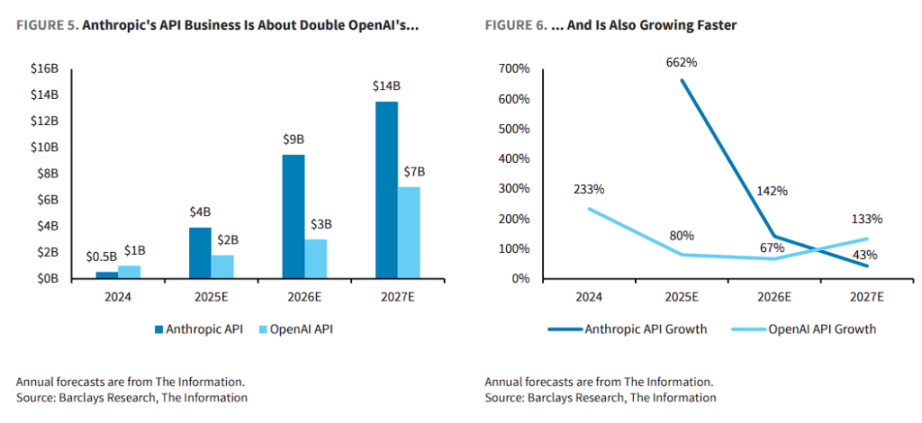
Analysis points out that this revenue structure difference reflects the distinct strategic focuses of the two companies. Claude specializes in providing programmable, integrated AI capabilities for enterprise clients, while ChatGPT relies more on subscription-based consumer service models.
Usage Scenario Divergence Confirms Business Positioning Differences
User behavior data further confirms the differing positioning of the two AI models.
According to the Anthropic Economic Index report, Claude users exhibit clear commercial traits: 77% of usage scenarios involve business applications, and 36% are dedicated to programming tasks.
Among API customers, this trend is even more pronounced—77% of enterprise usage follows an automated pattern, primarily for task delegation rather than collaborative interaction.
OpenAI's research paints a very different picture.
Analysis based on 1.5 million user chat records shows non-work uses have become ChatGPT's primary application scenario. In June 2024, work and personal uses were roughly equal, but by June 2025, non-work uses accounted for 73% of all conversations.
Among over one million classified conversations, "practical guidance" accounted for 28.3%, covering personal needs such as daily advice, academic help, and fitness guidance, with writing assistance ranking second.
The difference in programming task frequency is also telling. Among Claude users, 36% engage in programming-related work, whereas only 4.2% of ChatGPT user conversations involve programming, further underscoring the divergence in target user groups.
Enterprise Automation Demand Drives Claude Growth
Claude's success in the enterprise market stems from its precise understanding of automation needs.
API data shows enterprise clients primarily use Claude for programmable, task-execution purposes rather than collaborative human-AI interaction. This usage model aligns closely with enterprises' demands for efficiency and scalability.
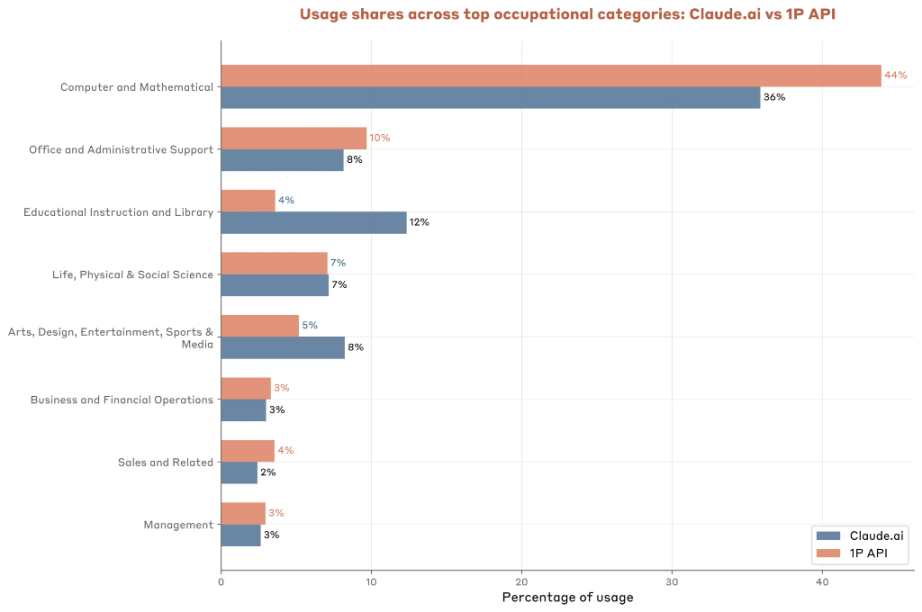
In terms of task distribution, 44% of Claude's API customers focus on computer and mathematics tasks, significantly higher than the 36% on the Claude.ai platform. Meanwhile, office and administrative management tasks account for about 10%, reflecting strong demand for automated office solutions. Enterprises also deploy Claude in marketing material creation and commercial recruitment data processing.
Surprisingly, enterprises show relatively low sensitivity to AI usage costs.
A 1% cost increase leads to only a 0.29% decrease in usage frequency, indicating that model capability, ease of deployment, and economic value outweigh cost considerations. More expensive tasks often see higher usage rates—computer and math tasks cost over 50% more than sales-related tasks, yet dominate in volume.
Geographic Distribution Reflects Different Market Strategies
The geographic usage patterns of the two AI models also reflect different market positioning.
Claude usage correlates strongly with national GDP—per capita GDP increases of 1% correspond to a 0.7% rise in Claude usage. Technologically advanced small economies like Israel and Singapore lead globally in Claude adoption.
In the U.S. market, Washington D.C. and Utah lead in per capita Claude usage, reflecting high demand from government agencies and the tech industry for enterprise-grade AI tools. This distribution aligns with Claude's positioning toward high-value enterprise clients.
ChatGPT, by contrast, shows a broader global penetration trend.
OpenAI research shows ChatGPT is growing faster in poorer countries than in wealthier ones, with a more diverse user base. As of June 2025, 52% of ChatGPT users are female, and nearly half are aged between 18 and 25.
Technical Capability Differences Shape Competitive Landscape
Different technical strengths of Claude and ChatGPT are shaping their respective competitive advantages.
Claude excels in code generation, debugging, and technical problem solving, closely tied to its success in the API market.
Rapid adoption by developer communities and the relatively low organizational barriers for individual developers have laid the foundation for Claude's enterprise applications.
ChatGPT, on the other hand, performs better in information retrieval and personal guidance.
"Information search" has become ChatGPT's third-largest use case, with users treating it as an alternative to web search. This application model poses a potential challenge to traditional search engines like Google and creates opportunities for OpenAI to explore new revenue streams such as advertising and e-commerce recommendations.
Differences in human-AI collaboration modes between Claude and ChatGPT are also noteworthy.
Claude users are more inclined to delegate entire tasks to AI, reflecting enterprises' preference for automation. ChatGPT users tend toward collaborative interaction, aligning with personal users' learning and exploration needs.
Join TechFlow official community to stay tuned
Telegram:https://t.me/TechFlowDaily
X (Twitter):https://x.com/TechFlowPost
X (Twitter) EN:https://x.com/BlockFlow_News