Interview with Sahara AI Co-Founder: The era is questioning the future of AI, and Web3 has the answer
TechFlow Selected TechFlow Selected
Interview with Sahara AI Co-Founder: The era is questioning the future of AI, and Web3 has the answer
"Sahara AI made users feel for the first time that AI is no longer something out of reach, but a tool that can bring them real benefits."
 Navigating Web3 tides with focused insights
By: TechFlow
In 2025, compared to topics firmly capturing market attention such as stablecoins, tokenized stocks, and crypto treasuries, Web3 AI appears somewhat "squeezed into the cracks."
Yet within these tight spaces, we can still see high-quality projects persistently building—moving beyond AI Meme speculation to explore real-world applications of Web3 AI and achieving impressive results. Sahara AI, which is dedicated to enabling everyone to participate in AI and benefit from contributing to it, is one such example.
In March, Sahara AI launched Season Three of its data services testnet, with over 3.5 million users signing up for testing;
In June, Sahara AI conducted a $SAHARA community fundraising event on Buildpad, attracting more than 30,000 KYC-verified users from 118 countries worldwide, exceeding its funding target by 777%;
Subsequently, $SAHARA was listed on major global exchanges including Binance, Coinbase, Upbit, and Bithumb, repeatedly ranking among the top three on Upbit—the largest cryptocurrency exchange in South Korea—with trading volume second only to BTC and XRP.
What has enabled Sahara AI to gain widespread recognition from both capital and users?
To answer this question, we engaged in an in-depth conversation with Tyler Zhou, Co-Founder and Chief Operating Officer of Sahara AI.
Discussing the current state of Web3 AI development, Tyler expressed firm optimism about Web3 AI:
There are indeed too many projects in the market that simply repackage existing AI tools and launch tokens; such practices hold little value. But I firmly believe the next big wave in AI will emerge from Web3. Web3 AI is foundational technology capable of transforming how the entire industry operates.
When analyzing the driving forces behind Sahara AI’s remarkable achievements, Tyler stated:
Sahara AI makes users feel, for the first time, that AI is no longer something distant, but a tool that brings tangible benefits. I believe we are the only AI project that has successfully established a sustainable business model. Our focus going forward will be on advancing AI into people's daily lives.
In this feature, let us follow Tyler Zhou—a front-line AI entrepreneur—to explore Sahara AI’s journey in building a user-needed, market-recognized, and feedback-driven sustainable development model in the new era of AI.

The Core Opportunity of AI: Empowering Every Participant as a Real-Yield Tool
TechFlow: Thank you for your time. Sahara AI has received significant attention this year. Could you please start by giving us a brief introduction to Sahara AI?
Tyler:
When people ask me what Sahara AI is, my favorite answer is: Sahara AI is the New Era of AI.
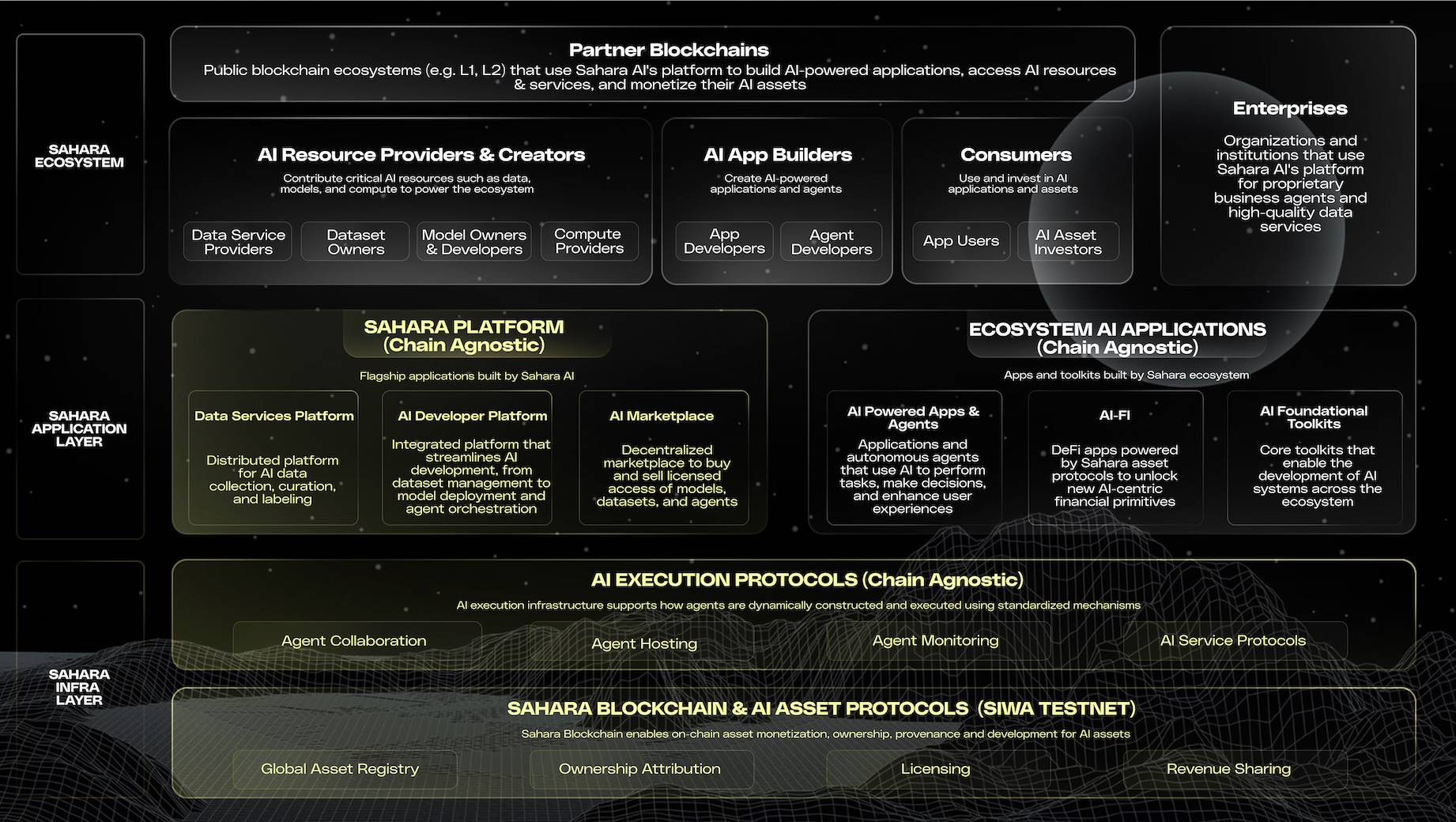
This isn't just a lofty concept. Our motivation for creating Sahara AI is simple: enable anyone interested in AI to truly participate. Whether you're a regular user hearing about AI for the first time, a developer writing code, or even an AI enterprise, you can find your place within the Sahara AI ecosystem.
Currently, our platform has over 3.2 million accounts, with tens of thousands of daily active users. What are these users doing?
Some earn money through data labeling, others deploy their own trained AI models, and enterprises find customized AI solutions here. Many users tell us this is the first time they feel AI is no longer out of reach, but rather a tool that delivers real financial benefits.
This genuine user demand also explains why we’ve gained support from so many leading exchanges. The market is smart—it recognizes an ecosystem that genuinely creates value.
TechFlow: Could you share some of your experiences before founding Sahara AI? What insights or experiences inspired you to create Sahara AI? Was this a move to chase trends, or driven by a deeper conviction?
Tyler:
During my years as an investor, I specialized in researching AI, reviewing hundreds of AI products and projects across both Web3 and Web2.
After ChatGPT surged in popularity in early 2023, I noticed an interesting phenomenon: the entire AI data labeling industry suddenly faced supply shortages. Prior to that, traditional data labeling had always been expensive, especially for complex datasets. Preparing data alone caused headaches for many small and mid-sized teams, and quality control was poor, often resulting in inconsistent annotations.
From a compensation standpoint, the traditional model involved platforms charging clients high fees while offering minimal returns to data labelers. Value distribution in the middle layer was highly imbalanced—an inherently flawed system.
In my view, the core opportunity lies not in “building a new tool,” but in redesigning the value distribution mechanism of AI. If we could use Web3 to reconstruct this process—enabling global participation, ensuring fair rewards for contributors, and making the entire workflow transparent and traceable—we could simultaneously solve the fundamental issues of insufficient supply and unfair value allocation.
I discussed this idea with Sean, another co-founder of Sahara AI, who is a professor. We found our thinking aligned perfectly. He saw bottlenecks in AI development from an academic perspective, while I identified flaws in the business model from an investment angle. Combining these two viewpoints formed the foundational framework of Sahara AI today.
I can clearly say that founding Sahara AI was absolutely based on conviction, not trend-chasing. Sahara AI was born with a mission from day one: to bring AI development into everyone’s daily life and ensure every participant benefits.

The Next Big Wave in AI Will Emerge from Web3
TechFlow: Some argue Web3 AI is useless and projects aren’t viable, while others believe the next major direction in AI will originate from Web3. How do you view these opposing perspectives?
Tyler:
Based on what I've shared, I understand both views.
Frankly, I understand why some think Web3 AI is useless—there are indeed too many projects that merely wrap existing AI tools and issue tokens. Such approaches naturally lack value.
But I firmly believe the next major wave in AI will come from Web3, because I see AI’s core challenge today as unfair value distribution, and Web3’s greatest strength is ensuring every contributor receives their rightful reward. Moreover, AI inherently requires global collaboration—data comes from all over the world, computing power is distributed, and developers are global. Traditional centralized models struggle to achieve true open collaboration, whereas Web3 is inherently designed to solve exactly this problem.
Based on these principles, what Sahara AI does is straightforward: we’ve built complete infrastructure to support this new collaborative model, enabling hundreds of thousands of daily active users to collaboratively create value on our platform, while establishing a sustainable economic cycle that ensures fair returns for every participant.
This future hasn’t fully arrived yet—that’s precisely why people like us need to build it.
TechFlow: In recent years, numerous AI projects have emerged, yet their performance in secondary markets remains weak. How do you interpret this phenomenon?
Tyler:
In each market cycle, people FOMO over different things.
Take Pyth Network as an example: everyone knows oracles are a major direction, and investors are bullish, but token prices performed modestly in prior years—the market wasn’t mature yet. Just days ago, the U.S. Department of Commerce announced a partnership with Pyth Network to put key economic indicators like quarterly GDP on-chain. This brought Pyth Network global attention and doubled its price.
This is similar to 2010, when everyone knew electric vehicles were the future and Tesla’s vision was advanced, but those who bought Tesla stock back then endured tough years—not because EVs lacked value, but because battery tech wasn’t ready, charging stations weren’t widespread, and the ecosystem needed time.
Web3 AI shares similarities with oracles—they’re not just another sector, but foundational technologies that can transform how entire industries operate. Just as smartphones didn’t just add touchscreens but redefined digital life, these transformative technologies will eventually explode.
The current challenge is that infrastructure remains incomplete, and very few projects have achieved viable business models. Most AI projects are still conceptual, failing to solve real problems—naturally, the market doesn’t respond.
But this is where the opportunity lies. We’re preparing the groundwork now, so when the market finally turns its attention to AI, Sahara AI will already have accumulated users, achieved data breakthroughs, and built a complete ecosystem—then value will naturally manifest.
Building a Sustainable Business Model to Bring AI into Daily Life
TechFlow: As the only AI project listed on two major Korean exchanges, how do you view Sahara AI’s influence in the Korean market? And within your vision of “New Era AI,” where does Sahara AI stand?
Tyler:
The most direct feedback comes from users, and Korea’s response is particularly convincing: on Upbit, $SAHARA has repeatedly ranked among the top three by trading volume, with consistently high activity. Korean users are indicative—they vote with real money, signaling to broader markets: Sahara AI is their chosen representative of AI.
Now, millions of users actively engage on our platform. Many earn $SAHARA rewards through data labeling and then use these tokens for further activities within the ecosystem. In the future, tokens will be more widely used for AI Agent calls, AI asset access, and authorization, forming a closed-loop economic model where participants genuinely experience the practical utility of tokens. Combined with our team’s background and execution capability, this strengthens community confidence.
From a commercial perspective, I believe we are the only AI project that has successfully established a sustainable business model. Sahara AI not only serves over 40 enterprise clients paying for our services on the B2B side, but also enables individual users on the consumer side to genuinely earn money. We avoid artificially subsidized false prosperity and instead build healthy, self-sustaining value cycles.
Calling ourselves a leader might be premature—the AI space is just beginning, and many excellent projects will emerge. But I believe that in 5 to 10 years, only a few truly impactful AI projects will remain, and some of them will grow massive. Projects relying on hype will fade, while those solving infrastructure challenges and building sustainable models will grow stronger.
What Sahara AI must do now is continue strengthening our foundation, enabling more people to participate in the New Era of AI through our platform. Whether we ultimately become a true leader will be decided by time.
TechFlow: What’s next for Sahara AI? Could you share your future roadmap and upcoming initiatives?
Tyler:
Sahara AI’s next phase will focus on how AI can truly integrate into people’s daily lives.
Consider ChatGPT today, which sees 800 million weekly users. Ordinary people now say “I’ll ChatGPT this,” just as they once said “I’ll Google it.”
As these AI models increasingly mirror human thought patterns, businesses are starting to use AI for actual operations and problem-solving, making high-quality training data increasingly scarce. Everyone wants to train their own models so AI better understands their business, but high-quality, scenario-specific data is hard to find—and mostly controlled by a few large platforms. This presents our opportunity.
Sahara AI aims to seize this window, focusing efforts in two key directions:
First, expand the DSP model across the entire AI value chain—such as financial data, DeFi transactions, imagery, content creation, and more;
Second, transform this data into tradable assets.
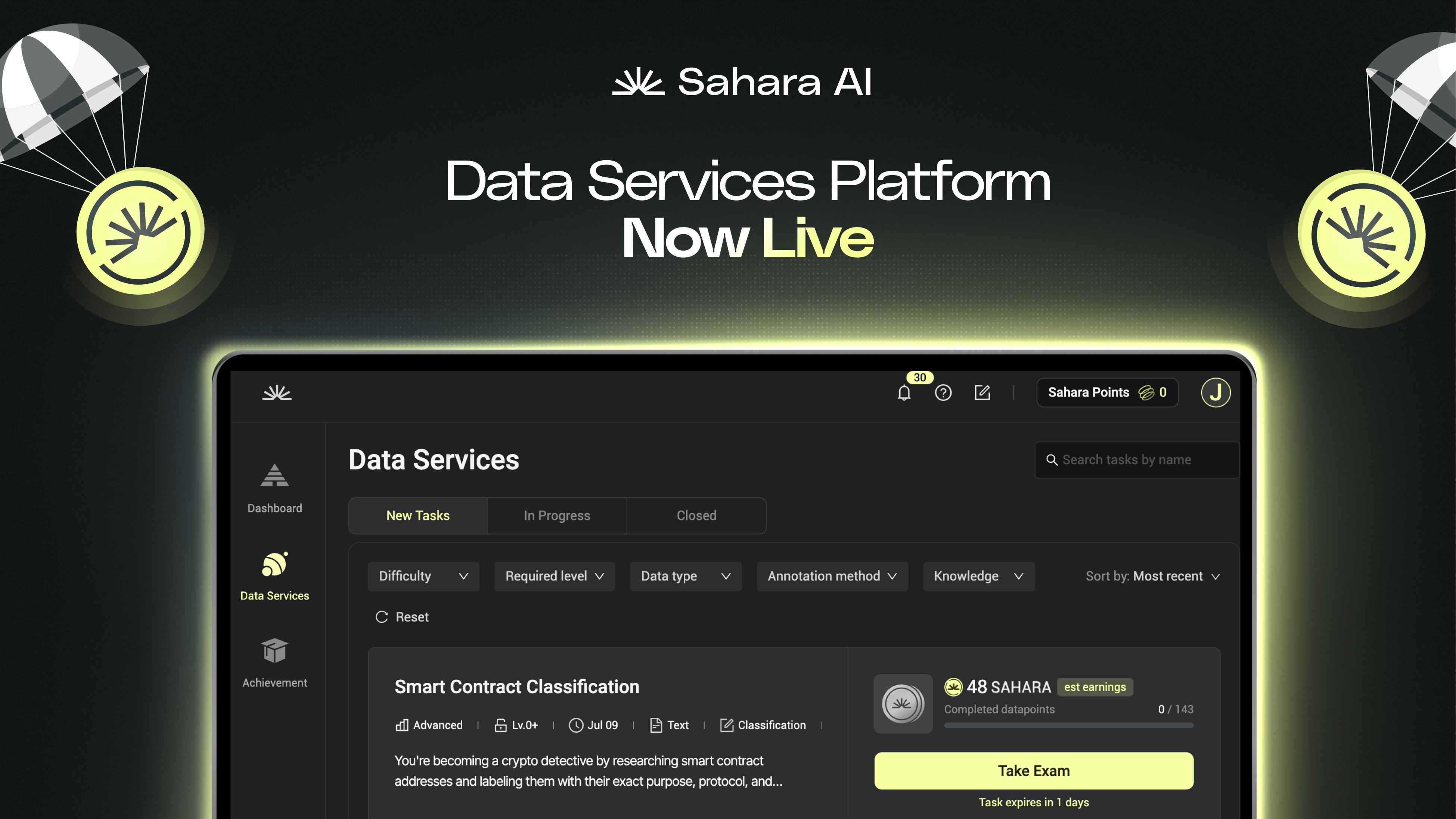
We officially launched DSP at the end of July. Beyond early partners like Myshell and Camp Network, over a dozen additional projects have begun integrating with DSP. Since the testnet phase, the platform has attracted over 200,000 contributors who have completed more than 8 million data labeling tasks, with accuracy exceeding 92%. Through our dual-reward mechanism, the total reward pool has surpassed several hundred thousand dollars, including incentives from partners like Myshell and Camp Network.
We’ve observed an interesting trend: enterprise demand for this transparent data service is far greater than expected. More and more projects are queuing to join DSP, discovering they can obtain higher-quality data through us, with full traceability and verifiability throughout the process.
The AI industry is still in its infrastructure-building phase, but I sense a turning point approaching. When AI begins large-scale commercial adoption, the value of data will grow exponentially.
All our current strategic moves are preparing for that moment.
TechFlow: As a successful entrepreneur, facing today’s challenging startup environment, what issues trouble you the most?
Tyler:
The question I think about most every day is: how can participants actually earn money within Sahara AI?
Many may assume the hardest parts of entrepreneurship are fundraising, marketing, or market expansion—but to me, none of these are the most important. What occupies my mind daily is: Do people really feel that their AI experience is smoother, opportunities more equitable, and their contributions finally rewarded through Sahara AI?
To understand this, I’ve created multiple accounts to observe discussions in communities and on X: I feel happy when someone says they enjoyed the product and earned money through labeling; when someone complains about a feature, I immediately note it down for the team to improve. Often, I even join various trading groups to discuss directly and understand their real thoughts.
To me, feedback matters above all, because I want users to feel, for the first time: AI is no longer an expert-only privilege, but something they can participate in and benefit from. Data contributors should realize that labeling work represents valuable assets, not cheap labor.
I’m well aware that whether they’re community members or token holders, people follow us because they seek real participation and returns—not just grand visions. If an ordinary user spends hours on our platform and walks away empty-handed, then all our technology and philosophy become meaningless.
This may sound unglamorous, but I believe it’s the most important thing. Only when users truly benefit can Sahara AI sustainably thrive.
TechFlow: Amid the accelerating convergence of Web2 and Web3, and given Sahara AI’s rich experience in both Web2 AI and Web3 AI, what opportunities do you see for AI’s future? And what challenges lie ahead?
Tyler:
Frankly, the integration of Web2 and Web3 in AI is indeed happening, but the process is slower than expected.
The biggest opportunity I see is AI becoming part of everyday life, with Web3 enabling ownership and fair distribution of its value.
For instance, when investing, you currently spend hours analyzing charts and data. In the future, your AI assistant will monitor the market continuously, alert you to opportunities, and even offer recommendations. For content creators, AI won’t just write articles—it will help promote content, interact with fans, and handle business collaborations.
More importantly, Web3 allows AI to become personal assets, not just tools. Just as owning property lets you earn rental income, the AI models you train or the data you contribute can generate revenue whenever others use them. For example, if you develop an AI that analyzes a specific industry, you can earn ongoing income every time others invoke that model.
We’re collaborating with prominent projects to deliver real-life AI solutions—such as providing AI-powered smart suggestions within wallets, or offering creators comprehensive AI solutions from content generation to revenue management.
Of course, challenges are evident: technologically, blockchain performance still falls short of AI’s high-frequency invocation needs; from a user experience perspective, there remains a barrier for average users; and from a business model standpoint, proving the sustainability of this new value distribution mechanism will take time.
These challenges are actually opportunities for Sahara AI. We’re proactively solving them—building infrastructure that can scale, designing interfaces so ordinary users don’t need to understand the underlying tech, and establishing sustainable business models.
I believe that in a few years, professional knowledge and even daily behavioral patterns could become valuable AI components, and Sahara AI may well serve as the foundational infrastructure of this new economy.
Even If You Don’t Embrace AI, AI Will Reshape Your Life
TechFlow: Given the opportunities and challenges, what advice do you have for ordinary people looking to participate in AI?
Tyler:
Regarding how ordinary people can get involved in AI, I don’t see it as a choice—it’s merely a matter of time.
Just like the shift from Yahoo to Google, initially people thought search engines were similar, but gradually realized Google was simply better, and eventually everyone switched.
AI will follow the same path—over the next few years, it will quietly permeate every scenario: investing, working, creating. It’s a natural evolution.
For those eager to get started, Sahara AI offers a great entry point today.
My advice is simple: If you’re interested in AI, try it now. The cost is low, the learning curve gentle, but it helps you adapt early to this new way of working. Much like early Google adopters, it may seem like just switching search engines, but they gained a significantly better experience.
I firmly believe: Even if individuals don’t actively embrace AI, AI will inevitably integrate into and reshape our lives. In the future, whether in work, study, investing, or socializing, AI will become an indispensable part of daily existence.
Sahara AI aims to provide exactly this kind of accessible gateway—enabling users to enter this new era at minimal cost and in the most natural way possible.
Join TechFlow official community to stay tuned
Telegram:https://t.me/TechFlowDaily
X (Twitter):https://x.com/TechFlowPost
X (Twitter) EN:https://x.com/BlockFlow_News
 深潮TechFlow