From Search Box to Financial Future: Google Prepares to Redefine Value Flow with Blockchain
TechFlow Selected TechFlow Selected
From Search Box to Financial Future: Google Prepares to Redefine Value Flow with Blockchain
The story begins with a blank page and a search box; its next chapter might be a ledger unseen by anyone yet used by everyone.
 Navigating Web3 tides with focused insights
Author: Prathik Desai
Translation: Block unicorn
Britney Spears’ songs played on every radio, The Matrix made us question reality, and teenagers around the world were busy burning CDs to make their own mixtapes. The internet was still clunky, requiring a screeching dial-up tone to connect, but it had already begun seeping into daily life. It was the late 1990s.
Search engines existed back then, but they looked and felt messy. Yahoo’s directory resembled a digital version of the Yellow Pages, while AltaVista and Lycos spat out long lists of links—fast, but disorganized. Finding the information you needed was often a daunting task.
Then came a white screen with a clean search box and two buttons—"Google Search" and "I'm Feeling Lucky." People tried it once and never left.
That was Google’s first "magic." The result? Larry Page and Sergey Brin’s creation turned “Google” into a verb synonymous with searching. When you forgot a physics theory, you’d say, “Just Google it!” Want to learn how to tie the perfect knot? “Why not Google how?”
Overnight, retrieving facts, finding businesses, or even learning programming became second nature.
The company then repeated this strategy with Gmail, Android, and cloud services. Each time, it transformed chaos into something simple and reliable—so reliably boring.
In every domain it now dominates, Google wasn’t the first mover, but quickly became the leader. Gmail wasn’t the first email service, but while competitors were still limiting storage to megabytes, it offered gigabytes. Android wasn’t the first mobile OS, but it became the backbone of budget smartphones worldwide. Those who rejected it were forgotten by history. Remember Nokia?
Cloud services weren’t the first hosting solution either, but it delivered the reliability that startups and banks were willing to bet on.
In each category, Google turned messy, raw technology into default infrastructure.
That was the last thirty years. Today, Google is doing something paradoxical.
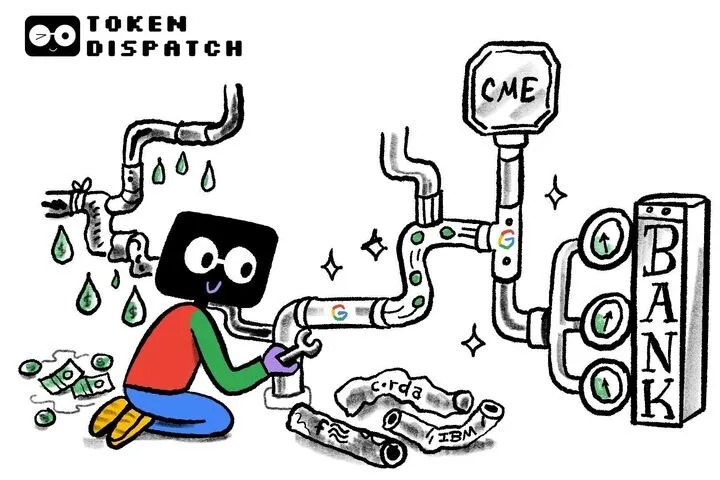
It is preparing to build on an innovation once envisioned to replace giants like itself—blockchain. With its native Layer 1 blockchain, the tech giant aims to replicate in the realm of value what it achieved in information over decades.
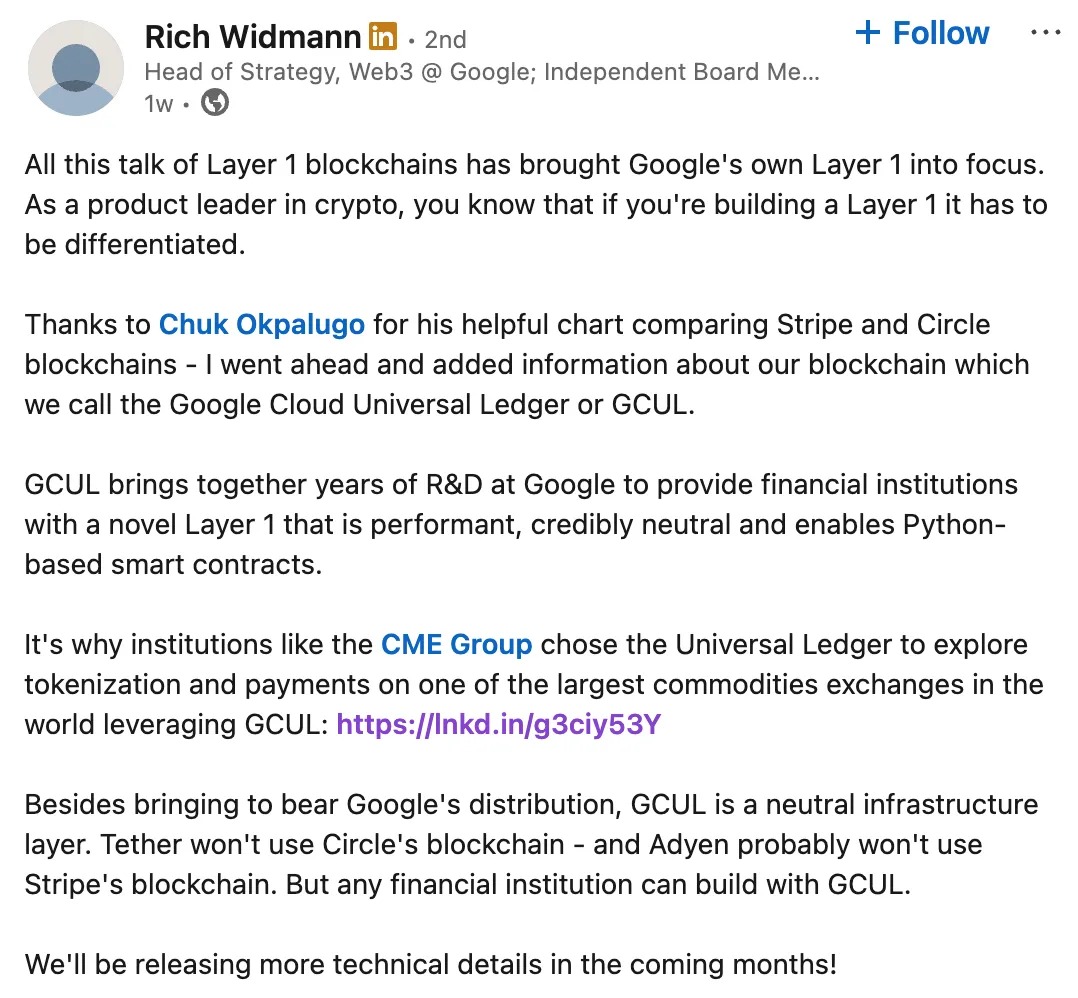
Through Google Cloud Universal Ledger (GCUL), the company wants to offer financial institutions a private, internally operated Layer 1 blockchain that is “efficient, trust-minimized, and supports Python-based smart contracts,” said Rich Widmann, Google’s head of Web3 strategy.
Global derivatives markets like CME Group have already started using the chain to explore tokenization and payments, Widmann noted.
Why build an internal blockchain now?
Because the plumbing of money needs fixing.
In 2024, stablecoins’ adjusted transaction volume exceeded $5 trillion, surpassing PayPal’s annual volume of $1.68 trillion and trailing only Visa’s annual payment volume ($13.2 trillion).
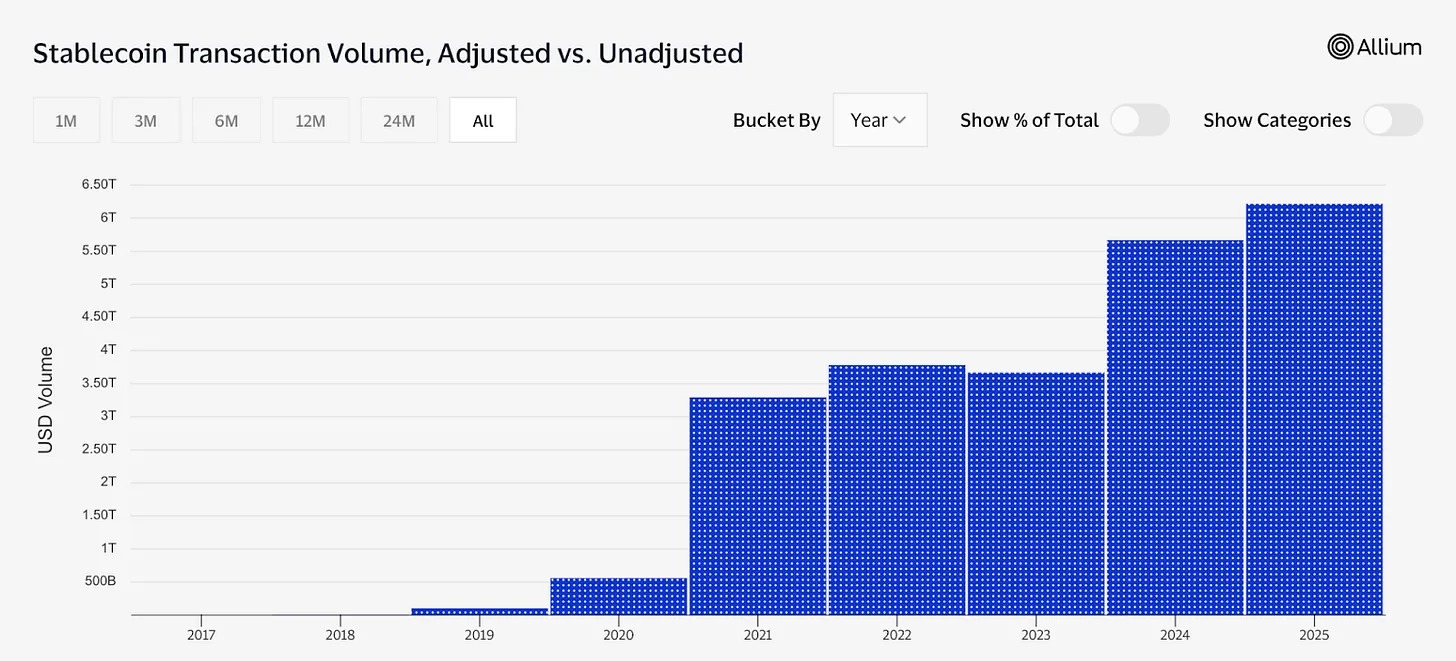
Yet cross-border payments still take days to settle, cost double-digit percentage fees, and rely on outdated systems. According to The Economist, if unchanged, inefficient settlement could cost the global economy $2.8 trillion annually by 2030.
Google wants to start with stablecoins, but its ambitions run deeper. “Stablecoins are just the beginning. The real opportunity lies in tokenizing broader real-world assets and building programmable financial applications on open infrastructure,” Google wrote in a blog post.
Who will use it?
The ledger is permissioned. All participants must undergo KYC verification. Smart contracts run in Python, a language already familiar to financial engineers. Access requires only an API integrated into Google Cloud’s existing services.
The industry remains skeptical of its label as “neutral infrastructure.” I don’t blame them. When a tech giant that built an empire through centralized data control now claims to offer a “neutral blockchain,” suspicion is natural.
What sets Google apart beyond scale? Widmann believes Google will become the platform others build upon. “Tether won’t use Circle’s blockchain, and Adyen probably won’t use Stripe’s. But any financial institution can work with GCUL.”
Stripe’s Tempo naturally favors Stripe merchants. Circle’s Arc is built around USDC. Google’s selling point is that it has no competing payments or stablecoin business, making it a trustworthy provider whose solution others may adopt.
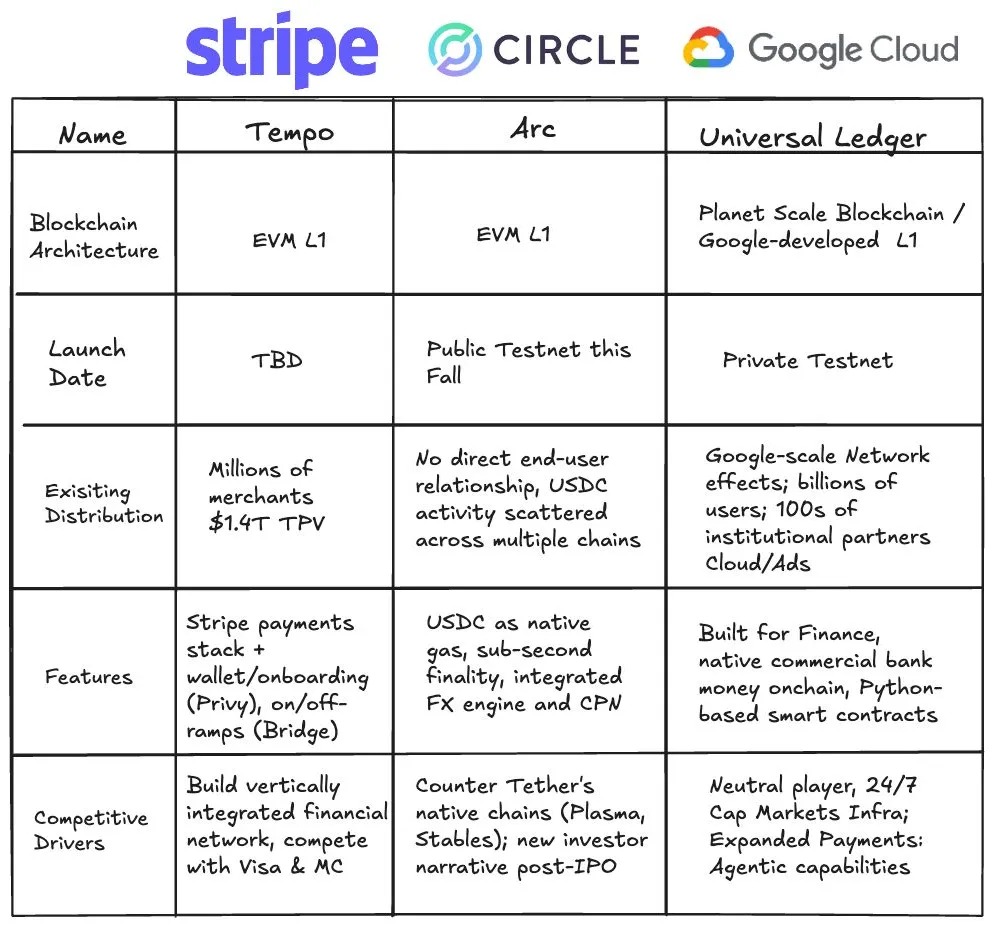
Again, Google isn’t first in this category. Other corporate giants have built their own blockchains before.
Meta’s (formerly Facebook) Libra, later renamed Diem, promised a global stablecoin but never launched. Regulators pushed back, warning it could undermine monetary sovereignty. By January 2022, the project’s assets were sold off.
R3’s Corda and IBM’s Hyperledger Fabric built solid platforms but struggled to scale beyond limited consortia. They were all permissioned chains—valuable to sponsors, but failed to bring entire industries onto shared rails, ultimately ending up siloed.
The lesson: if everyone believes one company controls the protocol, the network fails. That shadow looms over Google too.
But GCUL’s first partner—CME Group—offers a clue about direction. If the Universal Ledger can handle the daily cash flows of the world’s largest derivatives exchange, its scale becomes a compelling reason for broader adoption. It also answers the decentralization debate.
Google Cloud already counts banks, fintech firms, and exchanges among its customers. For them, connecting to the Universal Ledger via API might feel like adding another service, not switching platforms. Google also has the resources to sustain projects that smaller consortia abandon due to tight budgets. So for institutions already embedded in Google’s tech stack, adopting GCUL could be smoother than starting fresh elsewhere.
For retail users, the impact will be subtler. You won’t log into a Universal Ledger app, but you’ll still feel its presence.
Think of refunds that take days to arrive, international transfers stuck in limbo, and delays we’ve normalized. If the Universal Ledger succeeds, these issues could quietly disappear.
You might also see it extend into everyday products. Imagine paying a few cents to skip YouTube ads instead of subscribing monthly to YouTube Premium; paying fractions of a cent for extra Gemini queries; or streaming cloud storage costs in real time. The ad-subsidized internet could quietly shift toward pay-per-use models, giving users more choices rather than one default setting.
Users might finally get to choose whether to pay with attention or a few cents. Businesses could experiment with microtransactions previously impossible—from streaming payments for cloud storage to on-demand premium search results. If the GCUL model succeeds, Google’s empire could shift from being almost entirely ad-dependent (accounting for over 75% of Google’s total revenue) to a more flexible, transaction-driven model.
The debate between decentralization and centralization will continue.
I don’t think developers will choose to build permissionless apps on GCUL. No one will launch yield farms or meme coins on Google’s platform.
Institutions already using Google Cloud and other enterprise tools are most likely to adopt GCUL. The goal is clear and practical: move value across the internet with less friction, reduce reconciliation headaches, and provide banks and payment firms with trusted rails.
As a retail user, I don’t recall when I switched to Gmail. It just became synonymous with email, just as Google became synonymous with web search. I didn’t even know Google owned Android when I bought my first Android phone.
If the Universal Ledger becomes seamless infrastructure, you won’t care about decentralization. It’ll just be the thing that works.
But risks remain.
Google is no stranger to antitrust scrutiny. U.S. courts have previously ruled the tech giant maintained monopolies in search and advertising. Building financial rails will only intensify regulatory attention. The collapse of Libra proved that projects can unravel quickly once central banks perceive threats to sovereignty.
Currently, Google’s GCUL is still on testnet. CME Group has joined, and other partners are actively being pursued. Google plans broader rollout by 2026. But I believe this ambition isn’t empty talk.
Google is betting it can make the flow of money as boring, reliable, and invisible as typing into a search box.
The story began with a blank page and a search box. Its next chapter may be a ledger no one sees—but everyone uses.
Join TechFlow official community to stay tuned
Telegram:https://t.me/TechFlowDaily
X (Twitter):https://x.com/TechFlowPost
X (Twitter) EN:https://x.com/BlockFlow_News