OpenMind: Building an Intelligent Machine Economy
TechFlow Selected TechFlow Selected
OpenMind: Building an Intelligent Machine Economy
Amid the combined force of three paradigm shifts, the opportunity for the next trillion-dollar intelligent machine economy is quietly unfolding, much like the early days of Bitcoin.
 Navigating Web3 tides with focused insights
Author: Tony (@0xtony0x), Partner at Primitive Ventures
Contribution: Dovey (@DoveyWan), Founder of Primitive Ventures
The Tension of Money: Convergence of Three Paradigms
Money is humanity's most profound civilizational invention. It is not merely a medium of exchange, but an abstract carrier of order. When I pay someone to clean my room, I am essentially transferring my entropy to them, with money acting as the mediating force that turns disorder into order. At a macro level, money is a massive distributed database—a mechanism of order invented by humans to solve civilization’s core problem of resource allocation.
The greatness of Bitcoin lies in the fact that it is not only peer-to-peer money, but also a peer-to-peer system for energy and computational power distribution, enabling global energy arbitrage:
-
Directing computational power toward the cheapest available energy;
-
Arbitraging electricity costs globally;
-
Transforming dispersed energy into an ordered ledger solidified through PoW.
In the future, we believe the vast majority of economic activity will occur through interactions between machines and machines, and between machines and humans. In this new generation of intelligent machine economies, the form of money will become more diverse and fluid—but the second law of thermodynamics for money always holds: the protocol that coordinates machines with the least entropy increase will become the monetary order of the future.
Today, we stand at the intersection of three technological curves:
-
Large language models in AI endow machines with cognition;
-
Robotics hardware has significantly reduced costs due to positive externalities from consumer electronics and electric vehicle supply chains;
-
Cryptographic networks provide instant, borderless, trustless, and intermediary-free value settlement platforms.
Driven by this triple paradigm shift, the next trillion-dollar opportunity in intelligent machine economies is quietly unfolding—just as Bitcoin did in its early days.
From Open Networks to Open Machines
OM1 and FABRIC—the consensus, execution, and settlement layers for the machine economy.
Within the crypto context, OpenMind is building an open-source execution and settlement layer for the machine economy, running atop a new consensus layer:
-
Consensus Layer → Shared world state for machines
-
A globally agreed “world state”: who is where, what is happening, and what resources are available.
-
OM1’s natural language data bus and fused sensor streams generate logical states.
-
FABRIC provides cryptographic proofs of location and task execution, forming verifiable records.
Execution Layer → OM1 Cognitive Stack
-
Just as Android and iOS are operating systems for smartphones, OM1 is a modular, open-source robotic operating system that transforms inputs into actions.
-
AI models handle perception understanding, task planning, and low-latency control—similar to how smart contracts execute business logic.
Settlement Layer → FABRIC’s finality and payments
-
Verifying task completion, recording proofs, and settling via stablecoins.
-
Updating the shared world state so all agents remain synchronized with the same reality.
In short, OM1 is the plug-and-play brain for robots, while FABRIC serves as their shared wallet and identity. Together, they unify fragmented machine populations into a permissionless, composable global workforce:
-
Composability: Like stacking DeFi protocols, OM1 enables cross-platform interoperability among sensors, actuators, and AI modules;
-
Permissionless access: Anyone can deploy robotic applications without OEM gatekeeping;
-
Global distribution: Just like Bitcoin nodes, robots running OM1/FABRIC can collaborate seamlessly across borders;
-
Interoperability layer: OM1 and FABRIC connect robots of different models and capabilities into a unified network.
Open source is sovereignty. An open-source intelligent machine network can transcend geopolitical divides, becoming a supranational layer over the global robotics supply chain. Just as open-source blockchains defeated closed financial networks, and open models (like DeepSeek) are now challenging closed foundational models, open-source robotics stacks will inevitably prevail—because the compounding speed of open source far exceeds any closed moat, as Liang Wenfeng stated:
"In the face of disruptive technologies, closed-source moats are temporary. Even if OpenAI remains closed, it cannot stop others from surpassing it. Therefore, we accumulate value within our team; colleagues grow by accumulating knowledge, building organization and culture—that is our true moat."
— Liang Wenfeng, Founder of DeepSeek
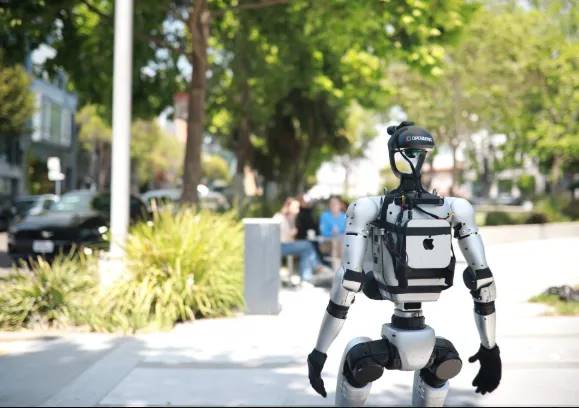
The first humanoid robot built on the Openmind Fabric Network
Machine Economy: A New Tradable System
Just as money has always been an ordering mechanism for resource allocation, the OpenMind network will become the resource coordination protocol for the machine economy:
-
M2M (Machine-to-Machine): Transactions between robots are fundamentally resource allocation events—they will bid and settle for electricity, payload capacity, sensor access, materials, storage, and even spectrum bandwidth.
-
M2H (Machine-to-Human): As economic agents, machines will also transact directly with humans—e.g., robots paying port fees or settling delivery contracts with human operators.
-
Stablecoins: Serve as the final settlement layer for both M2M and M2H transactions.
In the AI era, what is consumed is not just compute cycles, but real-world electricity, fuel, and goods ingested and processed by robots. Coordinating the flow of these energies and materials requires a neutral, global arbitrage layer—just as Bitcoin allocates energy and computation.
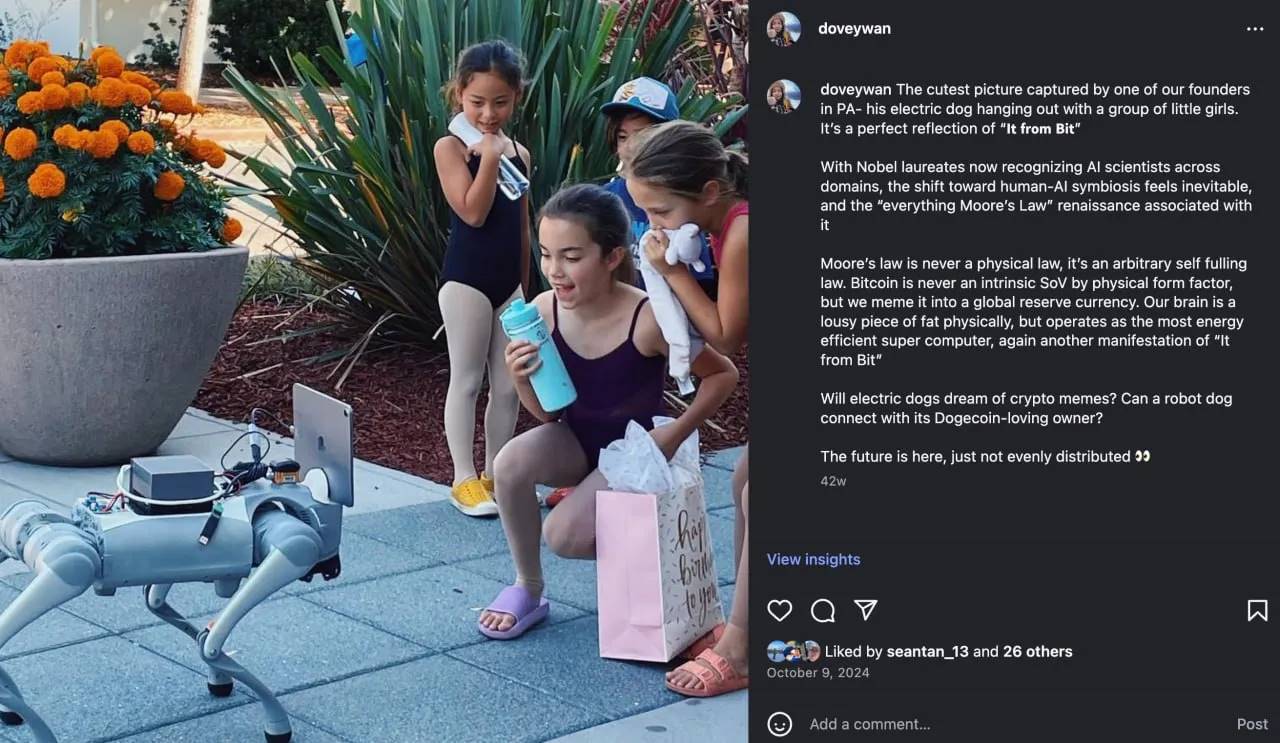
OpenMind's robot dog interacting with humans, filmed in Palo Alto
Why We Invested Early
Our story with OpenMind began in late 2023. During a meeting on Stanford campus, founder Jan Liphardt (a Stanford bioengineering professor) shared with us a vision bordering on science fiction: blockchain would become the monetary order layer for machine-native agents.
It sounded like sci-fi, yet we saw together a future where blockchain becomes the underlying infrastructure for machine–machine and machine–human activities—a world where exchanges can be securely verified and frictionlessly settled.
To us, a supranational, open-source intelligent machine protocol represents the convergence of multiple theses at Primitive Ventures:
-
Programmable money layered with programmable robots
-
The fusion of open-source software with global hardware supply chains
-
Borderless crypto networks bypassing geopolitical friction, enabling global hardware and open software to coordinate via programmable money into optimal resource allocation and arbitrage layers
Founder-Market Fit: The Fusion of Culture and Strategy
We invested when OpenMind had only two people and a PowerPoint deck. This was not a passive check, but a civilizational bet on sovereign robotic networks. Amid the push from the "Great Beautiful Act," automation and trusted allied supply chains are becoming trends. OpenMind’s open-source, sovereign stack turns these constraints into advantages: developers can source globally, verify origins on-chain, and coordinate economic activities across borders.
To build a global sovereign machine network, founders must navigate cultural and geopolitical complexity. Jan is precisely such a rare candidate: a French polymath raised in post-Cold War Europe, fluent in German, conducting research at Stanford. The fusion of cultural fluency and technical depth makes him ideally suited to build intelligent sovereign machine networks.
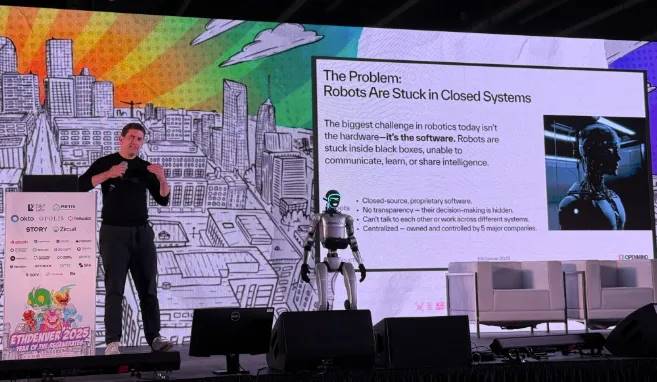
Jan presenting OpenMind on the main stage at ETH Denver
Ecosystem Status
Today, OpenMind is building the world’s first sovereign machine economy stack connecting intelligent machines and humans:
-
Robotics Companies
-
Robostore (Unitree’s primary distributor in the U.S.) has integrated OM1 + FABRIC into robotics curricula, reaching over 3,400 universities and high schools.
-
Unitree and Deep Robotics offer OpenMind as a technical solution to distributors and have authorized official product videos for crowdsourced evaluation on FABRIC apps; OpenMind is also an official distributor for both companies.
-
-
Academic Collaborations
-
Piloting and collaborating with Stanford Robotics Center, Berkeley Robotics Lab, Oxford Robotics Institute, National University of Singapore, and Seoul National University.
-
-
User Adoption
-
Pi Network (with over 50 million users, one of the largest crypto platforms globally) has partnered with OpenMind to crowdsource distributed robotics software development.
-
If you’re building on the OpenMind ecosystem, feel free to reach out!
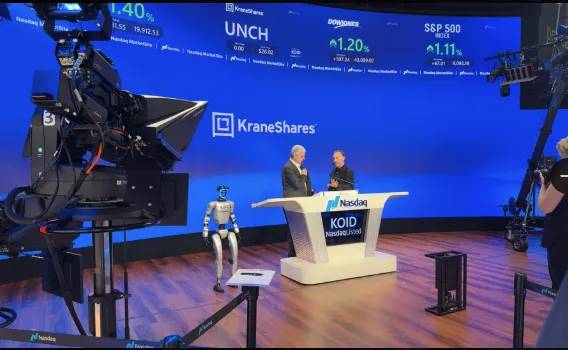
OpenMind's humanoid robot appears at Nasdaq, joining KraneShares in launching the world's first "Humanoid and Embodied Intelligence ETF."
Join TechFlow official community to stay tuned
Telegram:https://t.me/TechFlowDaily
X (Twitter):https://x.com/TechFlowPost
X (Twitter) EN:https://x.com/BlockFlow_News
 @primitivecrypto