CZ's Full Interview at Hong Kong Crypto Forum: Decentralization Will Inevitably Surpass Centralization, How Can Hong Kong Seize the Opportunity?
TechFlow Selected TechFlow Selected
CZ's Full Interview at Hong Kong Crypto Forum: Decentralization Will Inevitably Surpass Centralization, How Can Hong Kong Seize the Opportunity?
In-depth analysis of the five major topics in the Web 3.0 industry.
 Navigating Web3 tides with focused insights
Author: MetaEra
On August 27, at the "Hong Kong Crypto Finance Forum," Changpeng Zhao (CZ), founder of Binance—the world's largest digital asset trading platform—systematically shared his forward-looking insights on the industry’s future development.
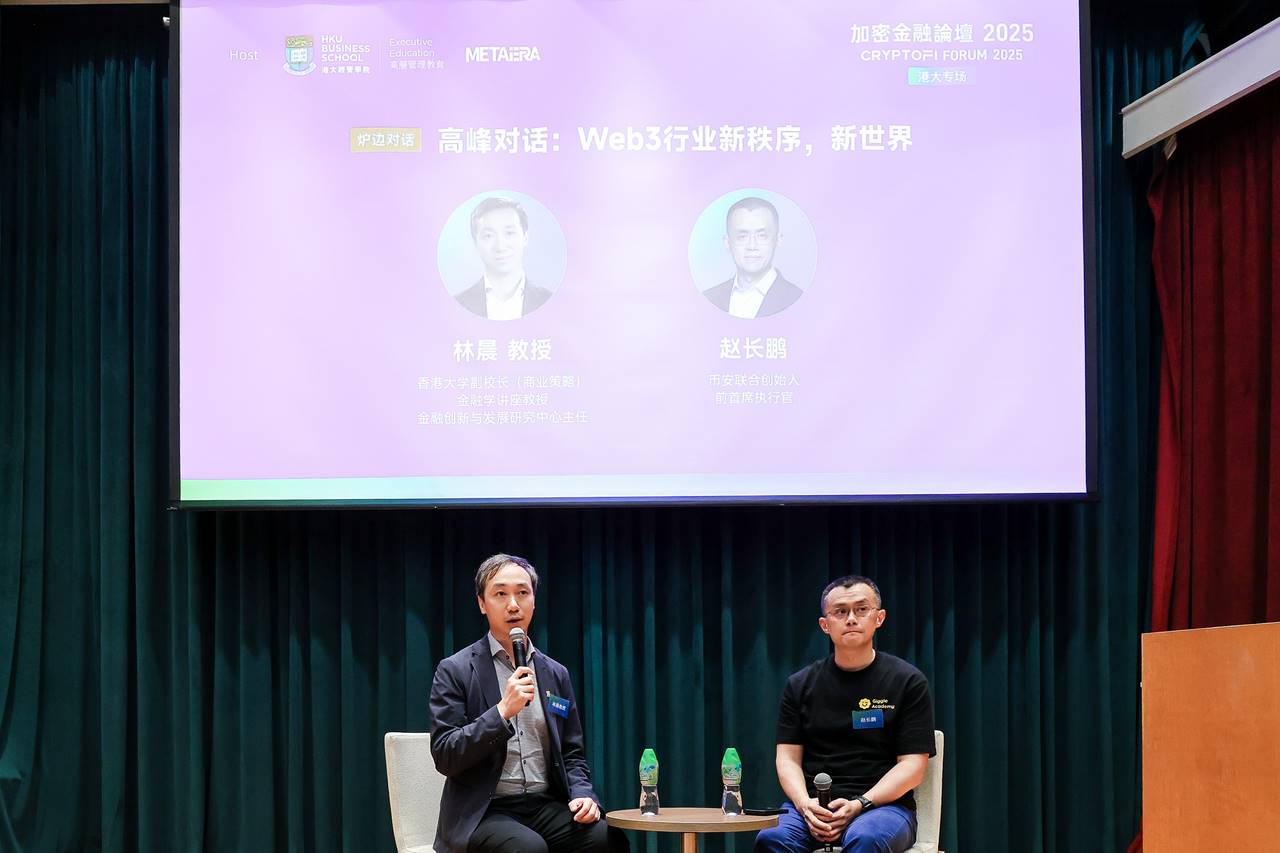
CZ focused on five key themes: the evolution of stablecoins and the strategic role of the U.S. dollar; regulatory and liquidity bottlenecks in RWA (Real World Assets); the potential of decentralized exchanges (DEXs); the Digital Asset Treasury (DAT) model as a new investment avenue for traditional investors; and the transformative impact of AI and Web3 convergence on trading models.
CZ’s perspectives reflect not only deep insight into current industry developments but also a strategic vision for the future of digital finance. These views offer valuable reference for understanding trends and investment opportunities in the crypto finance sector.
The following is a compilation of CZ’s remarks from the event, with efforts made to preserve his original phrasing.
CZ on Stablecoins: From Volatility “Safe Haven” to a Globalization Tool for the U.S. Dollar
Frankly, I’m not an expert in stablecoins, but Binance handles about 70% of global stablecoin trading volume, making us one of the most important distribution channels in the industry.
Let me briefly introduce the history of stablecoins. The earliest technical prototype was "Colored Coins," the Bitcoin community’s first attempt at "on-chain assets." In 2014, USDT was initiated by Brock Pierce. The project had a slow start, and Pierce gradually stepped back, handing it over to the current team led by Craig Sellars. It remained relatively stagnant until 2017.
When Binance launched in 2017, we focused on cryptocurrency-to-cryptocurrency trading pairs like BTC/ETH and BTC/BNB, but lacked fiat functionality. This created a user experience issue: whenever Bitcoin prices dropped, users had to withdraw BTC to fiat exchanges to cash out, with no guarantee those funds would return to our platform.
This was also highly inconvenient for users. To improve UX, we decided to support USDT as a "safe haven" during market downturns. At the time, we viewed stablecoins simply as short-term store-of-value tools, so integrating USDT was straightforward—no complex agreements or strategic partnerships, just product integration.
Then USDT entered its period of rapid growth:
First, after 2017, spot exchanges boomed, with many platforms—including Binance—adopting USDT, fueling its expansion.
Next, USDT gained further momentum: many Asian users needed access to dollars but faced difficulties opening USD bank accounts. USDT provided an alternative. Tether has always been highly profitable, but due to U.S. regulatory pressure and banking challenges, they’ve stayed relatively low-profile.
In 2019, Paxos, a U.S.-compliant firm, approached us proposing a stablecoin partnership, leading to the creation of BUSD. From 2019 to 2023, BUSD grew to a $23 billion market cap. We invested minimal resources, mainly providing brand support and promotions like "free withdrawals."
In 2023, the U.S. government phased out BUSD. If BUSD had continued, it could have achieved significant scale, as its growth rate was surpassing both USDT and USDC at the time. Importantly, when BUSD was wound down, all user funds were fully redeemed—demonstrating its compliance, transparency, and safety.
Stablecoins and exchanges have become among the most profitable sectors in crypto finance. The business model is highly simplified: after obtaining regulatory licenses, platforms issue tokens against user deposits and provide cash redemptions upon token surrender. This model features low barriers, high liquidity, massive market potential, and strong long-term profitability.

From a national strategy perspective, the U.S. government’s stance on stablecoins has shifted significantly in recent years. The current administration is very smart—its business background helps it deeply understand Tether’s strategic value for the global dominance of the U.S. dollar. Currently, over $100 billion worth of USDT holdings are invested in U.S. Treasuries, and Tether is widely used globally. Crucially, Americans themselves don’t need stablecoins—they can use ACH banking systems directly. Almost all USDT users are outside the U.S., which effectively extends the dollar’s global reach.
This aligns closely with China’s goal of expanding the international influence of the RMB. Stablecoins are essentially tools that help national currencies achieve globalization—an idea that should be highly attractive to countries worldwide. Of course, as freely circulating blockchain assets, stablecoins do pose challenges to foreign exchange controls, but these issues can be addressed. Currently, over a dozen countries I’ve engaged with show strong interest in launching local stablecoins—everyone wants their fiat currency on-chain.
In July, the U.S. passed the GENIUS Act, signaling a policy direction to limit central bank digital currencies (CBDCs). This reflects a profound strategic move to protect the dollar’s global dominance. Stablecoins are popular precisely because of their free circulation and superior user experience, whereas some government-issued digital currencies may face stricter regulation and surveillance, reducing market adoption. Since 2014, more than 20 countries have attempted CBDCs, yet none have achieved real market success.
Blockchain is fundamentally a ledger technology, and its first application is naturally in finance—making stablecoins a native use case. So far, only USD-based stablecoins have matured, while others tied to different currencies remain underdeveloped—indicating enormous future growth potential. Now, every country wants to develop stablecoins. I believe each nation should have at least several stablecoin products.
CZ on RWA: Triple Challenges of Liquidity, Regulation, and Mechanism
Despite the vast market potential of RWA (tokenized real-world assets), practical implementation has proven much harder than expected. The challenges fall into three main categories:
1. Liquidity Challenges
In practice, financial products are easier to tokenize because they already possess high tradability and mature digital representation. Non-financial assets face fundamental obstacles. While theoretically you can "Tokenize Everything"—cities, buildings, individuals—in reality, this creates numerous problems.
Take real estate: even Hong Kong’s volatile property market fluctuates far less than Bitcoin. Low-volatility assets generate weak trading activity once tokenized, resulting in shallow order books. This leads to poor liquidity, discouraging investor participation and creating a vicious cycle: thin order books lead to lower trading volumes. Attempting to trade hundreds of millions becomes nearly impossible. Even if assets go on-chain, insufficient liquidity makes them prone to unexpected volatility or short-term manipulation.
2. Regulatory Complexity
Financial products often raise a core question: are they securities? Are they commodities, securities, or something else?
In major or financially advanced nations, there are clear definitions and multiple regulators. In smaller countries, one agency might oversee everything. When multiple regulators are involved, compliance becomes complex. Companies must obtain various licenses: futures, spot, digital asset, custodial banking, etc. Holding many licenses restricts business flexibility—often preventing viable operations altogether.
3. Product Design Flaws
In my view, U.S. securities tokenization currently doesn’t work at the product level. Current stock tokenization products like xStocks do not peg token prices to real stock prices—that’s unreasonable. In theory, arbitrage should eliminate price differences. Yet such gaps persist, indicating a flawed mechanism. In other words, there’s no real linkage between tokens and underlying stocks, so the entire model fails at the product design stage. Despite various U.S. experiments, no truly viable solution exists yet.

Despite these challenges, there is one RWA model that works: stablecoins. Backed primarily by U.S. Treasuries and other traditional instruments, stablecoins prove financial asset tokenization is feasible.
The U.S. dollar has already gone on-chain via stablecoins. In today’s blockchain ecosystem, nearly all assets are priced in USD—euro and RMB are largely absent. As home to the world’s largest stock market, the U.S. benefits greatly by using blockchain to attract global investors. If U.S. equities also go on-chain, it will further solidify America’s dominance in global finance.
Rationally, the U.S. should actively support this path. Countries that don’t participate risk marginalization. For example, if HKEX—a globally influential exchange—misses this transformation, its relevance may decline. Exchanges like SSE face similar strategic choices.
Economically, this is something every country *must* pursue—or risk obsolescence. Just as China without Alibaba might have ceded e-commerce entirely to Amazon, absence in fintech carries profound economic consequences.
Despite regulatory hurdles, the economic implications are immense. All nations should seriously consider positioning themselves. With Asian ingenuity and innovation, solutions will emerge—the key lies in timing.
For businesses and entrepreneurs, navigating the market window requires precision: entering too early risks survival; too late means missing the opportunity.
Right now is a rare golden window. U.S. policy shows unprecedented support for crypto, prompting economically ambitious nations to act. Hong Kong, as a longstanding Asian financial hub with government backing, faces a historic and rare opportunity. Everyone should seize this strategic moment.
Exchange Evolution: Decentralization Will Surpass Centralization—How Can Hong Kong Seize the Opportunity?
1. The Essence and Vision of Exchanges
I believe exchanges should not limit tradable assets—all assets should circulate freely on the same platform.
Once on-chain, all assets are just tokens—whether crypto-native or RWAs. From a technical standpoint, exchanges see little difference. Adding new asset classes usually requires no complex development—just support on existing chains. Most RWA projects don’t need independent blockchains; they’re typically issued on public chains like Ethereum, BNB Chain, or Solana, making wallet and exchange integration easy. The real challenge lies in compliance: which regulator to approach and whether approval can be obtained. Once licensing is resolved, technical barriers are minimal.
In the long run, future exchanges should unify trading for all global assets—buildings, celebrity IP rights, personal valuations—all traded in one market. This maximizes liquidity and enables more efficient price discovery.
Of course, RWA presents unique challenges. For instance, if you tokenize a building and later want to sell it, you may only sell part of it. If even one investor holds a single unit and refuses to sell, you can’t fully repurchase the asset—or must pay a huge cost. Think of it as the “on-chain holdout” problem.
While full global asset tokenization will take time, it’s not out of reach for 90% of countries. Compared to large nations with extremely complex regulations, many smaller countries may adopt unified international standards faster, pioneering global on-chain asset circulation.
2. Pathways for Hong Kong to Build a World-Class Exchange
To analyze how Hong Kong can build a world-class exchange, let’s start logically. In early crypto regulation, many jurisdictions opt for strict control to minimize risk. Regulators fear mistakes and often require all operations to be local: local licenses, offices, employees, compliance teams, servers, data storage, matching engines, user bases, and entirely independent local wallet infrastructure.
This is manageable in the physical world—using vaults and physical isolation. But in crypto, location matters little. Whether servers are in Hong Kong, Singapore, or the U.S., hacking risk is the same—all systems are online.
More importantly, building a secure wallet infrastructure alone can cost over $1 billion. Beyond capital, talent is scarce—you can’t easily recruit hundreds of top-tier security experts repeatedly. Replicating a full system costs as much as building a top-tier international exchange.
From a liquidity standpoint, restricting trading to locals limits scale. Hong Kong has 8 million people; other small nations may have 200,000–300,000 active users—insufficient for meaningful trading volume. Without liquidity, price swings become extreme, harming users.
True user protection comes from deep order books—large orders won’t crash prices, and sufficient liquidity prevents forced liquidations during volatility. Buying 10 BTC on a low-liquidity exchange incurs high slippage and cost. Thus, large global exchanges inherently protect users by lowering transaction costs.
If every country builds isolated systems, management complexity becomes unmanageable—commercially unviable. Many also restrict tradable assets; Hong Kong, for example, limits listed tokens, narrowing product coverage. From what I know, most licensed exchanges in Hong Kong are currently operating at a loss—unsustainable long-term despite short-term viability.
Still, Hong Kong has advantages—it evolves quickly. We saw Hong Kong release a new stablecoin draft in May, even before the U.S. The government actively engages industry players, including conversations with insiders like us. Hong Kong may have been conservative in past years—understandable—but now it’s showing strong initiative amid changing global dynamics.
I believe this is a great starting point. Past restrictions don’t dictate the future—now is the perfect time to explore opportunities. That’s why many Web3 practitioners, myself included, are choosing Hong Kong.
The Future of Decentralized Exchanges
I believe decentralized exchanges (DEXs) will eventually surpass centralized ones in scale. Binance may be big now, but I don’t expect it to stay on top forever.
Currently, DEXs don’t require KYC, making them convenient and fast for wallet-savvy users, and highly transparent—even overly so, as everyone can see others’ orders.
・ From a regulatory standpoint, we’ve paid a heavy price for inadequate KYC at centralized exchanges. Meanwhile, the U.S. currently has limited DeFi regulation, possibly giving DeFi a regulatory advantage. However, due to past experiences, I personally can’t re-enter this space.
・ From a UX perspective, DEXs are decent but require wallet knowledge. Anyone who’s used legacy centralized exchanges knows the UX isn’t great—interfaces filled with addresses, contracts, and “gibberish,” frequent checks on block explorers, and constant vigilance against MEV attacks. I’ve been attacked multiple times myself.
Therefore, most Web2-to-Web3 newcomers still prefer centralized exchanges—email-and-password login with customer support feels familiar. But over time, as users grow comfortable with wallets, they may shift to DEXs. Currently, DEX fees are actually higher than CEX fees, but long-term, technological advances should make DEXs cheaper.
Many DEXs now use token incentives to drive usage. But such incentives can’t last forever—endless issuance devalues existing tokens.
So the market is still early, with token incentives playing a role. But long-term, I believe in 5–10 years, DEXs will grow substantially. In 10–20 years, DEXs will definitely surpass CEXs—that’s the trend.
I won’t lead such projects anymore, but from an investment angle, we’ve backed many such initiatives—minor stakes, offering behind-the-scenes support. I believe this space still holds significant potential.
CZ on Digital Asset Treasury (DAT): Bridging Traditional Investors into Crypto
Many oversimplify DAT (Digital Asset Treasury), but this field has many niches. At its core, DAT packages cryptocurrencies in stock-like forms, enabling traditional investors to participate easily.
DAT comes in various forms, much like traditional companies—different models can coexist. Crypto ETFs are mainly issued in the U.S., but many investors lack U.S. brokerage accounts or wish to avoid high trading and management fees. In contrast, public companies like Strategy that directly hold crypto can achieve asset allocation at lower cost. They also have diverse funding options across markets like the U.S., Hong Kong, and Japan. Differences in financing channels and investor bases shape distinct market landscapes.

Within the public company model, DAT firms operate in several ways:
1. Passive Single-Asset Holding Model
Exemplified by Strategy, this model focuses on passive holding of a single asset like Bitcoin. Simple in structure, it has low management and decision-making costs, allowing consistent adherence to strategy regardless of price movements.
2. Active Single-Asset Trading Model
Though holding only one asset, the management approach differs. These firms actively trade based on market outlook, requiring evaluation of managerial trading skills. Due to subjective judgment, outcomes can be positive or negative.
3. Multi-Asset Portfolio Management Model
More complex DAT firms hold multiple cryptocurrencies. Managers face tough decisions: how much BTC, BNB, ETH to hold, how often and when to rebalance—testing managerial expertise.
4. Ecosystem Investment and Development Model
The most complex form: beyond holding tokens, 10%, 20%, or more of capital is invested in ecosystem development. For example, an Ethereum-focused company might invest to boost the broader ecosystem—more dynamic but demanding higher management capability. Projects like BNB follow similar paths, requiring greater operational sophistication.
Thus, DAT is far more than just “holding coins”—different models entail varying management costs and requirements.
The DAT companies we support tend toward the simplest first model. We prefer firms focused on a single asset, especially BNB, as it’s easier to evaluate and requires minimal oversight. During bull markets, public companies generally benefit, but in bear markets—especially in the U.S.—they face litigation risks. Clear, simple strategies reduce legal exposure and lower legal costs—litigation is extremely expensive.
Our goal is to minimize operational costs while promoting long-term holding. We don’t want companies deploying capital into speculative investments, but rather engaging deeply in ecosystem support.
The significance of DAT lies in enabling entities like corporate treasuries, public firms, SOEs, and state-owned enterprises—which cannot directly buy crypto—to gain exposure through this model. This group represents a massive market, far larger than the crypto-native audience.
In the DAT projects we join, we usually play only a minor supporting role. Most funding comes from traditional markets or other sources, greatly benefiting our ecosystem by bringing non-crypto users into digital assets.
We typically don’t lead or manage these firms. Instead, we leverage our network to find capable managers. Running public companies isn’t our strength, but many in the industry have the experience—we prefer collaboration to create synergy.
AI and Web3 Convergence: The Inevitable Path from Concept to Reality
Frankly, the integration of AI and Web3 is still suboptimal. But I believe this isn’t hype—it’s an inevitable trend that will break through. A few months ago, I asked: What currency will AI use? Clearly not USD or traditional payment systems—AI can’t complete KYC. AI’s monetary system must be based on digital currencies and blockchain, where payments occur via API calls or broadcast transactions.
This implies exponential growth in blockchain transaction volume. In the future, each person may have hundreds or thousands of AI agents performing tasks in the background—video production, multilingual translation, content distribution, bookings, message replies. Their frequent interactions will generate massive microtransactions. Crypto transaction volumes could conservatively grow a thousandfold. For example, a blogger could offer the first third of an article for free, charging just $0.10 for the rest. With hundreds of thousands paying, they earn tens of thousands—impossible under traditional finance, but easily supported by AI and Web3.
Transactions will also become more global. I could simultaneously hire engineers and designers from China, India, and elsewhere, with AI automating settlements. However, most so-called “AI agents” in Web3 today remain at the Memecoin-level: flashy frontends calling established APIs like ChatGPT, lacking real utility. What we truly need are AI tools that perform real work and generate economic value. Top AI firms are actively exploring this path.
But AI development demands enormous capital. Competition in model compute power is fierce and costly. OpenAI reportedly has 1–2 PB of compute, with annual costs around $6.5 billion per PB, and plans to scale 10x to 100x—requiring astronomical investment, excluding chip costs. No VC, company, or even nation can shoulder this alone, which is why the AI industry is turning to Web3 for new fundraising models.
Fundamentally, AI should be seen as a public good. Today’s large models are too closed. Sharing revenue with token holders, making models more open-source, decentralized, and community-driven, may be a more rational path. I’ve discussed this with several top AI founders. While still early, this trend is inevitable.
Despite the current immaturity of AI and Web3 integration, its future remains highly promising.
Join TechFlow official community to stay tuned
Telegram:https://t.me/TechFlowDaily
X (Twitter):https://x.com/TechFlowPost
X (Twitter) EN:https://x.com/BlockFlow_News