Recapping the Monad Card Event: An "Anti-Burnout" Experiment for Crypto Twitter
TechFlow Selected TechFlow Selected
Recapping the Monad Card Event: An "Anti-Burnout" Experiment for Crypto Twitter
Decentralized nominations for a fair start for Monad.
 Navigating Web3 tides with focused insights
Author: Happy
Translation: TechFlow
I believe one common mistake many pre-TGE teams make is over-relying on growth tactics like Kaito boards or Zealy campaigns to gain attention.
I've been critical of this in the past, and frankly, I think these approaches often do more harm than good.
Anything that's promoted can be manipulated. Anything that's measured will be gamed.
You tend to attract the worst kinds of mercenary users, and it discourages organic posting, as the reputational cost of participation often outweighs any potential reward.
On the other hand, Monad Cards take the opposite approach.
They're distributed to CT users who've built influence across the broader crypto space—not just those who post specifically about Monad.
This works for several reasons:
-
It’s much harder to fake long-term social influence than it is to spam posts about a single project;
-
It allows successful CT users to have real skin in the game without having to "sell their soul";
-
It makes them feel genuinely rewarded and recognized for their broader contributions to crypto;
-
It incentivizes them to organically post about Monad to demonstrate their relevance;
-
It allows them to nominate others who might otherwise be overlooked.
In my view, the last point is the most important.
By allowing these users to nominate others, you give them power, trust, and responsibility.
In the long run, this also helps avoid a common FUD around social airdrops—"It's all going to insiders."
To be honest, that criticism has often been justified historically, even if not intentional.
Humans are always susceptible to unconscious bias, and airdrop criteria are usually kept secret and controlled by a small group. This almost inevitably results in rewards going to the team's "favorite" people.
But here, that's not the case. By decentralizing the decision-making process across the entire CT, you eliminate most of that bias.
If you've been active in this space for a while, even if you don't post much or have high social influence yourself, you likely know someone influential in a group chat. So if you don't get nominated, it's more a reflection of your own reach than something you can blame on the team.
And clearly, the team has also worked hard to embed this philosophy into their community.
They launched a recogniser app where users simply answer a yes/no question: Do you know this community member?
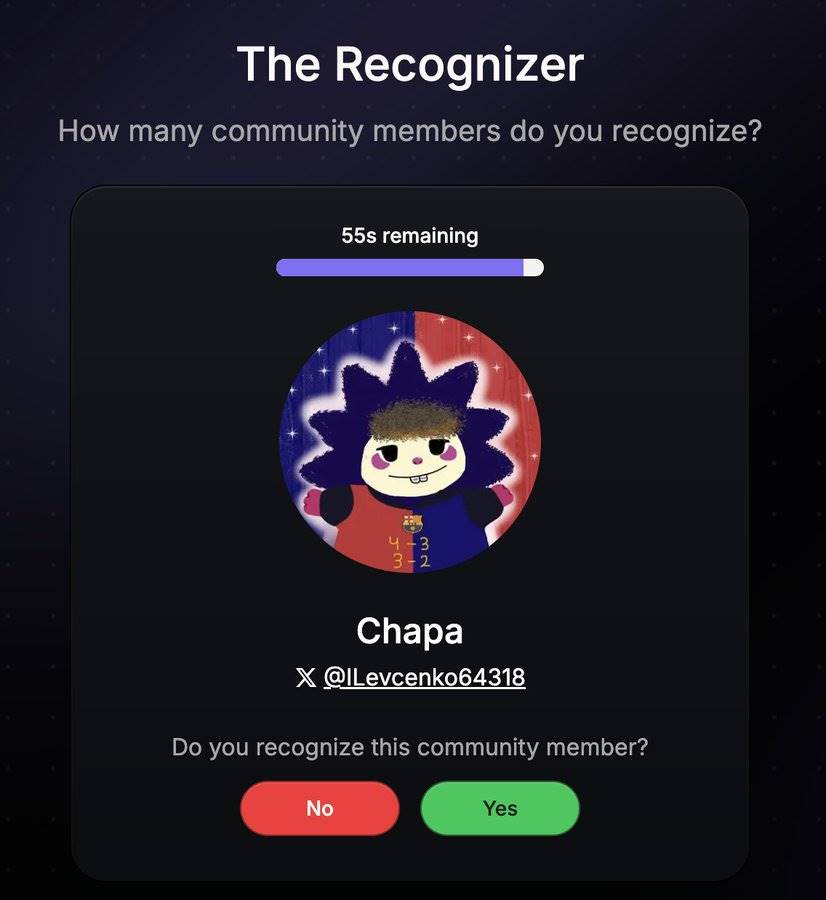
This is another step toward reducing bias in the decision process and adding more decentralized data points.
To outsiders, these might seem like trivial details, but I believe they have an outsized impact on a chain's origin story.
In my view, the perception of "fair" distribution in crypto is the single biggest predictor of future cultural success.
After all, the culture of this industry originated from the fairest distributions—Bitcoin, Ethereum, and more recently, Hyperliquid.
Of course, these measures alone won't solve all of Monad's problems, but they largely address the biggest complaint from CT—that it's been too hard for ordinary users to get skin in the game on Monad compared to other new chains raising funds in less regulated environments.
No initiative will please everyone, but this one has shifted the narrative around Monad and laid a stronger foundation for its future development.
Join TechFlow official community to stay tuned
Telegram:https://t.me/TechFlowDaily
X (Twitter):https://x.com/TechFlowPost
X (Twitter) EN:https://x.com/BlockFlow_News
 @happysubstack