Monad mainnet is即将 launching, these dApps are worth watching
TechFlow Selected TechFlow Selected
Monad mainnet is即将 launching, these dApps are worth watching
Monad's high-performance EVM ecosystem ignites a wave of innovative applications.
 Navigating Web3 tides with focused insights
Authored by: 100y.eth, Four Pillars
Translation: TechFlow
Key Takeaways
-
The highly anticipated Monad mainnet is about to launch. Monad has attracted significant attention from both institutional investors and retail users thanks to its high-performance, EVM-based tech stack. Despite full compatibility with the EVM, Monad is expected to deliver a smoother and more scalable user experience.
-
Thanks to its cutting-edge technology, Monad enables entirely new types of decentralized applications (dApps) that were previously unfeasible on other EVM networks. While many dApps are already building on Monad, this article will focus specifically on those that are truly native to the ecosystem.
1. The Long-Awaited Launch of Monad
1.1 Why Is Monad So Popular?
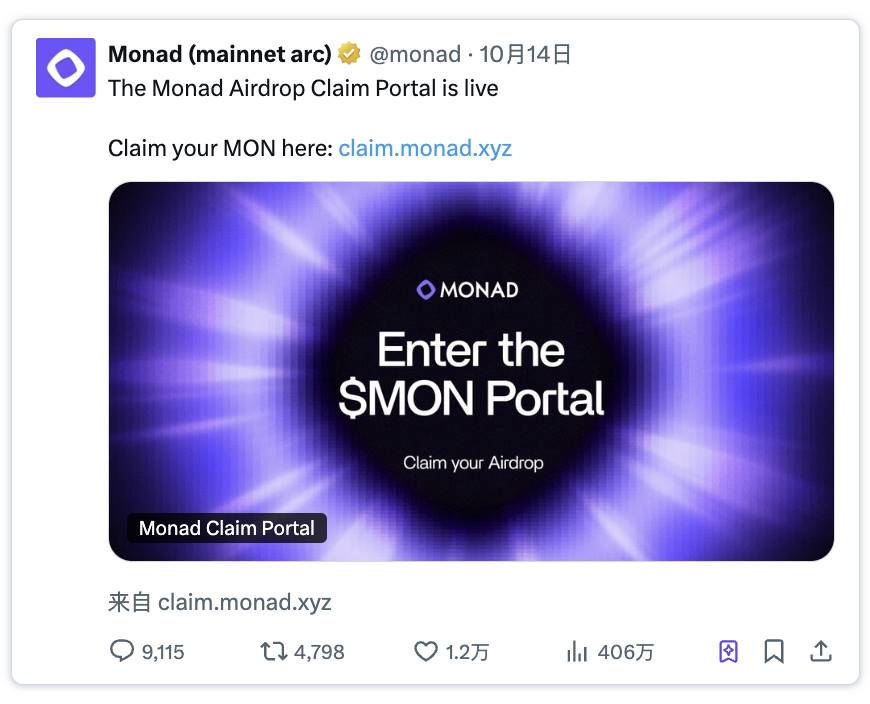
Original tweet link: Click here
On October 14, Monad officially announced the launch of its airdrop portal, sparking intense excitement among users. This enthusiasm is not surprising—Monad first gained widespread attention back in Q1 2023 when it announced its seed funding round. However, it has taken two and a half years since then for the mainnet to approach launch.
Several factors have contributed to Monad’s popularity, including backing from prominent VCs and a vibrant community culture. But at its core lies its groundbreaking technology. At the time, achieving a parallelized EVM was an ambitious goal—one powerful enough to capture the interest of investors, developers, and users alike.
Monad is a high-performance, EVM-compatible Layer 1 blockchain with the following technical features:
-
MonadBFT: An optimized Byzantine Fault Tolerance (BFT) consensus algorithm capable of achieving 10,000 transactions per second (tps) and sub-second finality, even with hundreds of consensus nodes. Unlike traditional BFT systems, MonadBFT reaches a "near-final" state in just one round of consensus.
-
RaptorCast: A method enabling the primary validator to efficiently distribute large blocks to other validators. The primary validator splits the block proposal into parts using erasure coding, sending each part first to non-primary validator nodes, which then further propagate them. This reduces the load on the primary validator while maintaining security, as data can be recovered even from partial block fragments.
-
Asynchronous Execution: In most blockchains, consensus and execution are tightly coupled, leading to inefficiencies. Monad decouples these processes: nodes first agree on transaction order, then execute them separately, allowing ample processing time.
-
Parallel Execution: Monad uses optimistic execution, processing transactions in parallel initially and only re-executing those that encounter conflicts.
-
MonadDb: Unlike Ethereum's architecture, MonadDb is based on a Merkle Patricia Trie and supports direct access to Trie nodes, asynchronous read/write handling, optimizations for parallel execution, and features like filesystem bypass and concurrency control.
These core optimizations enable exceptional scalability, making possible dApps that were previously unattainable on other EVM networks. Combined with full EVM compatibility, Monad offers developers an outstanding environment to build diverse applications without worrying about scalability constraints.
1.2 Monad’s Ecosystem: Built for Monad
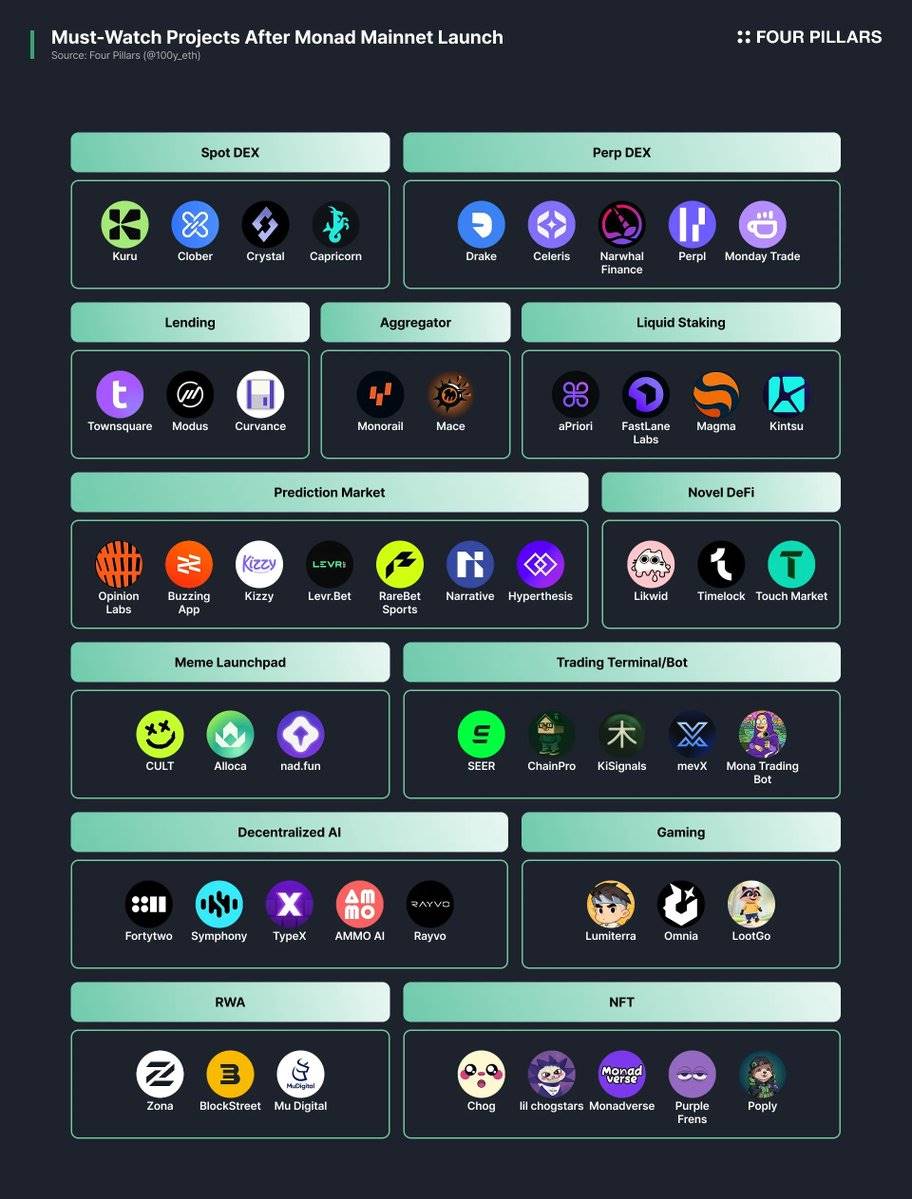
With the Monad mainnet launch imminent, what kinds of services can users expect in its ecosystem? As of October 11, 2025, the Monad Ecosystem Directory lists 293 dApps, including well-known projects such as 0x, Balancer, Euler, Farcaster, Lombard, Magic Eden, OpenSea, Pancake Swap, Stargate, StakeStone, Uniswap, and Wormhole.
However, Monad differs significantly from existing blockchain networks, paving the way for unique and innovative services to emerge. This article explores some of the most promising dApps within the Monad ecosystem, along with winners from Monad accelerator programs and hackathons.
Below is a quick overview of key dApp categories and representative projects. Readers interested in deeper insights can scroll down for detailed information:
-
Staking: aPriori, FastLane Labs, Magma, Kintsu
-
Spot DEXs: Kuru, Clober, Crystal, Capricorn
-
Perpetual DEXs: Drake, Celeris, Narwhal Finance, Perpl, Monday Trade
-
Aggregators: Monorail, Mace
-
Lending: Townsquare, Modus, Curvance
-
New DeFi: Likwid, Timelock, Touch Market
-
Prediction Markets: Opinion Labs, Buzzing App, Kizzy, Levr.Bet, RareBetSports, Narrative, Hyperthesis
-
Trading Terminals/Bots: SEER, ChainPro, KiSignals, mevX, Mona Trading Bot
-
Meme Coin Launchpad: CULT, Alloca, nad.fun
-
Gaming: Lumiterra, Omnia, LootGo
-
Artificial Intelligence: Fortytwo, Symphony, TypeX, AMMO AI, Rayvo
-
NFTs: Chog, lil chogstars, Monadverse, Purple Frens, Poply
-
RWA: Zona, BlockStreet, Mu Digital
2. Notable dApps in the Monad Ecosystem
2.1 aPriori
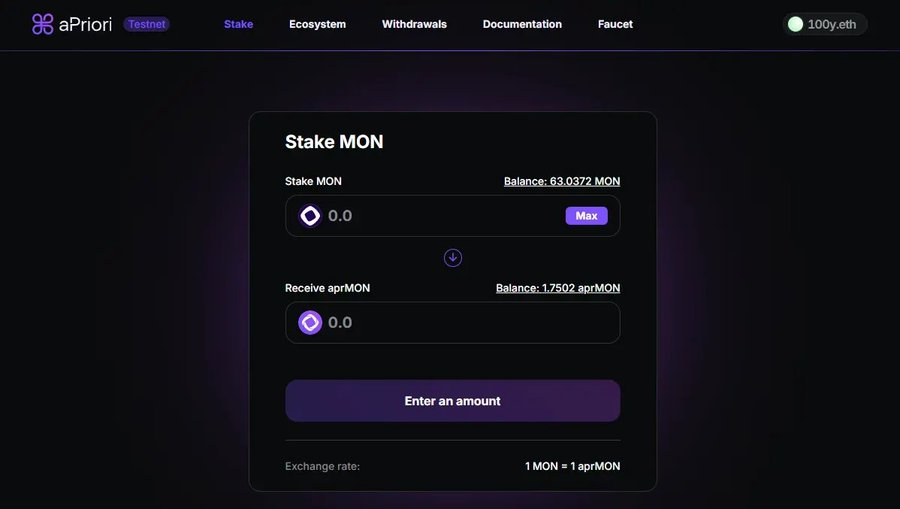
Source: aPriori
aPriori is the most well-known liquid staking protocol in the Monad ecosystem. Users can stake MON and receive aprMON, a liquid staking token. aprMON earns not only standard PoS staking rewards but also MEV (Maximal Extractable Value) revenue generated by the network, which is distributed back to users.
Due to Monad’s high scalability, the network will process a vast number of transactions, naturally creating numerous MEV opportunities. Unlike traditional EVMs that process transactions sequentially, Monad EVM handles them in parallel, fundamentally changing how MEV is captured. aPriori understands this shift deeply and has introduced the concept of probabilistic MEVA.
In 2023, aPriori raised $2 million in seed funding from Hashed and Arrington Capital. In July 2024, it secured an additional $8 million in seed funding from Pantera, Consensys, and Flow Traders. Most recently, in August 2025, it raised another $20 million from Pantera, HashKey, and IMC Trading. This makes aPriori one of the best-funded dApps in the Monad ecosystem. Users can currently stake MON on the testnet to obtain aprMON and use it across various DeFi protocols.
2.2 FastLane Labs
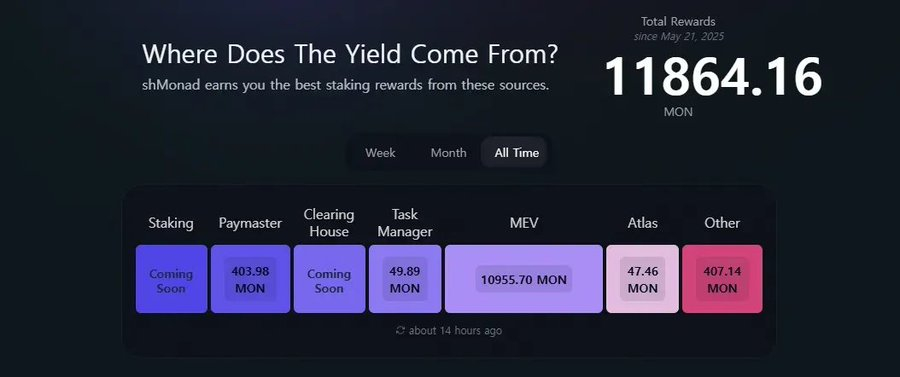
Source: FastLane Labs
FastLane Labs provides staking and MEV-related infrastructure for the Monad ecosystem, offering the following key services:
-
shMONAD: A liquid staking protocol for Monad built on FastLane’s MFL and Atlas technologies. It extracts MEV revenue and ensures value flows back to ecosystem participants.
-
shBundler: A bundler designed for the ERC-4337 account abstraction standard, integrating bundler functionality directly into validator nodes.
-
shMonad RPC: High-performance Monad RPC infrastructure that allocates network bandwidth based on staked amounts. Users holding more shMON enjoy higher bandwidth and lower latency, helping prevent network overload and Sybil attacks.
FastLane Labs not only operates a liquid staking protocol but also builds core infrastructure to help users interact with the network more efficiently and fairly. The project has raised $6 million in strategic funding from Coinbase Ventures, Figment Capital, DBA, Robot Ventures, Hashkey, Chorus One, and Kiln. Users can currently stake MON on the testnet to receive shMON and utilize it across various DeFi applications.
2.3 Kuru
Source: Kuru
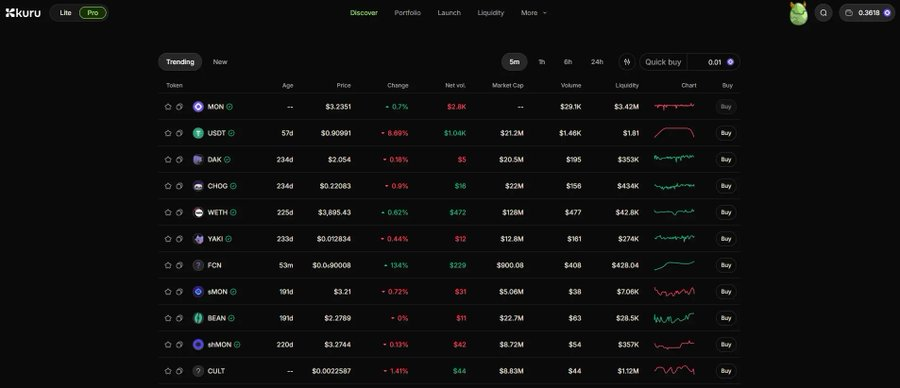
Kuru is a fully on-chain order book exchange on Monad, aiming to become a central trading hub. Thanks to the high scalability of Monad EVM, Kuru enables on-chain order book trading. Beyond using a CLOB (Central Limit Order Book), Kuru integrates AMM liquidity to ensure smooth trading even in markets with lower liquidity.
Kuru offers two modes: Lite and Pro. In Pro mode, users trade different tokens via the order book and provide liquidity. In Lite mode, users can easily swap tokens using a simplified interface powered by order book liquidity.
In July 2025, Kuru successfully raised $11.6 million from Paradigm, Electric Capital, and Credibly Neutral. Users can now try out basic swap functions through the testnet’s Lite mode, explore the Pro mode trading interface, and even experiment with providing liquidity to the order book.
2.4 Others
Other notable projects in the Monad ecosystem include (for reference only; protocols not covered in section 2.4 will be discussed in the next section):
Staking
-
Kintsu: A liquid staking protocol where users stake MON and receive sMON in return.
-
Magma: A liquid staking protocol where users stake MON to mine gMON. The protocol offers MEV-enhanced yields and uses Distributed Validator (DV) technology, allowing multiple participants to share validator node responsibilities.
Spot DEXs
-
Crystal: A CLOB-based decentralized exchange where all trades are processed directly on-chain via smart contracts.
-
Capricorn: Combines oracle-backed private pools with CPMM/CLMM liquidity pools, aiming to merge the efficiency of CLOBs with the composability of AMMs.
-
Monday Trade: A decentralized exchange (DEX) leveraging a hybrid CLOB/AMM architecture to offer a centralized-exchange (CEX)-like user experience, supporting trading of multiple tokens.
Perpetual DEXs
-
Narwhal Finance: A perpetual order book DEX on Monad that supports aprMON as collateral and enables trading of synthetic assets such as stocks, indices, and forex.
-
Perpl: A CLOB-based perpetual futures DEX built to leverage Monad’s exceptional scalability. In May 2025, the project raised $9.25 million from Dragonfly, Ergonia, and Brevan Howard.
Aggregators
-
Mace: A native Monad DEX aggregator that routes trades across multiple DEXs to find optimal execution paths.
Lending
-
Townsquare: A lending protocol in the Monad ecosystem and a finalist in the Monad Madness competition.
-
Modus: Positioned as an on-chain prime broker, Modus is a native lending protocol within the Monad ecosystem. Beyond simple lending, it offers modular features like vaults and delta-neutral strategies. The project has received investment from Yzi Labs.
-
Curvance: Users can borrow against a variety of assets within the Monad ecosystem as collateral on Curvance.
New DeFi
-
Timelock: A protocol leveraging Uniswap V3 liquidity to offer swapping and trading, along with a no-liquidation leveraged trading experience. Future plans include launching futures, options, and meme token services.
-
Touch Market: A protocol offering a novel trading experience where users set price and time ranges on a chart, profiting if the price "touches" that level. It stands out with an intuitive interface and up to 1000x leverage trading.
Prediction Markets
-
Opinion Labs: One of the most popular prediction markets in the Monad ecosystem, raising $5 million in seed funding from YZi Labs, Animoca, and Amber.
-
Narrative: A prediction market enabling users to trade or invest in assets based on narratives and emerging trends.
-
Hyperthesis: Though limited information is available, the project appears to be developing a prediction market within the Monad ecosystem.
Trading Terminals/Bots
-
mevX: A multi-chain trading terminal focused on meme and alpha tokens, offering sniping and copy-trading features, with plans to support the Monad mainnet.
-
Mona Trading Bot: A trading bot specifically built for the Monad ecosystem.
Meme Coin Launchpad
-
nad.fun: A meme coin launch and trading platform with a simple interface similar to pump.fun, easy for anyone to use.
Gaming
-
Lumiterra: A multiplayer open-world survival and building game where players explore the world through gathering, crafting, combat, and farming.
-
Omnia: A game natively built on Monad combining adventure and pet-based battle gameplay.
-
LootGo: A move-to-earn mobile app offering gamified experiences through gameplay similar to Pokémon GO.
NFTs
-
Poply: An NFT marketplace focused on the Monad community.
RWA
-
Zona: Enables tokenization and trading of real-world assets or synthetic assets, which can also serve as collateral for lending.
-
Block Street: Builds on-chain execution and lending infrastructure for tokenized stocks, featuring an RFQ system and risk engine. In October 2025, the project raised $11.5 million from HackVC, DWF, and other investors.
Others
-
Accountable: A real-time financial verification protocol allowing companies, protocols, and stablecoins to share transparent asset and liability information while preserving privacy.
3. Projects Highlighted in Monad’s Official Blog
Monad has featured several projects across five articles on its official blog. These projects have gained attention due to official endorsement. Below are detailed introductions:
3.1 Fortytwo
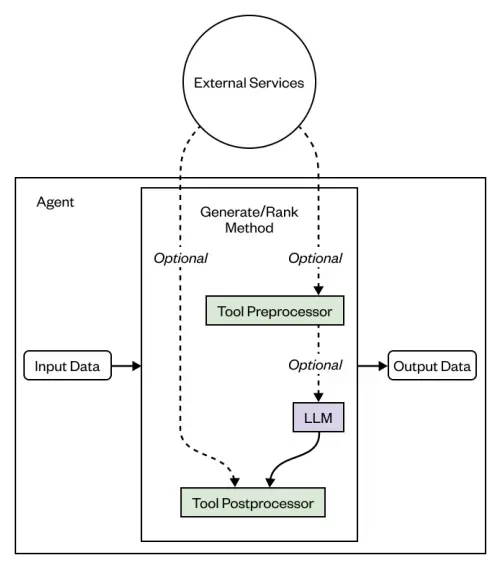
Fortytwo is a decentralized artificial intelligence network built on Monad. It runs multiple small language models (SLMs) simultaneously on consumer-grade hardware and combines their outputs through a consensus process to generate final inference results. In short, Fortytwo aims to create a more powerful AI system by connecting multiple smaller models.
Using multiple SLMs instead of a single large language model (LLM) is not a new idea and is already widely used in AI research. For example, autonomous driving systems are typically not built on a single large AI model but rather consist of multiple specialized submodules handling specific tasks, forming a more complete system.
Source: Fortytwo Whitepaper
Fortytwo’s operation is relatively straightforward. When a user sends a query to the network, participating nodes independently generate answers and evaluate each other’s responses. The answer with the highest score becomes the final consensus result. To ensure fairness, all answers are encrypted before submission and later decrypted. Additionally, to prevent Sybil attacks, nodes must stake a certain amount of tokens to participate. Monad serves as the coordination layer for settlement and reward distribution.
In March 2025, Fortytwo successfully raised $2.3 million in pre-seed funding from Big Brain Holdings, CMT Digital, EV3, Chorus One, and Mentat Group. Any user with a decent consumer desktop PC can run a node.
As of the testnet phase, there are already 739 active nodes in the network. For users interested in the Monad AI ecosystem, running a Fortytwo node after the launch of the Monad and Fortytwo mainnets could be a worthwhile experience.
3.2 Multisynq
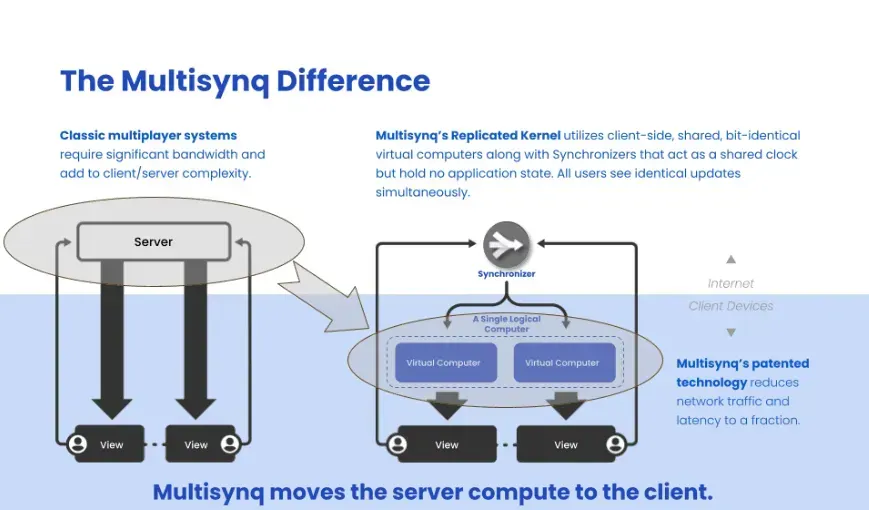
Multisynq aims to build a new internet protocol for real-time synchronization. Currently, there is no standardized protocol for real-time sync, forcing applications like game servers and video conferencing tools to build custom solutions from scratch. In centralized client-server architectures, servers handle all computation, creating a single point of failure.
Source: Multisynq
Multisynq solves this by eliminating server-centric structures. Instead, each user’s device runs application logic locally, while synchronization nodes in the Multisynq network handle coordination. These sync nodes do not store data or read encrypted message contents—they only manage synchronization.
The real-time synchronization protocol developed by Multisynq fills a critical gap in the modern internet. When combined with blockchain, it could help build a truly decentralized network. This might one day enable massive applications like MMORPGs supporting hundreds of thousands of players or map services powered by real-time traffic data from millions of users. Multisynq acts as the synchronization layer in this decentralized internet and plans to integrate the Monad blockchain for handling sync states and registries.
In April 2024, Multisynq raised $2.2 million in seed funding from Manifold Trading and Republic Capital. In February 2025, it raised an additional $350,000 through a community fundraising round hosted by Echo. Users can currently run sync nodes and earn points.
3.3 Likwid
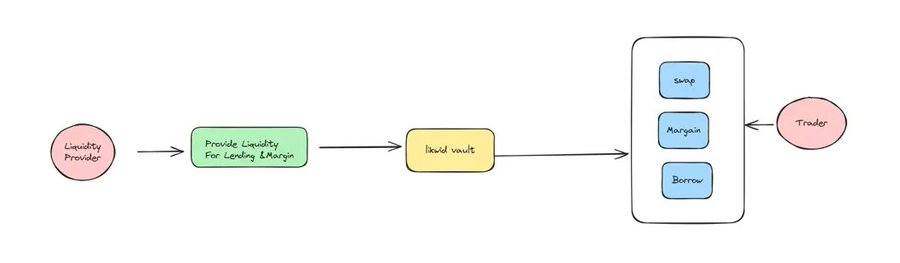
Likwid is a DeFi protocol on Monad that combines automated market maker (AMM) and lending functionalities into a single system, allowing users to provide liquidity, borrow assets, or open long and short positions—all on one platform. Its most distinctive feature is that it achieves this without relying on centralized exchanges, oracles, or counterparty trading.
Traditionally, opening short positions on new tokens via DeFi protocols has been extremely difficult. Users would need to deposit collateral into a lending protocol, borrow the token, and sell it. However, new tokens often lack oracle data or aren’t supported by lending protocols. Even if supported, liquidity is usually very low.
Source: Likwid
In Likwid, the liquidity pool itself acts as both the market and the lending platform, serving as the counterparty. Liquidity providers not only supply liquidity and earn fees like in AMM DEXs but also function as lenders and derivatives liquidity providers.
For example, in the MON/LIKWID liquidity pool, a user can deposit MON as collateral and instantly open a short position on LIKWID—all in one step, involving both borrowing and selling the LIKWID token.
After the Monad mainnet launch, users will be able to perform basic operations on Likwid such as token swaps, liquidity provision, and lending, as well as open long or short positions on new tokens to capitalize on early ecosystem trading opportunities.
3.4 Clober
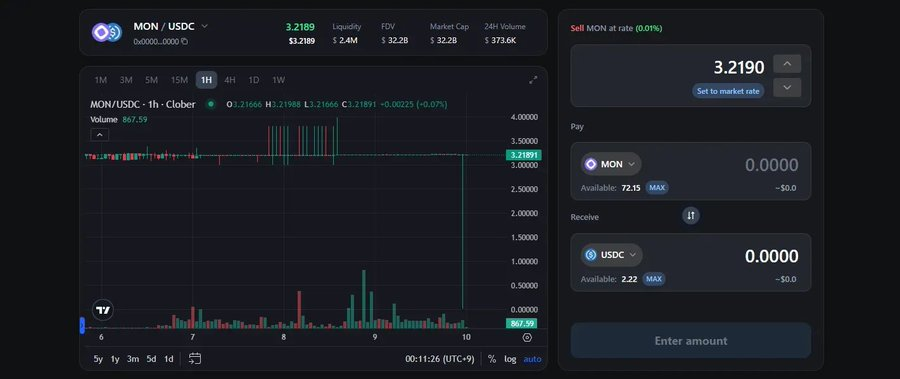
Source: Clober
Clober is a fully on-chain order book decentralized exchange (DEX) built on Monad. Beyond Monad’s scalability, the protocol introduces its unique LOBSTER (Limit Order Book with Segment Tree for Efficient Retrieval) mechanism, enabling efficient and gas-saving order matching.
Building an on-chain order book on EVM presents many technical challenges. For instance, when a user places a buy order, it must match sequentially with multiple sell orders. Processing this with for-loops or similar constructs consumes significant gas. LOBSTER addresses this with deferred execution: each sell order covers a specific price range, and the system decides whether to match based on the size of the buy order. Sellers later settle the trade.
For large market orders requiring scans across multiple price levels, on-chain order books are typically inefficient. LOBSTER uses a tree-based data structure to search only price levels where actual orders exist, improving performance and gas efficiency.
Through these innovations, Clober achieves AMM-level efficiency and CEX-level precision within on-chain constraints. Leveraging Monad’s scalability, it builds an advanced structure capable of matching CEX-level performance. Users can trade tokens via order books, place limit orders, and provide liquidity directly on the Clober platform.
3.5 Drake
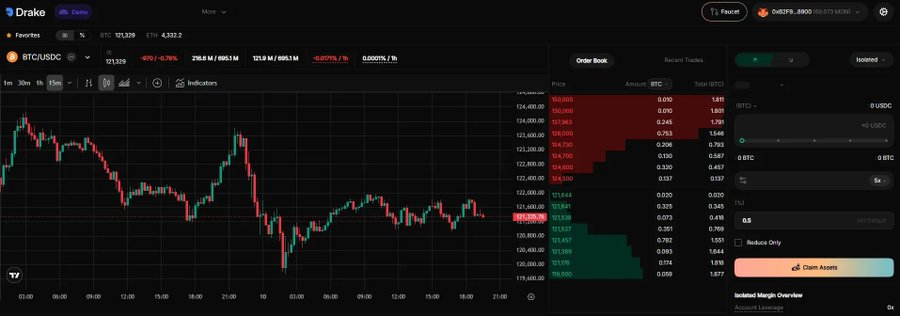
Source: Drake
Drake is a fully on-chain perpetual DEX built on Monad, aiming to deliver CEX-level performance while preserving DeFi’s transparency and composability. Drake’s order book, matching engine, risk engine, and vault all operate on-chain.
Thanks to Monad’s scalability, Drake can fully on-chain every component of the order book. Its parallel execution and low transaction costs allow efficient matching of large volumes of orders and state updates, enabling a truly on-chain perpetual DEX.
Drake also stands out with its hybrid order book model. It primarily uses on-chain liquidity but taps into AMM liquidity when order book depth is insufficient, ensuring deeper overall liquidity.
Drake has not yet raised venture capital, adopting a community-driven approach—a trend gaining popularity among new perpetual DEXs. Monad users can already try Drake on the testnet.
3.6 Celeris
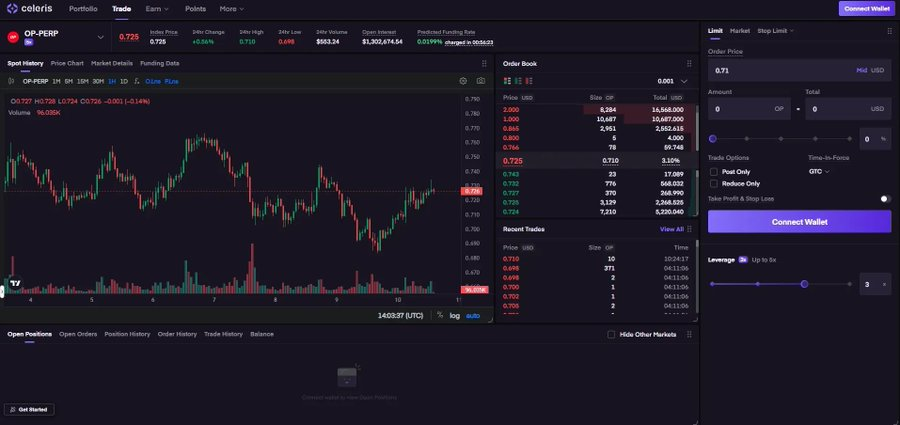
Source: Celeris
Celeris is a trading platform built on a novel PLOB (Parallelized Liquidity Order Book) model. In CLOB systems, liquidity is fragmented across separate markets, whereas in PLOB, a shared liquidity pool supports all markets simultaneously, greatly improving capital efficiency.
Because PLOB offers deeper liquidity than CLOB, traders experience less slippage. For liquidity providers, this model is more favorable—since the same total value locked (TVL) can be spread across more markets, it generates higher overall fees.
Implementing PLOB requires real-time management and synchronization of state across many markets—an extremely complex task on-chain. However, Monad’s parallel EVM and MonadDB enable parallel transaction processing and efficient multi-market management, creating the ideal environment for PLOB.
Users can deposit Monad testnet tokens into Celeris to trade perpetuals across multiple markets, and also try out liquidity provision and lending features.
4. Hackathon Winning Projects
Monad is known for its strong community and support for early-stage ecosystem projects. Through accelerator programs and hackathons, Monad has provided resources and exposure to many new teams.
While most participating teams are still in early stages, those winning official Monad events are definitely worth watching. Let’s take a quick look at some of them.
4.1 Monad Founder Residency Program
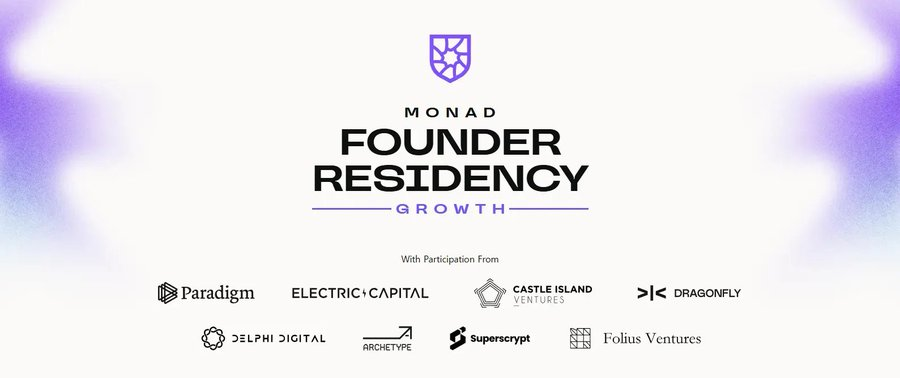
Source: Monad
The Monad Founder Residency is a three-week sprint program for early-stage crypto startups building on the Monad blockchain ecosystem. After the sprint, participating teams get the chance to pitch their projects to global VCs during demo day. The program offers growth activities, user retention strategies, mentorship, and networking support to help startups scale from multiple angles.
To date, two cohorts have been completed, each selecting up to ten projects. Below are brief introductions to the selected projects:
Cohort 1
-
Symphony: Uses Symphony AI agents to help users optimize trading strategies and explore cross-network investment opportunities.
-
Chog NFT: An NFT project based on Monad’s mascot character Chog, strongly supported by the community.
-
Meow Finance: A Monad-based vault protocol that tokenizes locked vault assets as NFTs for use elsewhere.
-
Zona Finance: A platform bringing RWA on-chain, focusing on real estate investment and allowing users to borrow stablecoins using these assets as collateral.
-
Monorail: A native Monad swap aggregator that helps users trade assets via optimal routes.
-
The Vape Labs: A DePIN project centered around smart vaping devices, using a "health-focused vaping to earn" model.
-
Rayvo: A Web3 smart glasses project using a "wear-to-earn" model, where users earn tokens by wearing glasses and contributing POV data usable by AI or on-chain systems.
-
Fans3 AI: A platform enabling creators to build and operate emotionally intelligent AI characters that interact with fans and generate revenue.
Cohort 2
-
TypeX Keyboard: A project creating an AI- and Web3-friendly smart keyboard that connects typing interfaces directly to AI and Web3 services.
-
Sonzai Labs: A studio combining Web3, AI, and gaming to create immersive experiences, developing mini-games on Telegram.
-
Buzzing App: A belief-based prediction market where users can bet on questions like "Will ETH exceed $10,000 by December?"
-
Agra: A protocol allowing users to trade, lend, and invest using assets across multiple networks as collateral.
-
SEER: A trading platform integrating market insights, social trends, and trading tools.
-
Yap.market: A marketplace connecting content creators ("yappers") with projects.
-
Kizzy: A social media prediction platform on Monad where users can bet on metrics like YouTube video views or influencer follower growth.
-
Rug Rumble: A GameFi project on Monad where two players bet memecoins and battle in card games.
-
CULT: A memecoin trading platform enabling easy launch and trading of new memecoins on Monad, featuring a reputation system with selective presales.
-
Mu Digital: A platform investing in tokenized real-world assets (RWA) in Asia, backed by UOB, Signum Capital, and CMS.
-
Levr.Bet: A leveraged sports betting platform on Monad. As prediction markets heat up, LEVR.BET stands out by offering up to 5x leverage.
4.2 Monad Madness
Source: Monad
Monad Madness is a global pitch competition for developers and startups, aimed at discovering and supporting innovative projects within the Monad ecosystem. With a prize pool of up to $1 million and potential VC funding opportunities totaling $60 million through partnerships with top-tier investors, the event draws significant attention.
Monad Madness has been held in New York, Bangkok, and Hong Kong. Below are the top three projects from each event.
New York
-
EarnOS (1st Place)
EarnOS is the first application built on OS (OpenSystem), a blockchain-based payment orchestration protocol. It is a rewards and advertising platform designed to solve inefficiencies in traditional ad markets. While traditional ads generate high clicks and impressions, actual effectiveness is unclear, and consumers are merely targeted. On EarnOS, brands can directly post tasks to users, who earn immediate rewards (e.g., USDC) upon completion. Users can register on EarnOS and participate in various activities to earn points.
-
ChainPro (2nd Place)
ChainPro, formerly SauceGG, is an on-chain trading terminal allowing users to trade various assets across multiple networks on a single platform. With excellent UI/UX and zero fees, ChainPro simplifies memecoin trading. It plans to support the Monad mainnet, making trading assets—including memecoins from the Monad ecosystem—more convenient.
-
LEVR.BET (3rd Place)
See Cohort 2 of the Monad Founder Residency Program.
Bangkok
-
RareBetSports (1st Place)
RareBetSports is a Web3 sports betting prediction market and a native Monad dApp. Its unique feature allows users to form lineups of 2 to 7 players and predict individual performances, adding a strong strategic element.
-
Kizzy (2nd Place)
See Cohort 2 of the Monad Founder Residency Program.
-
SparkBall (3rd Place)
SparkBall is a PC-based 4v4 hybrid sports and combat game where players score by getting the ball into the opponent’s goal during combat.
Hong Kong
-
AMMO AI (1st Place)
AMMO AI is a project building large-scale multi-agent systems on Web3. It creates a reinforcement learning environment where multiple agents autonomously interact and learn. The project has received investment from AMBER and Samsung Next.
-
GM Network (2nd Place)
GM Network is developing a mobile-first AI super app offering agent-driven chat services.
-
TypeX (3rd Place)
See Cohort 2 of the Monad Founder Residency Program.
4.3 Monad evm/accathon
Source: Monad
Monad evm/accathon was a hybrid hackathon held during ETH Denver, featuring both in-person and online tracks. The event focused on innovative solutions leveraging Monad’s high-performance EVM architecture. Five projects won prizes at evm/accathon:
-
KiSignals (1st Place)
KiSignals, developed by the KiFi team, is a Telegram-based alpha-call aggregator enabling users to trade tokens based on social data. KiFi is a mobile trading and SocialFi platform on Monad, and users can currently sign up for the beta waitlist.
-
StageFun (2nd Place)
StageFun, developed by the Blocklive team, is an event crowdfunding platform.
-
OwnPay (3rd Place)
OwnPay is a payment service enabling instant on-chain transactions between devices.
4.4 Monad Mach 2: NFT

Source: Monad
Monad Mach 2 is an accelerator program designed for NFT builders in the Monad ecosystem, offering one-on-one mentorship, workshops, and masterclasses. A total of 80 NFT projects were selected. The full list is available on the official X post by Monad Eco. Below are some notable projects:
-
Monad Nomads NFT: One of the OG NFT projects in the Monad ecosystem, launched in February 2023. Whitelist spots are earned through various community activities.
-
Monadverse: An NFT series centered around Monanimals characters, released in chapters. It has collaborated with over 40 other projects and is a core NFT project in the Monad ecosystem.
-
skrumpeys: A cute pet-themed NFT collection featuring 500 Skrumpets NFTs. The team has also teased a rare DN NFT collection, with only 135 to be minted in the future.
-
lil chogstars, Chog: Popular PFP projects in the Monad ecosystem, both inspired by the Chog character.
-
Breath of Estova: A 2D MMORPG built on Monad, allowing players to use NFTs from other projects as in-game skins.
-
Purple Frens: An NFT series issued via Alloca, a Monad-based token launch platform. Raised $2.5 million from CMS and Cogitent. Holders are expected to enjoy benefits such as revenue sharing, presale access, and platform perks.
4.5 Monad Momentum
Source: Monad
Monad Momentum is an incentive program designed to accelerate early ecosystem growth. Unlike traditional grant systems, it uses a matching incentive model—when selected projects invest their own resources, the program matches them with additional support.
In the past, many L1 and L2 ecosystems operated through grants or ecosystem funds but failed to build meaningful dApp ecosystems. However, Monad has learned valuable lessons from its previous initiatives like the Founder Residency, evm/accathon, and Monad Madness. Based on this experience, Monad aims to reward projects that make tangible contributions to the ecosystem and foster a sustainable, high-quality dApp environment post-mainnet launch.
Selection criteria for Monad Momentum are strict:
-
Projects must already be running on the Monad testnet or ready for imminent mainnet deployment.
-
Projects must have completed or scheduled a security audit.
-
Projects must demonstrate operational sustainability.
-
Projects must show meaningful user metrics.
The full list of selected projects for Monad Momentum has not yet been published. However, since MON incentives will be distributed to users of these dApps after mainnet launch, it’s worth closely monitoring updates from Monad Momentum.
Final Thoughts
From Bitcoin and Ethereum to countless subsequent L1 and L2 networks, some have succeeded while others have not. What ultimately determines success? While technology, user experience, and developer experience matter, the most critical factor is building a vibrant and sustainable dApp ecosystem. Monad is no exception.
Ethereum made smart contracts possible. Solana enabled high-performance applications beyond Ethereum’s reach. Monad’s greatest advantage lies in its “high-performance EVM,” and its success depends on whether it can attract enough demanding, performance-intensive EVM applications to draw users.
Looking at the current Monad ecosystem, we can draw several key insights:
-
Projects Fully Leveraging Monad’s Performance: Many existing dApps in the ecosystem, such as order book DEXs and memecoin launch platforms, fully utilize Monad’s parallel execution and MonadDb capabilities. Interestingly, while other ecosystems are dominated by AMM-based DEXs, Monad’s scalability enables a greater number of CLOB-based DEXs. Beyond trading, industries like social, gaming, and streaming may also thrive. We hope to see killer apps emerge
Join TechFlow official community to stay tuned
Telegram:https://t.me/TechFlowDaily
X (Twitter):https://x.com/TechFlowPost
X (Twitter) EN:https://x.com/BlockFlow_News
 Four Pillars