








EOS Legacy: Can Crypto Exchange Bullish Replicate Coinbase's IPO Path?
TechFlow Selected TechFlow Selected
EOS Legacy: Can Crypto Exchange Bullish Replicate Coinbase's IPO Path?
Bullish will list on the NYSE today, currently holding 24,000 bitcoins, 12,600 ETH, and $418 million in cash and stablecoins.
 Navigating Web3 tides with focused insights
Author: 1912212.eth, Foresight News
In May 2018, investor Li Xiaolai boldly proclaimed, "Let's revisit EOS seven years later." Seven years on, EOS's token price has plummeted over 40 times from its all-time high.
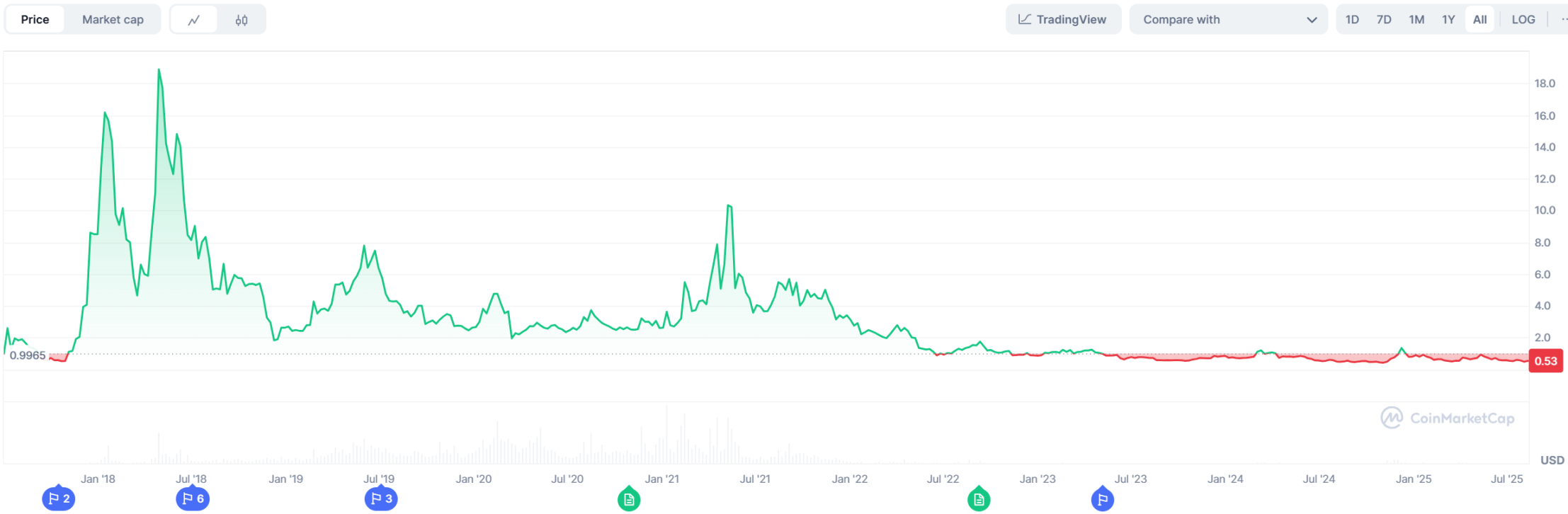
Ironically, Bullish—founded by Block.one, the company behind the EOS platform—is set to go public on the New York Stock Exchange (NYSE) on August 13, 2025 (exactly seven years later), under the ticker "BLSH," with trading expected to open at 21:30 Beijing time. Through its core businesses—the institutional-grade digital asset platform Bullish and media platform CoinDesk—Block.one has become a major player in the crypto ecosystem.
Amid the wave of crypto company IPOs, Foresight News uses data to examine Bullish.
Target Valuation of $4.8 Billion
Bullish’s IPO price range has recently been raised to $32–33 per share, with the number of shares offered increasing to 30 million, targeting total fundraising of up to $990 million and an enterprise valuation of approximately $4.8 billion. This marks an increase from earlier plans to sell 20.3 million shares at $28 to $31 per share. The adjustment reflects strong investor demand for crypto infrastructure, especially amid Bitcoin stabilizing above $110,000 and rising institutional adoption.
BlackRock and Cathie Wood’s ARK have both expressed intentions to purchase $200 million worth of shares. Bullish is expected to finalize pricing on Tuesday and begin trading the following day.
Officially established in June 2021 and headquartered in the Cayman Islands, Bullish has subsidiaries across Hong Kong, the U.S., Singapore, and beyond. Its business operates in two main segments: the Bullish exchange offers spot, margin, and derivatives trading services regulated in Germany, Hong Kong, and Gibraltar; CoinDesk focuses on indices, data, and market insights.
As of March 31, 2025, the Bullish exchange supports over 70 spot trading pairs and 45 perpetual futures pairs, serving qualified clients across more than 50 jurisdictions globally. In terms of trading volume, the platform has processed over $1.25 trillion in cumulative trading since launch. In 2024 alone, it captured global spot market shares of $284.8 billion in Bitcoin (BTC/USDx) and $144.5 billion in Ethereum (ETH/USDx), demonstrating its competitiveness in the institutional market.
User growth remains a key driver of Bullish’s expansion. In 2024, active institutional client numbers rose 36% year-on-year, while CoinDesk attracted over 55 million unique visitors, averaging 10.7 million monthly users. Assets under management (AUM) tied to CoinDesk’s index products exceeded $41 billion, with related trading volumes reaching $15 billion (as of June 30, 2025). Bullish is not only strengthening its trading infrastructure but also building an ecosystem loop through media and data services.
Financial performance further confirms its momentum. According to SEC F-1 filings, full-year net revenue in 2024 reached $80 million, with non-IFRS adjusted EBITDA at $52 million. However, Q1 2025 recorded a net loss of $349 million, primarily due to digital asset price volatility and operating costs. Yet adjusted net income remained at $2 million, indicating stable profitability in core operations.
Preliminary estimates for Q2 show total revenue between $60–62 million, adjusted EBITDA of $10–14 million, and net income ranging from -$2 million to $6 million. Revenue streams are diversified, including trading fees, spreads, licensing, and advertising, with adjusted trading revenue in Q2 2025 projected at $56–58 million.
Holding $3 Billion in Crypto Assets
In May 2021, Block.one launched Bullish Global, injecting $1 billion in capital comprising $100 million in cash, 164,000 BTC (worth about $9.7 billion at the time), and 20 million EOS tokens. External investors contributed an additional $300 million, including PayPal co-founder Peter Thiel, hedge fund veteran Alan Howard, and prominent crypto investor Mike Novogratz.

The company’s CEO, Tom Farley, formerly president of the New York Stock Exchange (NYSE), brings deep expertise in traditional finance and scaling institutional trading platforms. David Bonanno, now CFO of Bullish, previously served as CFO of Far Peak Acquisition Corp and plays a central role in capital allocation, business strategy, and key partnerships. Additionally, COO Sarah Johnson excels in compliance and risk management, having previously worked at the Hong Kong Securities and Futures Commission, helping Bullish secure regulatory approvals across multiple jurisdictions.
The prospectus (Form F-1) reveals that Bullish plans to convert over 50% of its IPO proceeds into USD stablecoins to enhance liquidity and hedge against crypto market volatility.
In Q1 2025, Bitcoin trading volume on the Bullish platform reached $108.6 billion, up 36% from $80.08 billion in the same period last year. Daily Bitcoin trading averaged $1.207 billion, up 37% from $880 million the prior year.
The filing shows that Bullish reported digital asset sales of $72.89 billion, $116.49 billion, and $250.2 billion in 2022, 2023, and 2024 respectively, with net profits of -$4.246 billion, $1.3 billion, and $79.56 million during those years.
As of August 2025, in a filing submitted Monday, the company stated it currently holds over $3 billion in liquid assets, including: 24,000 BTC; 12,600 ETH; and $418 million in cash and stablecoins. By the end of Q2, liquid assets are estimated to grow to $2.05–2.15 billion, with net liquid assets between $1.499–1.599 billion.
Bullish’s predecessor, Block.one, raised approximately $4.18 billion through the EOS ICO (Initial Coin Offering) in 2017–2018—one of the largest ICOs in crypto history—intended for the development of the EOS platform.
The EOS tokens were long ago distributed to investors, while continuous cash flow and revenue were used to accumulate Bitcoin and Ethereum. From this single investment strategy, Bullish has reaped enormous profits.
EOS failed to thrive despite immense expectations. Whether Bullish, the exchange built by block.one, can truly succeed remains an open question.
Join TechFlow official community to stay tuned
Telegram:https://t.me/TechFlowDaily
X (Twitter):https://x.com/TechFlowPost
X (Twitter) EN:https://x.com/BlockFlow_News
 Foresight News


