From JLP to Neutral: How to Capture Strategy Yields on SOL?
TechFlow Selected TechFlow Selected
From JLP to Neutral: How to Capture Strategy Yields on SOL?
JLP can triple in a year, but also fall 30% in three months. How can retail investors hedge the risk to make it "only rise, never fall"?
 Navigating Web3 tides with focused insights
Author: Alex Liu, Foresight News
From JLP to Neutral
To make money, the first step is often finding high-quality assets. Without exaggeration, even across the entire crypto space, JLP stands as one of the top-tier assets. It achieved a 3x gain within its first year, followed by a maximum drawdown of only 30% over the next three months. Despite strong performance and over $1 billion in capital capacity, how did it achieve this?
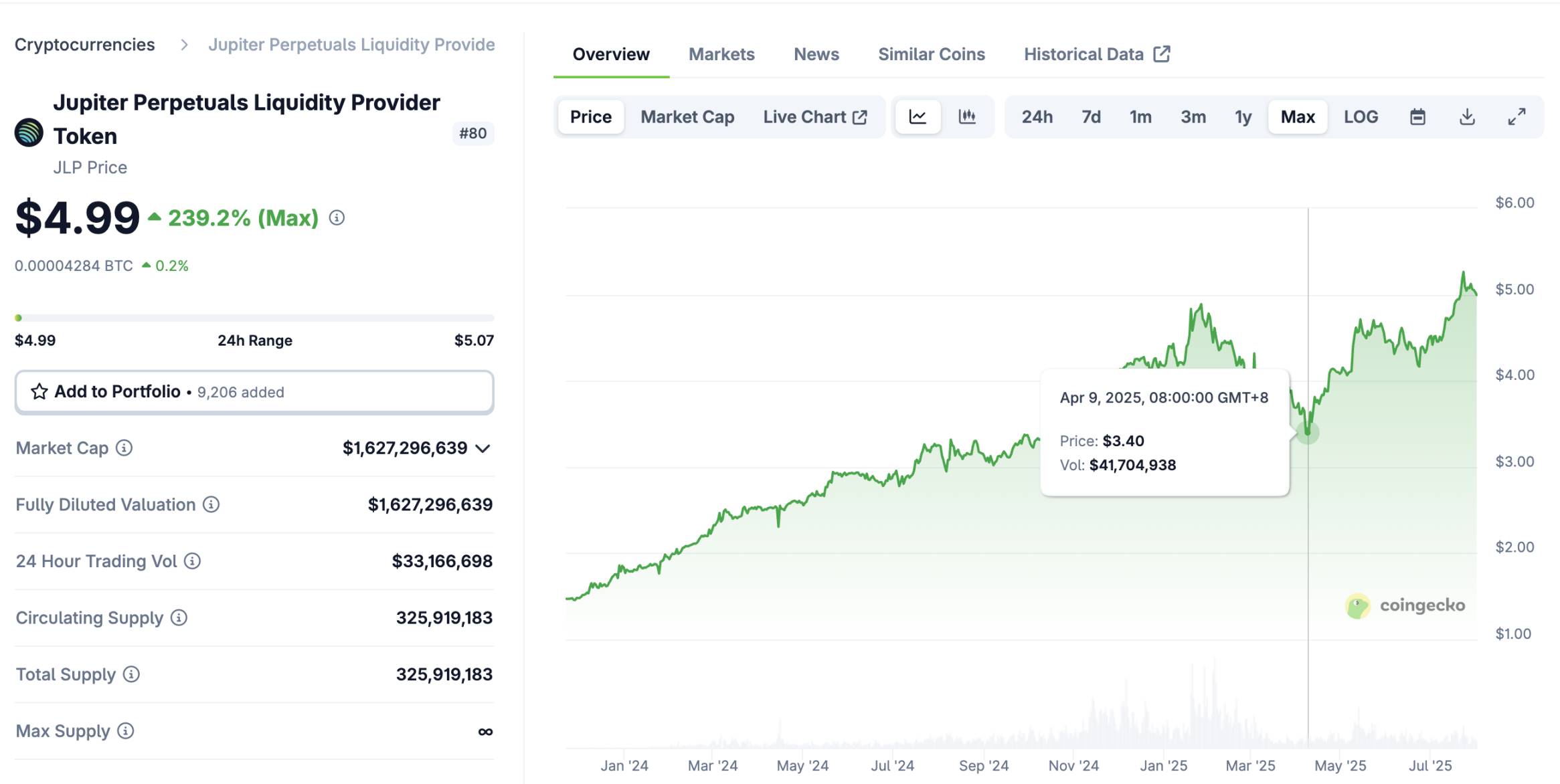
JLP price performance, data: coingecko
JLP stands for Jupiter Perpetual Liquidity Provider Token—essentially, a liquidity provider token for Jupiter's perpetual contracts. Holding JLP is like depositing money into Jupiter to act as the counterparty for derivatives traders. When perpetual traders profit, JLP loses; when they lose, JLP profits. Countless similar products have proven that, over time, perpetual traders consistently lose money—this forms JLP’s first income stream.
Additionally, 75% of Jupiter’s perpetual trading fees are distributed back to JLP holders. This substantial fee income keeps JLP’s annualized yield consistently above 30%, sometimes exceeding 50%.
JLP itself consists of 47% SOL, 8% ETH, 13% BTC, and 32% USDC, maintaining exposure to major crypto assets. Thus, during the strong SOL rally in 2024, combined with the two revenue streams mentioned, JLP surged over 3x. During the subsequent three months when SOL dropped from $295 to below $100, JLP’s limited risk exposure and offsetting income streams limited its decline to 30%. After SOL recovered, JLP quickly reached new highs.
In summary, JLP loses money primarily when traders profit during extreme short-term market moves (though statistically, they tend to give those gains back later), or when crypto prices trend downward long-term. The latter appears to be the only lasting risk. If we can hedge out this long-term price risk, we effectively obtain a high-yield strategy backed by a high-quality underlying asset.
Neutral is an institutional-grade on-chain strategy hedge fund on Solana, offering exactly such a solution:
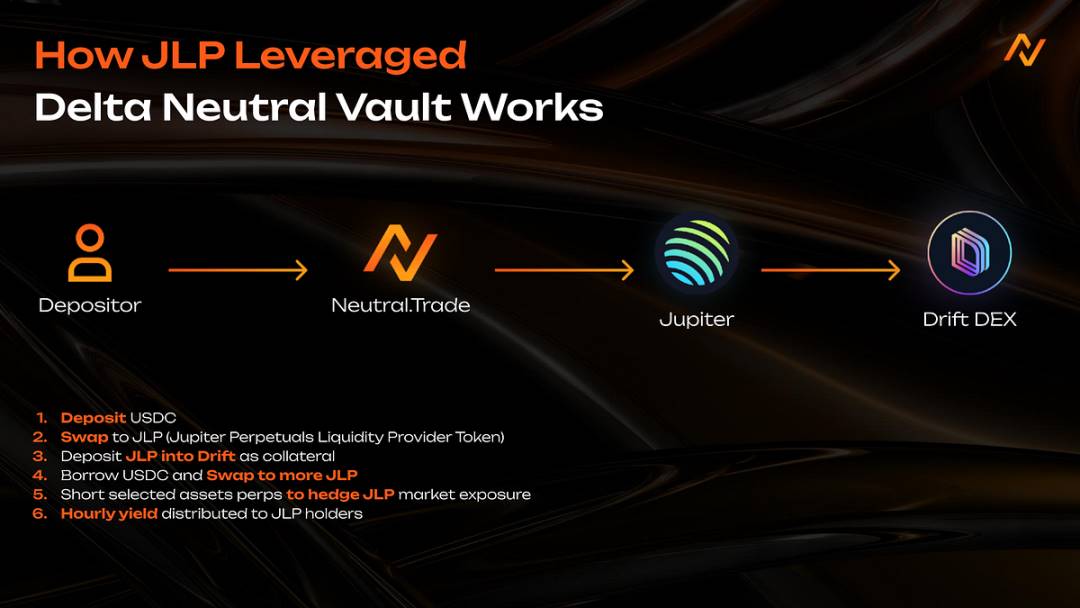
Users deposit USDC, convert it into JLP. They then collateralize JLP in a lending protocol to borrow USDC, which is again converted into JLP. (This loop is profitable as long as JLP’s yield exceeds borrowing costs.) Finally, perpetual contracts (on Drift) are used to short the corresponding crypto positions (SOL, ETH, BTC) held via JLP, making the overall strategy market-neutral (theoretically immune to price volatility losses).
The Neutral vault currently has over $12 million in TVL (total value locked), delivers over 15% annualized returns, and maintains maximum drawdowns largely under 2%.
Retail Risks vs. Institutional Advantages
So why not execute this strategy myself instead of using a product like Neutral? Doing it myself would avoid fees (Neutral charges a 10–25% performance fee on profits, deducted proportionally).
The reason is simple: retail investors often lack the capability to properly manage risk in complex strategies.
Executing this strategy involves risks: potential liquidation from hedging shorts, funding rate anomalies, and potential losses from inverted interest rates on leveraged borrowing. Even monitoring 24/7, retail users may lack spare funds to post margin or break the borrowing cycle during emergencies.
Institutional-grade hedge funds like Neutral are monitored around the clock by dedicated teams, equipped with extensive experience and contingency plans for systemic risks. Their risk management capabilities surpass retail by an order of magnitude. Since capital preservation comes first, the choice lies between pursuing maximum returns via a degen approach or sacrificing some yield for more secure risk management—a decision requiring careful personal evaluation.
Project Overview
Back to the Neutral project itself. It’s not the only on-chain hedge fund available, but we’re highlighting it due to its ongoing collaboration with the Chinese Solana community, lending it relatively credible backing. Additionally, Neutral features an active points system with potential token launch expectations, allowing users to earn strategy yields while positioning for future airdrops. (Its points system awards 1 point per dollar per year—equivalent to 1 point daily for every $365 deposited.)
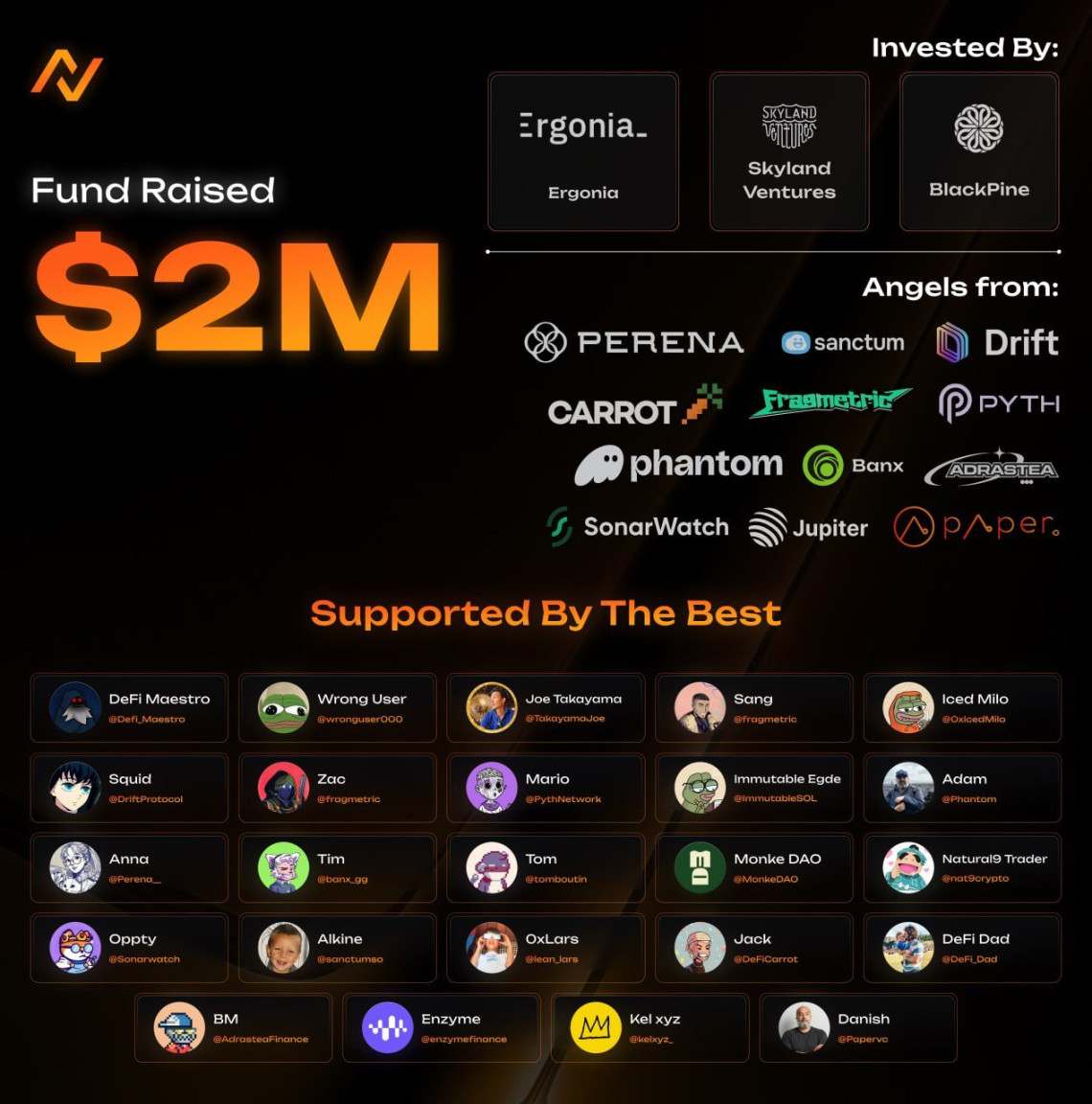
Neutral began as a prize-winning project at the Solana Radar Hackathon and has since grown into a notable emerging protocol with nearly $36 million in TVL and nearly $2.5 million in generated user returns. Founders Rick and Jared are veteran quant traders from Goldman Sachs and one of the world’s top three hedge funds. On June 1, Neutral announced a $2 million funding round led by Cumberland and supported by various Solana ecosystem projects and participants.
Beyond its flagship JLP neutral strategy, Neutral offers multiple other yield strategies, including Hyperliquid fee arbitrage. Note that not all strategies are market-neutral; directional strategies may experience significant volatility based on market conditions. Interested readers should conduct their own research.
Join TechFlow official community to stay tuned
Telegram:https://t.me/TechFlowDaily
X (Twitter):https://x.com/TechFlowPost
X (Twitter) EN:https://x.com/BlockFlow_News
 Foresight News