Full text of the U.S. SEC Chair's "Crypto Agenda" speech
TechFlow Selected TechFlow Selected
Full text of the U.S. SEC Chair's "Crypto Agenda" speech
The U.S. aims to become the global crypto hub by reforming its securities regulatory framework and moving its financial markets fully on-chain.
 Navigating Web3 tides with focused insights
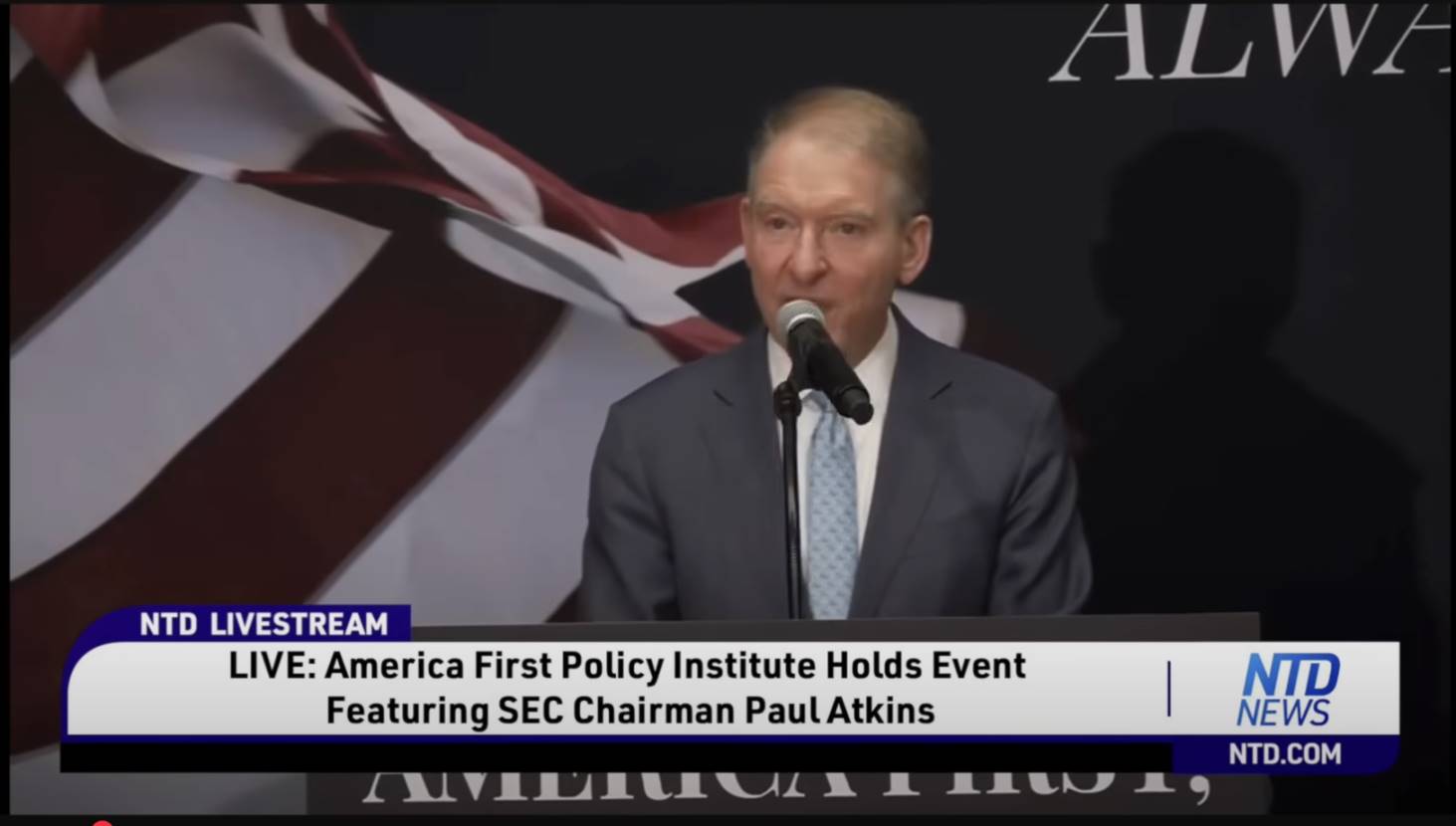
Speaker: Paul S. Atkins, Chairman of the U.S. SEC
Translation: Alex Liu, Foresight News
American Leadership in the Digital Finance Revolution
Good afternoon, everyone. Thank you, Norm, for the kind introduction, and thank you all for inviting me here today. I'm delighted to be with you at what I believe is a pivotal moment for American leadership in the crypto asset markets. Before sharing my thoughts, I want to thank the America First Policy Institute for convening this timely discussion. And to put our compliance team at ease, I must state that the views expressed here are solely my own and do not necessarily reflect those of the SEC or any other commissioners.
Today, I'd like to speak about what Commissioner Hester Peirce and I call "Project Crypto", which will serve as the SEC's guiding star in supporting President Trump's historic effort to make America the "global crypto capital." But before discussing our vision for crypto market dominance, let me reflect on some turning points in capital markets history—moments strikingly similar to where we stand today—and consider how the future we shape should honor the legacy we've inherited.
From the Buttonwood Tree to the Blockchain: The Evolution of Capital Markets
Innovation has always swept through our capital markets, sometimes like a hurricane. In 1792, it stirred the branches of a buttonwood tree—under whose shade more than two dozen stockbrokers gathered to sign an agreement forming the precursor to the New York Stock Exchange. That handwritten parchment, fewer than a hundred words long, launched an elegant system that has governed the orderly flow of capital across generations.
For centuries, our markets have never stood still. They've expanded, evolved, and reshaped themselves alongside contemporary ideas and technologies. Markets thrive because people participate. They channel human creativity toward society’s toughest challenges and reward those who develop the most valuable, most sought-after solutions. This is Adam Smith’s “invisible hand” in action: even as individuals pursue their self-interest, markets guide them toward serving the public good.
The SEC’s role is to safeguard such a market—one where human ingenuity and skill can benefit society. Throughout its history, the SEC has both fostered and, regrettably, stifled innovation. Fortunately, forward momentum ultimately prevails. When our regulatory posture embraces innovation with prudence rather than fear, America’s global leadership consistently rises.
In the 1960s—before my time—Wall Street was booming, but behind the scenes, market operations were straining. Most clearing and settlement processes relied on costly and cumbersome procedures. Mountains of paper stock certificates had to be wheeled by clerks back and forth across Wall Street and financial centers nationwide.
This paper-based system was designed for a gentler era and clearly could not handle surging trading volumes. Delays at one firm would cascade through the entire chain; securities were frequently lost or stolen; trade failures soared; and weaker broker-dealers faced insolvency due to operational breakdowns. As a result, trading hours were shortened, and exchanges even closed every Wednesday just so firms could catch up with piles of paper certificates.
The then-chairman of the SEC described this systemic collapse as “the most severe and prolonged crisis the securities industry has faced in 40 years... with firms failing and investor confidence plummeting.” To its credit, the SEC responded proactively, driving market participants to establish what we now know as the Depository Trust & Clearing Corporation (DTCC), fundamentally transforming how securities are held and traded.
Afterward, there was no longer a need for paper certificates to shuttle between clients and brokers, or among broker-dealers. Ownership of securities began to be recorded electronically in ledger systems. The physical certificates themselves were “frozen,” securely stored in vaults, while ownership transferred via computer systems—laying the foundation for today’s clearing and settlement infrastructure.
Just like this ticker tape machine beside me—an innovation in its day that allowed Americans to receive transaction data line by line in real time—innovation must not remain confined to past glories.
By the late 1990s, electronic trading systems disrupted many assumptions underlying traditional market structures. Then-SEC Chair Arthur Levitt rightly believed the SEC had a duty to provide regulatory flexibility for innovation in electronic markets. Thus, Regulation ATS, introduced in 1999, allowed these systems to operate under broker-dealer regulation rather than as traditional exchanges.
Now we arrive at today—a moment demanding American ambition, and a project capable of unleashing it.
Our regulatory framework must not remain anchored in the analog age, refusing to explore new frontiers. After all, the future is accelerating, and the world won’t wait for us. America cannot merely keep pace with the digital asset revolution—we must lead it.
Forging the Future: American Leadership in a Financial Golden Age
Today, I want to declare to the world that under my leadership, the SEC will not stand idly by as innovation flourishes overseas while our own capital markets stagnate. To realize President Trump’s vision of making America the global crypto capital, the SEC must holistically assess the potential benefits and risks of migrating our markets from off-chain to on-chain.
We stand at a new threshold in capital markets history. As I mentioned earlier, today I formally launch Project Crypto—an agency-wide initiative aimed at modernizing securities regulations so that America’s financial markets can fully transition onto the blockchain.
Just weeks ago, President Trump signed the GENIUS Act into law, establishing a gold-standard regulatory framework for stablecoins in global payments. Following its passage, he publicly endorsed congressional efforts to pass comprehensive crypto market structure legislation this year. I commend the bipartisan support demonstrated in the House and look forward to the Senate building upon this foundation to create a legal structure that protects against regulatory overreach and solidifies America’s dominance in the global crypto industry.
Yesterday, the President’s Working Group on Digital Asset Markets released the PWG Report, offering clear recommendations to the SEC and other federal agencies to build a framework that maintains American leadership in crypto assets. This report is a blueprint to ensure the United States leads in blockchain and cryptographic technologies. As the President said last week, he wants the world to run on American technological infrastructure. I am ready to help make that happen.
Therefore, I am launching Project Crypto and directing the SEC’s policy divisions to work closely with Commissioner Peirce’s crypto task force to rapidly develop plans implementing the PWG Report’s recommendations. Project Crypto will ensure America remains the best place in the world to start a company, develop cutting-edge technology, and participate in capital markets. We will bring back to the United States the crypto businesses that fled due to the previous administration’s “enforcement-over-regulation” approach and Operation Chokepoint 2.0. Whether established players or new entrants, the SEC welcomes market participants eager to innovate.
Bringing Crypto Back to America: A New Era at the SEC
Project Crypto will encompass a series of initiatives within the SEC.
First, we will work to bring crypto asset issuance back to the United States. Complex offshore corporate structures, pseudo-decentralization theater, and confusion over whether crypto assets are securities will become relics of the past. President Trump has declared that America is entering its “golden age”—and under our new agenda, the crypto economy will enter its golden age as well.
Fulfilling a key recommendation of the PWG Report, one of my top priorities is to quickly establish a regulatory framework in the U.S. for crypto asset issuance. Capital formation is central to the SEC’s mission, yet for too long the SEC has ignored market demand and suppressed crypto-based fundraising models. This has driven crypto markets away from issuing productive assets and deprived American investors of opportunities to engage in productive economic activity through this technology. The SEC’s long-standing avoidance of crypto, coupled with a "shoot first, ask questions later" approach, must become history.
Although the SEC’s past stance treated most crypto assets as securities, in reality, the majority of crypto assets are not securities. However, due to the ambiguity of the Howey Test, many innovators have conservatively treated all crypto assets as securities. American entrepreneurs are using blockchain technology to modernize various traditional systems and tools. For example, Ohio’s current U.S. Senator and former entrepreneur Bernie Moreno founded a company that placed car titles on the blockchain before his campaign. He identified inefficiencies in title transfers and offered a practical blockchain-based solution.
These entrepreneurs need—and deserve—clear criteria to determine whether their activities fall under securities laws. I have directed Commission staff to develop clear guidelines to help market participants assess whether a crypto asset is a security or constitutes an investment contract. Our goal is to assist them in categorizing assets according to clear standards, such as digital collectibles, digital commodities, or stablecoins, and evaluating the economic substance of their transactions. Through such classifications, market participants can determine whether an issuer has ongoing commitments or obligations, thereby assessing whether the asset constitutes an investment contract.
Moreover, being classified as a security should not be a death sentence. We need a regulatory framework adapted to crypto securities so these products can thrive within U.S. markets. Many issuers will want to leverage the design flexibility offered by securities laws, and investors will benefit from features like dividends and voting rights. Projects should not be forced to prematurely establish DAOs, create offshore foundations, or rush into decentralization. I am excited about new applications of crypto securities in business, such as tokenized stocks participating in blockchain consensus mechanisms.
Therefore, for crypto asset transactions that do fall under securities laws, I have asked staff to propose tailored disclosure requirements, exemptions, and safe harbor provisions—including for so-called “initial coin offerings (ICOs),” airdrops, and network reward programs. Our aim is to enable issuers to include U.S. users in their offerings—not exclude them due to legal risk—so they can benefit from legal certainty and a supportive regulatory environment. I believe that if we stay on this course, we may witness a Cambrian explosion of innovation.
In addition, many companies wish to “tokenize” traditional securities such as common stock, bonds, or partnership interests—or tokenize securities issued by others. Due to U.S. regulatory barriers, much of this innovation occurs overseas. Meanwhile, our policy division receives numerous applications—from Wall Street household names to Silicon Valley unicorns—seeking approval to distribute security tokens within the United States. I have instructed the Commission to collaborate with these firms and, where appropriate, grant regulatory exemptions to ensure America does not fall behind in crypto innovation.
Expanding Freedom: Diversified Custody and Trading Venue Options
Second, to achieve the President’s goals, the SEC must ensure market participants enjoy maximum freedom in choosing custody and trading platforms. As I’ve stated, the right to own and manage private property is a core American value. I firmly believe individuals have the right to use self-custody wallets to hold their crypto assets and participate in on-chain activities such as staking. At the same time, some investors will still choose to entrust their assets to SEC-registered intermediaries like broker-dealers or investment advisers, which incur additional regulatory responsibilities when providing custody services.
During my tenure, implementing the PWG Report’s recommendation to “modernize the SEC’s custody obligations for registered intermediaries” will be a top priority. The prior administration’s special purpose broker-dealer framework, SAB 121, and Operation Chokepoint 2.0 have left the market with virtually no compliant crypto custody providers. Existing custody rules fail to account for the unique nature of crypto assets. I have directed staff to study how to adapt current rules—including granting exemptions or modifying regulations when necessary—to foster the development of crypto custody services.
The PWG Report also recommends allowing market participants to operate multiple lines of business under the most efficient licensing structure. We must not force them into a “Procrustean bed” of ill-fitting regulation. I support enabling them to freely choose the regulatory path best suited to their business, provided investor protection is maintained.
Enabling Super-Apps: Horizontal Integration of Products and Services
Third, another major objective during my chairmanship is to allow innovation under a “Super-App” framework. Many people ask me: “What is a Super-App?” Simply put: securities intermediaries should be able to offer diverse products and services on a single platform and under one license. A broker-dealer operating an Alternative Trading System (ATS) should be able to offer non-security crypto trading, security crypto trading, traditional securities services, and staking, lending, and other functions—all without needing licenses from fifty states or multiple federal regulators.
Current federal securities laws do not prohibit registered trading platforms from listing non-security assets. I have directed Commission staff to develop further guidance and proposals to advance such “Super-Apps.” Perhaps we’ll eventually name it “Reg Super-App.”
As recommended by the PWG Report, the SEC should collaborate with other regulators to establish the simplest, most efficient licensing regime for registered intermediaries, avoiding overlapping supervision. This model is already widely adopted in banking—banks typically don’t need separate registration as broker-dealers or clearing agencies. Regulators should apply oversight with the lightest necessary touch, protecting investors while encouraging enterprise growth. We must not drive businesses overseas with excessive, paternalistic regulation, nor let regulatory burdens favor well-resourced incumbents at the expense of smaller competitors.
In line with specific PWG Report recommendations, I have directed the Commission to develop a framework allowing non-security and security crypto assets to trade side-by-side on the same SEC-regulated platform. Additionally, I have asked staff to evaluate how we can use the Commission’s authority to permit certain crypto assets to list on non-SEC-registered trading platforms. This would allow state-licensed platforms to offer more assets and enable CFTC-regulated platforms to introduce margin functionality—even without additional statutory authority—unlocking greater liquidity.
Unlocking American Market Potential: Powerful and Beautiful On-Chain Software Systems
Fourth, I have directed Commission staff to update outdated regulations to unlock the potential of on-chain software systems in U.S. securities markets. On-chain software takes many forms—some systems are truly decentralized and require no intermediary; others are maintained by specific operators. Both should have a place in our financial markets.
Any regulatory framework for crypto market structure must provide a clear path for developers of on-chain software that doesn’t rely on centralized intermediaries. Decentralized finance (DeFi) software systems—such as automated market makers (AMMs)—enable automated, non-intermediated financial market activities. U.S. federal securities laws have long assumed the presence of intermediaries subject to regulation, but that doesn’t mean we should artificially impose intermediaries just to fit old regulatory logic. If a market can function without intermediaries, we should respect that.
We will make room for both models—centralized and decentralized—to develop within U.S. markets. We will protect developers who merely publish software code, clearly distinguish between intermediary involvement and non-intermediary activity, and establish clear, feasible regulatory rules for intermediaries wishing to operate on-chain software systems. DeFi and other on-chain software systems will become part of our securities markets—not be strangled by redundant or excessive regulation.
To realize this vision, we will need to revise existing rules. For example, to support on-chain trading of securities, we may need to amend Regulation NMS. In fact, twenty years ago, I co-authored a dissenting statement with then-commissioner Cynthia Glassman opposing Reg NMS, and today those concerns feel even more relevant. Over the past two decades, Reg NMS’s excessive requirements have distorted market behavior and hindered the natural evolution of U.S. securities markets. Congress originally intended for “competitive forces, not unnecessary regulation,” to guide the national market system. I will work to return us to that original intent and further promote innovation and competition in our markets.
Driving Innovation: Commercial Viability as Our Guiding Star
Finally, innovation and entrepreneurship are the engines of the American economy. President Trump has called America a “nation of builders.” Under my leadership, the SEC will encourage this spirit—not suppress it with red tape and one-size-fits-all rules. The current Commission is actively considering industry-proposed reforms to stimulate innovation. We are also exploring an “innovation exemption mechanism”—allowing registered and non-registered entities to quickly bring new business models and services to market, even if they don’t perfectly align with existing rules.
In my vision, this innovation exemption will allow technological pioneers and entrepreneurial thinkers to enter the market immediately—without being burdened by outdated or economically harmful regulations. In return, they would need to meet certain principle-based conditions to fulfill the core policy objectives of federal securities laws. These might include commitments to regular reporting to the SEC, implementation of whitelists or “certified pools,” and allowing only security tokens meeting compliance functionality standards (e.g., ERC3643) to circulate. I encourage market participants and SEC staff alike to treat “commercial viability” as the central criterion when developing models.
Conclusion
As we advance these priorities, I look forward to collaborating with other government agencies to collectively make America the global crypto capital. This is not just a shift in regulatory philosophy—it is a generational opportunity.
From paper agreements under the buttonwood tree to digital ledgers on the blockchain, the winds of innovation still blow strong. Our mission is to ensure these winds continue to propel American leadership forward. Because, ladies and gentlemen, we have never been content to follow. We will not sit on the sidelines. We will lead. We will build. And we will ensure the next chapter of financial innovation is written in America.
Thank you all for listening today. Stay tuned for upcoming announcements and proposals, and please continue to share your valuable feedback and suggestions.
Join TechFlow official community to stay tuned
Telegram:https://t.me/TechFlowDaily
X (Twitter):https://x.com/TechFlowPost
X (Twitter) EN:https://x.com/BlockFlow_News
 @SECGov