
Why are Web2.5 projects more favored by institutions?
TechFlow Selected TechFlow Selected
Why are Web2.5 projects more favored by institutions?
The mainstream investment direction over the next 3-5 years may revolve around "the crypto transformation of traditional businesses."
 Navigating Web3 tides with focused insights
By: Haotian
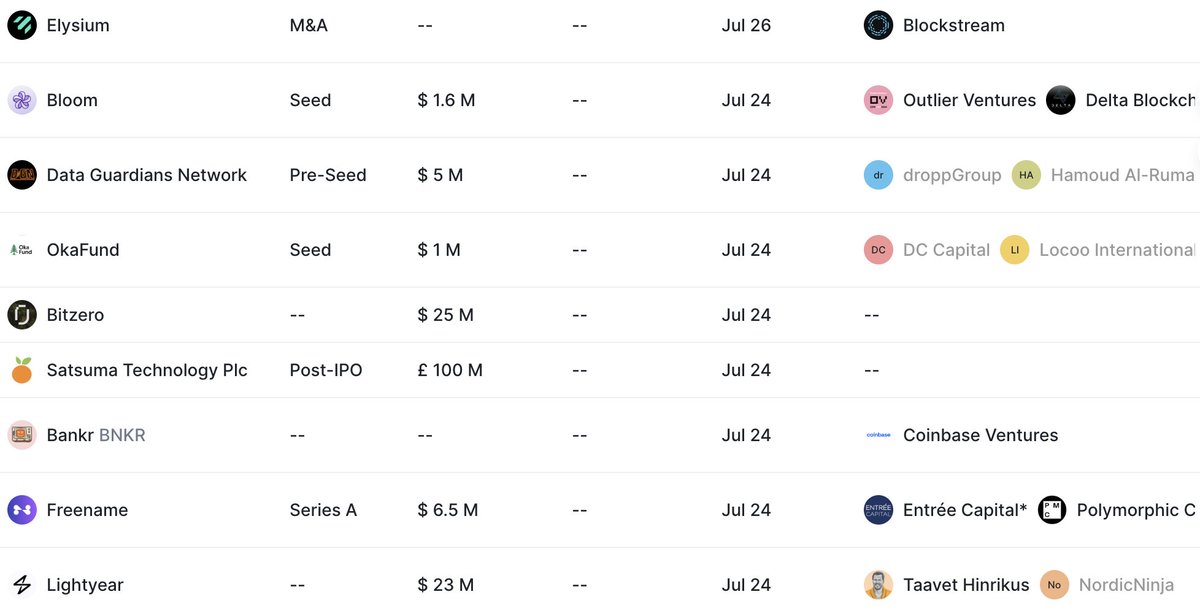
Looking at recent projects favored in the primary investment market, I noticed a common trait: they all lean toward "hybrid innovation," using web3 technical infrastructure to support mature business logic derived from proven web2 business models.
For example, @go_lightyear brings traditional stock ETF investment logic to Web3, @HilbertCapital focuses on digital asset quant strategies, @bitcoin2100m specializes in crypto asset allocation, and @ElysiumLab_io builds a daily Bitcoin payment wallet.
Most of these projects fall into the category of hybrid innovation—essentially aligning with the same operational logic seen when some web3 projects "go public by shell merger" or U.S. listed companies begin holding crypto assets.
Why is this trend emerging? Frankly, there are three core reasons:
1) Pure native on-chain innovative projects have hit a ceiling. Not only is user scale struggling to break beyond niche circles, but their business models also heavily rely on tokenomics incentives. Crucially, their narratives and product designs have fallen into a self-referential "echo chamber." In a liquidity-constrained bear market, this clearly puts them at a disadvantage;
2) The regulatory environment is showing increasingly "crypto-friendly" characteristics. The approval of BTC and ETH spot ETFs, the establishment of GENIUS and CLARITY bills, and Wall Street financial institutions rushing in with FOMO have collectively transformed crypto assets from niche speculative instruments into mainstream financial derivatives. Undoubtedly, under such circumstances, hybrid innovation approaches—either actively adopting traditional finance's mature business models or proactively seeking usable web3 technical infrastructure—will become highly attractive;
3) User investment demands are maturing. Originally, crypto users cared deeply about whether a product or protocol was decentralized, evaluating projects based on consensus strength. But as large-scale mainstream web2 users enter, people now simply care about usability, security, and profitability. Therefore, products offering simpler experiences and more immediate returns will gain greater market traction.
So where will investment trends go next? Following this logic, we can anticipate that the mainstream investment focus over the next 3–5 years may revolve around the "crypto transformation of traditional businesses":
1) In niche financial markets such as investment, payments, asset management, insurance, credit scoring, supply chain finance, and cross-border trade settlement, many projects will emerge combining "traditional business logic + crypto technology infrastructure." Crypto infrastructure will increasingly operate behind the scenes, solely addressing cost, efficiency, and transparency issues, while front-end user experiences remain nearly indistinguishable from traditional products;
2) Technical standardization and the "invisibility" of infrastructure will become key trends. New infrastructures supporting web3+web2 hybrid innovation will no longer be confined to the original Crypto Native paradigm, nor will they chase flashy technological concepts. Instead, they will focus purely on delivering reliable, efficient, and low-cost cryptographic support. While terms like "modularization" and "chain abstraction" may no longer be hyped sectors, they will quietly serve as foundational layers for standout products;
3) Traditional financial institutions will shift toward "active participation." Rather than merely buying and holding crypto or investing in Web3 ventures, they will directly leverage their licenses, resources, and user bases to localize and transform financial services using crypto. For instance, banks launching stablecoin payments, insurers issuing on-chain policies, or brokers providing crypto custody services. Such moves by giants will bring larger capital inflows and user growth, intensify product competition, and drive the industry toward maturity.
Join TechFlow official community to stay tuned
Telegram:https://t.me/TechFlowDaily
X (Twitter):https://x.com/TechFlowPost
X (Twitter) EN:https://x.com/BlockFlow_News
 Haotian | CryptoInsight