









Ethereum's Decade: Vitalik's Intellectual Evolution
TechFlow Selected TechFlow Selected
Ethereum's Decade: Vitalik's Intellectual Evolution
In the darkness, he chose to persevere, waiting for dawn.
 Navigating Web3 tides with focused insights
Author: Vitalik Think Tank
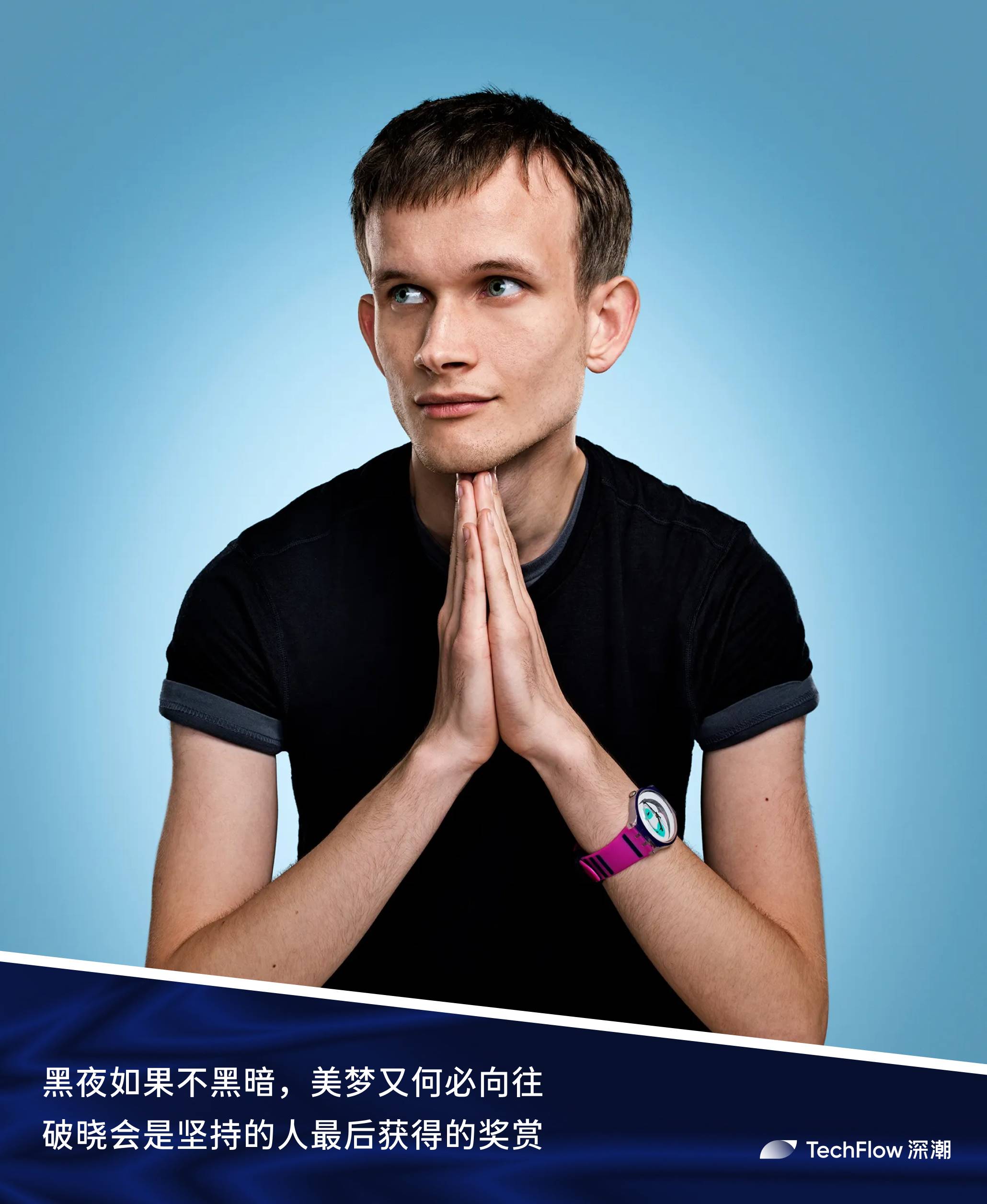
On July 30, 2015, the Ethereum mainnet launched.
Bitcoin emerged like a myth—self-organized, impersonal, and unchangeable. Ethereum, by contrast, has been like an unfinished script, with its author never leaving the stage.
Vitalik Buterin, a young, idealistic technologist, spent ten years embedding his philosophy, values, and inner struggles into code.
From the initial vision of a "world computer," to governance reflections during the DAO crisis, from The Merge to deep transformations within the Foundation—every evolution of Ethereum bears the mark of Vitalik’s thinking.
Ethereum’s first decade is also a history of Vitalik’s intellectual evolution.
The Utopia of a Genius
In 2008, a financial crisis brought unprecedented turmoil.
As banks collapsed and trust disintegrated, Bitcoin emerged, sounding the call of rebellion against the old world. This new technology captured not only hackers and cryptography enthusiasts but also changed the life trajectory of one teenager—Vitalik Buterin.
Geniuses often rise early. While most teenagers were discovering love, 17-year-old Vitalik encountered Bitcoin.
In 2011, he learned about Bitcoin from his father—a computer scientist—and after quitting World of Warcraft, Bitcoin became his new obsession.
He began searching Bitcoin forums online until he found someone willing to pay him in Bitcoin for articles. At that time, he earned 5 bitcoins per blog post.
Vitalik’s writing quickly caught the attention of Romanian Bitcoin enthusiast Mihai Alisie. They began corresponding and co-founded Bitcoin Magazine by the end of 2011.
In 2013, Vitalik used the Bitcoin he earned from writing to travel globally—visiting Israel, London, San Francisco, and Los Angeles—to meet local Bitcoin communities. Upon returning to Toronto, he became utterly convinced that everyone else had completely misunderstood blockchain 2.0.
This was because they all tried building complex applications on top of Bitcoin, but Bitcoin's scripting capabilities were too limited.
Vitalik realized that if he built a version of Bitcoin with a Turing-complete programming language, the network could provide all digital services—replicating social networks, restructuring stock markets, even creating fully digital companies—free from control by any government entity.
In November that year, 19-year-old Vitalik turned his idea into a white paper and named it: Ethereum.
The white paper rapidly swept through the crypto community. For the first time, people realized blockchain could be more than just money—it could become a global, decentralized platform.
Co-founders like Joseph Lubin and Gavin Wood joined soon after. Lubin even called him “a genius alien bringing the gift of decentralization.”
During this period, Vitalik was an extremely pure idealist. In interviews, he openly admitted holding a dualistic worldview, believing most societal ills stemmed from centralization. “I see everything involving government regulation or corporate control as purely evil.”
Yet, there has always been a gap between idealism and reality.
The first rift appeared within the team. Some co-founders wanted Ethereum to become a profitable business entity, while Vitalik preferred sticking to a non-profit, open community model. He even proposed reducing his own and other founders’ allocations to prevent future power concentration.
In June 2014, tensions peaked.
Vitalik asked Charles Hoskinson and Amir Chetrit to leave the team. That same year, he established the Ethereum Foundation (EF), cementing a non-profit governance direction. Later that year, Gavin Wood also left due to disagreements with Vitalik over development priorities and the non-profit path, eventually founding Polkadot in 2020.
In an interview with TIME, Vitalik acknowledged Ethereum’s transformative vision risked being overwhelmed by greed:
“If we don’t raise our voices, only things that can generate immediate profit will get built—and those are often not what the world truly needs.”
On July 30, 2015, dozens of young developers in a small Berlin office witnessed the Ethereum mainnet boot up automatically. There was no grand celebration, no massive media coverage—just a group of idealists quietly watching blocks scroll across their screens.
The “world computer” vision moved from white paper to reality.
Yet behind the spotlight, the young Vitalik was unprepared for a more complex and harsh real world.
The Cracks in Idealism
In Ethereum’s early years, Vitalik resembled a pure technological utopian. He firmly believed blockchain’s ultimate meaning lay in decentralization—emphasizing that anyone could freely build applications on Ethereum without approval from a central authority.
At Devcon 1 in 2015, Vitalik repeatedly stressed Ethereum’s openness and trustless nature, painting a picture of an ideal world governed by code rather than power.
But decentralization doesn’t mean everything naturally turns out well. Vitalik opposed centralization yet inevitably became the final arbiter of community opinion. This subtle power paradox was dramatically amplified in the subsequent DAO crisis.
In 2016, The DAO—the world’s first decentralized investment fund—launched on Ethereum, raising over 12 million ETH worth $150 million. However, in June, a hacker exploited a smart contract vulnerability and stole approximately 3.6 million ETH.
That year, Vitalik was only 22, just getting used to being called “V God.” After the crisis erupted, he worked nearly around the clock—communicating with the community, formulating solutions, attempting damage control.
An urgent need to protect investor assets clashed sharply with the technical creed of decentralization. Ultimately, Vitalik chose a pragmatic compromise: advocating a hard fork to recover the stolen funds, with the entire community voting on the decision.
This move successfully stabilized the market but split Ethereum into today’s ETH and ETC.
In this crisis, Vitalik lost not only sleep but also his faith in the “perfect execution” of smart contracts and his previously “perfect” image as a leader. Because of this event, the 100% tech-trusting “saint” disappeared, and a more pragmatic Vitalik began emerging.
After the DAO crisis, Vitalik wrote in his blog post *Thinking About Smart Contract Security* about the gap between ideals and reality. He called for stricter security audits and formal verification, and began discussing governance in public speeches, emphasizing that “community collaboration,” not technological absolutism, was key to Ethereum’s success.
The crisis sparked reflection, but the market quickly plunged into speculative frenzy, burdening the network heavily.
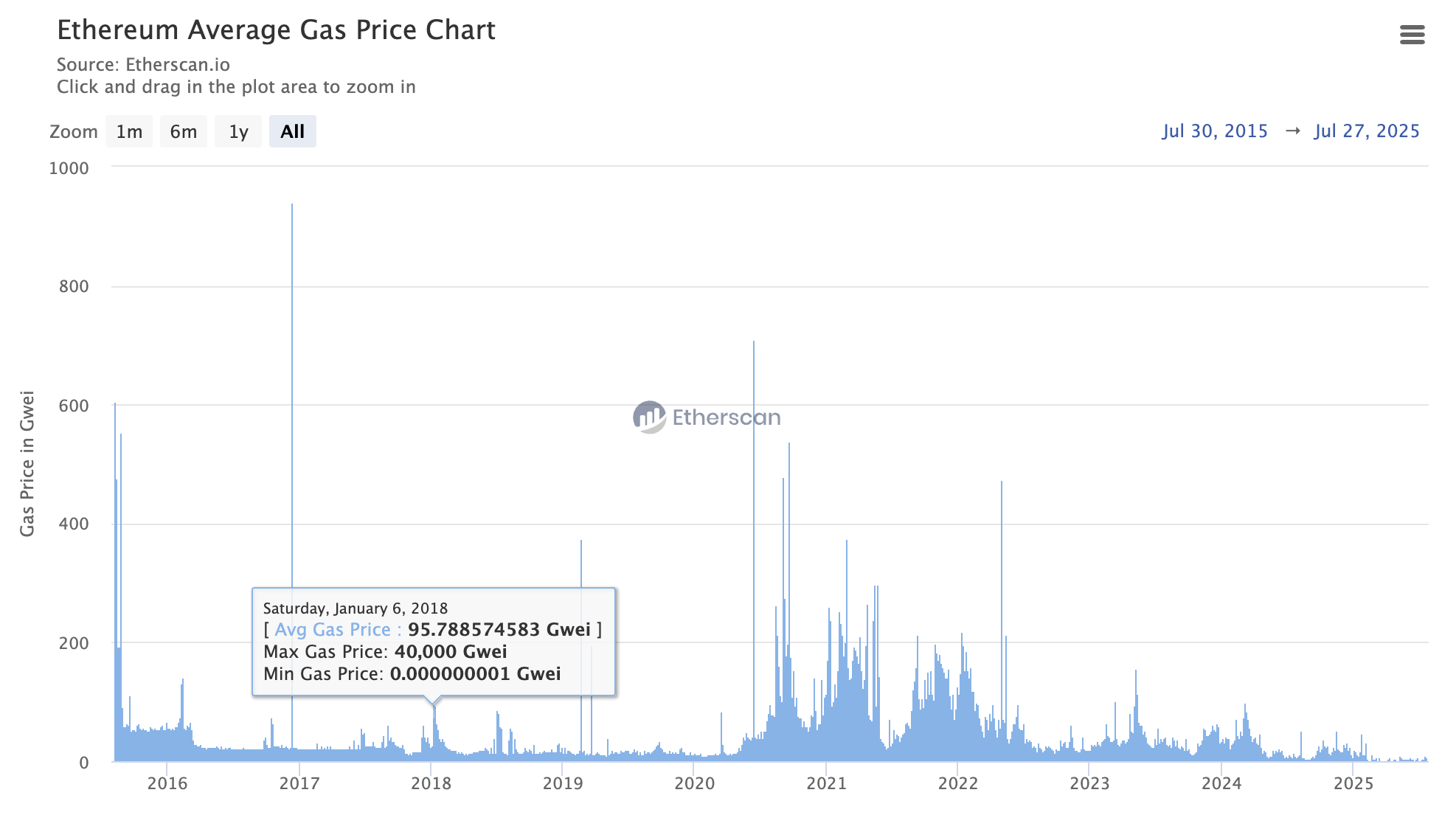
In 2017, ICOs (Initial Coin Offerings) became a phenomenon-level fundraising method. Projects like EOS, Tezos, and Bancor easily raised hundreds of millions on Ethereum. By year-end, the NFT game CryptoKitties caused severe Ethereum congestion due to user surge, pushing gas fees above 800 Gwei. Vitalik realized: If scalability issues weren’t solved, Ethereum would struggle to achieve inclusive aspirations.
In interviews, he openly expressed disappointment at the industry’s speculation:
“Many projects appear decentralized but are merely repackaged. We must prove blockchain has real advantages over traditional technologies (like Excel spreadsheets).”
The hype soon faded. In 2018, the crypto market crashed overall—ETH dropped from $1,400 to $83—and most ICO projects collapsed.
During this time, Vitalik constantly pondered how to steer blockchain back toward meaningful directions.
In 2018, he co-authored *Liberal Radicalism: A Flexible Design for Charitable Matching Funds* with Harvard scholar Zoë Hitzig and Microsoft researcher Glen Weyl, proposing quadratic voting. The goal was to use public funding models to support genuinely valuable public goods instead of short-term speculation.
To address network congestion caused by poor scalability, Vitalik and community developers proposed EIP-1559, introducing dynamic gas fees and pushing Ethereum’s transition from Proof-of-Work (PoW) to Proof-of-Stake (PoS) to reduce energy consumption and increase transaction throughput.
The DAO crisis, speculative bubbles, and price crashes led to a profound ideological shift in Vitalik. He evolved from a “techno-saint” pursuing extreme decentralization into a builder who must consider security, governance, and social value.
Ethereum remained his utopia, but no longer a pure technological playground—it had become a rugged real-world path requiring compromise, trade-offs, and broader vision.
Through this process, Vitalik gradually developed his own pragmatic philosophy.
Battles Beyond Code
If 2015–2019 marked Vitalik’s transformation from pure technological idealism to pragmatism, then 2020–2022 represented another pivotal turn: he began confronting the complexity of the real world, shifting from narrow technical idealism toward multidimensional thinking encompassing social governance, public responsibility, and realpolitik—especially the Russia-Ukraine war, which prompted him to leverage his influence in political matters.
In August 2020, in his blog post *Trust Models*, he argued blockchains can never be fully “trustless”—real-world social contracts and power relations cannot be entirely eliminated, a stark contrast to his earlier belief that code could fully replace human consensus.
In 2021, Vitalik criticized single-token voting governance in his post *Moving Beyond Coin Voting Governance*, arguing capital weight shouldn’t be the sole decision-making logic. He advocated for multi-dimensional consensus and soft governance mechanisms, aiming to align blockchain decision-making with human societal logic.
An idealist further integrating into reality.
2022 was a year of major challenges for both Ethereum and Vitalik—the Merge.
The transition from PoW to PoS wasn’t smooth. Many original Ethereum community members criticized PoS for concentrating power further among large stakeholders. Some miners and node operators resented abandoning the PoW mining model they’d maintained for years.
Cardano founder Charles Hoskinson labeled Vitalik a dictator of Ethereum, calling it a “dictatorship” with Vitalik holding excessive power.
Despite this, Vitalik and the Foundation pushed forward. On September 15, Ethereum officially completed The Merge, retiring PoW.
Vitalik emphasized this upgrade drastically reduced PoW energy consumption (by ~99.95%) and laid the foundation for future steps like sharding and rollup scaling, enabling thousands to tens of thousands of transactions per second.
Regarding the “dictator” label, he responded that Ethereum governance relies on community consensus, not individual decree—all major changes go through EIPs, core developer meetings, and public discussion.
In February that year, the Russia-Ukraine war broke out.
Rarely breaking his usual “neutrality,” Vitalik—of Russian descent and born in Moscow—publicly condemned Putin in Russian on Twitter, calling it “a crime against both the Ukrainian and Russian peoples,” and penned the widely shared line: “Ethereum is neutral, but I am not.”
Just weeks later, Vitalik extended aid to Ukraine via cryptocurrency donations, contributing a total of 1,500 ETH (around $5 million) to Unchain Fund and Aid for Ukraine for humanitarian and military support.
In September, he personally visited Kyiv to attend the Kyiv Tech Summit and ETHKyiv hackathon, showing solidarity with Ukraine.
“I want to see with my own eyes the thriving Ethereum projects amid the war and meet the developers behind them,” he said. “Ukraine could become the next Web3 hub.”
“Just keep building Ethereum well—why meddle in politics?”
Vitalik faced criticism again but remained unfazed. In a Time interview, he stated: “One of my decisions in 2022 was to try being more willing to take risks and stop staying neutral. I’d rather Ethereum offend some people than become an empty shell representing nothing.”
This statement signaled that Vitalik’s willingness to “offend” was expanding—social value had become his central concern. Even the NFT boom that benefited Ethereum didn’t escape his sharp critique.
“If crypto is only about letting people buy monkey pictures and get rich quick, it will lose its purpose.”
Especially after the collapse of Luna and FTX, Vitalik believed the real issue in crypto was no longer protocol-level security or scalability, but how to deliver social value at the application layer.
He urged the community to build decentralized applications that improve public governance, fund public goods, and promote transparent financial tools.
In a 2022 blog post titled *What in the Ethereum application ecosystem excites me*, he listed the directions he most looked forward to:
-
Scaling solutions centered on Layer 2 and Rollups;
-
Privacy-preserving technologies based on zero-knowledge proofs;
-
DAOs driven by public goods funding mechanisms;
-
Prediction markets and stablecoins solving real-world problems.
After enduring Merge controversies, war shocks, speculative frenzies, and industry collapses, Vitalik was no longer just a geek behind the code. For the first time, he stepped forward actively, engaging public issues as both actor and thinker.
His ideal republic began taking new shape: not just a technical architecture, but a multidimensional experimental ground where governance, freedom, and public value coexist.
Dawn Breaking Through the Night
After The Merge, Ethereum’s technical roadmap entered a stable phase.
At this point, the NFT craze had faded and DeFi excitement cooled. The crypto industry briefly fell into anxiety over “no new narratives.” During this period, Vitalik continued advancing ideas around public goods funding and information finance:
-
Supporting open-source development and community governance via Gitcoin and quadratic funding;
-
Exploring prediction markets and data financial tools to make information a valuable, incentivized asset;
-
Advocating for more decentralized applications to focus on social issues and public governance rather than pure hype.
Meanwhile, ChatGPT ignited a global AI wave. In Silicon Valley, the “effective accelerationism (e/acc)” ideology gained traction, promoting rapid technological innovation and welcoming AGI with optimism.
Vitalik stood on the opposite side, proposing an alternative cautious path—“defensive acceleration (d/acc)”—arguing that technological development should prioritize “defense,” protecting democracy and decentralized order, closely aligning with Ethereum’s original intent. In his post *My techno‑optimism*, he warned of AI centralization risks: “A government controlled by 45 people might determine the fate of billions.”
The awakening from AI and Ethereum’s evolution intertwined in Vitalik’s mind. In *Make Ethereum Cypherpunk Again*, he called for Ethereum to reclaim its early crypto spirit: privacy protection, open-source collaboration, and decentralized power.
He reiterated this in interviews: Ethereum is not a tool for institutions, but infrastructure empowering individuals. Its purpose is to resist centralization—not to become a new centralized order.
Yet, ideals and markets often diverge.
In 2024, the crypto market did not follow Vitalik’s guidance but moved toward the very direction he criticized. His advocated themes—privacy, Layer 2—were ignored by the market. ETH prices stagnated for long periods, while MEMEs took center stage. Solana, leveraging high performance and a booming MEME ecosystem, was hailed by some investors as the “new Ethereum.”
Market chatter grew: “Ethereum is aging,” “The Foundation has lost innovation.” Chinese communities intensified attacks: accusations that the Foundation frequently sold ETH, neglected developer support, researchers had conflicts of interest with external projects, and Vitalik was surrounded by sycophants...
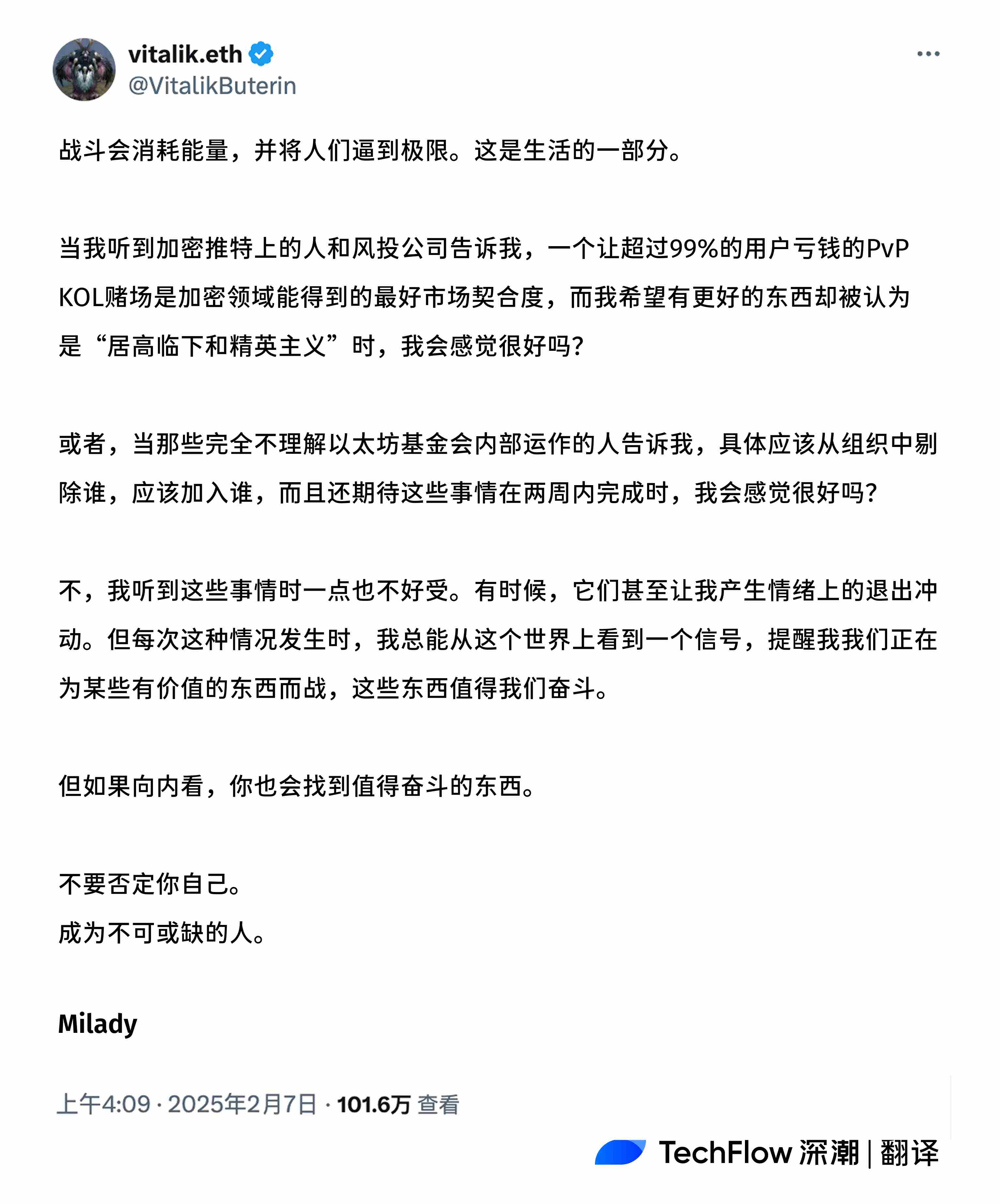
Vitalik didn’t hide his frustration on X: crypto Twitter and VCs treated “KOL gambling schemes where 99% of users lose” as the industry’s best products; outsiders demanded he complete a full reform within two weeks despite knowing nothing about the Foundation’s internal affairs. These voices once made him want to quit. But each time he considered giving up, some signal reminded him “it’s still worth fighting”:
“Don’t undermine yourself—make yourself unshakable.”
Criticism continues, but change is happening.
In January 2025, Vitalik announced major reforms to the Ethereum Foundation’s leadership structure on X. In March, the Ethereum Foundation revealed significant personnel changes:
Former Executive Director Aya Miyaguchi transitioned to Chair of the Foundation;
Hsiao-Wei Wang and Tomasz Stańczak promoted to new Co-Executive Directors;
Core researcher Danny Ryan founded a new experimental organization, Etherealize, to accelerate technology deployment.
After hardship comes relief. With Circle’s IPO and the rise of stablecoins and RWA concepts, Ethereum—once again as core infrastructure—regained focus.
Consensys founder Joseph Lubin initiated an “ETH reserve” through Nasdaq-listed SharpLink Gaming (SBET), becoming the “Ethereum version of MicroStrategy.” Companies including BitMine, Bit Digital, and GameSquare followed suit, launching an ETH reserve race.
ETH prices doubled since April and rose 40% in July alone. The market seemed to have forgotten its doubts about Ethereum just months prior.
Vitalik neither explicitly endorsed nor rejected the “MicroStrategy” model. But at EthCC in early July, Vitalik Buterin issued another industry warning: Web3 stands at a crossroads—unless developers anchor their work in freedom, decentralization, and privacy, the industry risks betraying its founding principles.
“Ethereum is at a critical juncture,” he said. “The dream of decentralization that fueled the blockchain revolution is now fading due to corporate involvement, political attention, and user convenience.”
July 30 marks Ethereum’s 10th anniversary.
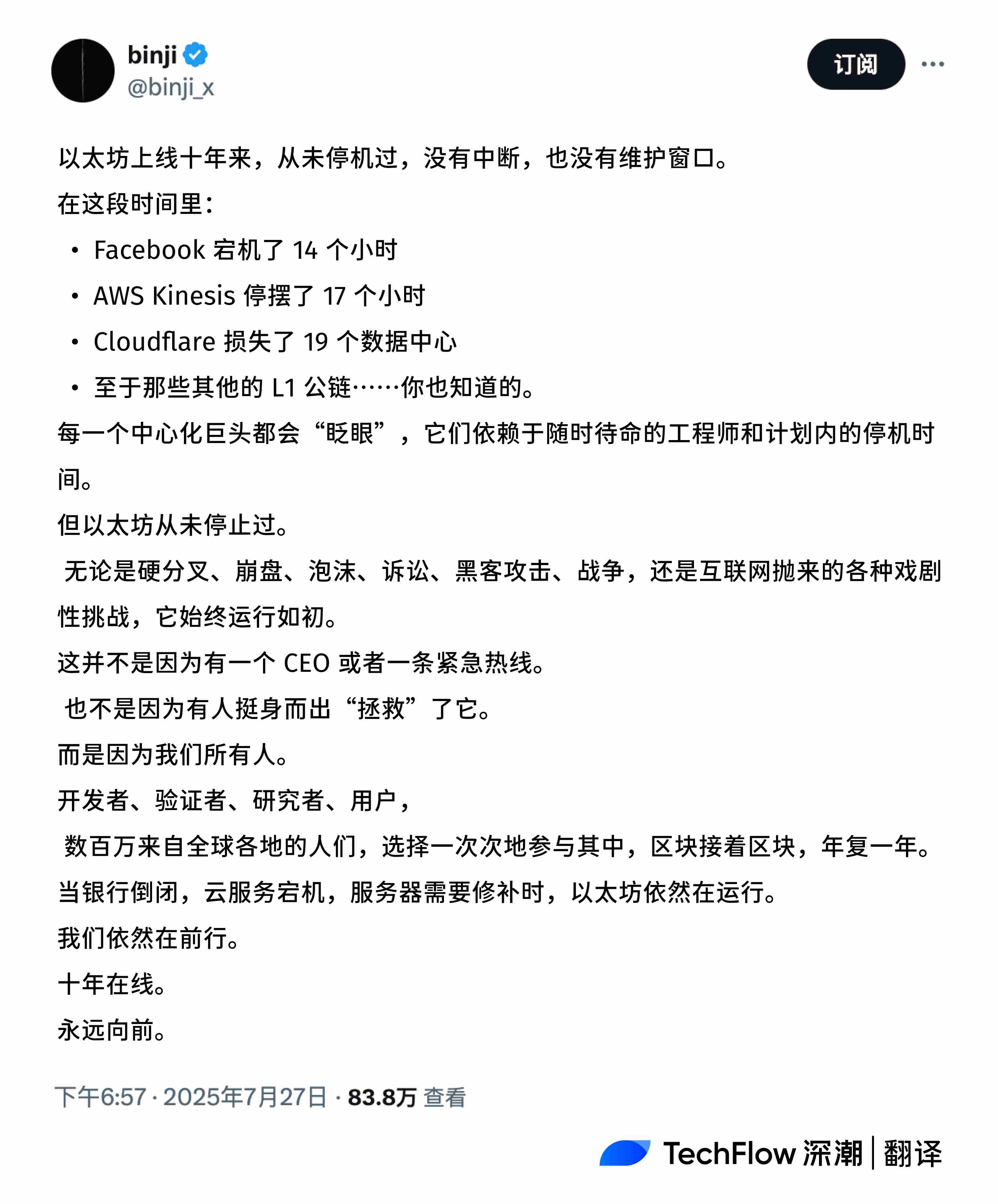
Vitalik’s X homepage features a repost from Ethereum Foundation member Binji’s “Reflections on Ten Years of Ethereum”:
“When banks fail, cloud services go down, servers patch themselves—Ethereum keeps running. We keep moving forward. Ten years online, forever onward.”
Interestingly, Vitalik recently reshared lyrics he loves from S.H.E’s song *Starry Light*:
If darkness didn’t exist, why dream of light?
Dawn is the reward for those who persist till the end
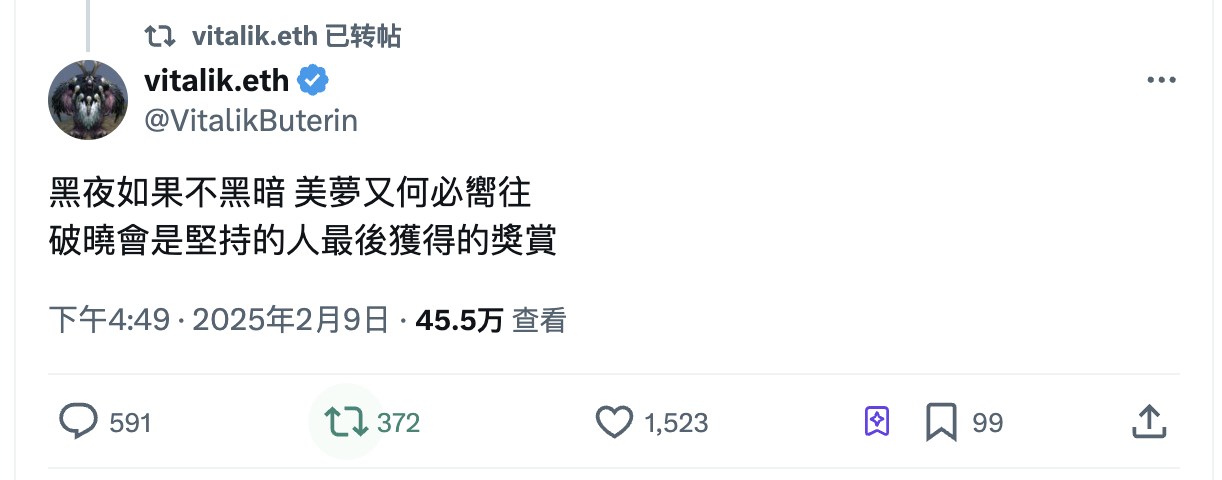
This seems the perfect commentary on Ethereum and Vitalik’s stormy journey over the past two years: In darkness, he chose persistence, waiting for dawn.
Join TechFlow official community to stay tuned
Telegram:https://t.me/TechFlowDaily
X (Twitter):https://x.com/TechFlowPost
X (Twitter) EN:https://x.com/BlockFlow_News
 深潮TechFlow


