Shopify, which went "All in AI," shared their practical implementation of AI across the entire team—pure干货 (practical insights)
TechFlow Selected TechFlow Selected
Shopify, which went "All in AI," shared their practical implementation of AI across the entire team—pure干货 (practical insights)
Unlimited budget, legal department gives the green light.
 Navigating Web3 tides with focused insights
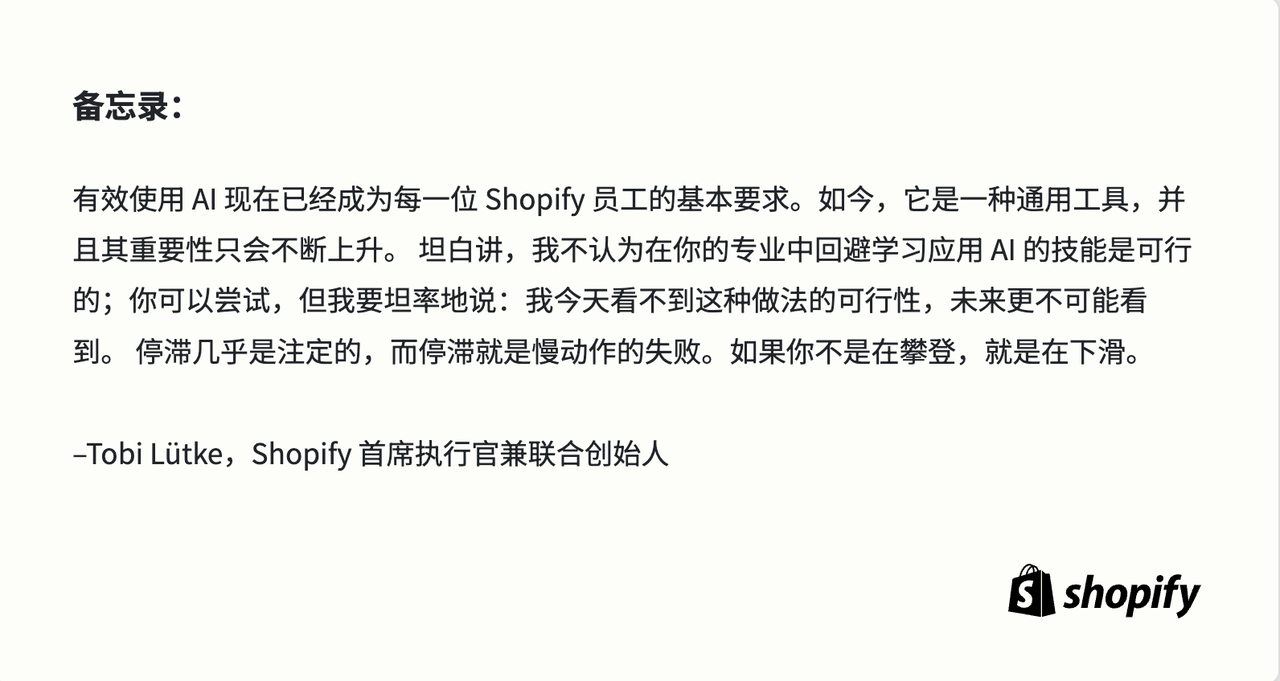
Three months ago, Shopify co-founder and CEO Tobi Lütke sent an internal company-wide memo, announcing an "All in AI" strategy. Lütke stated, "Effectively using AI technology is a basic expectation for every Shopify employee." This approach has since drawn widespread emulation, from companies like Box and Fiverr to even the Prime Minister of Canada.
Three months later, what actual changes have taken place within Shopify? Was this just a leader's passionate slogan, or has AI truly been adopted effectively across the organization?
How exactly has AI transformed workflows?
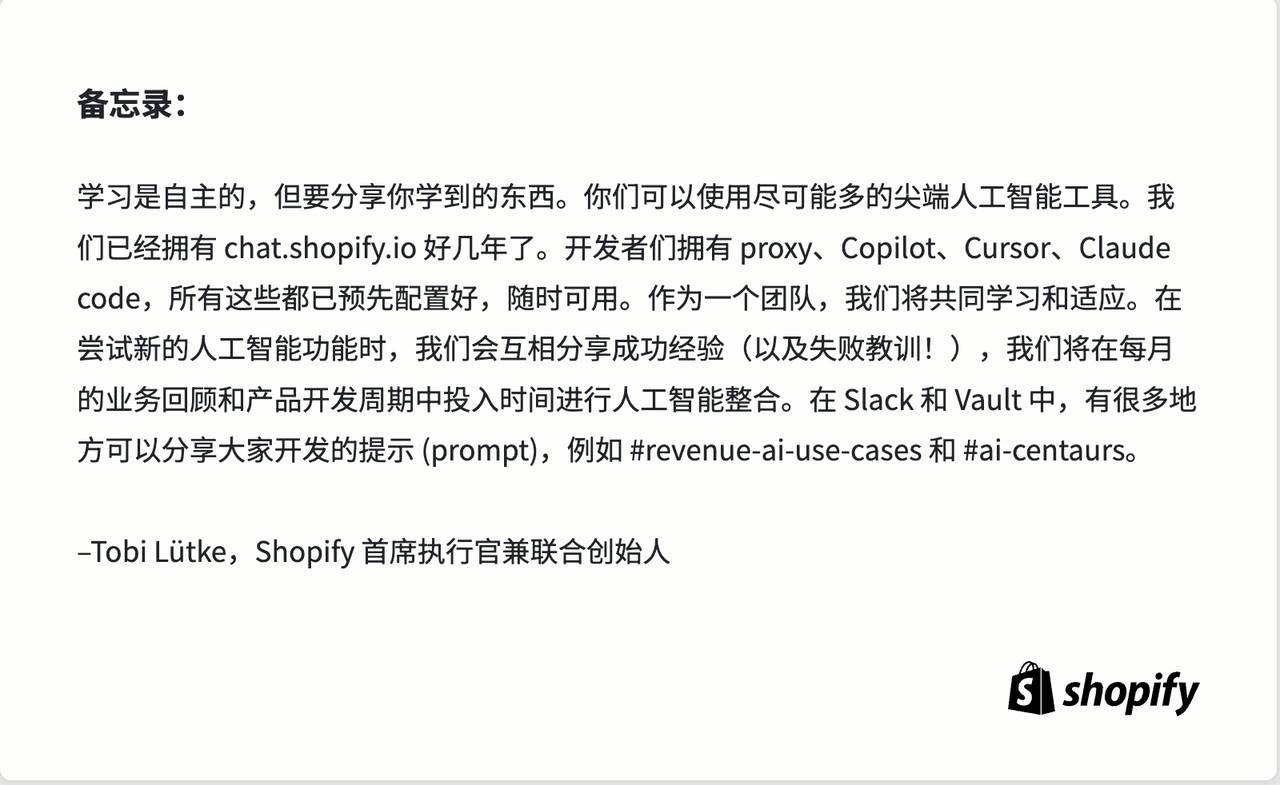
First Round Review spoke with Thawar, Vice President at Shopify, who shared the company’s concrete AI adoption strategies, measurable improvements, and three "counterintuitive" insights.
-
All employees use AI equally, with no spending caps.
-
Encourage AI to show its thinking and results, rather than hide them.
-
Newcomers and recent graduates are highly valuable, especially in AI usage.
In short, when it comes to implementing AI in organizations—from strategic guidance to technical execution—Shopify offers an exemplary model.
This article is compiled by Founder Park based on content from First Round Review.
Original link: https://www.firstround.com/ai/shopify
01 Universal "Equal-Access" AI Usage

Many companies only provide employees with access to basic AI tools while reserving more powerful models and applications for technical teams. Shopify does the opposite: it allows all employees to use every tool and model the company adopts.
The logic behind this strategy is simple: high-value innovations can emerge from anywhere in the company. You cannot predict which use case will ultimately prove most worthy of investment.
Last year I purchased 1,500 Cursor licenses, but quickly realized demand exceeded supply, so I had to add another 1,500. The fastest-growing user group wasn’t engineering—it was customer support and revenue teams.
Farhan Thawar, VP of Engineering & Head of Engineering, Shopify
To encourage employees to actively adopt the best and latest models, Shopify implemented three key strategies:
Strategy One: Legal Defaulting to “Yes”
Change starts at the top. The entire senior leadership team, including legal, must agree that embracing AI is the company’s top priority. Alignment at the highest level means that when addressing critical issues like security and privacy, the starting point must be “how do we make it happen?” “If you don’t set ‘yes’ as the default, you’re effectively defaulting to ‘no,’” Thawar pointed out. “If rules are unclear, it effectively means ‘not allowed’—that’s how most companies operate.”
In late 2021, when Thawar decided to adopt GitHub Copilot, he communicated directly with the legal team: “My first words were, ‘We’re moving forward with this project—how do we ensure it’s done safely?’” Thawar said. “They responded, ‘We’ll figure it out.’ No objections whatsoever.”
This attitude stands in stark contrast to experiences of other tech CTOs. In a private WhatsApp group of peers, Thawar often hears complaints about legal roadblocks.
People constantly ask me: ‘Can your general counsel (GC) talk to ours?’ The resistance they face—we’ve never experienced it.
Farhan Thawar, VP of Engineering & Head of Engineering, Shopify
Strategy Two: Unlimited Budget for AI Tools
Cost is unavoidable when pursuing broad AI adoption. As Cursor gained popularity internally, some worried expenses would spiral out of control. But this contradicts Thawar’s core intent: he wants everyone to use powerful tools freely whenever they create value.
Thawar monitors an internal leaderboard showing who spends the most on Cursor tokens. “We don’t impose limits. I don’t want anyone gaming the system with scripts, but it’s an excellent proxy for measuring value. We don’t want employees hesitating when using AI or the latest models,” Thawar said. “I know people who proudly made it into the top token spenders because their AI use delivered real impact.” Shopify’s CTO, Mikhail Parakhin, recently ranked among them.
“When I talk with other CTOs and CEOs, I see a troubling trend: excessive focus on token costs,” Thawar said. “They calculate: ‘If engineers use Cursor, Windsurf, GitHub Copilot—each could cost $1,000–$10,000 extra per month—can I afford that?’ So they tighten budgets.”
This mindset runs counter to AI adoption goals.
“If your engineers spend an extra $1,000/month on LLMs but gain 10% efficiency, that’s an incredible return. Any company should be thrilled by such ‘cheap’ productivity gains.” (Thawar even added: if your engineer can spend $10,000/month creating value, message him—he wants to learn.)
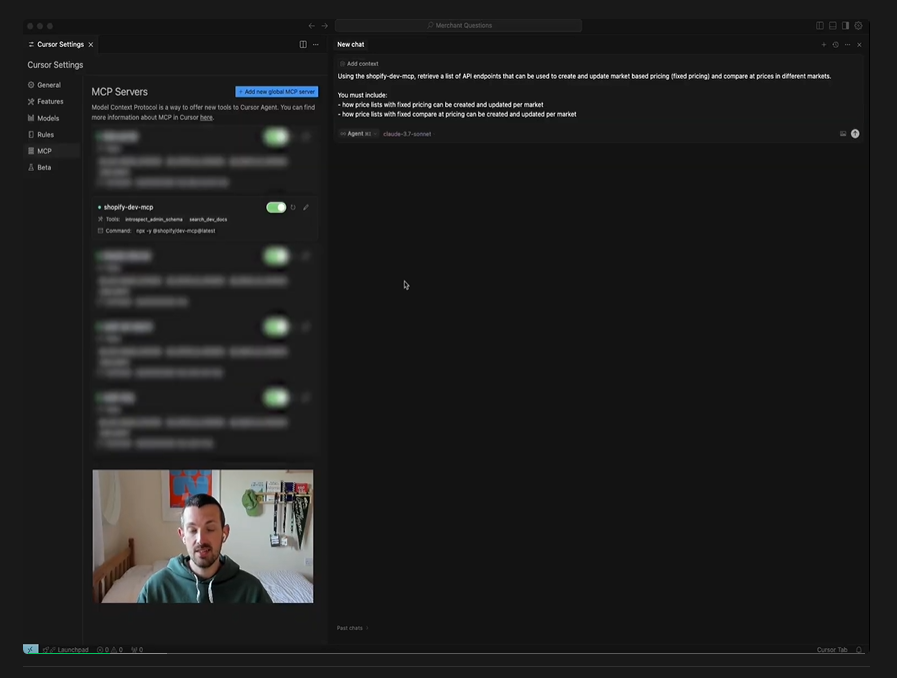
Strategy Three: Unified AI Entry Point and MCPs
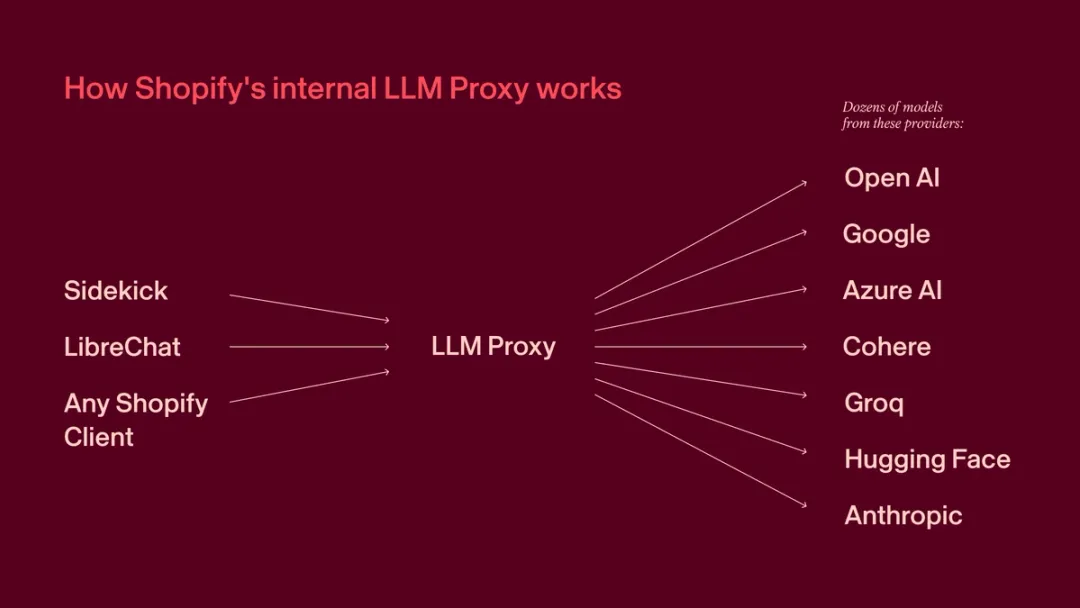
To make it easy for employees to use and build the latest AI tools, Shopify consolidated all resources into one platform: an internal LLM agent. Acting as a unified interface, this agent enables seamless interaction and switching between various models. In production, it also handles scaling, tracking, and failover.
Employees can use this LLM to build custom workflows, freely choose models, and always access the latest versions immediately. The platform includes a rich library of built-in MCPs—users simply request them via agents or tools like Cursor. There’s even a peer-created agent library available for all. It’s a one-stop AI workstation meeting every employee need.
 “The MCP server is a critical infrastructure layer connecting all our internal tools. Our philosophy is ‘everything is an MCP,’” Thawar said. “Every piece of internal data, regardless of where it’s stored, becomes instantly accessible through MCPs, empowering employees to build their own workflows.”

02 AI-Powered Workflow Examples
With MCPs, Cursor, and chat-based infrastructure in place, both technical and non-technical staff have seen dramatic productivity gains. Here are standout examples from outside R&D:
Example One: A Website Audit Tool Transforming Lead Qualification
In Shopify’s sales process, website performance benchmarking is crucial. To demonstrate superior site speed to potential merchants, sales reps must audit prospects’ websites and present data proving Shopify’s edge. Previously, this was entirely manual and time-consuming.
Recently, a non-technical sales rep used Cursor to build a tool that automatically generates detailed website performance comparison reports. It pulls prospect site data, compares it against Shopify benchmarks, and even references internal documents to provide precise talking points for sales conversations.
Bobby Morrison, Shopify’s Chief Revenue Officer (CRO), praised this mindset and workflow: “Our top performers are redefining everything—from market analysis and opportunity identification to crafting merchant strategies and solutions. The most successful all possess ‘AI fluency.’ They intuitively collaborate with AI tools and evolve at AI speed. For them, AI isn’t separate—it’s a way of working.”
For Shopify, AI’s real opportunity lies in reimagining entire sales models. “In an upsell scenario, a rep can now have an agent retrieve in seconds data that previously took hours. These insights were once scarce—now they’re instantly available,” Thawar explained.
“How does this change sales tactics? You can argue more confidently and forcefully, opening new communication paths within client organizations—and potentially revolutionizing cold outreach altogether.”
Example Two: A Sales Engineer’s “Today’s Tasks” Dashboard
A sales engineer integrated MCPs from his most-used tools—GSuite Drive, Slack, Salesforce—into a personal dashboard built with Cursor. The dashboard intelligently prioritizes tasks based on real-time inputs from all connected apps.
Previously, he constantly switched between apps. Now, he opens the dashboard each morning and asks: “What should I do today?” The system might detect an impending deal in Salesforce and notice an unanswered critical email, prompting immediate action. “He rarely opens those standalone tools anymore—Cursor is his homepage. He doesn’t even log into email. It’s mind-blowing,” Thawar said.
This is exactly the ROI Shopify expects from its AI infrastructure investment. For a company known for infrastructure excellence, this is natural. “We prioritize internal AI infrastructure—it’s in our DNA,” Thawar said.
“Rather than spending weeks building isolated features, we invest longer in reusable infrastructure. By building LLM agents and MCP servers, we create systems everyone can reuse. Once someone builds an MCP for Slack, the whole company benefits immediately.”
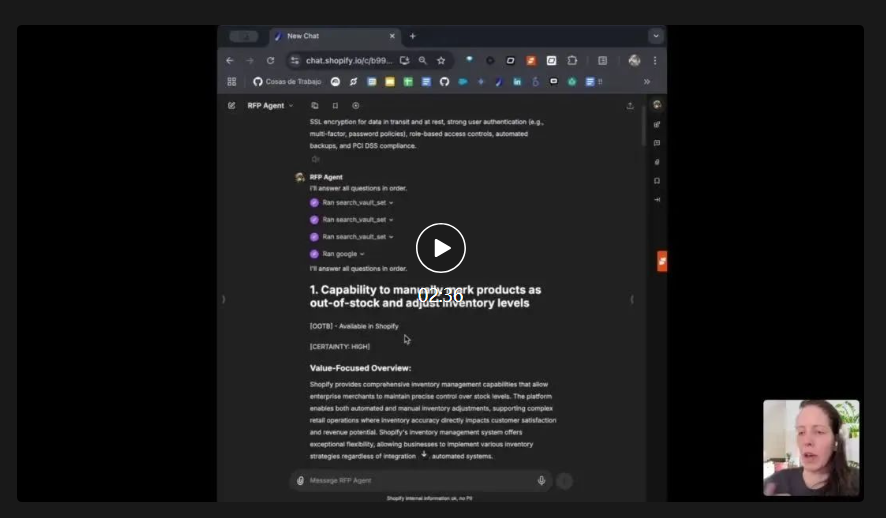
Workflow Example Three: RFP Agent Boosting Win Rates
For enterprise sales, responding to requests for proposals (RFPs) is routine. Each RFP contains hundreds of questions requiring extensive customization, company-specific knowledge, and cross-departmental coordination.
To address this, Shopify’s revenue tools team built an agent capable of answering multiple RFP questions at once. Built on LibreChat (of which Shopify is a core contributor), it pulls from internal knowledge bases—including public docs, help centers, and case studies—to generate rich, well-sourced responses, greatly freeing solution engineers.
The agent also assigns a “confidence score” to each answer, indicating information sufficiency. It learns from past winning RFP responses and stores new successes in the knowledge base to continuously improve future answers.
03 Let AI Show Its Thinking—Don’t Hide It
Many fear over-reliance on AI will make our brains “rust” and disconnect us from work. But a counterintuitive truth is that, when used correctly, AI can actually reveal more detail and deepen engagement.
“Most people think ideal UX is asking a question and getting an answer—the messier middle part should be minimized,” Thawar said. “But if your goal is helping people master skills, showing that process works better.”
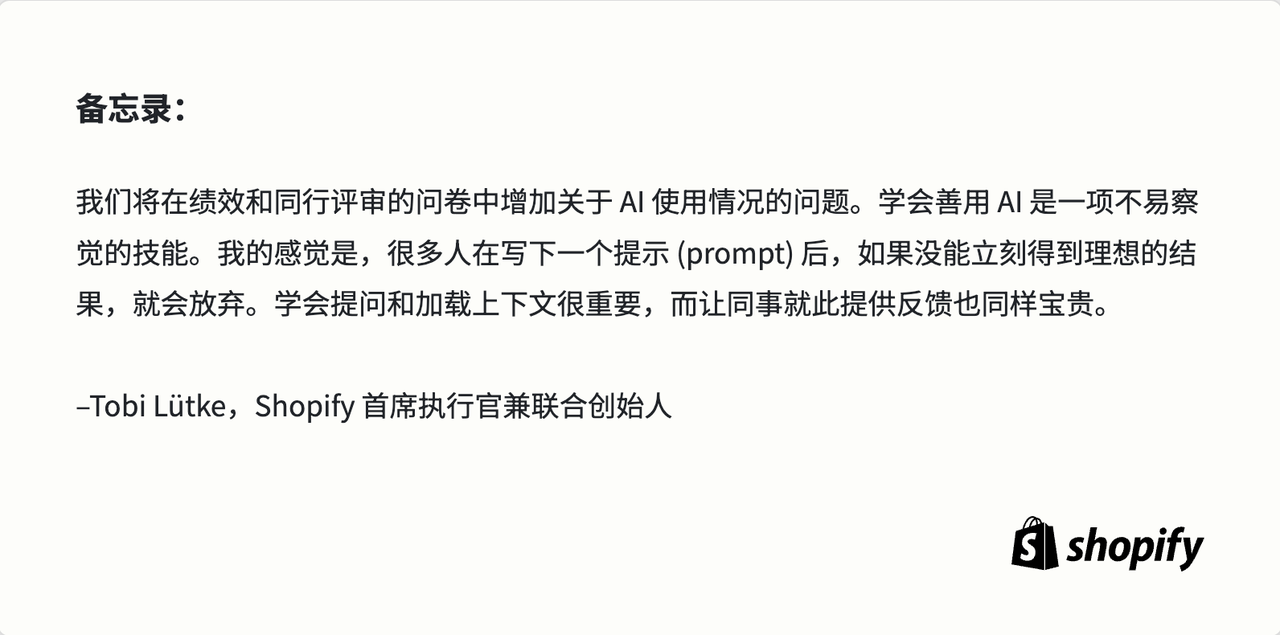
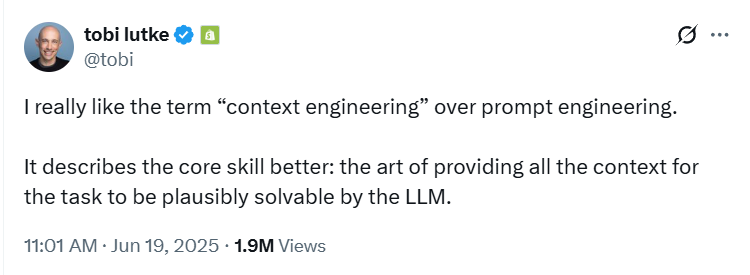
Strategy: Context Engineering for People
Shopify realized that driving effective AI adoption requires not just prompt optimization, but systematically applying “context engineering” to employees.
For example: Project leads at Shopify must submit weekly progress reports, turning the company’s project management system into an information highway. Now, an AI agent automatically gathers relevant GitHub pull requests, documents, comments, and Slack channel updates to draft the report.
Every Friday, leads receive this AI-generated draft along with challenging follow-up questions like “What exactly did you accomplish this week?” This forces them to critically review the AI summary and refine it. They’re motivated to spot inaccuracies and expose risks—not accept output blindly—because they want their work properly understood.
“Based on lead feedback, AI generates a revised report. We compare final versions against drafts, and the AI learns from these edits to continuously improve,” Thawar said. Where writing weekly reports once consumed significant time gathering data, leads now focus on what humans do best: critical thinking and challenge—making outcomes better.
We found half of the AI-generated draft reports required no changes—they passed as-is. Their quality is high, partly because AI integrates all available relevant information.
Farhan Thawar, VP of Engineering & Head of Engineering, Shopify
Workflow: Roast—a Framework for “Critiquing” Code
Shopify operates one of the world’s largest Ruby on Rails applications. Enabling thousands of engineers to efficiently collaborate on a massive monolithic codebase remains a constant challenge—especially in Ruby, a language that promotes “convention over configuration” and encourages individual developer freedom.
Shopify engineers discovered AI could become a powerful tool for enforcing coding conventions, standardizing unit tests, and maintaining update practices. But AI alone isn’t reliable—it needs structured guidance combined with deterministic tools and principles.
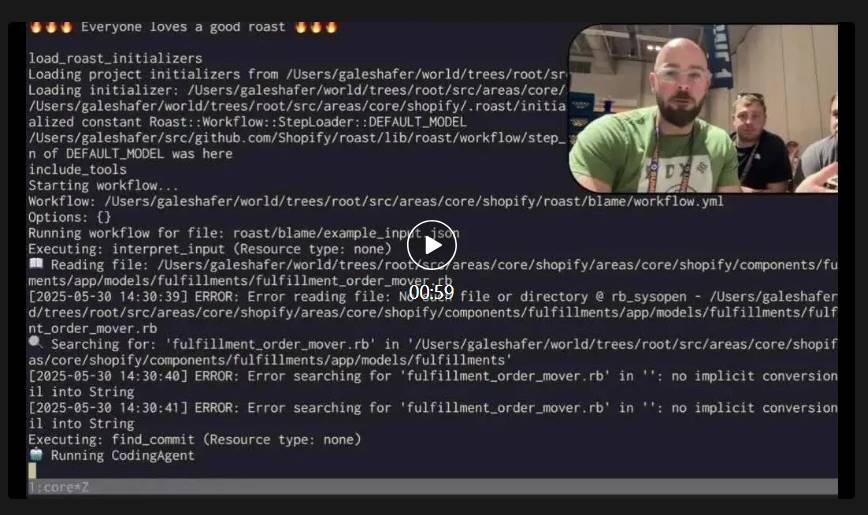
Hence, Shopify developed Roast—an open-source AI orchestration framework for code review, fixing, and iteration. Named after an internal AI tool that “roasts” (critiques) existing code and unit tests with constructive feedback, Roast isn’t a single all-encompassing prompt. Instead, developers design and run feedback loops composed of small, precise, high-success-rate steps:
-
Roast breaks workflows into steps, clearly displaying AI’s reasoning at each stage.
-
These steps form a complete conversation history, enabling engineers to trace AI’s decision logic.
-
The core CodeAgent (built on Claude Code) summarizes each action and its rationale.
-
When scoring tests, Roast provides detailed feedback, explaining “why” and “how” before presenting final results.
“Combining deterministic tools with AI tools allows them to exchange information and fill gaps,” said Samuel Schmidt, a Shopify developer involved in Roast’s creation. Roast simplifies agent usage and shows engineers the full process, making complex workflows easier to execute repeatably and at scale.
The tool has already solved numerous internal technical challenges—helping engineers analyze thousands of test files and automatically fix common issues, significantly improving test coverage. In doing so, the team developed a new paradigm for reliably using AI in complex engineering tasks, a challenge many teams face. Therefore, Shopify decided to open-source Roast, inviting the broader community to shape the future of AI-assisted task execution.
04 Cultivating a “Beginner’s Mindset” in Product Development
Shopify isn’t just increasing the number of beginners—it’s reshaping product development to emphasize prototyping, a practice embodying the beginner’s mindset. They believe this is the true key to breaking through bottlenecks and finding solutions.
Strategy: Hire More Junior Talent
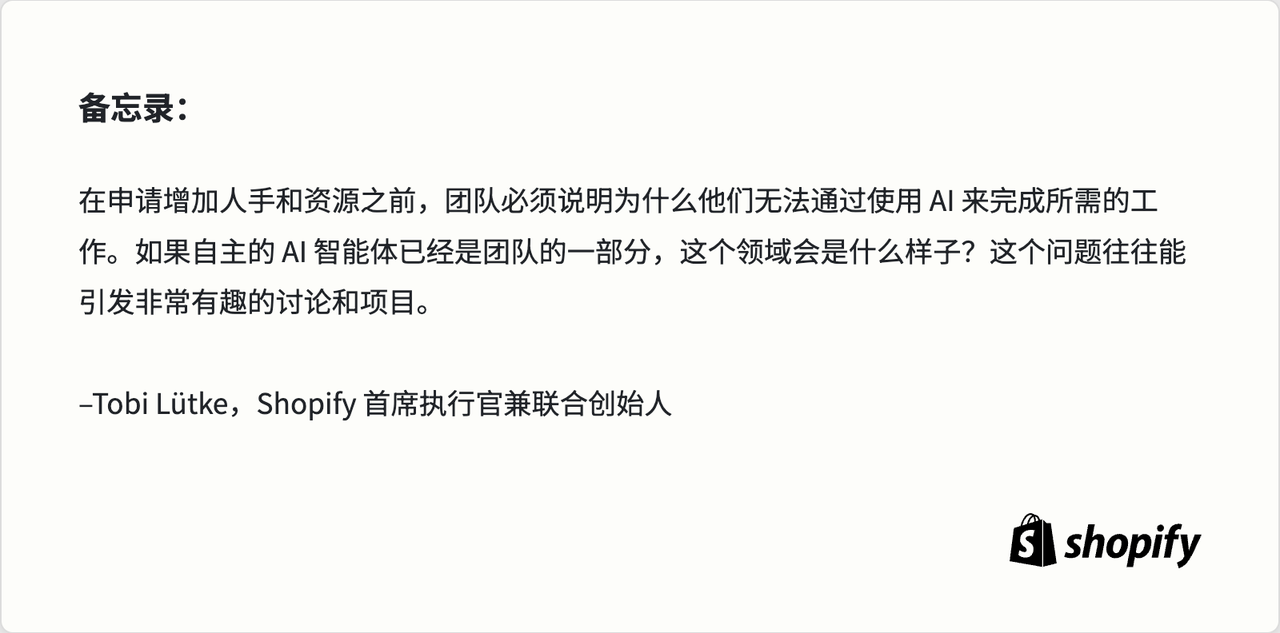
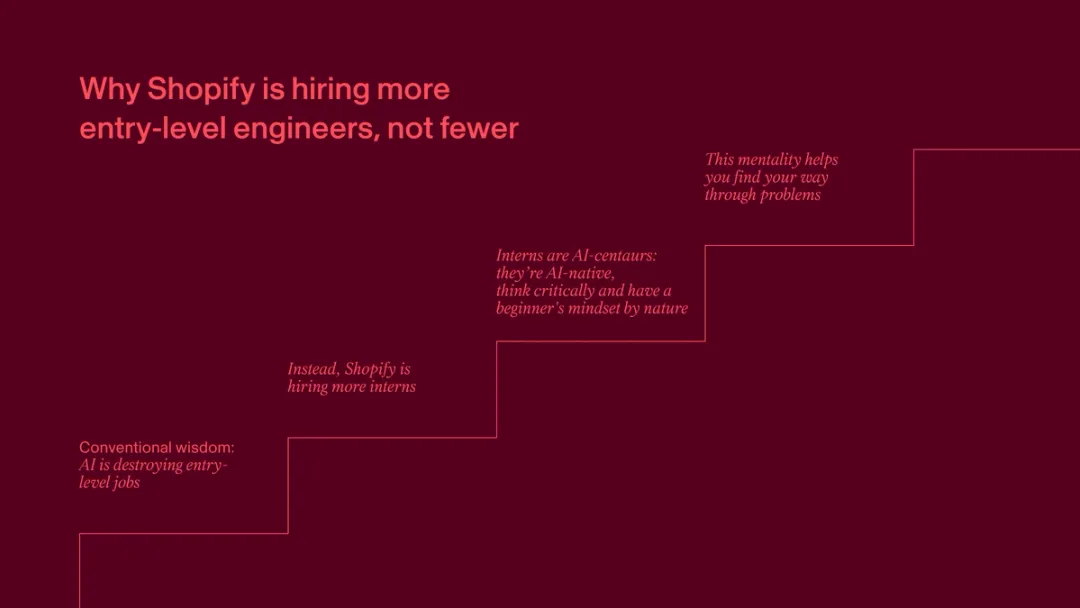
In talent strategy, Shopify shifted perspective—not stuck on simplistic notions like “AI will replace jobs”—but adopting a new principle: “If you can use AI to create exceptional value, the company will invest more resources to support you,” including hiring additional people.
Conventional wisdom says AI will eliminate entry-level roles, leaving engineering graduates fearing imminent unemployment. But Shopify did the opposite—hiring more interns. They found these young people use AI in the most creative ways, naturally possessing a beginner’s mindset.
After successfully onboarding 25 engineering interns, Lütke asked Thawar how large this program could scale. “My initial answer was 75, given current infrastructure. But I later revised it to 1,000,” Thawar said.
Thawar has extensive experience managing internship programs. He knows interns bring energy, passion, and momentum. In the post-LLM era, they bring a new skill: they’re natural “AI centaurs.” “They’re always curious about new tools and shortcuts. I want them to ‘be lazy’—to leverage the latest tools,” he said. “We saw this during the mobile internet era. I hired many interns because I knew they were ‘mobile natives.’”
Strategy: Build More Prototypes to Find the Best Path
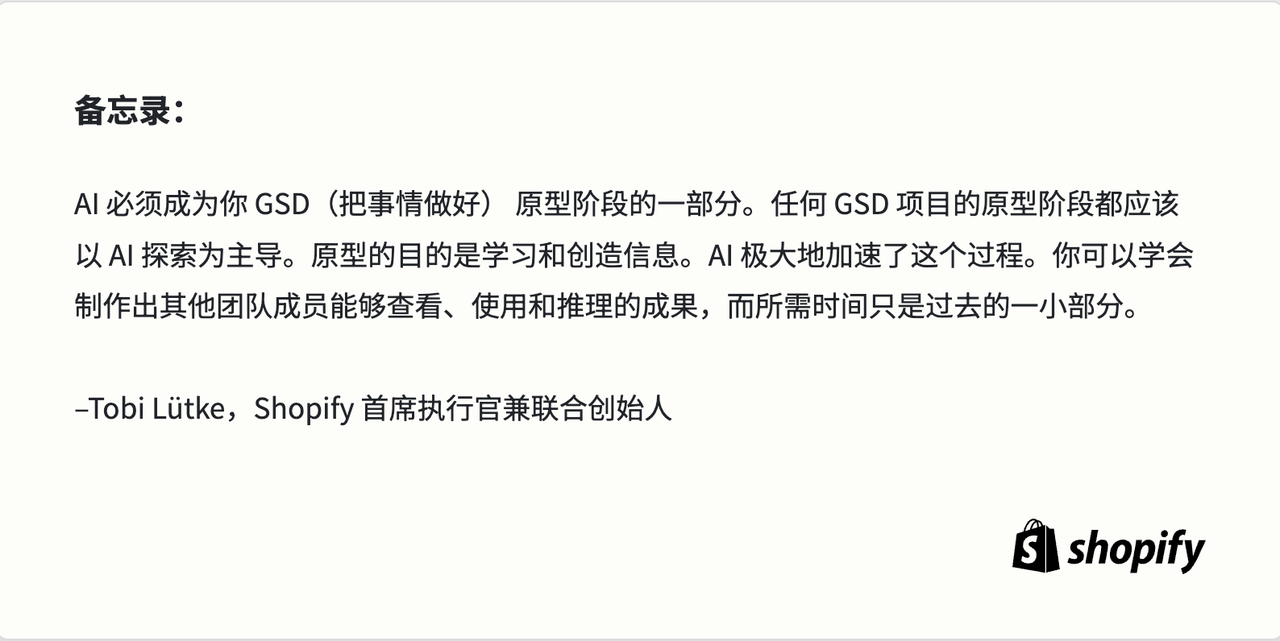
At Shopify, prototyping now plays a central role in product development. Specifically, the company focuses on increasing the ratio of prototypes attempted versus products ultimately shipped. This embodies Shopify’s core principle of the “green light for product development”: the only way to solve a complex problem is to keep trying. Lütke once told Thawar: “There are countless bad solutions to a problem, and maybe ten thousand decent ones. Your job is to find the best among those ten thousand. What you showed me was just the first working solution—not the best. Why did you stop?”
Thawar added: “You’re dealing with a problem involving hundreds of variables and layers. You must explore different paths. These may lead to end products that look similar, but the underlying trade-offs could be vastly different.”
For instance, Shopify’s internal AI chat tool originated from a prototype. Senior engineer Matt Burnett initially experimented with open-source tools to improve internal LLM access. He iterated early versions, solving data loss and scalability issues, and exposed architectural flaws by letting colleagues try it early. Eventually, the tool became widely adopted, leading the company to form a dedicated engineering team to maintain it.
Tight Integration Between AI Usage and Performance
To measure various dimensions of engineering efficiency across the organization, Thawar uses an engineering activity dashboard. It tracks who engages in pair programming, who participates in interviews, and—as mentioned earlier—who uses Copilot.
Years of Shopify data show pair programming significantly accelerates learning. Using this dashboard, the company analyzed the relationship between pair programming duration and performance reviews. Results showed a strong positive correlation: the more engineers paired, the greater their impact.
Now, the dashboard also tracks employee usage of AI tools like Cursor, Claude Code, and LLM agents. Preliminary analysis indicates a positive correlation between AI tool usage and individual impact. This helps identify truly valuable tools and their connection to personal performance.
Shopify has incorporated AI-related questions into its 360-degree review system. Managers and peers evaluate each other on “AI-native” or “AI-reflexive” behaviors. The company plans to conduct deeper analysis of the relationship between AI usage and individual impact after accumulating several years of data.
Thawar leads by example, using pair programming to demonstrate AI integration. “When I pair with an engineer, I want to observe their problem-solving approach—but also model my philosophy. I always have a ChatGPT tab open, showing in practice how I constantly collaborate with AI.”
05 Efficiency Gains Will Reshape Workflows
If you could precisely analyze every movement in a professional sports team’s training or a Michelin-starred kitchen, you’d find motion efficiency around 80%. Contrast that with a typical company, where operational efficiency might be as low as 20%.
“Companies waste unimaginable amounts of effort—simply because we haven’t yet discovered optimal ways of working,” Thawar noted. “AI accelerating existing processes is obvious. But the deeper, less-known value is that it suddenly reveals your workflows could be executed in a completely different order, under entirely different assumptions. When that ‘aha’ moment hits, you might skip vast amounts of redundant work—or redesign the entire process.”
Consider the website audit tool again. Thawar reflects on how it could transform sales. “When generating a website audit report becomes nearly free, you might change who presents the data and when. You could introduce it much earlier in the sales funnel, not wait until prospects are highly qualified. This could even change the type of leads SDRs engage,” he said. “It might birth an entirely new sales process. And the sole driver? Our ability to generate audit reports at near-zero cost.”
He cites the famed yet notoriously hard-to-replicate “Toyota Production System.” AI might change that. “AI fundamentally alters our basic assumptions. You can use it to solve complex combinatorial problems on the production line, boosting efficiency a thousandfold. That’s the real magic. What we’re chasing is this ‘power of process.’”
Join TechFlow official community to stay tuned
Telegram:https://t.me/TechFlowDaily
X (Twitter):https://x.com/TechFlowPost
X (Twitter) EN:https://x.com/BlockFlow_News