Shanghai Signal: Interpreting China's New Cryptocurrency Strategy Under "One Country, Two Systems"
TechFlow Selected TechFlow Selected
Shanghai Signal: Interpreting China's New Cryptocurrency Strategy Under "One Country, Two Systems"
On July 10, the Shanghai State-owned Assets Supervision and Administration Commission held a study session to discuss strategies for cryptocurrency and stablecoin development, triggering a surge in Bitcoin's price.
 Navigating Web3 tides with focused insights
By Oliver, Mars Finance
The Midnight Announcement and That 5,000-Dollar Green Candle
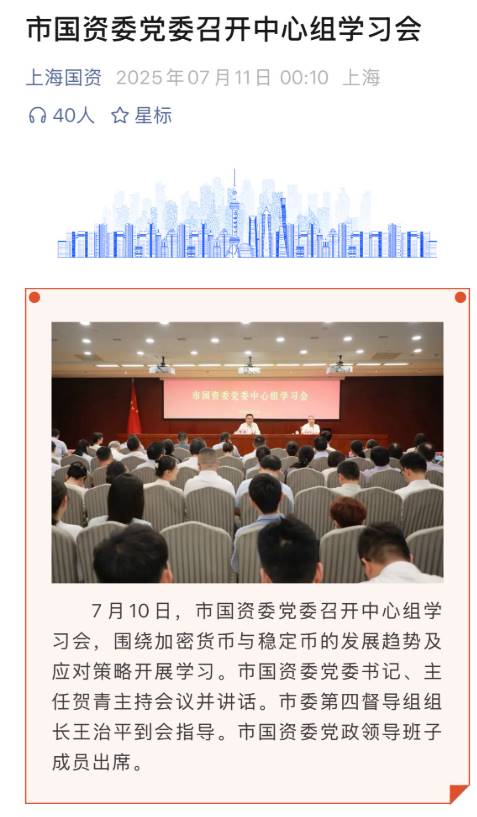
At midnight on July 11, 2025, a seemingly routine post on an official WeChat public account sent shockwaves through China’s—and the world’s—cryptocurrency community. The publisher was the State-owned Assets Supervision and Administration Commission of Shanghai Municipality (referred to as "Shanghai SASAC"), announcing a theoretical study session held by its Party Committee on July 10, focused on “the development trends of cryptocurrency and stablecoins, and response strategies.”
The market responded in the most direct and primal way possible. In the following hours, Bitcoin surged like it had broken free from chains, climbing from around $111,300 to peak above $118,400—an intraday rally exceeding $7,000—setting a new all-time high. This price explosion was accompanied by sharply increased trading volume, clearly indicating that a powerful wave of buying pressure had been instantly activated. The most sensitive nerve in the crypto market has always been the one called "policy sentiment."
This raises a core question: Why could an internal study meeting by a local state asset regulator trigger such dramatic price movements in a global top-tier digital asset? What subtext did the "smart money" in the market detect within this brief announcement? The answer lies not on the surface of the text, but deep within China's decade-long complex stance toward cryptocurrency, Hong Kong’s unique role as a financial special zone, and the grand narrative of digital finance’s future. The market isn’t trading the meeting itself, but rather the potential strategic shift it foreshadows.
A Glimpse Through the Tube: A Calculated Embrace, Not Full Opening
To understand the market’s excitement, we must dissect the specific content revealed in this study session. The meeting invited Li Mingliang, Chief Expert at Guotai Haotong Institute of Policy and Industry Research, to deliver a keynote report. His proposal went far beyond mere “learning” or “understanding,” outlining a carefully considered, highly actionable strategic framework.
The most significant recommendation in the report was the construction of a dual-currency system for RMB-backed stablecoins: CNYC (onshore-offshore RMB stablecoin) and CNHC (offshore-offshore RMB stablecoin). This is an exceptionally refined design. CNHC aims to become a globally tradable stablecoin pegged to offshore RMB, directly competing with dollar-based stablecoins like USDT and USDC. CNYC, on the other hand, might be used within specially regulated zones such as the Shanghai Free Trade Zone, serving specific cross-border trade and financial scenarios. This “dual-track” approach seeks a perfect balance between open competition and risk isolation.
More importantly, the report explicitly proposed achieving compliance through “electronic fencing” technology. This term is the key to understanding China’s new strategy. It signals that this is not an unconditional surrender to the crypto world, but rather a deliberate, self-directed “co-optation.” “Electronic fencing” implies a permissioned or tightly monitored system where transactions are confined to specific users, jurisdictions, or use cases, effectively preventing Beijing’s biggest fears: uncontrolled capital outflows and cross-border financial contagion.
The ultimate goal of this entire strategy aligns perfectly with what He Qing, Director of Shanghai SASAC, emphasized in his concluding remarks: “integration of industry and data”—exploring blockchain applications in areas such as “cross-border trade, supply chain finance, and asset digitization.” This matches precisely with the report’s objective of using stablecoins to support “RWA (real-world asset) settlement and RMB internationalization.” It is clear that Shanghai’s initiative is driven by national-level industrial upgrading and currency internationalization goals—not by catering to retail speculation. It is about creating a compliant channel for China’s vast assets to enter the global digital value network, and carving out a new pathway for the RMB to bypass the traditional SWIFT system.
The Policy Great Wall: Contradictory History and Stubborn Reality
The reason Shanghai’s positive signal is so shocking is precisely because it contrasts so sharply with mainland China’s strict regulatory history over the past decade. Only by reviewing this history of contradictions and struggles can we grasp the profound implications of the current potential shift.
China’s crypto regulation has broadly gone through three phases. The first began in 2013, when the central bank and four other ministries issued a notice prohibiting financial institutions from engaging in Bitcoin-related business, defining it as a “specific virtual commodity” rather than currency. The second phase peaked in 2017, when regulators labeled ICOs (initial coin offerings) as “illegal public fundraising” and swiftly shut down all domestic cryptocurrency exchanges. The official rationale was to prevent financial risks and fraud; at the time, Chinese officials noted that over 90% of ICO projects were suspected of being scams.
The third and harshest phase arrived in 2021. Ten government bodies, led by the People’s Bank of China, jointly declared all virtual currency-related activities as “illegal financial activities,” launching a comprehensive crackdown on crypto mining. Official motivations were multifaceted: massive energy consumption conflicted with China’s “carbon peak and carbon neutrality” goals, while growing illegal activities such as money laundering, gambling, and capital flight via cryptocurrencies became increasingly rampant. Blockchain analytics firm Chainalysis once estimated that in 2020 alone, approximately $50 billion worth of crypto assets flowed overseas from East Asia—primarily China.
Yet, these strict bans failed to eliminate demand, instead giving rise to a vast and hidden underground market. As Chainalysis noted in an early 2024 report, even under the harshest crackdowns, grassroots cryptocurrency adoption in China remained among the highest globally. After exchanges were banned, users quickly migrated to more decentralized OTC (over-the-counter) platforms and peer-to-peer networks. Especially during periods of economic uncertainty, inflows into crypto via OTC channels showed significant increases. Ben Charoenwong, a finance professor at INSEAD, commented: “Under certain conditions, cryptocurrency is seen by some as a hedging tool and a means of asset preservation.”
This reveals a deep policy paradox: stringent controls intended to strengthen financial oversight have objectively pushed activities into harder-to-track gray zones, thereby undermining regulatory effectiveness. It may be precisely this stubborn reality that has prompted policymakers to consider a new approach—rather than blocking, they now seek to channel activity into a controllable, attractive, compliant ecosystem.
Hong Kong Shift: One Country, Two Cryptos
While mainland China has built a wall against cryptocurrency, just across the water, Hong Kong has rolled out the red carpet. This stark contrast is no accident—it’s a precise strategic move under the “one country, two systems” framework. Hong Kong is emerging as a critical testing ground and international gateway for China’s crypto strategy.
Over the past two years, Hong Kong has rapidly established a comprehensive digital asset regulatory regime. It introduced a mandatory licensing system for Virtual Asset Service Providers (VASPs), imposing anti-money laundering (AML) and investor protection standards comparable to those for traditional financial institutions. In June 2025, Hong Kong officially released the draft Stablecoin Issuer Regulation, set to take effect on August 1, paving the legal path for compliant stablecoin issuance. Even more symbolically, in February 2025, Consensus—the world’s most influential crypto summit—held outside North America for the first time in over a decade chose Hong Kong, drawing nearly 10,000 global participants. Hong Kong’s Financial Secretary, Paul Chan, delivered opening remarks declaring, “Hong Kong is back, Web3 is back.”
Hong Kong’s openness and Shanghai’s exploration form a perfect strategic synergy. CNHC (the offshore-offshore RMB stablecoin) envisioned by Shanghai would find its ideal issuer and testing ground in Hong Kong. By issuing through licensed entities regulated by the Hong Kong Monetary Authority, CNHC could compete globally with dollar-based stablecoins, while any associated financial risks would be absorbed by Hong Kong’s mature regulatory system and independent financial firewall, shielding the mainland. This is the essence of the “one country, two cryptos” strategy. It allows China to achieve two seemingly contradictory goals simultaneously: maintaining financial stability and strict capital controls on the mainland, while actively participating in global digital finance innovation and competition in Hong Kong—vying for leadership in the next-generation internet economy.
The Top-Level Game: An Alternative Voice Beyond the Shanghai-Hong Kong Model
Yet, the elegant and cautious “sandbox” model of Shanghai-Hong Kong linkage has sparked deeper strategic debate. Some argue that focusing primarily on offshore markets and limited pilots fails to fully leverage China’s core advantage as the world’s second-largest economy. In an all-out digital finance race against the United States, relying solely on Hong Kong as a single “special zone” window may not generate overwhelming competitive strength.
This school of thought calls for a fundamental, top-down rethinking and redefinition of virtual capital markets at the national level. Its core idea is to acknowledge and distinguish two fundamentally different types of financial demand: “investment-type” and “gambling-type” (or speculative). Stablecoins, in this view, are inherently closer to instruments in speculative financial markets—primarily serving high-frequency trading and risk hedging, rather than direct payment or value storage. To ignore their “speculative” nature is akin to burying one’s head in the sand.
Based on this understanding, a bolder blueprint emerges. In this vision, Shanghai and Hong Kong play distinctly different yet complementary roles. Shanghai, as China’s economic heart, should focus on building an “investment-type” virtual capital market. Its primary mission would be promoting digital RMB (e-CNY) to serve the digital transformation of the real economy, providing a financing platform based on real assets and future rights for millions of enterprises, households, and individuals—fully separating pure financial speculation. Meanwhile, Hong Kong should evolve into a strictly regulated, international “gambling-type” virtual capital market. There, compliant RMB stablecoins would serve as core trading instruments, directly challenging dollar-based stablecoins and offering the world a credible “RMB solution” for the virtual economy.
To realize this grand vision, infrastructure must come first. Hence arises the concept of establishing a “China DataNet” company—akin to a “national grid” for digital assets. This entity would build a world-class blockchain infrastructure platform, ensuring convenient, secure, efficient, and low-cost transactions. Equally important is clarifying the role of state-owned financial capital: they should not act as ordinary market players, but fulfill the mission of a “national team,” making strategic investments aligned with national objectives—such as saturated angel investing in key technologies or acting as the ultimate stabilizer during market failures.
Two Futures for the New Game
When we weave together all these threads and perspectives, the significance of Shanghai SASAC’s study session transcends a single policy signal. It resembles a road sign at a crossroads, pointing toward two possible futures for China’s digital finance strategy.
The first future is the incremental path represented by the current Shanghai-Hong Kong collaboration. Cautious and pragmatic, it uses “electronic fencing” and offshore test zones to cautiously extend its reach, aiming to open a new path for RMB internationalization and RWA without disrupting the existing domestic financial order. This embodies the wisdom of “crossing the river by feeling the stones,” seeking to accumulate small wins into a major victory.
The second future is a deeper, top-down systemic transformation. It demands that decision-makers confront the dual nature of virtual capital, strategically dividing markets into “investment” and “speculation,” assigning distinct roles to Shanghai and Hong Kong, and backed by national-level digital infrastructure. This is undoubtedly a much larger game—one aiming not just to join the contest, but to reshape the rules entirely.
Thus, the 7,000-dollar green candle that lit up the charts today carries emotions far more complex than they appear. It is not merely a momentary pricing of the signal “opening,” but a fierce expression of speculation and imagination over which path China will choose. Traders are betting on the possibility of the world’s second-largest economy evolving from a “strict regulator” of the crypto world, to a “controlled participant,” and ultimately, to a “rule-maker.” The midnight announcement may not have been the starting gun—but it could well be the opening bell for a high-stakes game that will shape the fate of China’s digital finance future.
Join TechFlow official community to stay tuned
Telegram:https://t.me/TechFlowDaily
X (Twitter):https://x.com/TechFlowPost
X (Twitter) EN:https://x.com/BlockFlow_News