How can Hong Kong win the race to become the "global tokenization hub"?
TechFlow Selected TechFlow Selected
How can Hong Kong win the race to become the "global tokenization hub"?
If successful, Hong Kong will not only be a frontrunner but also one of the definers of future financial forms.
 Navigating Web3 tides with focused insights
Editor's Note: On July 3, the South China Morning Post published an article by Lily Z. King, COO of Cobo, offering deep insights into how Hong Kong is seizing a first-mover advantage in the global race for tokenization. The article points out that as real-world asset (RWA) tokenization accelerates into the mainstream, Hong Kong is building next-generation financial infrastructure through a clear regulatory framework, open market strategy, and proactive policy innovation. In the second half of this competition, success will no longer be driven by policy alone, but by whether products truly meet market demand.
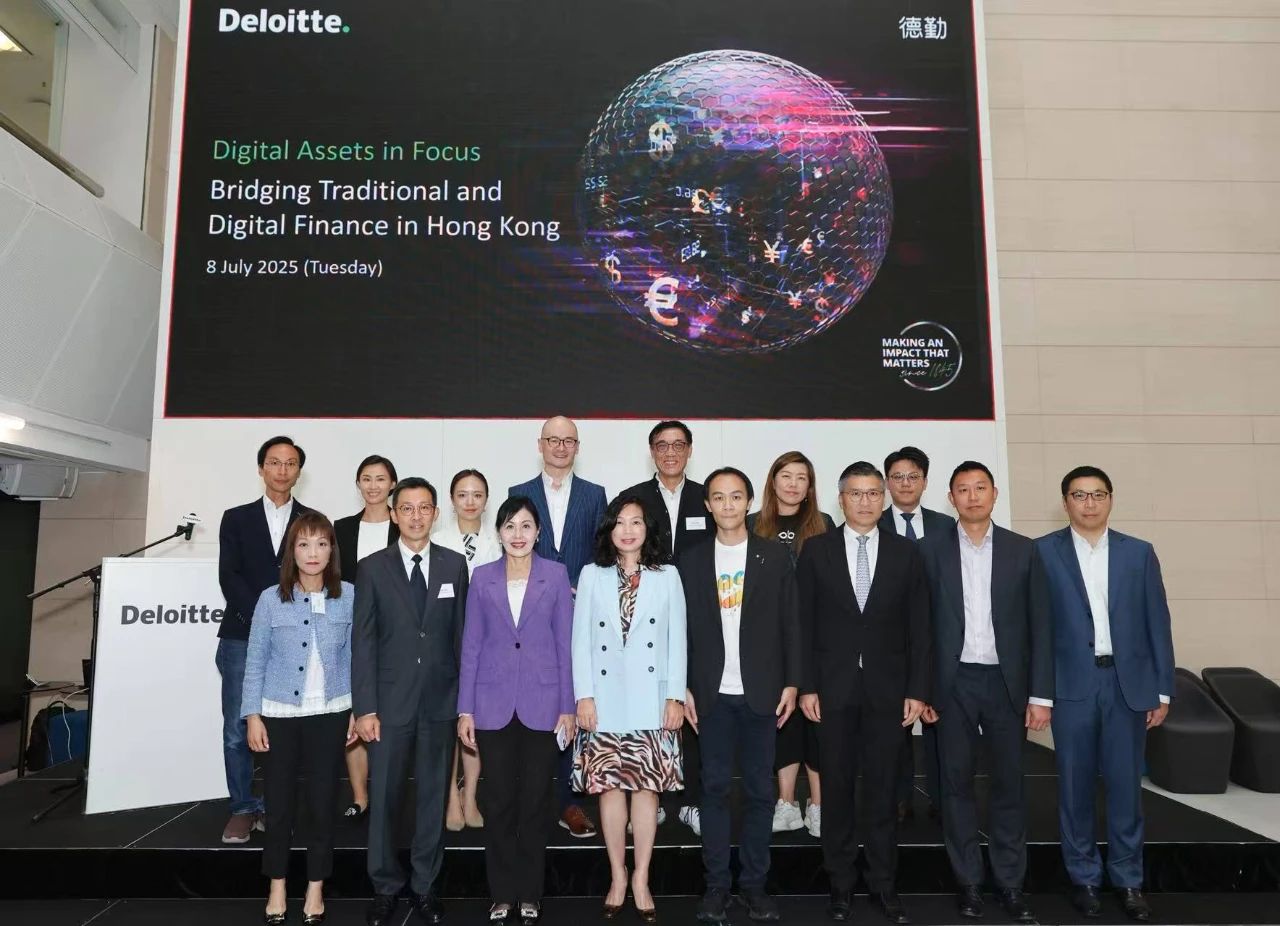
Lily Z. King speaking at Deloitte’s Digital Assets Forum in Hong Kong on July 8
Attendees included officials from Hong Kong’s Financial Services and Treasury Bureau, Securities and Futures Commission, Legislative Council, and Monetary Authority, along with industry institutions
When Larry Fink, CEO of BlackRock, wrote in his annual letter to shareholders that “every stock, every bond, every fund—every single asset can be tokenized,” he wasn’t predicting a distant transformation. He was describing one already underway—a shift redefining how capital is formed, how assets are distributed, and how financial opportunities are accessed.
At the heart of this change lies a concept once niche but now rapidly going mainstream: real-world asset tokenization (RWA). Today, over $24 billion worth of RWAs circulate on public blockchains, including yield-bearing U.S. Treasuries, private credit pools, tokenized commodities, and real estate. What was once seen as a “crypto curiosity” is now becoming part of global financial infrastructure—the plumbing of capital markets is quietly being rebuilt.
The question is no longer if tokenization will reshape finance, but who will lead that reshaping.
In its "Digital Asset Development Policy Statement 2.0" released on June 26, Hong Kong made its ambition clear.
The statement introduced the “Leap” regulatory framework, expanding oversight to stablecoin issuers, custodians, and RWA platforms. More importantly, it sent a strong signal: Hong Kong isn't just allowing tokenization—it is actively advocating for it.
“Leap” stands for Legal & Regulatory Simplification, Expand Tokenized Products, Advance Use Cases, and People & Partnerships. Through measures such as establishing a licensing regime for stablecoins, clarifying the regulatory framework for tokenized ETFs, and continuing earlier pilots in digital bonds and green finance, Leap aims to foster a broader vision—encouraging the tokenization of everything from precious metals to renewable energy infrastructure.
But perhaps the most significant shift isn't about what the policy regulates, but how it defines tokenization—positioning it as a core pillar of new financial infrastructure rather than a sandbox experiment. This distinction alone sets Hong Kong apart from other markets.
In contrast, Singapore has taken a more cautious approach—focusing on institutional participation while restricting retail investors. Hong Kong, however, has chosen a broader, more inclusive path. By setting clear suitability rules, it allows retail participation, thereby expanding the potential market size.
Compared with the EU’s prescriptive Markets in Crypto-Assets (MiCA) framework and the fragmented regulatory battles in the U.S., Hong Kong offers a more unified, principle-based system, providing innovators and investors with much-needed clarity.
Yet laying the tracks doesn’t guarantee the train will run on time. Issuing a tokenized asset is easy; the challenge lies in whether anyone wants to hold, trade, or trust it.
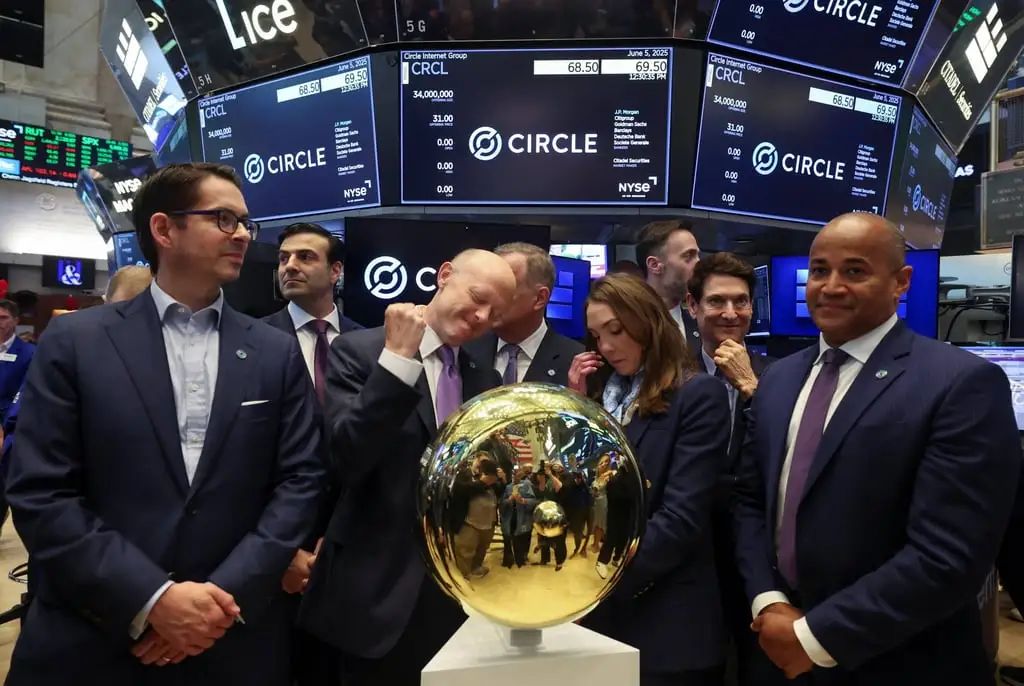
On June 5, Jeremy Allaire (third from left), CEO and co-founder of Circle Internet Group—one of the world’s largest stablecoin issuers—and Heath Tarbert (second from left), President of Circle, at the New York Stock Exchange on the day of their initial public offering.
Photo: Reuters
Too many tokenization projects have learned this the hard way: the technology works, but the market doesn’t buy in. Lacking distribution channels, actual demand, or real-world relevance, many products end up shelved. The bottleneck isn’t technical or regulatory—it’s commercial viability. The real test is whether a tokenized asset genuinely solves a problem for a clearly defined user group.
Some projects, however, have passed this test and scaled successfully. For example, tokenized U.S. Treasury products have gained widespread adoption among global savers due to their stable, transparent yields—especially in emerging markets where safe-yield options are scarce.
Likewise, protocols like Maple Finance have opened new pathways in private credit by connecting institutional borrowers with crypto-native lenders, using on-chain transparency for risk control, making the product usable for both sides.
These successes didn’t come from novel technology, but from perfect alignment between asset, user, and product design.
Hong Kong’s local ecosystem is evolving in this direction. The Hong Kong Monetary Authority’s “Project Ensemble” is experimenting with tokenized bonds, funds, carbon credits, EV charging infrastructure, and supply chain finance. These initiatives show promise, but a breakout product that fully connects assets, audiences, and use cases at scale has yet to emerge.
All the ingredients are in place. What’s needed now is market traction. Hong Kong has built a solid foundation: clear regulation, institutional recognition, and credible public-private collaboration. It is increasingly seen as a secure and well-structured environment for digital asset experimentation. Combined with its potential role as a strategic bridgehead for China’s digital asset ambitions, its significance extends far beyond the local market.
But the hardest part is just beginning. The next phase of competition will be determined not by more policies, but by product-market fit. Can Hong Kong attract Southeast Asian savers to invest in stablecoin products that deliver real yields? Can it connect Chinese industrial assets to global capital through compliant digital structuring? Can it incubate a new generation of RWA products that are not only legal and compliant, but also genuinely in demand?
These questions will determine whether RWA remains just a passing trend or becomes a lasting transformation—and whether Hong Kong can become the global capital of tokenization in this new era. If successful, Hong Kong won’t just be a leader—it will help define the future of finance itself.
Join TechFlow official community to stay tuned
Telegram:https://t.me/TechFlowDaily
X (Twitter):https://x.com/TechFlowPost
X (Twitter) EN:https://x.com/BlockFlow_News
 Cobo
Cobo