With on-chain activity sluggish and applications lacking, where is the once top-funded Eclipse headed?
TechFlow Selected TechFlow Selected
With on-chain activity sluggish and applications lacking, where is the once top-funded Eclipse headed?
Unless Eclipse offers exclusive products, the token will temporarily inflate.
 Navigating Web3 tides with focused insights
Author: Pine Analytics
Translation: TechFlow

Summary
Eclipse Labs has raised $65 million from top-tier investors to build a Solana Virtual Machine (SVM)-based Layer-2 on Ethereum. Backed by firms like Polychain, Placeholder, and Hack VC, Eclipse positions itself as a high-performance, cross-chain rollup platform with ambitious architectural plans.
However, despite strong funding and reputation, the on-chain reality tells a different story. Activity is shallow and fleeting, driven primarily by airdrop farming rather than organic demand. Gas fees, deposit volumes, and Total Value Locked (TVL) have all been declining. The current application ecosystem lacks a uniquely valuable product—most are weaker copies of existing ones.
Due to the absence of standout applications and declining usage, Eclipse enters its token launch cycle at an inflated valuation. Despite network fundamentals that cannot justify this valuation, its fully diluted valuation is expected to exceed $300 million.
The likely outcome: a brief short squeeze followed by sustained selling pressure, as insiders and market makers capitalize on retail interest before exiting.
Unless Eclipse delivers products that can only exist on its stack, the token will temporarily inflate the ecosystem—and then gravity will pull it back down.

Funding Raised
Since inception, Eclipse Labs has raised **$65 million** across multiple funding rounds, making it one of the best-funded Ethereum Layer-2 projects.
Funding Round Breakdown
-
Pre-Seed ($6 million) – August 2022
This round was led by Polychain Capital, with participation from Tribe Capital, Tabiya, Accel, and Polygon Ventures. This early financing positioned Eclipse as an ambitious attempt to bring Solana’s high-performance SVM to Ethereum. Estimated valuation for this round was between $30–40 million, typical for strong infrastructure projects in pre-product stages.
-
Seed Round ($9 million) – September 2022
Coinvested by Tribe Capital and Tabiya, with participation from CoinList, Infinity Ventures Crypto, Soma Capital, and Struck Crypto. Although Eclipse had not yet launched a formal network or protocol, this round pushed its valuation into the nine-digit range (post-money valuation of $100–120 million). Funds were used to expand the engineering team and accelerate infrastructure development.
-
Series A ($50 million) – March 2024
Co-led by Hack VC and Placeholder, with participation from Delphi Digital, Polychain (returning investor), OKX Ventures, GSR, Flow Traders, Distributed Capital, Maven 11, and DBA. This round aimed to launch the Eclipse mainnet and bootstrap its ecosystem. While the official valuation remains undisclosed, industry estimates place it between $300 million and $500 million, positioning Eclipse among the top contenders in the Ethereum L2 space.
Strategic Positioning
Eclipse’s fundraising is unique not only in scale but also in its promised strategic cross-ecosystem appeal:
Backed by both Ethereum and Solana investors (e.g., Anatoly Yakovenko, Solana Foundation, Ethereum Foundation researchers).
An architecture merging Ethereum security, Solana's execution layer, and Celestia's modular data availability.
This allows Eclipse to present itself as the future of cross-chain performance—a “best-in-class” rollup stack.
Polychain’s Track Record
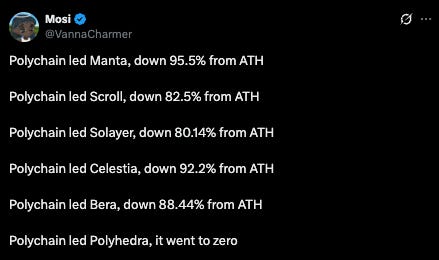
Polychain Capital led Eclipse’s pre-seed round and participated in later rounds—but their behavior in other recent investments raises serious red flags. In projects such as Celestia, they reportedly dumped over $240 million worth of $TIA after token launch, contributing to a 90% price collapse. A similar pattern emerged with other Polychain-backed tokens like Manta, Scroll, and Solayer, all of which dropped 80% to 95% from their peaks.
There is no reason to expect Eclipse to be any different. Polychain has consistently shown a willingness to prioritize returns over ecosystem health. Their early position in Eclipse suggests they are prepared to exit when liquidity emerges—not to build long-term alignment.
On-Chain Activity and Usage
Despite raising $65 million and positioning itself as Ethereum’s fastest L2 using Solana’s virtual machine, on-chain activity on Eclipse reflects a transient, airdrop-driven usage pattern with little organic demand. The following visualizations illustrate sharp rises and rapid declines in key metrics such as gas payments, user deposits, TVL, and app engagement.
Network Fees Reveal Airdrop-Driven Speculation
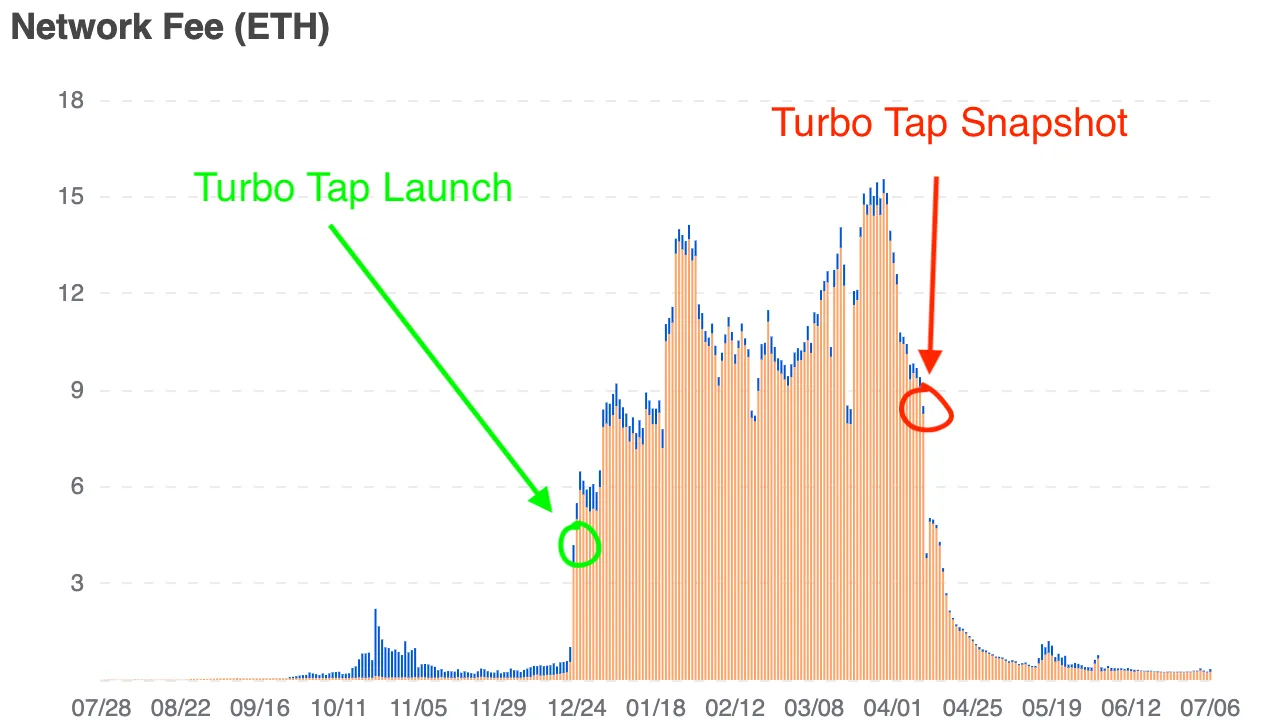
This chart shows the total daily network fees paid on Eclipse (in ETH). Activity spiked immediately after the launch of Turbo Tap—an app designed specifically for airdrop farming. The sharp drop following the Turbo Tap snapshot further confirms the correlation between usage and reward expectations.
By June 2025, network fees had fallen below 1 ETH per day (~$750), reflecting both declining transaction volume and the disappearance of incentive-driven behavior. This trend supports the view that there is no organic transaction demand beyond airdrop farming.
Chain Deposits in Steady Decline
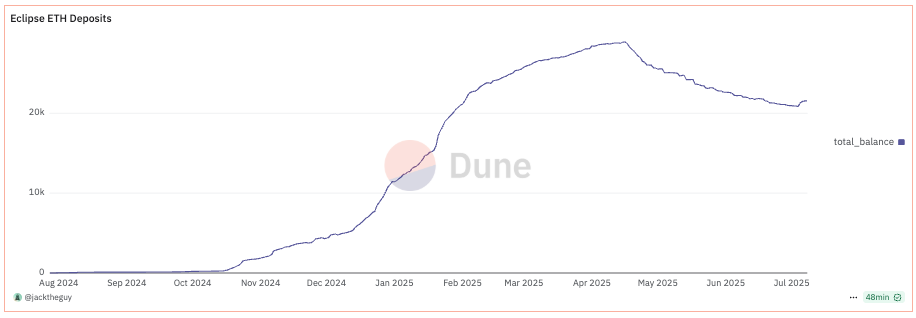
ETH and Hyperlane deposits into Eclipse closely mirror gas usage surges—both grew rapidly during Q4 2024 to Q1 2025, fueled by incentive-driven activity. Starting in Q2 2025, deposit volumes began a steady decline as users withdrew funds, likely reallocating them to more liquid or active ecosystems.
Hyperlane-based deposits peaked at $25–27 million in Q1 2025 but have since dropped below $17 million. This downward trend is consistent across bridged assets such as USDC, SOL, and WIF. Importantly, this is not a rebalancing of asset composition, but a net outflow from the entire ecosystem. As incentive programs fade, user engagement drops, exposing the fragility and temporary nature of Eclipse’s liquidity base.
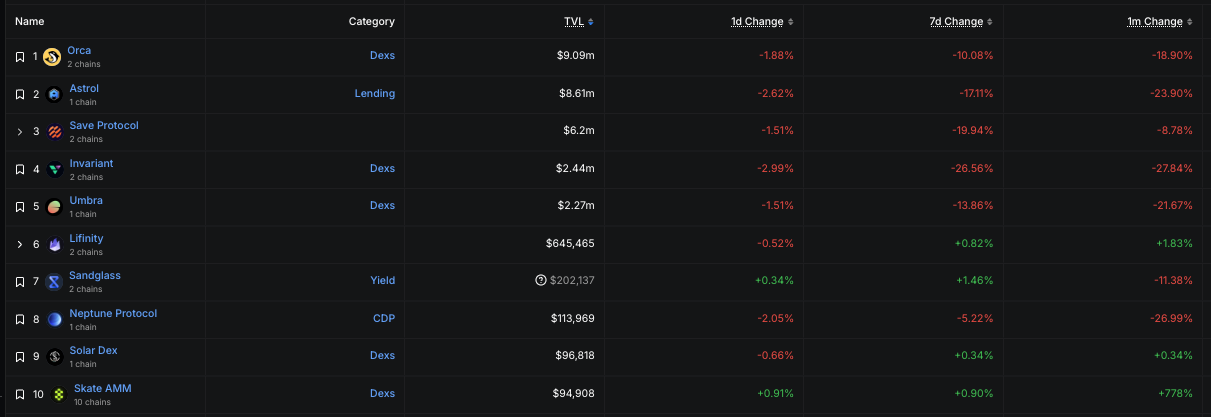
DeFi App Ecosystem: Small, Illiquid, and Bleeding
Among the top 10 Eclipse apps, TVL remains low:
-
Only 3 apps have TVL above $2 million (Orca, Astrol, Save).
-
Most others sit below $500k, some even under $100k.
-
The 1-month change column shows double-digit declines across nearly all major protocols (Astrol -24%, Invariant -28%, Neptune -27%).
This indicates that developers haven’t found sticky traction and users lack compelling reasons to stay or earn.

Lack of a Core Application
As it stands, Eclipse’s application ecosystem lacks any unique or valuable product. The current suite—DEXs, lending markets, stablecoins, NFT markets—is structurally indistinguishable from those on Solana, Ethereum, or other Layer-2s. In most cases, they offer fewer features, poorer liquidity, and no competitive advantage.
For a blockchain to sustain long-term usage and justify its blockspace, it needs a clear raison d’être—an application or experience users cannot get elsewhere. So far, Eclipse has failed to deliver this.
Instead, short-term activity on the network is almost entirely driven by airdrop farming. While the upcoming token launch may briefly reignite user interest, without a core reason to stay, it’s unlikely to hold attention. Token incentives can spark user growth, but they cannot replace true product-market fit.
Without a standout native application, the ecosystem could quickly unravel post-TGE. Builders will leave for more liquid platforms. Users will migrate to chains where their tokens have exit opportunities. And the network—despite strong funding and engineering—may become irrelevant, not due to technical failure, but because there’s nothing truly meaningful inside it.
If Eclipse wants a future, it must incubate or attract an application that can only exist on its architecture—one that leverages SVM in ways no EVM chain can replicate. Otherwise, the token will merely provide a temporary inflation of the ecosystem, before gravity pulls it back down.

Expected Token Launch Dynamics
Based on comparable projects and the current state of the Eclipse ecosystem, the most likely outcome is a valuation mismatch at TGE. Despite declining usage and a lack of sticky applications, Eclipse’s fully diluted valuation (FDV) is expected to exceed its latest private round—possibly surpassing $300 million. This would place it among the highest-valued L2 platforms immediately, despite lacking corresponding fundamentals.
Perpetual futures markets may go live shortly after launch, and traders are likely to short the token, attempting to push its price toward intrinsic value. In response, market makers and early backers may orchestrate a short squeeze, temporarily driving up the price until short positions are manageable. Once liquidity dries up, insiders holding unlocked or liquid tokens will begin gradual sell-offs, creating sustained selling pressure and triggering the kind of prolonged, steep downtrend commonly seen in overhyped, underutilized ecosystems.
This pattern—overpriced launch, initial short squeeze, followed by prolonged distribution—is common in highly speculative, low-utility environments. Without a catalyst for organic demand or a unique application to capture attention, Eclipse’s token is likely to follow the same trajectory.

Final Thoughts
Eclipse has raised significant capital, built an impressive tech stack, and attracted attention from top investors. But none of this has translated into sustained user demand, product-market fit, or a reason for the blockchain to exist beyond short-term speculation.
The current reality is clear: Eclipse has no killer app, no sticky user base, and no compelling reason for developers or capital to remain post-token launch. Its token issuance will likely follow the path of many before it—a brief wave of hype followed by sustained selling pressure as insiders rotate out and natural demand fails to materialize.
Eclipse might still find its footing, but that path requires more than capital and clever architecture. It needs to offer something only Eclipse can provide—not just technically, but economically and experientially. Until then, the project’s valuation will remain disconnected from utility, and its token pricing will be driven more by narrative than actual usage.
In such a market, downward gravity will eventually prevail.
Join TechFlow official community to stay tuned
Telegram:https://t.me/TechFlowDaily
X (Twitter):https://x.com/TechFlowPost
X (Twitter) EN:https://x.com/BlockFlow_News