Meme Casino Goes Public: When Pump.fun's Scythe Swings at Retail Investors' Retirement Funds
TechFlow Selected TechFlow Selected
Meme Casino Goes Public: When Pump.fun's Scythe Swings at Retail Investors' Retirement Funds
The VC capital's harvesting game, packaged as "community benefits."
 Navigating Web3 tides with focused insights
Author: White55, Mars Finance
A "meme casino" with revenue fluctuating by a factor of 100 raises $600 million at a $4 billion valuation—VCs and retail investors paying the same price. Is this financial innovation, or the most spectacular harvest script in crypto history?
In the early hours today, cryptocurrency exchange Gate staged a surreal spectacle: its official website suddenly launched a countdown page for the public sale of Pump.fun's token PUMP, clearly stating that 15 billion tokens (15% of total supply) would be issued on July 12 at 0.04 USDT each, aiming to raise $600 million within 72 hours. The page disappeared faster than a meme coin’s lifespan—deleted almost as quickly as the platform wipes out韭菜wallets.
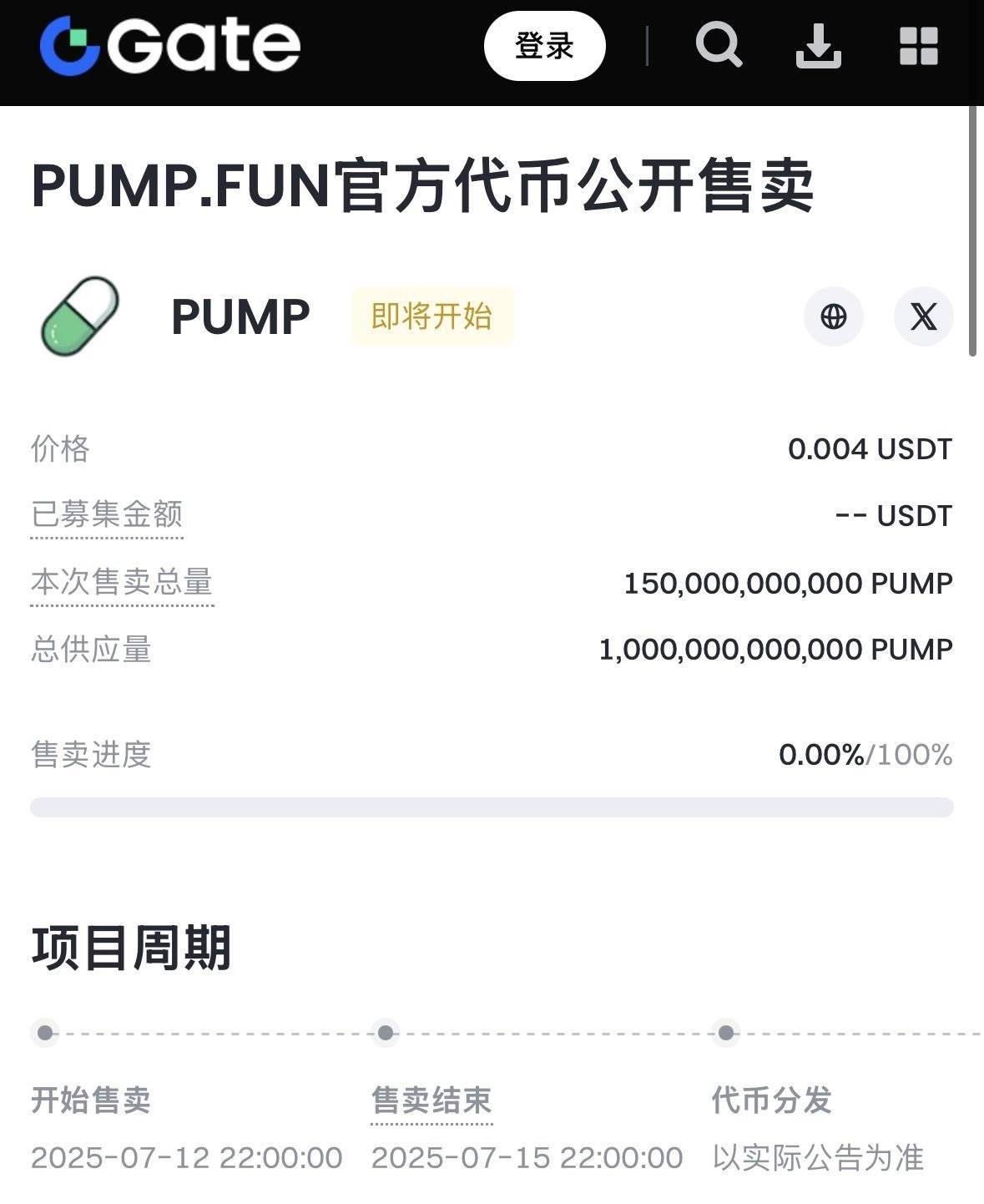
This was no accidental leak—it was a technically crafted teaser, meticulously orchestrated by crypto capital.
After all, when Pump.fun—the $700 million annual revenue "casino table"—suddenly seeks a $4 billion valuation to raise $600 million, you need some drama.
This so-called fair public sale is essentially leftover scraps from the VC banquet repackaged as "community benefits." While retail investors wave their glow sticks chanting "participating in history," they remain oblivious that they’re purchasing VIP tickets straight into a meat grinder.
I. Casino Economics: From SOL Money Printer to韭菜Pulverizer
Flash back to January 2024, when three twentysomethings founded Pump.fun. Tired of being victims of meme coin scams, they decided to open their own casino.
The one-two punch of zero-barrier token creation and bonding curve exploitation instantly ignited the crypto world: users could mint tokens for free while the platform lounged on 5% transaction fees; once a token hit $100,000 market cap, it automatically listed on Raydium—seamlessly transitioning from gambling table to slaughterhouse.
The numbers tell the tale of absurdity:
-
Launched 5.7 million tokens in a year and a half—accounting for 71% of Solana's daily new token issuance
-
Single-day revenue peaked at $14 million on January 2, 2025—like a money-printing assembly line
-
Revenue plunged to just $110,000 on March 9, 2025—a drop of over 99%
This rollercoaster revenue curve perfectly illustrates what “emotion-driven economics” looks like—when FOMO hits, it turns lead into gold; when speculation cools, it leaves naked swimmers stranded on the beach.
But the real dark humor lies in user data: in May 2025, among 594,000 active wallets, only 3.6% earned more than $500, while over half lost money—with some losing millions.
This isn’t decentralized financial revolution. It’s Las Vegas relocated onto blockchain—a probability game where the house always wins, dressed up as a fairy tale of “financial democratization.”
II. Valuation Magic: When Bubbles Wear Bespoke Suits
$4 billion valuation—that figure alone could make traditional finance elites drop their jaws. After all, stablecoin giant Circle’s U.S. IPO valuation was only $7.2 billion, yet Pump.fun’s core business is a highly cyclical speculative service.
The platform has its own esoteric logic of “market cap management”:
-
Price-to-sales ratio (P/S) of 5.63x: Seems reasonable compared to DeFi protocols like Uniswap—but conveniently ignores that meme revenues are as fragile as a candle in the wind
-
Price-to-earnings ratio (P/E) of 11.4x: Assumes tokens capture half the revenue, yet the whitepaper still hasn’t specified any dividend mechanism
-
FDV/revenue ratio of 64x: Far exceeds real cash-flow-generating protocols like Raydium and PancakeSwap
Even more ingenious is the design allowing VCs and retail investors to buy in at the same price. Private round raised $200 million, public round $800 million—all executed at a $5 billion valuation.
Beneath this façade of fairness lies early investors’ desperate need for an exit route—after all, the platform has already dumped $182 million worth of SOL for stablecoins, draining liquidity like a crypto version of the Three Gorges Dam.
While analysts cry out that “a meme launchpad surpassing DeFi blue-chip valuations signals moral collapse in the industry,” KOLs cheerfully compare it to Hyperliquid’s $4 billion valuation.
They selectively forget: Hyperliquid is a derivatives protocol, whereas Pump.fun’s true competitor is Bonk, valued at just $190 million—equivalent to labeling a vegetable market scale as a jeweler’s balance and selling potatoes by the gram.
III. Funding Enigma: Are We Buying a New Set of Scalpels for $600 Million?
Faced with the existential question of “what will the funds be used for?”, Pump.fun’s roadmap reads like performance art laced with irony:
The founders once claimed they’d build an “investable social platform” to rival Instagram and TikTok. In plain English: upgrade Pump.fun from casino to casino-plus-influencer-live-stream complex—because live dealers streaming token launches can harvest another batch of metaverse韭菜.
The actual tech upgrades are even darker in tone:
-
Launch proprietary AMM (automated market maker): solving the problem of “tables not slippery enough for韭菜to escape quickly”
-
Revive live streaming: previously shut down due to users performing dangerous stunts like self-immolation on toilets to promote coins
-
Develop anti-scam tools: despite attackers still impersonating Solana-pumpfun-bot on GitHub to steal wallets
The irony deepens: as the platform proclaims building a “closed-loop meme ecosystem,” rival Bonk.fun is capturing market share through community governance. In the crypto world, “representing the community” often means “cutting more gently,” whereas Pump.fun’s VC-backed scalpel gleams menacingly.
IV. Crypto Apocalypse: When the Casino Becomes the Most Valuable Company
Pump.fun’s capital feast reflects the sharpest ideological rift in the crypto world:
-
Proponents of attention economics chant “traffic is value,” rebranding FOMO as a new paradigm
-
Believers in fundamentals denounce it as an “innovation disaster,” suggesting capital is murdering the ideals of blockchain technology
A deeper metaphor hides in the data: in 2024, the total market cap of meme coins evaporated by $40 billion, yet Pump.fun attempts to erect a $4 billion valuation monument atop the ruins. It eerily resembles the 2008 subprime crisis scene where Goldman Sachs employees counted cash while debating the “necessity of financial innovation.”
When the platform labels 52.5% user losses as “ecosystem vitality,” calls a 60% daily volume drop “market maturation,” and interprets regulatory warnings (such as the UK FCA ban) as “badges of honor”—the entire industry is losing reverence for the essence of value. This carnival under the banner of “financial democratization” will ultimately become a textbook case of collective hysteria.
Conclusion: A Crypto-Era "Hillside Sheep"
Bitcoin peaks high, contracts rage like thunder
Altcoins snake along paths of entrapment
Gazing at the crypto world, my heart hesitates
Pumpfun’s scythe devours leftover bones
All the new coin frenzies turn to dust
Rise, and韭菜suffer
Fall, and韭菜suffer
When Zhang Yanghao wrote “rise, people suffer; fall, people suffer” in the 14th century, he couldn't have imagined that seven centuries later, blockchain casinos would reenact history using smart contracts. The verdict—“Pumpfun’s scythe devours leftover bones, all new coin frenzies turn to dust”—has already exposed the nature of this capital game.
When Gate Exchange’s 404 page becomes the best performance art, when VCs wait for retail investors to absorb their private allocations, when KOLs’ rainbow praise drowns out rational voices—the ultimate paradox of the crypto world emerges: the more devout the belief in decentralization, the more efficient the centralized harvesting becomes.
Future historians looking back at the summer of 2025 might record it thus: that year, casino owners no longer settled for taking rake—they made gamblers fund the construction of new casinos.
And the韭菜s, reciting “rise,韭菜suffer; fall,韭菜suffer,” line up eagerly to buy preferred shares in the casino IPO.
Because in this industry, suffering itself has become the most addictive form of consumption.
Join TechFlow official community to stay tuned
Telegram:https://t.me/TechFlowDaily
X (Twitter):https://x.com/TechFlowPost
X (Twitter) EN:https://x.com/BlockFlow_News