Trader's Memoir: How I Used Soros' Method to Make 100% on PEPE
TechFlow Selected TechFlow Selected
Trader's Memoir: How I Used Soros' Method to Make 100% on PEPE
"We should invest 200% of our funds in this deal, not 100%."
 Navigating Web3 tides with focused insights
Author: Leo
Translation: Luffy, Foresight News
The art of speculation boils down to two things: how much you make when you're right, and how much you lose when you're wrong. Everyone looks back at trades they were certain would be huge winners and asks themselves why their position was so small. Likewise, everyone reflects on hesitant trades and wonders why they kept adding to a losing position.
Position sizing is one of the hardest skills to master, yet improving it offers the most effective leverage. All top traders constantly explore ways to enhance it because the consequences of getting it wrong can be catastrophic. While I have many shortcomings in execution, position management has been one of my strongest abilities throughout my career—it compensated for numerous other mistakes I made.
One of my favorite stories is told by Stanley Druckenmiller and George Soros about "aggressively doubling down on asymmetric opportunities." They are among the greatest fund managers of all time.
In 1992, Druckenmiller served as chief portfolio manager at Soros’s Quantum Fund. He noticed that the Bank of England was artificially propping up the pound and believed this support couldn’t last long. He approached Soros with his thesis.
"George, tonight I’m going to sell $5.5 billion worth of pounds and buy Deutsche marks—that means we’re putting 100% of the fund into this single trade."
As I spoke, he started frowning, like something was wrong with me—almost as if he was about to reject my idea. Then he said: "That’s the most ridiculous money management approach I’ve ever heard. What you’re describing is an incredibly one-sided bet."
"We should put 200% into this trade, not 100%. Do you know how rare an opportunity like this is? Maybe once every 20 years. What’s wrong with you?"
Druckenmiller ultimately executed the trade with double leverage. It became one of the most famous trades in history, earning $1 billion in a single day. Soros even earned the nickname “the man who broke the Bank of England.”
My most profitable trade to date was a swing play on $PEPE when Coinbase and Robinhood announced its listing in November 2024. During execution, I kept thinking of that legendary story—asking myself, “What would Soros do?”
At around 6 a.m. that day, I was sitting on the toilet scrolling through my phone as usual—checking group chats, monitoring Twitter, and watching price charts. I already had a small long position in $PEPE because the chart looked strong and my gut told me to buy—but the position was deep in the red, making me anxious.
I was intensely staring at the 1-minute candlestick chart on my trading app when suddenly a massive green candle shot upward, bringing me back to breakeven. I was clearly excited but also confused. Then I got a Twitter notification: “PEPE listed on Robinhood.” I doubted whether it was real—it seemed too surprising—so I verified across group chats and Twitter. Once confirmed, something clicked in my mind: this was *the* once-in-a-lifetime opportunity.
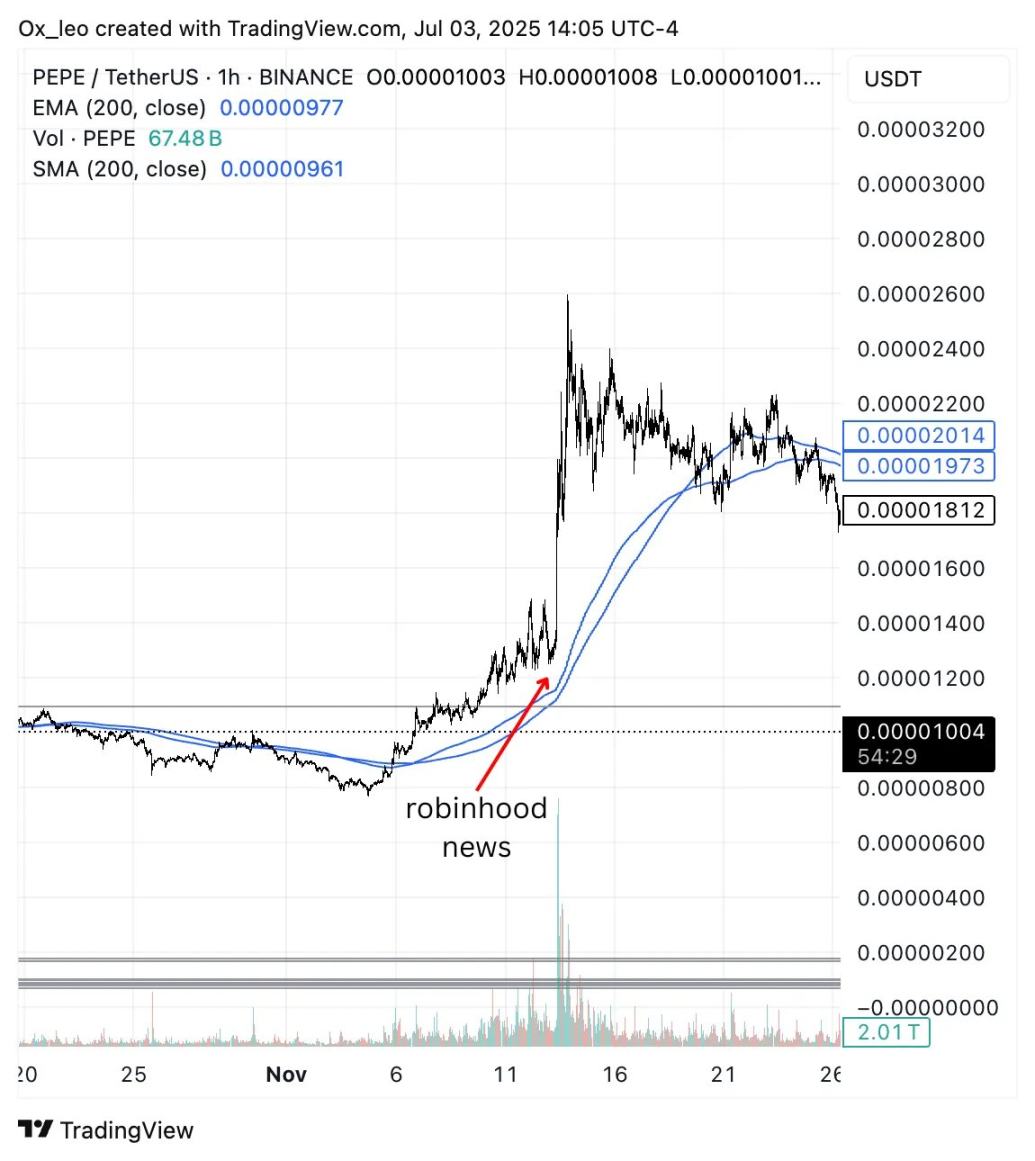
Right after the Robinhood news broke, the price surged from $0.000012 to $0.000016 instantly. The announcement was significant because no other memecoin had been listed on Robinhood since $DOGE and $SHIB. Previously, PEPE had no easy access route for U.S. investors—Americans either bought it on-chain or through obscure exchanges. Listing on Robinhood opened the floodgates to massive retail capital, and the market quickly priced that in.
For context: $PEPE’s all-time high (ATH) at the time was $0.000017. One of my favorite setups is breaking out above ATHs—and I realized anyone selling at this level fundamentally misunderstood the significance of the news.
I immediately bought five times my current position at market price, using nearly 2x leverage—effectively making my position size equal to twice my portfolio value. Looking at the dollar amount on the trading app, I felt nauseous—literally sick to my stomach. If I’d eaten breakfast, I would’ve thrown up. I’d never invested so much in a single altcoin, let alone a memecoin. Yet internally, I was completely calm—because I knew this was the right decision.

About an hour after the Robinhood news, Coinbase also announced $PEPE listing, pushing the price past ATH. Later that day, Upbit listed $PEPE, driving the price to $0.0000255. I couldn’t even look at the trading app—the P&L swings were too extreme. At peak, I made roughly 100% in under 12 hours. It was, without question, a wild day. I didn’t exit at the top, but still locked in substantial gains—more than my profits from the previous few months combined—highlighting the immense value of adjusting position size during asymmetric opportunities.
These are stories of oversized positions that worked out—but it would be criminal not to discuss the other side. For every success story of a concentrated bet, there are countless others who went all-in and blew up. That’s exactly why successful investing is so hard: balancing conviction in your thesis with respect for the market isn’t easy.
Sometimes you go all-in confidently, only to lose for several days straight, so you decide to cut losses and exit. Then magically, as if the market gods were watching your position, the moment you exit, the price reverses and moves exactly according to your original thesis. Other times, you hold on, wake up a week later, and find your portfolio down 50%. There’s no denying it—this is a skill difficult to master.
I’ve personally had many failed oversized bets, but one thing has kept me alive: extremely strict risk management. If the price doesn’t move according to my thesis and losses persist, I exit. No matter how strong my belief, the market is always right.
Never cling to a losing trade—better ones are just around the corner. There will always be plenty of opportunities worth going big on. But if I lose a large chunk of my portfolio, I won’t have enough firepower to capitalize on the best ideas.
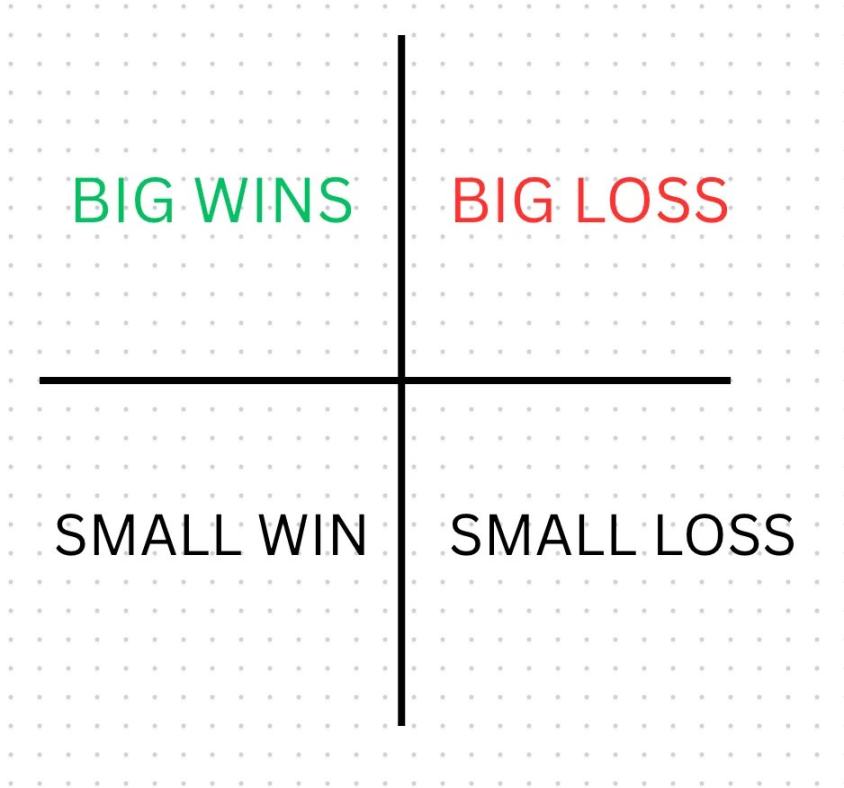
Avoid catastrophic losses at all costs—this is truly the most important principle in any risk-based game. What constitutes a “catastrophic loss” is relative. In the early days, when building a smaller portfolio, I had to take bigger risks. I could easily allocate 10–15% of my portfolio to a high-conviction trade because that’s the nature of the markets I operated in. On-chain assets were extremely illiquid and volatile, so I had to accept larger drawdowns for my thesis to play out. As my portfolio grew and the markets I entered became slightly more liquid, I could no longer afford such large risks. Knowing your personal risk tolerance is critical—so every time you enter a trade, you clearly understand how much you can afford to lose. I’ve seen many brilliant, astonishing traders get wiped out by a single unrecoverable blow and forced to leave the game.
This is why one of my favorite strategies is breakout trading. I love breakouts because they offer defined risk—one where the trade either works or fails quickly. For example, my timing on the $PEPE trade came when the price struggled near the top, failed to break through, or briefly broke ATH then pulled back below. In both cases, I had clear exit points, making it rational to build a large position at that level.
Looking back on my trading journey so far, every meaningful growth in my portfolio has come from “all-in” returns. Each year, only a few trades generate most of the profits. Beyond that, it’s truly a survival game. You must stay sharp enough to identify those rare high-upside opportunities, yet disciplined enough to avoid losing everything on low-conviction ideas or doubling down on losing positions.
In the next phase of my journey, one major area I’m focusing on improving is holding power. I’m good at going big, but terrible at holding through large unrealized gains. It’s my internal risk management instinct acting up—but if I could apply my thesis more consistently instead of over-trading, I’d go much further.
Join TechFlow official community to stay tuned
Telegram:https://t.me/TechFlowDaily
X (Twitter):https://x.com/TechFlowPost
X (Twitter) EN:https://x.com/BlockFlow_News
 @0x_Leo_