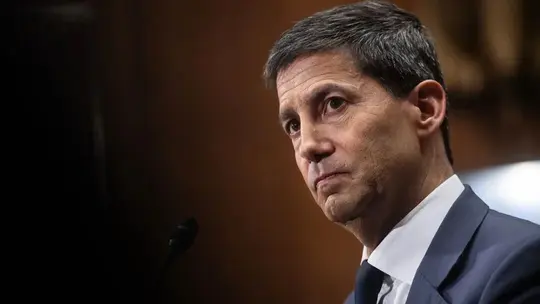
Powell did not rule out a rate cut in July, saying they would have already cut rates if not for tariffs, and that tariffs are likely to impact inflation.
TechFlow Selected TechFlow Selected
Powell did not rule out a rate cut in July, saying they would have already cut rates if not for tariffs, and that tariffs are likely to impact inflation.
Regarding the July FOMC meeting, Powell declined to make predictions, stating that the future economic outlook will determine the policy path.
 Navigating Web3 tides with focused insights
By He Hao, Bu Shuqing, Wall Street Journal
On Tuesday local time, Federal Reserve Chair Jerome Powell spoke at a conference hosted by the European Central Bank in Portugal, alongside central bank leaders from Europe and Asia.
Powell said stable economic activity gives the Fed time to study how tariff hikes affect prices and growth before resuming rate cuts. He left multiple options open. On Tuesday, Powell reiterated his previous stance:
"We're just pausing for now. So long as the U.S. economy remains solid, we believe it's prudent to wait, gather more information, and see what these effects might be."
A clear majority of Fed officials expect rate cuts later this year.
In recent weeks, investors have increased their expectations for Fed rate cuts in the second half of 2024, after U.S. inflation data for April and May came in below some economists' forecasts.
Powell said the Fed would likely already be gradually cutting rates this year if not for concerns that tariffs could disrupt the final phase of the inflation fight the central bank has led over recent years. When asked whether the Fed would already be cutting again had Trump not announced his controversial plan earlier this year to raise tariffs on many foreign trading partners, Powell responded:
"I think so. In fact, when we saw the scale of the tariffs, and when nearly all inflation forecasts for the U.S. were revised significantly higher due to tariffs, we paused our rate cuts."
Regarding the upcoming July FOMC meeting at the end of the month, Powell declined to make predictions, saying future economic developments will determine policy direction. "I don't rule out any meeting, nor do I put one explicitly on the agenda."
On Inflation and the Labor Market
After significant declines over the past two years, a key core inflation measure is now stable slightly above the Fed’s 2% target. Using the Fed’s preferred gauge, core inflation excluding food and energy stood at 2.7% in May.
Fed officials broadly expect tariffs to push up prices this summer. Powell said officials will closely watch whether inflation does or doesn’t materialize. "Inflation has performed as we expected and hoped. We anticipate inflation readings will rise over the summer."
Powell reiterated that tariff impacts are expected to show up in inflation data over the coming months, though he acknowledged uncertainty remains. "We’re watching, and we expect to see somewhat higher numbers this summer." He added that the impact of tariffs could be greater or smaller than expected, and may arrive earlier or later—policymakers are prepared for such variability.
Despite strong pressure from Trump to cut rates, the Fed has held steady so far this year, partly to observe whether price increases triggered by tariffs evolve into more persistent inflation. But so far, prices have not risen significantly due to inflation. "We’ve consistently said there’s high uncertainty about the timing, magnitude, and persistence of inflation," Powell said.
On the labor market, he said: "We expect the labor market to gradually cool. We are watching very closely for any unexpected signs of weakness."
Last week during congressional testimony, Powell suggested Fed officials are more likely to wait until at least the September meeting to assess the full extent of tariff-driven price increases.
Commentary from the 'New Fed Wire'
Nick Timiraos, the influential financial journalist known as the "New Fed Wire," commented:
"Powell’s recent remarks, including during Tuesday’s discussion, show he is working hard to preserve broad policy flexibility over the coming months. This suggests the Fed’s rate-cutting strategy could shift—especially if the final tariff increases end up being smaller than the levels Trump announced in April."
"In the past, the Fed may have required clear signs of economic deterioration before cutting rates. Now, Powell hints that under current conditions, weaker summer job data combined with price gains below expectations might be enough to restart rate cuts."
Citing analysts, Timiraos noted another reason why the Fed might resume cutting: they believe tariffs are more likely to squeeze corporate profits, weaken economic activity, and raise unemployment, rather than trigger sustained and meaningful inflation.
Timiraos pointed out that consumer spending data so far this year shows signs of slowing, especially in discretionary areas like travel.
Divisions Within the Fed
The Fed voted unanimously in June to hold rates steady, but the latest dot plot reveals disagreements among officials over the future path of interest rates. Ten policymakers expect at least two rate cuts this year, seven forecast no cuts in 2025, and two anticipate only one rate cut by year-end.
As previously reported, the Fed is experiencing a "historically high level of division" over the monetary policy path. Bowman and Waller support potentially cutting as early as July, arguing that tariff-driven price increases are one-time events. In contrast, hawkish official Hawk opposes such moves, while Powell emphasizes the need to observe summer data. Some officials worry that Trump’s sharp increase in import tariffs this spring could reignite inflationary pressures—particularly since years of high inflation have made businesses more adept at raising prices.
Markets currently price in 70 basis points of rate cuts this year. Citigroup still expects the first cut in September but acknowledges growing odds of a July move.
Pressure From the Trump Administration
Powell’s comments come amid rare public criticism from Trump and his senior advisers, who have accused Powell of partisan bias—a claim Powell firmly denies. The Fed cut rates by 1 percentage point last year, but Trump has called for cuts of up to 3 percentage points.
Republicans in Congress are advancing tax-cut legislation, which some analysts believe will exacerbate fiscal deficits in the coming years. Previous attempts by the government efficiency office to reduce spending fell far short of targets, highlighting the difficulty of deficit reduction.
In a letter sent Monday from the White House to Powell, Trump reiterated his desire for lower interest rates, arguing it would reduce U.S. interest expenses. But this rationale lacks credibility at the Fed, whose congressional mandate is to maintain low inflation and strong employment—conditions many economists believe are the true foundation for lower borrowing costs over time.
U.S. Treasury Secretary Bessent recently said in a television interview that the Fed appears still “traumatized” by the high inflation experience of 2021–2022. He compared the Fed to an elderly person who, having fallen once, walks constantly looking down to avoid falling again—but ends up more prone to tripping.
Although Powell’s term as Fed chair runs until May next year, Bessent has indicated the White House may nominate a successor as early as October or November to fill a board seat set to become vacant in February.
Powell deliberately avoided responding on Tuesday to ongoing White House attacks questioning his intelligence and integrity.
At a welcome dinner for central bankers on Monday, Powell received a standing ovation from attendees after ECB President Lagarde praised him as “embodying the standard of a courageous central banker.”
Join TechFlow official community to stay tuned
Telegram:https://t.me/TechFlowDaily
X (Twitter):https://x.com/TechFlowPost
X (Twitter) EN:https://x.com/BlockFlow_News