Interview with Franklin Templeton Executive: In the Future, Every Company Will Be on the Blockchain
TechFlow Selected TechFlow Selected
Interview with Franklin Templeton Executive: In the Future, Every Company Will Be on the Blockchain
"We need to combine traditional finance with cryptocurrency technology."
 Navigating Web3 tides with focused insights
Compilation & Translation: TechFlow
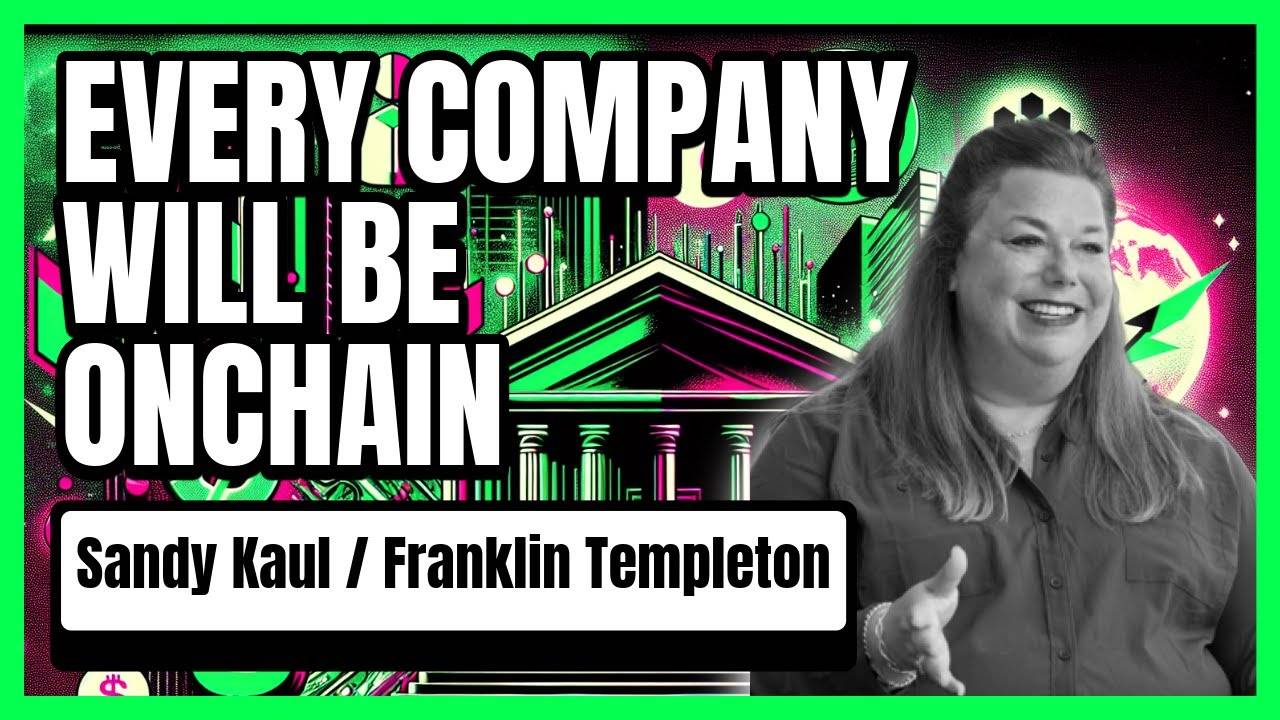
Guest:
Sandy Kaul, Head of Innovation at Franklin Templeton
Host:
Camila Russo, Founder of The Defiant
Podcast Source: The Defiant - DeFi, Web3 & NFT Insights
Original Title: Every Company Will Be a Crypto Company: Expert Insights with Sandy Kaul from Franklin Templeton
Air Date: June 14, 2025
Key Takeaways
What happens when traditional finance meets decentralized finance?
Join Sandy Kaul, Head of Innovation at Franklin Templeton, to explore the cutting-edge experiments of this global asset management leader in the crypto space. This discussion reveals how DeFi is unlocking new opportunities and how tokenized money market funds are reshaping the future of finance.
Topics covered in this episode:
-
Franklin Templeton’s on-chain money market fund
-
How evolving crypto infrastructure is reshaping traditional finance (TradFi)
-
New TradFi products powered by crypto technology
-
Tokenization vs. stablecoins
-
DeFi-enabled supply chain and enterprise resource management
-
Regulation, barriers, and the convergence of TradFi and DeFi
Highlights Summary
-
Every company will be on-chain.
-
Blockchain not only optimizes traditional financial processes but also enables entirely new capabilities impossible in legacy systems—unlocking revolutionary possibilities for asset management.
-
Each ecosystem functions like an independent digital nation, with its own currency (native tokens used to buy blockspace) and entrepreneurs (developers building applications and projects on the platform).
-
Precise shareholder yield calculation, daily yield payouts, and peer-to-peer transferability—these features open up entirely new use cases for money market funds that were previously unachievable in traditional finance, making them truly transformative.
-
For institutions launching on-chain products, security is paramount. They also evaluate transaction recording mechanisms to ensure sufficient transparency and robustness.
-
A key advantage of tokenized money market funds is that their underlying assets are highly regulated. Another major benefit is our ability to pass through all fund earnings directly to users, offering higher returns.
-
We believe liquidity pools are a core component of the future financial system and have strong confidence in their potential. We're also interested in lending protocols and aim to integrate our Benji product suite as a superior alternative to stablecoins.
-
We need to combine traditional finance with crypto technology.
-
Traditional financial firms often struggle to think beyond existing frameworks and create new models because they’re constrained by regulatory mindsets from the outset. What we really need is imagination—the ability to rethink technological potential from first principles and ask whether it can enable entirely new functions. That kind of creativity comes more naturally from crypto-native companies. It's their innovation, energy, and willingness to challenge conventions that allow them to define these new models.
-
Within the next 12 to 18 months, the U.S. should begin clarifying the framework for new regulations. This will provide a compliant foundation for expanding current use cases and bringing more types of assets into the crypto ecosystem.
-
Within three to four years, we’ll reach a critical inflection point where all newly launched funds will register and operate on blockchain.
-
Wallet-based systems will become a major driver of new product innovation and broader adoption of crypto wallets.
-
We're moving toward a world of diversified payment methods, where fiat will no longer be the only option but one among many.
-
Cryptocurrencies aren't just asset classes—they represent different nations or new investment growth opportunities. Investors should build complete portfolios rather than betting everything on a single asset.
-
Success means crypto becomes central to how we operate—not just an add-on—but integrated into every part of Franklin Templeton’s business.
-
When dealing with emerging assets, investors should diversify to manage risk.
Introducing Sandy Kaul, Head of Innovation at Franklin Templeton
Camila:
Today I’m honored to welcome Sandy Kaul, Head of Innovation at Franklin Templeton. Sandy, I'm really excited about our conversation today because Franklin Templeton has been at the forefront of bridging traditional finance (TradFi) and decentralized finance (DeFi), and your on-chain financial activities are particularly impressive. I’d love to understand what motivated you to take this step and your vision for the future.
But before that, could you share some personal background? What sparked your interest in this field, and how did it lead to driving DeFi innovation at Franklin Templeton?
Sandy:
My career path has been quite diverse across multiple domains. I started as a researcher, then moved into commodities as a research analyst. Over time, I became deeply interested in how emerging technologies transform financial operations.
At the end of the 1990s during the rise of the internet, I joined a startup consulting firm focused on developing new financial models based on the internet—like online research, online trading, and online banking. While these seem commonplace now, back then they were revolutionary and fundamentally changed how financial markets operated.
Later, I transitioned into consulting, helping traditional financial firms leverage new technologies for transformation. Around 2011–2012, I first encountered Bitcoin and blockchain technology. At the time, I found it interesting but wanted to see how it evolved. Then in 2016, Ethereum caught my attention. Its smart contract functionality made me realize this technology could completely transform how finance works. In traditional finance, much of the work revolves around reconciliation and managing complex paper trails. If smart contracts could automate those processes, efficiency would improve dramatically.
From there, I began researching and writing about blockchain and DeFi. Later, I led thought leadership initiatives at Citigroup, advising large asset managers and hedge funds on blockchain developments. During this period, I discussed blockchain opportunities with Jenny Johnson, CEO of Franklin Templeton.
Franklin Templeton differs from many traditional financial firms—it operates more like a family office. Jenny is the third-generation leader, and her perspective isn’t limited to short-term gains but extends to the company’s long-term trajectory over decades. That’s why she showed strong interest in blockchain and pushed forward experimental initiatives in this area. By 2021, I was so excited by their progress that I reached out to Jenny asking if I could join. In 2022, I officially joined Franklin Templeton to work with the digital assets team, building blockchain capabilities. We firmly believe this is the future of finance.
Franklin Templeton’s Cost-Reduction Experiments via Crypto Technology
Camila:
Franklin Templeton’s background is indeed fascinating—it resembles a well-established family office, which seems to offer more room for innovation. As a traditional asset manager overseeing over $1 trillion, your active participation in on-chain finance is impressive. Could you elaborate on the projects and products you’ve launched?
Sandy:
Absolutely. We’re fortunate that Jenny had early responsibilities at Franklin Templeton in operations and technology, giving her deep familiarity with how the company functions. We manage numerous mutual funds, each requiring daily maintenance of securities records and shareholder registers. We also act as transfer agents, maintaining detailed shareholder information. These tasks involve extensive ledger management and reconciliation processes.
Jenny proposed a bold idea: "Since blockchain is a decentralized ledger, why don’t we try using it to manage funds? Maybe we can reduce costs and replace legacy mainframe systems."
So we decided to start with a money market fund, launching a tokenized version. Money market funds calculate and pay yields daily, making them ideal candidates for testing blockchain technology. Our goal was to validate whether blockchain could optimize operational costs.
Back in 2019, there were no ready-made solutions available—we had to build everything from scratch. There were no wallets compliant with KYC and AML rules, no trading systems capable of handling institutional orders, and no accounting systems designed for fund accounting. So we built it all ourselves. This was also when we truly began engaging with crypto-native companies—because to operate in digital assets, we needed to partner with crypto-native firms.
Franklin Templeton’s On-Chain Money Market Fund
Camila:
How has your on-chain money market fund performed so far? Is it more efficient compared to traditional mutual funds?
Sandy:
Our first major finding was that operating via blockchain significantly reduces costs. But more importantly, we quickly realized blockchain allows us to maintain shareholder records with greater decimal precision, improving accuracy. Since all transactions settle instantly on-chain, we no longer wait until market close to update records. We discovered that blockchain doesn’t just optimize traditional financial processes—it enables entirely new capabilities impossible in legacy systems. These innovations unlock fresh possibilities for the asset management industry.
Today, we’ve built a fully native blockchain platform that supports functionalities other asset management platforms can’t achieve, giving us a unique competitive edge.
From 2019 to Today: The Evolution of Crypto Infrastructure
Camila:
I’d like to dive deeper into the new functionalities you’ve discovered and how blockchain infrastructure has evolved since your exploration began in 2019. You mentioned the lack of KYC-compliant wallets and missing infrastructure components. How do you view the industry’s progress since then? With improved infrastructure, is launching on-chain products easier now—or do you still prefer building your own tools?
Sandy:
Yes, we’ve seen tremendous progress. From early blockchain networks to today’s Benji infrastructure, we’re now deployed across nine public blockchains and one private chain. This scalability allows us to expand and interact with multiple ecosystems. In our view, each ecosystem functions like an independent digital nation, with its own currency (native tokens used to buy blockspace) and “entrepreneurs” (developers building apps and projects on the platform).
We want to participate in multiple ecosystems because they’re hubs of innovation. We encourage developers to integrate our products and features into their applications and protocols. As ecosystems advance, we can scale further. We’ve also patented some early-stage technologies we developed, allowing us to move faster.
We’ve made substantial progress in whitelisted wallets, system controls, and cross-chain mobility. These improvements let us better leverage native tools being developed within ecosystems to grow our business.
Institutional Priorities When Launching On-Chain Products
Camila:
What key considerations do institutions typically focus on when planning to launch on-chain products?
Sandy:
First and foremost, security is the top priority. We’ve developed a comprehensive framework to assess the decentralization level of blockchains. Some chains claim to be decentralized, but if validator numbers are too low, we question the adequacy of checks and balances. We closely examine the security measures in place to prevent vulnerabilities and how ongoing community testing enhances reliability.
We also study how they record transactions to ensure mechanisms are transparent and robust. We find different blockchains perform better in different scenarios. For small retail orders, we usually prefer low-cost, fast-processing chains. But for multi-million dollar institutional trades, we favor high-security chains that reliably preserve transaction history—even if gas fees or other costs are higher.
To serve clients better, we’ve developed a full framework for intelligent order routing. It matches client needs and order characteristics with the most suitable blockchain, achieving optimal balance between efficiency and security.
Selecting Blockchains Based on Use Cases
Camila:
Besides security, what else matters when institutions choose blockchains? You mentioned whitelisting and customization—how important are those? Are there areas that still need improvement and could see significant advancement in the future?
Sandy:
I believe interoperability is a crucial factor. We need multiple programming languages to connect different blockchain systems. Some languages offer better primitives and smart contract templates, enabling more efficient development. We’re closely watching how various blockchain ecosystems address gaps in developer tooling.
Currently, cross-chain operations are very smooth for EVM-compatible chains because their smart contracts are interoperable. For non-EVM chains, we observe whether similar compatibility can be achieved and whether transaction speeds are sufficient. If a blockchain lacks horizontal scalability (supporting multiple nodes processing transactions simultaneously), what’s its on-chain throughput? These are key factors in evaluating partnership suitability.
Beyond that, we evaluate specific features such as support for whitelisting, validator distribution mechanisms (especially in staking networks), and how staking rewards are paid and distributed. All these go into our assessment framework.
Three New Types of TradFi Products Enabled by Crypto Technology
Camila:
In your on-chain work, what new functionalities have emerged? What can Franklin Templeton and others now do on-chain that wasn’t possible before?
Sandy:
I’d highlight three concrete examples that excite me.
First is real-time yield distribution for money market funds. In traditional finance, money market fund trades occur only Monday through Friday, with fixed market open and close times. Only after market close, once all trades are reconciled, can shareholder yields be calculated. If you hold the fund partway through the day—say depositing in the morning and withdrawing in the afternoon—you don’t earn any yield for that day. With blockchain, we can compute shareholder records per second. This means even holding the fund for three hours and two minutes entitles you to precise yield for that exact duration.
Second is frequency of yield payments. Traditional money market funds typically accrue and pay yields monthly. But with blockchain, we can distribute yields daily—including weekends and holidays. We do this through incremental token issuance tied directly to the fund’s actual assets, not off-chain records in legacy systems. Daily yield distribution is far more flexible and efficient than monthly payouts.
Third is peer-to-peer transferability of tokens. Because tokens reside directly in users’ wallets, we know exactly who holds each token and where it is. Transfers become simple—direct wallet-to-wallet movement. Traditional mutual fund share transfers usually take weeks and involve extensive offline documentation and confirmation. This P2P transferability greatly increases liquidity, making fund shares more useful as collateral.
These three features—precise shareholder yield calculation, daily yield payments, and peer-to-peer transferability—open up entirely new use cases for money market funds. These are impossible in traditional finance, making them truly revolutionary.
Additional DeFi Applications: Supply Chain Management
Camila:
The third use case reminds me of one of my favorite aspects of DeFi—the concept of “money legos,” where financial products stack together like building blocks to create new applications. You mentioned token holders can use these tokens as collateral—beyond that, are you exploring broader DeFi applications?
Sandy:
We’re actively exploring new financing use cases, and one particularly promising area is supply chain management. For example, suppose I order goods today that arrive by ship at a port. When they reach the port, they’re entered into the port’s electronic booking system. Traditionally, the buyer receives arrival notice and initiates payment, but actual settlement often takes 30 to 60 days.
We aim to streamline this process using smart contracts. Once goods enter the electronic system, an oracle network can relay this data to a smart contract. The smart contract automatically triggers payment using our tokenized money market fund for instant settlement—transferring funds directly from one wallet to another via blockchain. This reduces payment time from 30–60 days to seconds while significantly boosting efficiency. It’s a classic blockchain application in supply chain management.
Additional DeFi Applications: Enterprise Resource Planning (ERP)
Camila:
Are you currently in talks with shipping companies about this?
Sandy:
We’re exploring how DeFi technology can be applied to enterprise resource planning (ERP) systems. Large multinational corporations operating globally often have payment and HR systems spanning hundreds of countries. They conduct massive cross-border payments, which are inefficient and expensive under current banking systems.
To address this, we’re studying how tokenized money market funds can serve as a new settlement mechanism between different legal entities within a corporation. This lets companies bypass cumbersome traditional cross-border payment processes, drastically reducing costs and increasing transaction speed.
We want to use blockchain infrastructure to rethink financing—not just innovating within DeFi, but integrating these technologies into more traditional financing models to deliver more flexible and efficient solutions for enterprises.
Tokenized Money Market Funds vs. Stablecoins
Camila:
Compared to USDC or other stablecoins, what advantages does your tokenized money market fund offer?
Sandy:
Tokenized money market funds have clear advantages—and some limitations depending on use cases.
First, a key feature is that the underlying assets are strictly regulated. Money market funds must disclose holdings daily and store assets with certified third-party custodians. This ensures full transparency into the fund’s underlying assets. Our U.S. government money market fund, for instance, invests primarily in high-quality government bonds and short-term instruments, making it extremely secure.
Due to high transparency and quality of underlying assets, users typically need less collateral when using tokenized money market funds versus stablecoins like USDC, which may require higher collateral ratios for equivalent exposure.
Another major advantage is our ability to pass through all fund earnings directly to users. In contrast, due to regulatory constraints, stablecoins like USDC cannot distribute all their earnings—if they did, they’d be classified as investment products and required to register with the SEC. Our tokenized money market funds face no such restrictions, so users earn higher returns.
Of course, there are trade-offs. Our product is KYC and AML compliant, so users don’t enjoy the same level of freedom as with USDC. Any transfer involving our tokenized money market fund requires identity verification and KYC screening to confirm the recipient wallet belongs to an eligible holder.
Product Offerings and Asset Classes
Camila:
I hadn’t realized that because you can pass through all earnings, your product offers higher yields than some lower-yielding stablecoins. Do you plan to launch additional products?
Sandy:
We’re currently rolling out several new products. Many categorize these as “real-world assets,” but I dislike that term because it’s poorly defined.
We all live in the real world—including people in crypto. Rather than debate definitions, we focus on how to tokenize the investment portfolios we manage as a $1.6 trillion asset manager. These span equities, fixed income, alternatives, and crypto.
Additionally, we plan to tokenize specific alternative products—like real estate-related investments, private debt, and secondary private equity markets. These are all areas we’re exploring. More importantly, we believe this will give rise to entirely new asset classes—what we call “cultural assets,” including collectibles and intellectual property. As blockchain and tokenization mature, we believe these will become essential parts of investor portfolios because the technology simplifies inclusion.
Camila:
Among the products you’re planning, which ones are next in line for release?
Sandy:
We’re launching multiple versions of our tokenized money market fund for global coverage. While stablecoins circulate freely worldwide, registered investment products must operate within specific legal jurisdictions.
We’ve already launched a U.S.-based fund under the Investment Company Act of 1940. We also launched a Luxembourg version that operates across multiple international markets. Additionally, we have a private fund version. Recently, we received approval to launch a fund under Singapore’s BCC structure, enabling access to the Singapore market. Through these efforts, we’re expanding our offerings so investors worldwide can easily access our money market funds.
Camila:
Besides completing KYC, do investors need to be accredited to purchase your money market fund?
Sandy:
No, and that’s a key reason we chose to start with a standard money market fund. Anyone can buy it. Just download our Benji app, register, and we’ll quickly complete your KYC and AML—then you can start trading immediately.
You can use it as a cash management tool, earning full money market fund yields without going through a broker. Everything is direct with Franklin Templeton—accessible to anyone.
Barriers to Launching More Crypto Products
Camila:
You mentioned using these tokens as collateral in supply chain finance and B2B contexts. I imagine you’ve explored permissioned DeFi areas like permissioned lending, vaults, and related KYC components. What’s your view on this space? Though still early, is this a direction you’ll pursue—or are there current barriers preventing implementation?
Sandy:
Exactly. We’re very interested. Right now, we’re mainly waiting for regulators to provide clearer guidance—especially regarding how registered investment products can participate in liquidity pools.
We believe liquidity pools are a core component of the future financial system and have strong confidence in their potential. We’re also interested in lending protocols and hope to integrate our Benji product suite as a superior alternative to stablecoins.
We believe tokenized money market funds offer clear advantages: higher yields, more stable underlying collateral, plus transparency and third-party custody—all enhancing user protection. We’re currently working with market makers to establish pricing for our money market fund against major crypto assets. Once regulators give clear approval, we plan to enter the market on multiple fronts because we believe these innovations will redefine the future financial landscape.
Desired Regulatory Clarity
Camila:
Which specific regulations or guidance documents would help clarify how to participate in liquidity pools?
Sandy:
We’re focusing on several key areas.
First, stablecoin legislation. For example, Europe’s MiCA (Markets in Crypto-Assets) rules clearly state stablecoins cannot pay yield. In the U.S., policy direction remains uncertain. So we’re studying how to meet KYC and AML requirements. If we join a liquidity pool, must every participant comply? Must the pool be permissioned? Or can we include our tokens in permissionless pools as long as we control KYC/AML on our end? These are key questions we’re exploring.
Second, we’re closely watching the adoption and acceptance of digital identity. Several innovative digital identity models are emerging—especially those linking identity directly to transactions. If identity can be attached to every transaction, might that eliminate the distinction between permissioned and permissionless pools? These technologies could offer new regulatory solutions.
We’re also examining legal enforceability of smart contract terms and bankruptcy remoteness rules. If a protocol, token, or wallet provider fails, what legal liabilities do we have as fiduciaries of client assets? These are areas we’re trying to clarify.
We’re involved in many discussions and actively participating. I co-chair the CFTC’s Digital Assets Subcommittee, collaborating with a cross-product team of both crypto-native and traditional finance participants. I’ve testified at SEC crypto roundtables. We’re pushing for active engagement across the company. From a TradFi perspective, few firms are as deeply involved in crypto. We want to work closely with regulators to advance this space, ensuring rules balance innovation and compliance.
DeFi and Traditional Finance
Camila:
Hearing that permissionless liquidity pools and DeFi are becoming part of potential legislation—and even on-chain identity may be codified—is astonishing. And now traditional finance firms are starting to integrate these technologies. I find this remarkable. As an expert deeply immersed in this space, what’s your take on this shift? It must feel like an incredible transformation. How do you think regulators view this? Are they open-minded?
Sandy:
I feel this deeply. Throughout my career in traditional finance, I’ve realized we need to combine traditional finance with crypto technology. TradFi firms often struggle to break out of existing frameworks and invent new models because they’re constrained by regulatory thinking from day one. They find it hard to imagine operating without a clear regulatory blueprint. What we really need is imagination—the ability to rethink technological potential from first principles and ask whether it enables entirely new functions. That imagination comes more naturally from crypto-native firms. It’s their creativity, energy, and willingness to challenge norms that allow them to define these new models.
Yet crypto-native firms often encounter problems TradFi solved long ago. Over the past century, traditional finance accumulated vast expertise. To make new models sustainable, that knowledge is equally vital. That’s why the most exciting frontier is the fusion of TradFi and crypto-native firms. It’s not just combining two worlds—it’s creating more efficient solutions through collaboration.
Today’s capital market infrastructure is about 50 years old—shaped by the technology of its time. We never truly rethought its architecture—until now. That’s what makes this era so revolutionary and compelling.
As for regulators, I believe they see the potential but remain cautious—especially about setting precedents. Once new rules are established, they can shape the industry for decades. So regulators tend to move carefully. I think most people understand this—rules need stability and trust.
Since 2019, we’ve worked closely with regulators. Franklin Templeton has partnered with them throughout, and they’ve been very open to learning alongside us, often asking insightful questions that help us refine our thinking. It’s truly a collaborative process—combining fresh perspectives and bold innovation with the certainty and protection that rules provide—to find the best path forward.
Regulation Will Unlock New Asset and Value Pools
Camila:
How far are we from a clear regulatory framework? Will that help you engage more deeply in the industry and shape the rules?
Sandy:
I’m optimistic about the future. I believe within the next 12 to 18 months, the U.S. should begin clarifying the framework for new regulations. This will create a compliant foundation for expanding current use cases and bringing more asset types into the crypto ecosystem.
Remember, the entire crypto market cap is still only about $3.5 trillion. Compare that to over $100 trillion in professionally managed assets in traditional finance. Once broader asset pools enter the crypto ecosystem, it will unlock massive growth opportunities and generate more value for all participants.
What Will the Fusion of TradFi and Crypto Look Like?
Camila:
What form do you envision the convergence of traditional finance and crypto taking? You mentioned capital will go on-chain, but right now these seem like separate systems—traditional mutual funds versus on-chain assets. Do you think all assets will eventually be on-chain in ten years? Or will on-chain and off-chain worlds coexist long-term? How will they work together?
Sandy:
I believe within the next three to four years, we’ll hit a key inflection point—every newly issued fund will register and operate on blockchain. Of course, this doesn’t mean every existing fund will migrate immediately—moving legacy funds involves complex adjustments to processes, regulations, and service providers.
We saw this with ETFs. ETFs are hugely popular in the U.S. today, but the shift from actively managed mutual funds to ETF structures only gained momentum in the past three to four years because it’s complex and challenging. So I expect that within five years, nearly all new funds will be on-chain.
For existing funds, migration will be gradual—likely starting with less liquid funds, where blockchain delivers clear operational efficiencies. ETFs may also be early candidates since their margins are already thin, and smart contracts and blockchain can cut operating costs. I expect migration will start at both ends—lowest and highest liquidity—and gradually spread. I believe within five years, almost all new funds will be on-chain.
Will Back-Office Systems Move On-Chain?
Camila:
What about investment firms’ back-office systems? As you mentioned, ledger-keeping tasks done manually seem perfectly suited for on-chain migration. What’s your view?
Sandy:
I completely agree. But the reality is, many firms’ back-office systems have been running for 20, 25, or even over 30 years. These systems are outdated and poorly interoperable. Extracting data or connecting them via APIs to new processes remains a major technical hurdle. Migration will likely take longer than expected because we can’t bypass the technological and logical constraints of the existing financial ecosystem.
This isn’t just migration—it’s more like phased upgrades. I expect a prioritized roadmap, and even 20 years from now, traditional mutual funds may still exist—but instead of dominating 98% of the market, they might shrink to around 5%.
Consumer Demand for Crypto Products
Camila:
It’s reminiscent of how information and the internet evolved. Newspapers still exist, but most content consumption is now online. Regarding consumer or token demand—where is this demand coming from? Does it already exist, or do we still need to attract a new wave of crypto users? After all, the current user base still seems niche. What’s your outlook?
Sandy:
On this, I’d distinguish between “account-based systems” and “wallet-based systems.” Currently, about 99% of investing still happens through traditional account-based systems. Say you have a portfolio with three or four ETFs, some mutual funds, and stocks. These sit in separate accounts, making it hard to get a unified view. Plus, accounts rarely interoperate.
In wallet-based systems, the wallet itself holds all these assets. Since they’re tokenized, they’re interoperable and composable. Users can manage and use assets in entirely new ways, greatly enhancing flexibility and utility.
We’re already seeing positive signals in wallet adoption. Platforms like Robinhood are shifting toward wallet-based services. PayPal launched its digital wallet. The EU recently introduced a pan-European digital wallet initiative. As wallet ecosystems grow, more investors will prefer holding assets in wallets due to greater utility. That’s why we’re not seeing mass redemptions of stablecoins into fiat—people prefer keeping stablecoin balances to stay within wallet-based systems. So I believe wallet-based systems will drive new product innovation and broader crypto wallet adoption.
Camila:
Where do you see the growth drivers for wallet-based systems coming from?
Sandy:
I believe it will come from new channels and user segments—increasingly young investors and early crypto adopters seeking new asset utilities. More credit card companies are enabling crypto- or stablecoin-based payments, opening doors for merchants. Those merchants then need wallets. Our crypto ETFs—and others’—require wallets to hold the crypto portion. So we’re bringing wallets into the traditional financial ecosystem. I believe wallets will start permeating, and this trend will accelerate.
Non-Fiat Payments
Camila:
Especially given what you’ve said, with rising regulatory clarity around stablecoins and banks now offering stablecoin services, perhaps reliance on fiat will gradually decline. Maybe one day, all our transactions will be in crypto or on-chain assets.
Sandy:
I agree. Even governments issuing fiat, like the U.S., are unlikely to fully transition to a digital dollar because the U.S. already has a mature and efficient commercial banking system. More likely, we’ll see forms of digital fiat issued by commercial banks.
But in smaller or less financially developed countries, central bank digital currencies (CBDCs) and digital wallets may become mainstream payment tools. I believe these different payment forms will become interoperable. For example, you could use tokenized gold just like a tokenized money market fund as a payment method. Such assets could see broad use in other payment contexts.
I believe we’re moving toward a diversified payment world. In this world, fiat won’t be the only option—it’ll be one among many.
Integrating Crypto into Franklin Templeton’s Portfolio Models
Camila:
It’s truly an exciting time. For Franklin Templeton, we’ve discussed future priorities like globalization. You also mentioned bringing more funds on-chain. What’s your next target fund?
Sandy:
As I mentioned, we’re currently focused internally on traditional offerings like model portfolios and alternative investments. We’re also very interested in cultural assets, such as collectibles or valuable but illiquid assets like intellectual property. We’ll soon announce exciting new partnerships. We believe now is the perfect time to bring these assets into broader investor portfolios—greater diversification strengthens resilience across economic cycles, unlocks real asset utility, and captures diverse income streams.
We’re excited about introducing new asset types—art, music, sports. These aren’t traditionally part of investment portfolios, but we want to include them to offer investors more choices.
Current Demand for Crypto Products
Camila:
Talking about ETFs, you’re clearly active in this space and have launched crypto ETFs. How is market demand shaping up? You mentioned earlier expectations—can you share feedback on your various crypto products?
Sandy:
It’s a fascinating market. Currently, ETF buyers fall into two groups: institutional investors who’ve built strong relationships with early movers that successfully raised assets; and consumer-facing ETF providers who’ve also done well. Our early growth relied heavily on advisor networks.
Earlier this year, we launched a model portfolio allocating 1% to crypto—similar to allocations for equities, fixed income, and alternatives. But Franklin Templeton took a bolder approach—our model portfolio allocates up to 6% to crypto. We’ve also included crypto in our benchmark portfolios, an industry innovation.
You may know Bitcoin outperformed all other asset classes in 8 of the past 10 years. Simply holding Bitcoin would beat the average portfolio. But if we treat Bitcoin as part of the benchmark, outperforming the market means investing in assets that beat Bitcoin. That’s why we’ve incorporated crypto into our benchmarks and deliver exposure through our multi-asset ETF. Every time we launch a new single-asset ETF, it’s automatically included in our index ETF, giving investors broader crypto exposure. We believe this model portfolio approach will help us scale assets in crypto ETFs and demonstrate crypto’s value as a diversified portfolio component.
Camila:
So you favor passive strategies—rather than picking individual winners, you aim to achieve goals through diversified offerings.
Sandy:
Our philosophy is that when dealing with emerging assets, investors should diversify to manage risk. That way, even if one asset underperforms, it won’t significantly impact the overall portfolio. It’s the same logic as stock investing—few put all their money into one stock.
We believe cryptocurrencies aren’t just asset classes—they represent different nations or new investment growth opportunities. Investors should build complete portfolios rather than bet everything on a single asset.
How Franklin Templeton Defines Success in Crypto
Camila:
With the SEC recently approving Ethereum ETFs and many other crypto applications, I believe you’re eager to add more cryptocurrencies. Given your wide-ranging initiatives and future direction, how does Franklin Templeton define success in crypto?
Sandy:
For us, success means crypto becomes central to how we operate—not just a side project—but embedded in every part of Franklin Templeton’s business. Our head of digital assets jokes that in the future, having a dedicated digital assets team might seem quaint—just like having a separate internet division once did. Today, the internet is integral to all business and global operations. For us, success means digital assets—especially crypto—become foundational to our business model. We’re using this tech infrastructure to build the company’s future and how we serve clients every day.
Camila:
That’s truly fascinating. It reminds me of your early internet days—everyone talked about internet companies, and now that’s just how things work. Soon, every company might become a crypto company.
Sandy:
Every company will be on-chain.
Join TechFlow official community to stay tuned
Telegram:https://t.me/TechFlowDaily
X (Twitter):https://x.com/TechFlowPost
X (Twitter) EN:https://x.com/BlockFlow_News
 深潮TechFlow