AI × Web3: Who Will Build the Chain for This Era?
TechFlow Selected TechFlow Selected
AI × Web3: Who Will Build the Chain for This Era?
Regardless of which path the project takes, it must ultimately integrate into AI's collaborative logic, leveraging AI to enhance competitiveness and efficiency.
 Navigating Web3 tides with focused insights
Author: jiayi
When a true technological paradigm shift occurs, we often see the hype before the system.
The current AI wave is no different.
As a primary investor, I firmly believe that betting on the deepest transformative forces within an industry is far more valuable than chasing surface-level narratives.
Over the past year, I’ve reviewed countless projects in RWA, consumer applications, infoFi, and beyond—each exploring ways to bridge the real world with on-chain systems.
But an increasingly clear trend has emerged: No matter which path a project takes, it will eventually need to integrate into AI’s collaborative logic, leveraging AI to enhance competitiveness and efficiency.
For example, in RWA, the future lies in using AI for risk optimization, off-chain data validation, and dynamic pricing;
Or in consumer apps and DeFi, where superior user experience is critical—AI enables user behavior prediction, strategy generation, incentive distribution, and more. I won’t belabor other similar directions across sectors.
Whether it's asset digitization or experience enhancement, these seemingly independent narratives will ultimately converge on one technical logic: infrastructures lacking AI integration and capacity simply won't support the complex coordination required by next-generation applications.
To me, the future of AI isn't just about being "stronger" or "used more widely." The real paradigm shift lies in the重构 of collaboration logic.
Just like the early internet revolution wasn't driven by DNS or browsers alone—but by enabling everyone to create content and turn ideas into products, thereby catalyzing an entire open ecosystem.
AI is now following this same trajectory: Agents will become intelligent co-creators for everyone, helping individuals transform expertise, creativity, and tasks into automated productivity tools—and even monetize them.
This is something today’s Web2 world struggles to answer, and it reflects my foundational thinking on the AI + Web3 space: building systems where AI becomes collaborative, transferable, and revenue-sharing is what truly matters.
Today, I want to talk about the only project so far attempting to systematically build AI’s foundational layer from the blockchain architecture up: Sahara.
(Disclosure: I am not part of the Sahara team, but as an investor who participated in two consecutive rounds over nearly two years, I’ve witnessed its growth and unique potential beyond public perception—though admittedly with some subjective bias.)
Investing is fundamentally worldview-driven—choosing the value system you believe in
My investment approach isn’t about combining “public chain narrative” with “AI” and then backing the team with the best resumes.
Investing, at its core, is a choice of worldview. And I keep asking one fundamental question: Can the future of AI be collectively owned by more people?
Can blockchain help restructure the ownership and distribution of AI value, allowing ordinary users, developers, and various participants to contribute and benefit sustainably? Simply put, only when such a mechanism exists do I believe a project can become a true disruptor—not just another “dead chain +1.”
To find answers, I evaluated nearly every AI project available until I encountered Sahara. Tyler, one of Sahara’s co-founders, responded with clarity: Build an open, participatory ecosystem where everyone can own and benefit.
Simple words, yet they directly address traditional public chains’ weakness: they typically serve developers exclusively; their tokenomics revolve around gas fees or governance, rarely enabling a positive feedback loop for the broader ecosystem, let alone supporting sustainable development in emerging fields.
I know this path is full of challenges—but precisely because of that, it represents an unavoidable revolution. And this is exactly why I’m committed to investing.
As emphasized in my earlier article on the evolution from Web2 to Web3: True paradigm shifts aren’t about launching individual products—they’re about building enabling systems. (Readers interested in this logic are welcome to refer to that piece.)
Sahara stands out as one of the most promising cases I foresaw back then.

From initial investment to doubling down at 8x valuation
If my first investment in Sahara was driven by its mission—the very one I envisioned for leading AI innovation—building the economic and infrastructural system for AI—then what made me chase the opportunity at 8x the previous round’s valuation within just six months was the exceptional strength I observed in the team.
One co-founder is the youngest tenured professor at USC, deeply specialized in AI. The significance of a 90s-born tenure-track professor in top-tier U.S. academia goes beyond academic excellence—it means having both vision and energy, plus the courage to execute. Over the past year getting to know Professor Ren, I’ve seen firsthand what it means to be a genius who works over ten hours daily, remains emotionally stable, and stays humble.
Tyler, formerly Investment Director at BN Lab overseeing North American investments and incubation, needs no introduction in web3. His discipline is extraordinary: sleeps only in multiples of 1.5 hours, maintains fitness regardless of workload, avoids sugar entirely for mental clarity, and works over 13 hours daily. I once joked he’s a robot; he calmly replied, “I’m lucky to be this busy.” His dopamine comes from daily progress—building dreams is his passion, needing no external fuel.
I’m grateful to have met them—they’ve changed me. I’ve started prioritizing regular sleep, emotional stability, and fitness...
So when people say Sahara got funding just because of luck, I always add bluntly: “Capital’s embrace was inevitable.” I vividly remember how difficult fundraising was in this market cycle—yet Sahara was chased by investors.
People remember Polychain, Binance, and Pentera investing in Sahara. But Sahara also marked Samsung’s entry into Web3 AI, with its Samsung AI Award serving as a key catalyst for Samsung’s investment. Beyond that, major AI-focused funds, national banks, and other institutions have all joined Sahara’s cap table. You’re seeing traditionally tech- and industry-oriented organizations quietly placing bets on AI × Web3 through Sahara.
Capital only pays for direction with certainty and proven execution—this is the direct validation of Sahara’s technical depth, team caliber, system design, and operational capability.
This explains why it has already delivered tangible, solid structural metrics:
Over 3.2 million accounts activated on testnet, more than 200,000 data annotators on its platform (with millions waiting in queue), serving clients including Microsoft, Amazon, Character.AI, Motherson, and achieving revenue in the tens of millions of dollars.
On this infrastructure chain, Sahara has gone much deeper and further than 99% of “AI narrative” projects—from “who builds it” to “whether it can be built.”

The ultimate challenge for public chains: sustained rewards for contributors and economic flywheels
Returning to our original thesis: In a system combining AI and blockchain, does a mechanism exist that genuinely recognizes, records, and continuously rewards every contributor?
Model training and data optimization rely heavily on large-scale annotation and interaction. Conversely, without user contributions, projects must spend more capital purchasing data or outsourcing labeling—increasing costs and weakening community-driven value creation.
Sahara is among the few Web3 AI projects enabling ordinary users to participate in data construction from day one. Its data annotation task system runs daily, with extensive community participation in labeling and prompt creation—not just improving the system, but investing data into the future.
Through Sahara’s mechanisms, users don’t just improve model quality—they learn about and engage in the decentralized AI ecosystem, tying data contribution directly to rewards and creating a genuine virtuous cycle.
A prime example is Myshell on BNB Chain, which leveraged Sahara’s decentralized data collection and human-AI collaborative labeling to rapidly build high-quality datasets covering multiple languages and accents, significantly boosting training efficiency for its TTS and voice cloning models. This propelled open-source projects like VoiceClone and MeloTTS to earn thousands of GitHub stars and over 2 million downloads on Hugging Face.
Meanwhile, users contributing annotations received token rewards from Myshell, forming a two-way incentive loop between developers and data contributors.
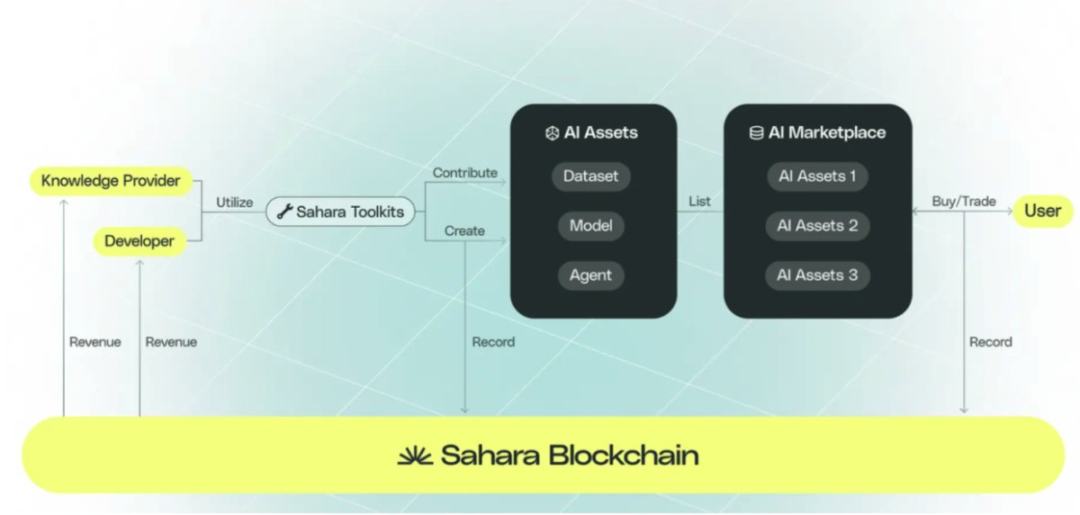
Sahara’s “permissionless copyright” mechanism ensures participant rights while enabling open circulation and reuse of AI assets—this is the foundational logic driving explosive ecosystem growth.
Why is this a scenario with long-term value support?
Imagine wanting to build an AI application—you naturally want your model to be more accurate and closer to real users than others’.
Sahara’s key advantage: it connects you to a vast, active data network—hundreds of thousands, soon millions, of annotators—who can continuously provide customized, high-quality data services, accelerating your model iteration.
More importantly, this isn’t a one-off transaction. Through Sahara, you gain access to a potential early-user community; these contributors may well become your product’s real users in the future.
This connection isn’t a single buyout. Sahara’s smart contract system and rights-verification mechanism enable long-term, traceable, and sustainable incentive structures.
No matter how many times data is reused, contributors receive ongoing revenue shares dynamically tied to usage.
But this extends beyond data labeling and model training. Sahara has built an economic system spanning the entire AI model lifecycle—calls, combinations, cross-chain reuse—all embedded with revenue-sharing mechanisms, allowing value capture over extended periods.
Model developers, optimizers, validators, compute providers—all can earn continuously at different stages, rather than relying solely on one-time sales or buyouts.
This creates a compounding effect for model reuse and cross-chain integration. A trained model becomes like a Lego block, repeatedly used and combined across applications—each use generating new income for original contributors.
For this reason, I share Sahara’s core belief: a truly healthy AI economy cannot be based on data extraction or model buyouts, nor should it allow only a few to reap all benefits. It must be open, collaborative, and win-win—where anyone can participate, every valuable contribution is recorded, and rewarded over time.
But the closer to real structure, the greater the challenges
While I’m bullish on Sahara, I won’t ignore the hurdles ahead due to my investment position.
One of Sahara’s architectural strengths is that it is not confined to any single chain or ecosystem.
From the start, its system was designed to be open, omnichain, and standardized: deployable on any EVM-compatible chain, and offering standard APIs that allow Web2 systems—be it e-commerce backends, enterprise SaaS, or mobile apps—to directly call Sahara’s model services and settle on-chain.
Yet despite this rare architectural design, there’s a core risk: infrastructure value doesn’t lie in “what it can do,” but in “who chooses to build on it.”
To become a trusted, adopted, composable AI protocol layer, Sahara’s success hinges on how ecosystem participants assess its technical maturity, stability, and future predictability. While the system is already built, whether it can attract numerous projects to adopt its standards remains uncertain.
Undeniably, Sahara has achieved key validation: serving top-tier enterprises like Microsoft, Snapchat, MIT, Motherson Group, and Amazon, providing data services and solving some of the industry’s toughest data challenges—early signals proving the system’s viability.
However, these partnerships primarily come from the Web2 world. What truly determines Sahara’s long-term success is the maturity and penetration rate of the broader Web3 AI sector. Sahara benefits from the macro trend of Web3 AI, but to fully unlock its infrastructural value, it still needs more native Web3 AI products and technical solutions to emerge and mature.
But remember, Sahara is currently the only player.
In the niche of blockchain infrastructure natively designed for AI, while imitators have proposed conceptual frameworks, only Sahara has achieved full implementation—from on-chain rights verification, off-chain execution, cross-chain invocation, technical closure, to real revenue and customer validation.
This grants Sahara a first-mover advantage, but also introduces structural risks: if successful, it could define the industry benchmark for Web3 × AI Infra; if it fails, it might lead the market to view AI Layer1 as premature.
Since Sahara is now the only option in this space, market scrutiny will naturally be harsher and more cautious—it must withstand the test of time and ecosystem adoption.

Finally, a message to all builders and observers: seize the window of construction, not regret after completion
For me, every primary investment decision boils down to three things: depth of understanding of the world, dimensionality of trend judgment, and confidence in the team’s resilience across cycles. Products and features are important, but often just manifestations of these deeper convictions.
Web3 isn’t short of ideas or stories—it lacks hands that turn logic into order, and people who truly know what to persist in and what to let go.
Can Sahara become a paradigm-shifting chain? I can’t guarantee it.
But it is currently the only attempt worth taking seriously, observing closely, and potentially backing.
If you wait until everything works smoothly, the ecosystem matures, and industry consensus forms—the opportunity will have passed you by.
So perhaps you should panic—not because you missed out, but because you’re standing right at the beginning of a system’s formation.
While others hesitate, waiting for clear market signals, you already know this system exists, its direction is clear, and its structure is taking shape—even if few truly understand it yet.
Most will rush in after it succeeds, but you—right now—are positioned at the moment the flywheel hasn’t spun up, and standards haven’t been set.
This isn’t a guaranteed opportunity, but it’s a real beginning.
Not everyone sees it—but you’ve already glimpsed something before consensus arrives.
Join TechFlow official community to stay tuned
Telegram:https://t.me/TechFlowDaily
X (Twitter):https://x.com/TechFlowPost
X (Twitter) EN:https://x.com/BlockFlow_News
 @jiayi_en