From Crypto Quant Giant to Infrastructure Recluse: Jump Crypto's Redemption-Driven Transformation
TechFlow Selected TechFlow Selected
From Crypto Quant Giant to Infrastructure Recluse: Jump Crypto's Redemption-Driven Transformation
Once a high-frequency trading giant at the forefront of the crypto scene, Jump Crypto has fallen silent and exited the stage amid a series of intense upheavals.
 Navigating Web3 tides with focused insights
Author: Nancy, PANews
Once a dominant high-frequency trading powerhouse at the center of the crypto storm, Jump Crypto has since retreated into silence amid a series of turbulent events. Now, this once-covert force behind on-chain liquidity is attempting a comeback to the forefront—rebranding itself as a "builder of cryptographic infrastructure."
Recently, Jump made a rare and high-profile announcement declaring a full transformation into a core driver of on-chain infrastructure. It also unusually disclosed its involvement in U.S. crypto policy advocacy, aiming to rebuild market trust in the new crypto cycle through technological innovation and regulatory collaboration.
Transitioning to Infrastructure Builder: First-Time Participation in U.S. Crypto Policy Advocacy
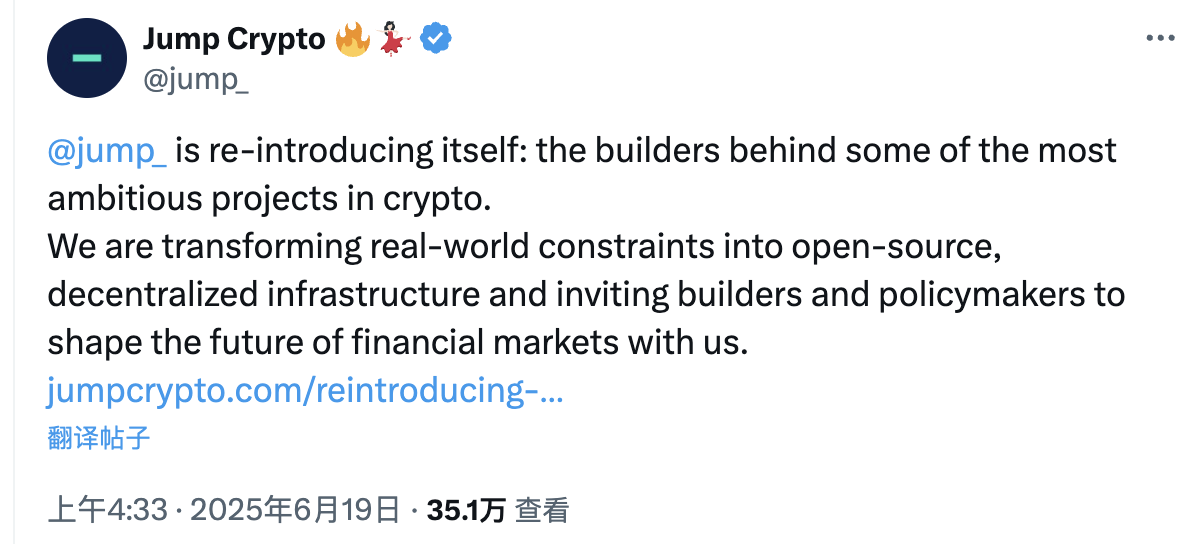
On June 20, after a long period of silence, Jump Crypto broke its quiet streak by officially reintroducing itself to the world as a "builder of crypto infrastructure." Widely regarded as one of the largest participants in crypto trading, the firm is transitioning from a behind-the-scenes trading giant into a key enabler of on-chain infrastructure.
In a public statement posted on its website, Jump Crypto reflected that although it had operated discreetly over recent years, it never stopped building. The team remained focused on identifying and overcoming core bottlenecks limiting performance and scalability in crypto systems. "We don’t sit in ivory towers talking about the future ten years from now; we go straight for the hardest bones to chew. History tells us: building begets more building," Jump wrote.
Jump emphasized its pivotal contributions to projects such as Pyth, Wormhole, Firedancer, and DoubleZero, noting that while these initiatives differ technically, they all originated from real-world technical constraints encountered during on-chain trading. It was precisely this "build-from-trading-pain-points" approach that enabled Jump to evolve from a liquidity provider into a critical driver of crypto infrastructure.
Nonetheless, Jump repeatedly stressed that despite being a core contributor across multiple infrastructure projects, it retains no controlling authority over any of these networks. "We firmly believe the essence of decentralization lies in no single entity holding unilateral control. Therefore, the protocols we build are not just open-source—they are fully open-sourced and freely forkable. In our view, decentralization can take many forms (validator sets, token governance, etc.), but the key criterion remains: does any party have the ability to unilaterally alter the protocol?"
Meanwhile, Jump has also invested in security-focused infrastructure. Its self-developed custodial wallet operations platform, Cordial Systems, provides enterprise-grade digital asset wallet solutions for both Jump and several centralized exchanges. Additionally, its internally incubated security team, Asymmetric Research, has helped mitigate over $5 billion in potential risks and handled more than 100 security incidents.
Notably, Jump’s recent public outreach isn’t merely about clarifying its role—it also marks its first-time proactive engagement in shaping regulatory policy. For decades, Jump’s parent company, Jump Trading, has stayed entirely out of public policy discussions. However, last month, Jump Crypto submitted a formal comment letter to the U.S. SEC—the first time in Jump Trading’s history that the firm has publicly voiced an opinion on public policy. In the letter, Jump shared its views on how U.S. securities laws should adapt to the digital asset era, calling for common-sense reforms to eliminate the widespread regulatory ambiguity and uncertainty felt across the industry.
"Now is the optimal window to rebuild financial infrastructure—and even the way organizations coordinate. It's not just technological maturity, but also shifting policies that have brought the industry to a critical turning point," Jump stated.
Rebounding After Multiple Crises Amid Warming U.S. Regulatory Climate
Jump Crypto was once the flagship arm of Wall Street quant legend Jump Trading’s expansion into the crypto world. But after being embroiled in controversies including the UST manipulation allegations, the FTX collapse, and the Wormhole hack, the high-frequency trading giant faced severe reputational damage and financial strain, prompting it to gradually withdraw from the spotlight.
Jump’s reputation crisis began in earnest with the 2022 Terra ecosystem collapse. According to filings by the U.S. SEC, Jump, through its wholly owned subsidiary Tai Mo Shan Limited, secretly entered into an agreement with Terraform Labs during UST’s first depeg event in May 2021. It deployed over $20 million of its own capital to quietly purchase UST in an attempt to artificially stabilize its $1 peg. In return, Jump secured discounted rights to a large allocation of LUNA tokens. This arrangement significantly amplified the illusion of UST’s self-correcting mechanism, misleading the public about the efficacy of its algorithmic design.
The SEC alleged that between January 2021 and May 2022, Jump effectively acted as an unregistered underwriter of LUNA tokens, illegally distributing securities within the U.S. market. Through low-cost purchases and high-price sales, Jump reportedly profited nearly $1.3 billion. Ultimately, in late 2024, Jump settled with the SEC for $123 million—exposing part of the hidden machinations of this once-mysterious trading giant in the depths of the crypto markets.
The crises did not end with Terra. In February 2022, Wormhole—a cross-chain bridge developed by Certus One, which Jump had previously acquired—was hacked, resulting in a loss of $325 million, making it one of the largest security breaches in the crypto industry at the time. To preserve the protocol’s usability and user confidence, Jump chose to cover the loss out of pocket, injecting $320 million to rescue the network. While this move salvaged short-term credibility, it severely strained Jump’s own balance sheet.
The FTX implosion further deepened Jump’s financial hole. As a major market maker and strategic partner to both FTX and its sister company Alameda Research, Jump was deeply involved in providing liquidity on their platforms. It also jointly held heavy positions in the Solana ecosystem, becoming one of the largest institutional players in Solana. However, when FTX collapsed, Solana’s price plummeted by over half and its ecosystem disintegrated overnight, worsening Jump’s already fragile financial position. According to Michael Lewis’ book *Going Infinite*, Jump lost as much as $206 million in the FTX crash, while its affiliate Tai Mo Shan lost over $75 million—totaling more than $300 million in combined losses.
Faced with consecutive setbacks, tightening U.S. regulations, and the onset of a crypto winter, Jump Crypto rapidly pulled back—cutting staff, scaling down venture investments, and strategically retreating from the U.S. market, gradually fading from public view in the crypto community. In the second half of 2024, Jump aggressively sold off major holdings including ETH, USDC, and USDT, fueling speculation that it was exiting the crypto space entirely.
It wasn't until March this year, as the U.S. regulatory landscape began to clarify, that signs emerged of this missing "whale" reactivating. According to CoinDesk, citing sources familiar with the matter, Jump is restoring its U.S. cryptocurrency operations to full capacity. While it continued digital asset trading and market-making activities globally, its U.S.-based crypto trading volume is now accelerating. Jump plans to hire a batch of crypto engineers and will soon begin filling roles focused on U.S. policy and government relations.
Notably, based on public data, Jump has restarted its crypto venture investment strategy this year. From January to now, it has participated in funding rounds for at least six crypto projects, including Humanity Protocol, Momentum, Securitize, and SOON—mostly infrastructure-focused ventures. This marks the first large-scale return to public investing since October 2024, underscoring Jump’s determination to execute its strategic pivot toward becoming an on-chain infrastructure builder.
Join TechFlow official community to stay tuned
Telegram:https://t.me/TechFlowDaily
X (Twitter):https://x.com/TechFlowPost
X (Twitter) EN:https://x.com/BlockFlow_News
 PANews