








TGE Countdown: The Optimal AI Solution Through Collective Intelligence — How Allora Becomes the AI Control Center?
TechFlow Selected TechFlow Selected
TGE Countdown: The Optimal AI Solution Through Collective Intelligence — How Allora Becomes the AI Control Center?
More efficient AI model collaboration, broader AI application scenarios.
 Navigating Web3 tides with focused insights
Author: TechFlow
Crypto AI is approaching the "Gartner Hype Cycle" development curve:
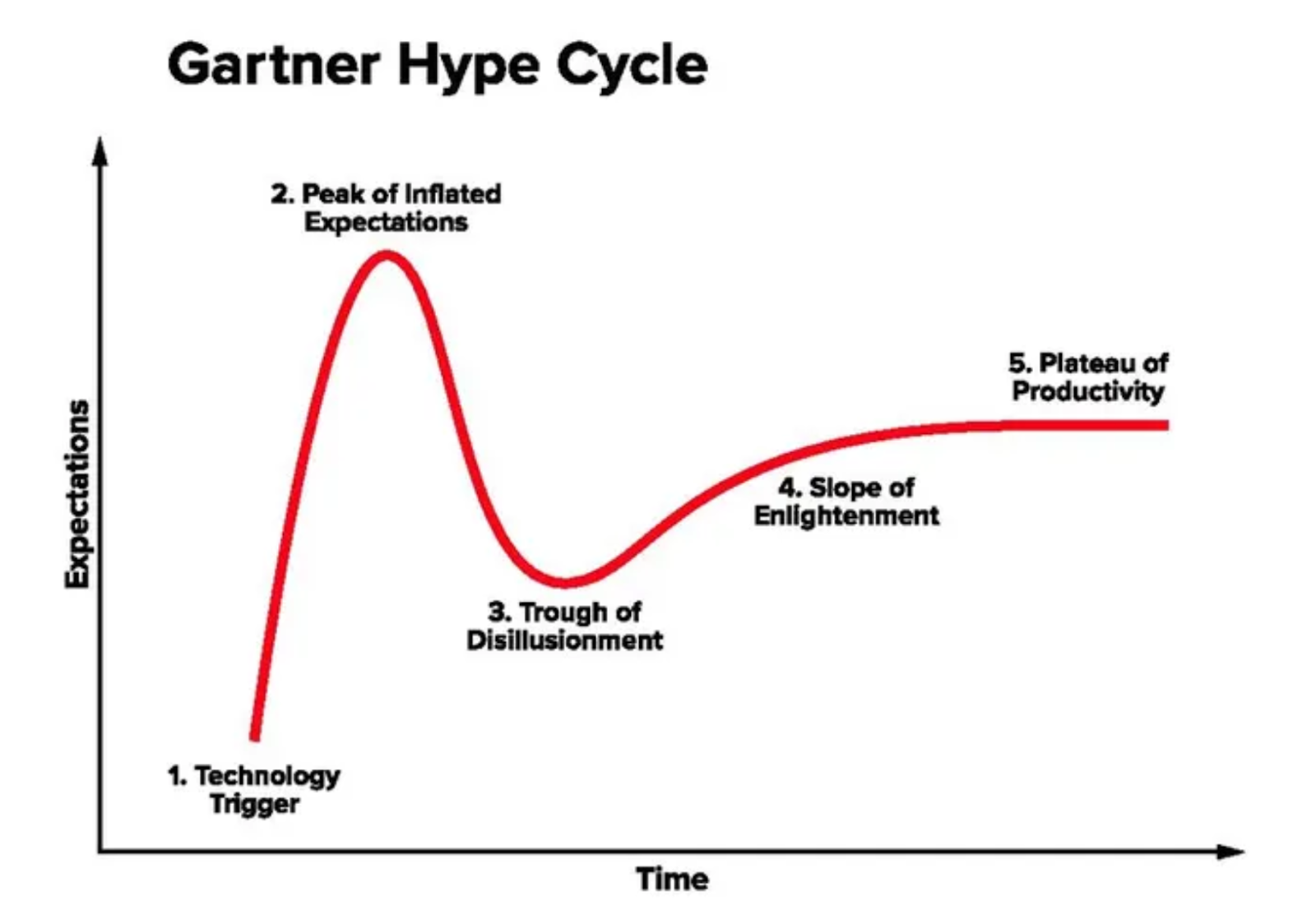
After ChatGPT burst onto the scene, the Crypto + AI innovation narrative quickly attracted massive attention. The emergence of GOAT further ignited market sentiment, and we collectively witnessed the AI Meme Summer of 2024, when Crypto + AI entered a peak-of-expectations phase dominated by conceptual speculation.
Subsequently, under the combined impact of factors such as TRUMP Meme, Deepseek, and tariffs, the AI Meme bubble burst prematurely. The market cap of Crypto + AI sharply retreated, pushing an overheated market into a brief period of "calm." However, the bursting of the bubble does not mean an end—it clears the stage for genuine value creators.
As Crypto + AI transitions into a pragmatic exploration phase focused on real-world applications, infrastructure projects committed to advancing Crypto AI toward its fifth stage—stable production—are emerging as long-term wealth opportunities after the AI Meme era. With mainnet launch and TGE approaching, Allora Network, a self-improving decentralized AI network, is drawing increasing public attention.
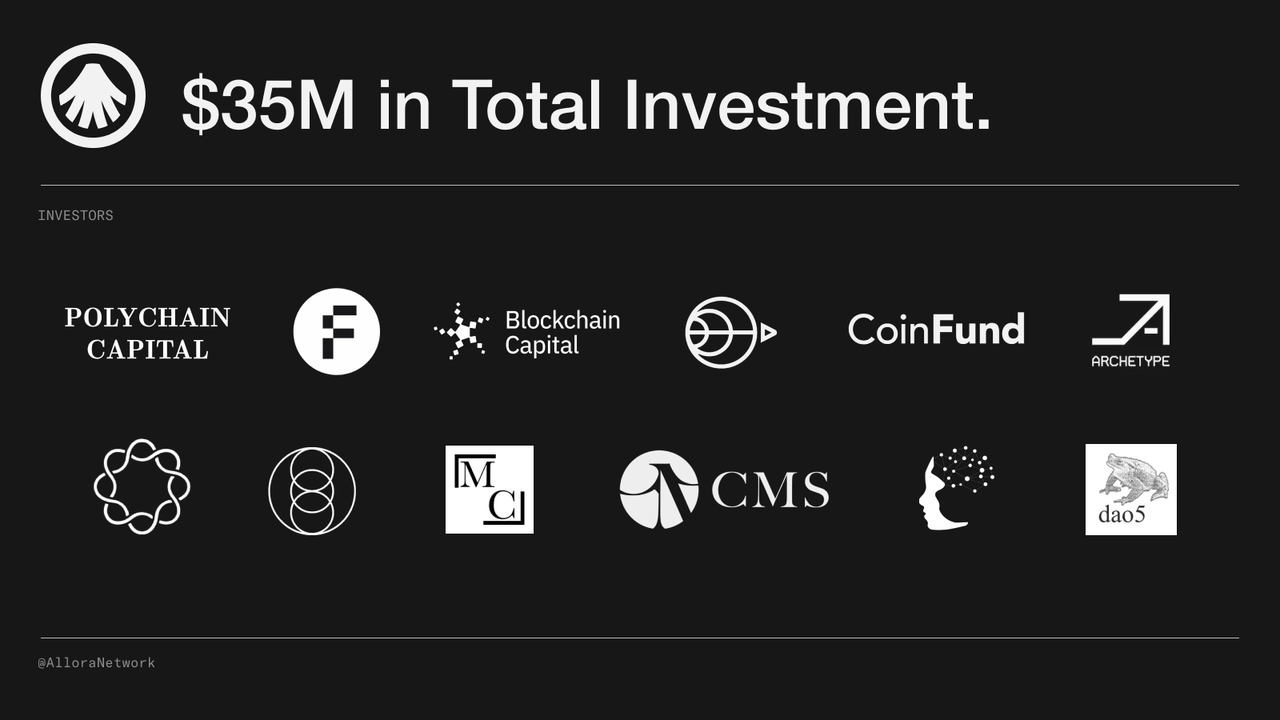
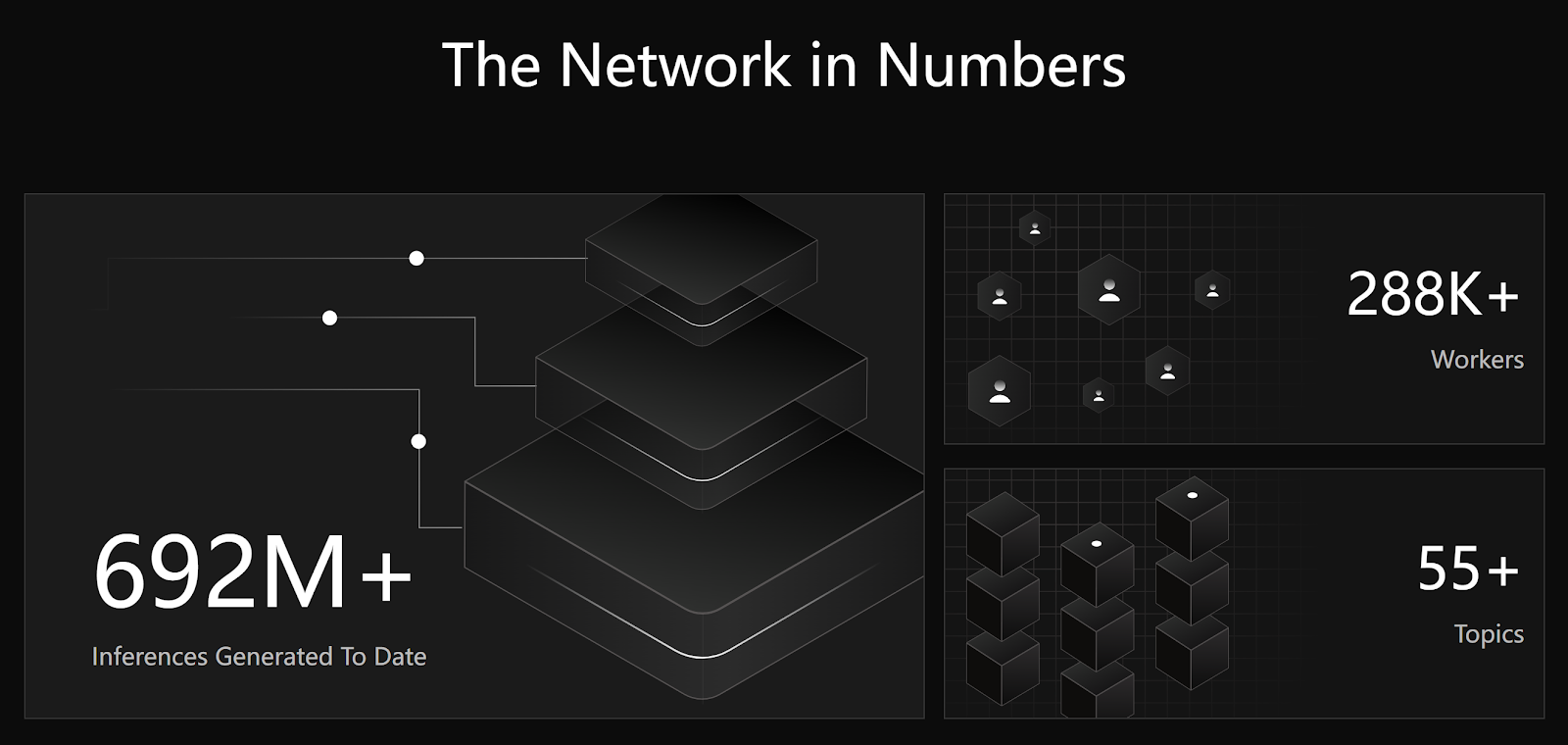
Raising $35 million in funding cumulatively, since Allora announced the launch of its mainnet beta version in February, its ecosystem has continuously expanded: not only has the number of Workers surpassed 288,000, generating over 690 million inferences to date, but its ecological reach has also extended into multiple domains including DeFAI, RWA, and GameFi, highlighting its growing importance as infrastructure enabling AI deployment across diverse scenarios.
What does “self-improvement” mean? It implies stronger reasoning and judgment capabilities, more efficient intelligent decision-making systems, and enhanced ability to serve complex scenarios. How does Allora achieve all this?
At this critical juncture just before the official mainnet launch, should Allora be on your radar—and how can you participate more effectively?
This article aims to find out.
More Efficient AI Model Collaboration, Broader AI Application Scenarios
The AI products we know—ChatGPT, Claude, or Gemini—all seem to relentlessly pursue universality, aiming to build an omniscient, all-capable AI that meets every user's needs and captures greater market share.
But developing AI in isolation is time-consuming, labor-intensive, and expensive—and no single AI model can do everything perfectly.
Compared to inference results from a single AI model, synthesized outcomes derived from collaboration among multiple AI models represent collective intelligence and clearly offer superior advantages:
Collaboration across different models avoids the biases inherent in individual outputs, yielding more comprehensive and accurate results. Cross-validation among multiple models reduces errors that might occur with any single model. When facing complex problems in intricate real-world scenarios, multi-model collaboration provides higher flexibility and adaptability, enabling better practical deployment of AI.
In short, closer AI collaboration leads to higher-level intelligence, which in turn enables broader application scenarios for AI.
Yet achieving efficient collaboration remains a significant challenge:
On one hand, different AI models often operate within isolated closed systems lacking a unified coordination mechanism. This siloed nature hinders efficient inter-model collaboration and limits AI’s full potential.
On the other hand, under current technological and commercial conditions, incentive mechanisms encouraging AI model collaboration remain immature. Creating win-win cooperation among diverse models is an urgent issue needing resolution.
At this pivotal moment when Crypto AI is transitioning from hype to value creation, how does Allora solve these pain points?
Empowering AI with Contextual Awareness: Optimal Inference Through Collective Intelligence
Dual Input Weighting System: Enabling Contextual Awareness for More Accurate Results
In simple terms, Allora doesn’t train any AI models itself—it acts as a coordinator between AI models.
For example, when a user requests a “weather forecast for tomorrow,” Allora functions like a central control panel, mobilizing specialized AI models focusing on temperature, wind speed, humidity, UV intensity, and other dimensions. It then aggregates their responses to deliver an optimized, crowd-sourced result to the user.
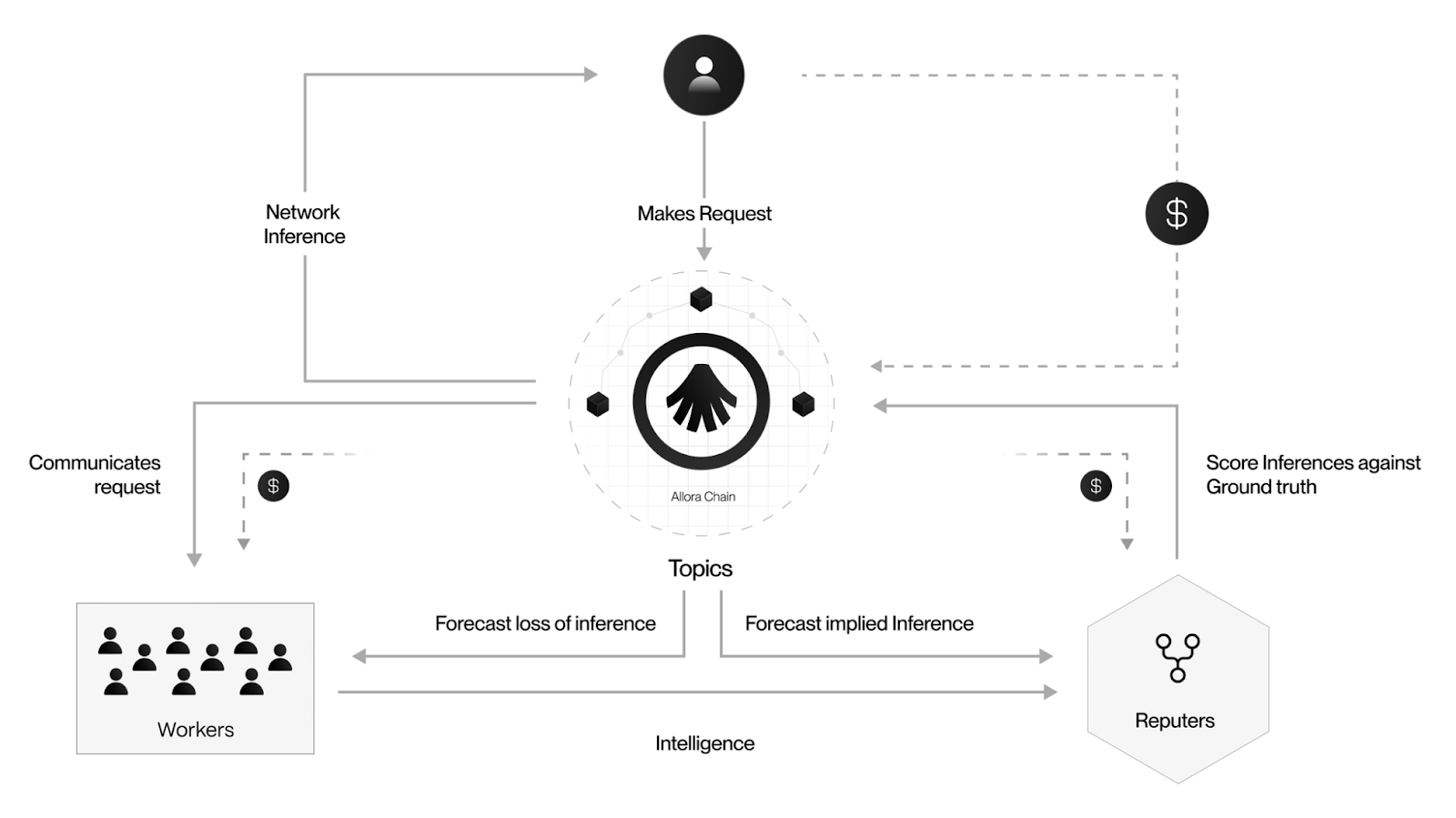
In this process, Allora Chain serves as the consensus layer—a platform enabling various users to participate in the network. Built on the Cosmos SDK using CometBFT and DPoS consensus mechanisms, it forms the foundational architecture.
To handle diverse inference demands, Allora categorizes them into Topics—for instance, one Topic could focus on predicting future asset prices, while another analyzes social sentiment. These Topics are managed by coordinators (Topic Coordinators), who play key roles as interaction hubs and task allocators.
There are three main participant types on Allora Chain:
-
Consumers
-
Workers
-
Reputers
Specifically:
When a consumer wants an inference result, they submit a request to the network and pay a fee;
Upon receiving the request, the coordinator either creates a new Topic or activates existing Topics to fulfill the task;
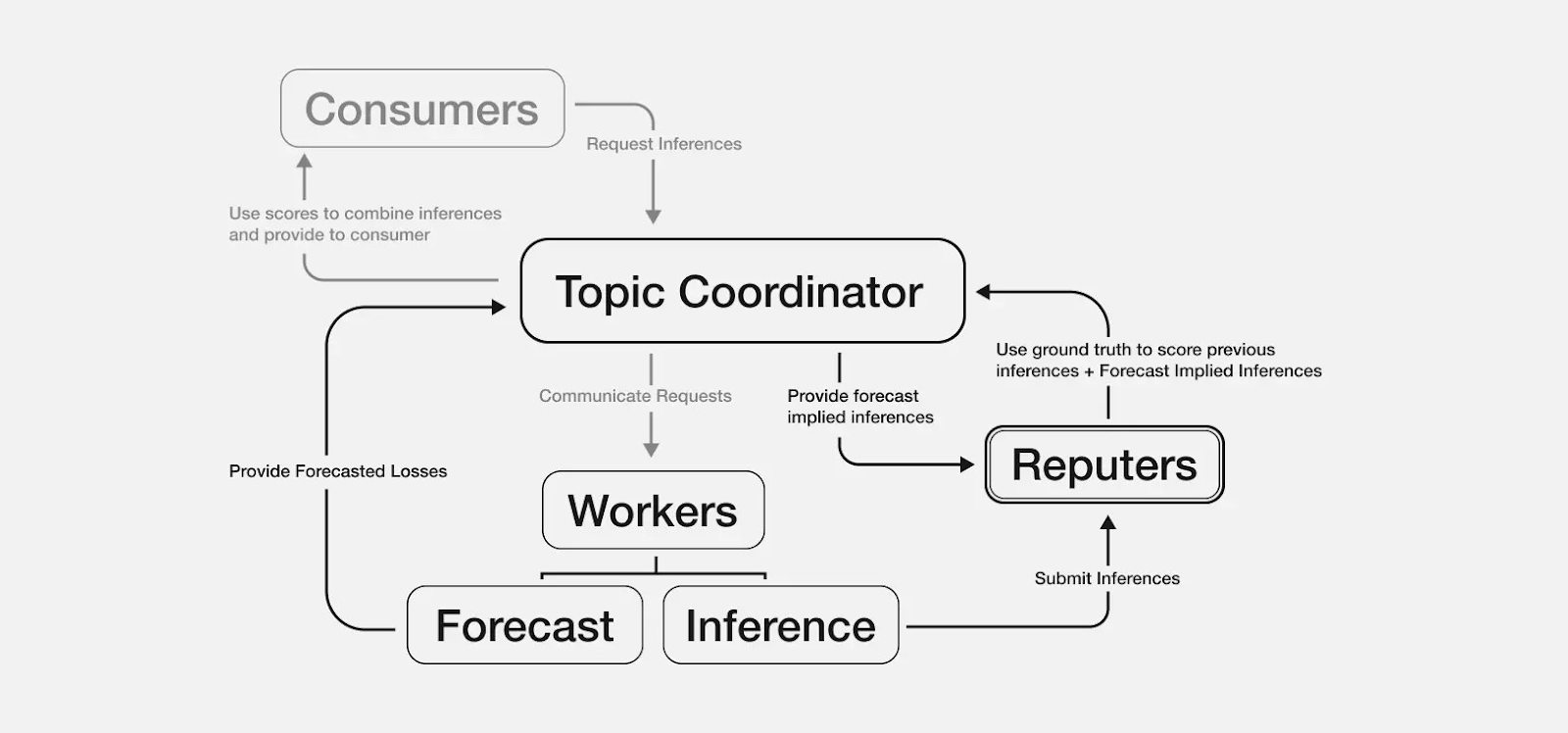
Workers must pay a fee to register for a Topic to become eligible participants. Here lies Allora’s first major innovation: after receiving a task, Workers must not only submit their own inference but also evaluate the accuracy of other Workers’ inferences. Simply put, Workers don’t just provide answers—they also predict how accurate others’ answers will be. This dual-input system establishes the foundation for contextual awareness.
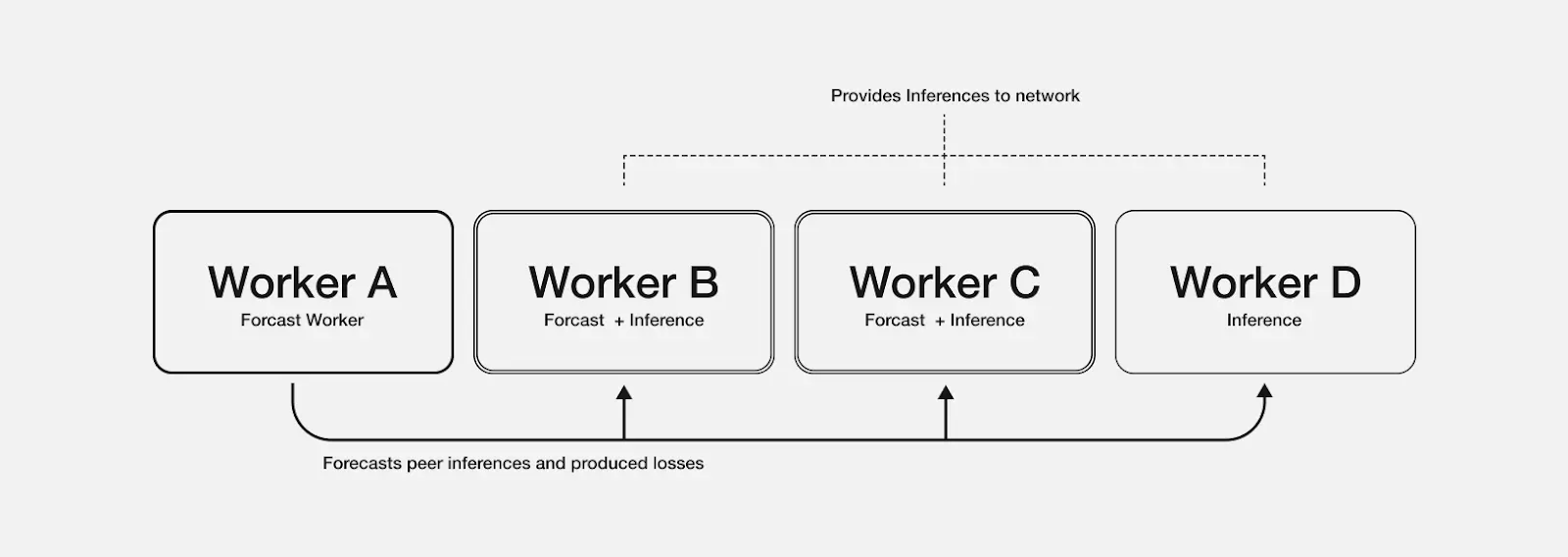
Based on these two inputs, the coordinator performs a weighted calculation according to each Worker’s weight, generating a context-aware composite output delivered back to the consumer.
Yes, you’ve likely noticed—different Workers have different weights. This is another key innovation in the Allora system:
Allora doesn’t simply average all Worker feedback. Instead, Reputers assess Workers in real-time. Workers who produce accurate inferences and correctly predict others’ accuracy receive higher rewards and increased weights.
Meanwhile, to ensure evaluation integrity, Reputers must pay a registration fee and stake additional tokens. If malicious behavior is detected, they face asset slashing penalties.
For example, consider a user requesting a “tomorrow’s weather forecast”:
Worker A has an average weather prediction accuracy of 90%, but their accuracy drops during summer.
Worker B has an average accuracy of 88%, but improves during summer.
If it’s currently summer, and multiple Workers predict “Worker A will have ~10% error” and “Worker B will have ~5% error,” Allora will assign Worker B a higher weight—even though Worker A has higher overall accuracy.
Thus, Allora dynamically adjusts prediction weights based on current environmental conditions rather than relying on static or historical data. This context-aware collective reasoning allows Allora to deliver fairer, more accurate, and adaptable outputs tailored to complex demands, laying the groundwork for its differentiated reward mechanism.
Differentiated Reward Mechanism: Empowering Every Ecosystem Participant
As Allora’s native token, $ALLO is the core of network incentives and serves multiple purposes:
-
Purchasing inference results: Consumers use $ALLO to pay for more accurate inference services. Allora adopts a flexible “Pay What You Want (PWYW)” model, allowing consumers to decide how much $ALLO they wish to pay per inference;
-
Paying participation fees: $ALLO is used to cover costs such as creating or registering Topics, facilitating deeper network engagement;
-
Staking: Reputers and network validators can stake $ALLO to earn staking rewards. Other token holders may delegate their tokens to Reputers or validators;
-
Reward distribution: The network uses $ALLO to reward contributors. Higher inference accuracy yields greater rewards for Workers. Reputers and validators earn rewards proportional to their stake and consensus contribution.
The differentiated reward mechanism, another Allora innovation, leverages the real-time adjustable weighting system to provide customized incentives for various participants, ensuring rewards go to those delivering higher-quality contributions and maintaining peak system performance.
Additionally, the Allora system calculates counterfactual values—assessing what would happen “if a particular Worker’s input were absent”—ensuring rewards align with actual information gain from each contribution.
Building Infrastructure for Multi-Scenario AI Deployment: From DeFAI and RWAFi to GameFi
Having discussed the product, let’s now turn to the ecosystem.
And regarding the ecosystem, Allora reveals remarkable breadth:
From the user perspective, Allora delivers higher-quality AI services;
From the developer standpoint, creators can build more powerful applications leveraging Allora’s decentralized, self-improving machine learning model network. Developers can deploy models on Allora to respond to user needs, earn rewards, tokenize model value, continuously enhance model capabilities, or integrate existing platforms with Allora to embed AI functionality into their apps.
Allora’s rapid cross-sector ecosystem expansion powerfully demonstrates this potential.
According to the official website’s ecosystem page, over 100+ projects have partnered with Allora, spanning DeFi, RWA, GameFi, public blockchains, and more—making its ecosystem increasingly rich and robust.
Among these partners are well-known Web2/Web3 projects such as Monad, Berachain, Story Protocol, 0xScope, Virtuals Protocol, Eliza OS, and Alibaba Cloud.
DeFAI is one of Allora’s most important ecosystem segments. Efficient collaboration between different AI models can synthesize on-chain trading data, social media sentiment, and macroeconomic indicators to enable more precise market trend forecasting, advanced risk management, optimized investment strategies, and smarter trade execution.
Several projects have already collaborated with Allora to explore DeFAI possibilities:
PancakeSwap announced the launch of an AI-powered prediction market on Arbitrum, supported by Allora’s AI price forecasts. Users can predict token price movements every 10 minutes;
Joule Finance integrated Allora’s advanced price prediction capabilities into its Move AI agent toolkit. These AI agents execute smart leveraged loops and yield optimization strategies, enhancing efficiency and intelligence within the DeFAI ecosystem;
Drift Protocol, in partnership with Allora and deploying jointly with RoboNet, introduced AI-driven looping strategies within its Agent framework. These strategies dynamically optimize returns, reduce risks, and adjust leverage based on predicted market conditions, aiming to deliver more efficient and intelligent DeFi solutions.
The Virtuals AI Agent Game development team announced a collaboration with Allora Network, enabling Virtuals developers to utilize Allora’s AI technology for AI Agent trading strategies.
Mind Network and Allora Network jointly launched FHE TrustPrice Index—the first privacy-preserving price oracle for DeFAI scenarios—ensuring input data confidentiality, verifiable processes, and tamper-proof outputs.
Moreover, Allora announced support for DeepSeek as an AI Agent to evaluate LLM trades, using Allora Network as the interaction platform for transaction management in Hyperliquid’s treasury, enabling more intelligent trading strategies.
Beyond DeFAI, Allora’s self-improving decentralized AI network strongly empowers the RWAFi sector:
The core of RWAFi lies in digitizing and financializing real-world assets, where accurate asset valuation and pricing are crucial. Multi-AI model collaboration significantly enhances these capabilities.
Toward this end, Allora announced a partnership with Plume, a leading project in the RWAFi space, integrating Allora’s collective intelligence network into Plume’s ecosystem. This integration provides advanced AI-driven insights for RWA valuation, pricing, and risk management for projects built on Plume. Future collaboration directions include real-time AI-driven valuation models for multiple asset classes, advanced APY predictions using AI oversampling techniques, dynamic risk management systems with adaptive thresholds, and intelligent liquidity optimization strategies.
In the GameFi sector, Allora also performs impressively:
Multi-AI model collaboration can significantly elevate the intelligence level of GameFi platforms, offering players more personalized gaming experiences. At the same time, through collaborative AI modeling, features such as dynamic economic balance, asset valuation and dynamic pricing, yield optimization, and distribution can be achieved, further strengthening the stability and security of GameFi economic systems.
Allora’s collaboration with Japanese digital entertainment company Gumi exemplifies this well. Together, they aim to explore how decentralized AI can reshape the future of gaming, with future cooperation focusing on AI-driven game reasoning, intelligent in-game agents, and AI-powered anti-cheat systems.
Viewing Allora’s application scenarios within the broader AI narrative, one realizes that its self-improving decentralized AI network equips Allora with strong capabilities as AI infrastructure, driving AI adoption across multiple application areas.
Theoretically speaking, more accurate inference leads to smarter AI, enhancing service capabilities in complex environments. Wherever there is demand for more efficient collaboration, more precise inference, or higher-quality AI services, Allora can deliver.
As Allora continues to strengthen its ecosystem, welcoming more partners, its footprint will expand into sectors like DeFi, social, healthcare, and beyond—further solidifying Allora’s role as essential infrastructure advancing Crypto AI.
TGE and Mainnet Milestones Approaching: How to Participate in Allora More Effectively?
Various developments indicate that Allora stands at the threshold of mainnet launch and TGE:
January 10, 2025: The Allora Foundation was established and launched its official X account, signaling TGE;
January 17, 2025: Allora announced the Forge Engineering Competition, during which ML engineers competed over one month to build models predicting 12-hour ETH/USD volatility, 12-hour ETH/USDC trading volume, and 5-minute ETH/USD prices—aimed at selecting top AI model creators ahead of mainnet launch;
February 2025: Allora launched its mainnet beta version, explicitly stating it would be the final version before full mainnet release;
Meanwhile, the rapidly growing number of Workers and high-profile node partners underscore Allora’s solid preparations for mainnet launch: As reported, Allora currently hosts over 55 Topics and more than 288,000 Workers. Major entities including Bahrain telecom operator stc Bahrain and Exaion, a subsidiary of energy giant EDF Group, have joined Allora’s node program.
At this crucial moment, how can one participate in Allora more effectively?
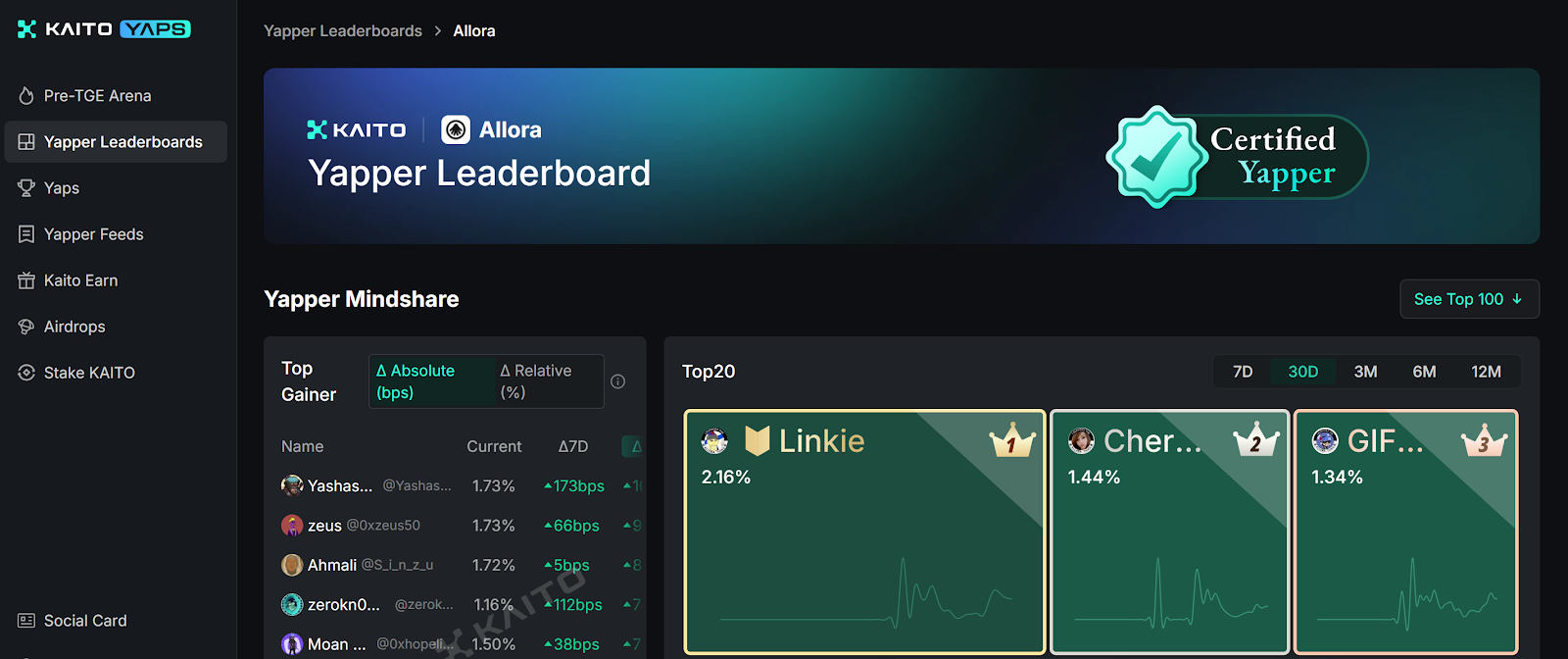
Currently, the most talked-about initiative is Allora’s ongoing Kaito campaign.
As early as March 20, Kaito announced that Allora was selected as the next pre-TGE project from Yapper Launchpad.
The Allora Yapper leaderboard is now live: users can boost their rankings by posting high-quality content and engaging with KOLs in comments. This serves as a key method for the project to identify core influencers and supporters—top-ranked users are highly likely to receive future airdrop rewards.
Besides the Kaito campaign, point-earning activities are the most important way for users to accumulate airdrop eligibility.
According to official documentation, users can earn points via both on-chain and off-chain activities.
On-chain activities include:
-
Creating Topics: Identifying and defining specific problems or interest areas within the network, attracting others to develop and provide solutions.
-
Introducing Machine Learning Models: Adding ML models to the network for others to use.
-
Using Allora-Supported Applications: Engaging with apps and services powered by Allora’s machine intelligence.
Off-chain activities include:
-
Community Engagement: Following Allora on Twitter, joining Discord and Telegram groups.
-
Participating in Community Events: Joining curated community events and initiatives to support the Allora network.
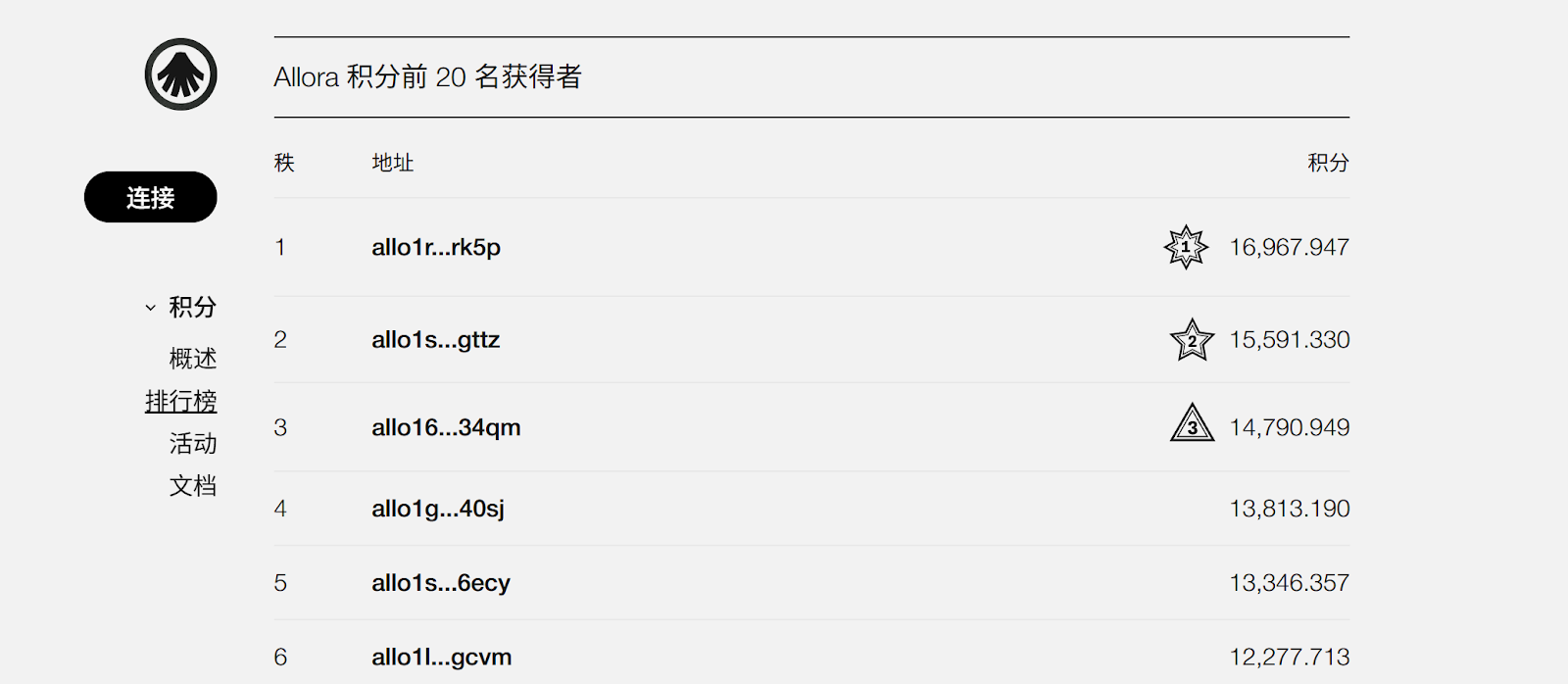
Users can log in to the Allora Points Program page, connect their wallets, complete tasks, and check their point standings on the leaderboard.
Although Allora hasn't explicitly stated that points guarantee airdrops, the official point description hints at “exciting rewards waiting for our most active contributors.” By unspoken agreement, this may represent the final opportunity to participate before TGE.
In addition, Allora recently launched the Allora Agent Accelerator Program targeting developers:
This program brings together a select group of Agent teams—some applying from the community, others nominated by the foundation. Selected Agents undergo multidimensional evaluations, including on-chain performance, user interaction and usage, integration quality with Allora, and overall value. To ensure fairness, a snapshot of all participating Agents is taken on day one, establishing a baseline so all projects have equal opportunity to demonstrate their worth during the accelerator.
Allora releases a real-time leaderboard weekly, highlighting top-performing Agents, with higher performers earning more points.
During the program: Projects receive technical support, product guidance, and community exposure from the Allora ecosystem, helping attract users, partners, and investors. Additionally, Allora publishes weekly leaderboards showcasing standout Agents, with better performance translating to higher points. After the program concludes, the top-performing Agents will receive ALLO token grants.
Lasting six weeks, the program aims to discover, refine, and amplify intelligent Agents demonstrating significant effectiveness and deep integration within the Allora network, building a talent and product pipeline for sustained ecosystem growth.
Conclusion
Following the trajectory of the "Gartner Hype Cycle," we stand at a pivotal moment when Crypto AI is shifting from noise to rationality, poised for explosive growth built on solid foundations.
As a self-improving decentralized AI network, Allora boasts not only deep technical expertise—achieving more accurate inference through multi-AI model collaboration—but also impressive progress in ecosystem development. Its strong performance across DeFAI, RWAFi, and GameFi showcases its powerful capability as AI infrastructure driving practical Crypto AI applications. As more users and developers join the ecosystem, will Allora truly evolve into an AI command center, harnessing collective intelligence to unleash a wave of AI utility?
As Crypto AI continues its recovery and with TGE and mainnet launch on the horizon, let’s watch closely how Allora performs in this next wave of the AI revolution.
Join TechFlow official community to stay tuned
Telegram:https://t.me/TechFlowDaily
X (Twitter):https://x.com/TechFlowPost
X (Twitter) EN:https://x.com/BlockFlow_News
 深潮TechFlow


