TechFlow Even such a niche AI sector overseas managed to raise $100 million
TechFlow Selected TechFlow Selected
TechFlow Even such a niche AI sector overseas managed to raise $100 million
Laurel is using AI to address a multi-trillion-dollar industry pain point: making knowledge workers' time visible, measurable, and optimizable.
 Navigating Web3 tides with focused insights
By Leo, Deep Circle
Have you ever wondered why manufacturing can calculate the cost of producing a car down to the minute, and retail can precisely track every item in inventory, yet law firms, accounting firms, and consulting companies remain clueless about their most critical resource—their people’s time? This question puzzled me for a long time—until I learned about Laurel's recent $100 million Series C funding. The company is using AI to solve a multi-trillion-dollar industry pain point: making knowledge workers’ time visible, measurable, and optimizable.
After digging deeper, I realized Laurel isn’t just doing simple time tracking. They’re building the world’s first AI-powered time platform, aiming to solve what founder Ryan Alshak calls the “time intelligence challenge”—the inability of knowledge-based industries to accurately link time investment with business outcomes. In the age of AI, quantifying and understanding human capital has shifted from a “nice-to-have” to a mission-critical business imperative. This round was led by IVP, with participation from GV (Google Ventures) and 01A. New investors include DST Global, Kevin Weil from OpenAI, Alexis Ohanian, and GitHub CTO Vladimir Fedorov.
The Pain and Awakening of Six-Minute Billing
The root of the problem traces back to decades-old workflows in professional services. Lawyers, accountants, and consultants are required to log their work in six-minute increments so clients can be billed hourly. Ryan Alshak experienced this firsthand as a lawyer: “It’s like being a chef on a busy Saturday night trying to cook for 500 guests while simultaneously documenting every ingredient used—a workflow that’s both distracting and dehumanizing.”
I understand the frustration. Imagine finishing a complex legal analysis at peak mental clarity, only to have to pause and reconstruct: How long did research take? How many minutes writing that memo? What was discussed in the client call? These forced interruptions don’t just hurt efficiency—they make professionals feel monitored like factory laborers, not valued experts delivering intellectual services.
Alshak’s epiphany was simple: “Why should I have to tell the machine what I did, instead of letting the machine tell me?” Behind this seemingly basic question lies a counterintuitive insight: lawyers, accountants, and consultants often underbill because they forget work they’ve already completed. If a solution can increase profits for employers while saving time for users, that’s the perfect foundation for a company.
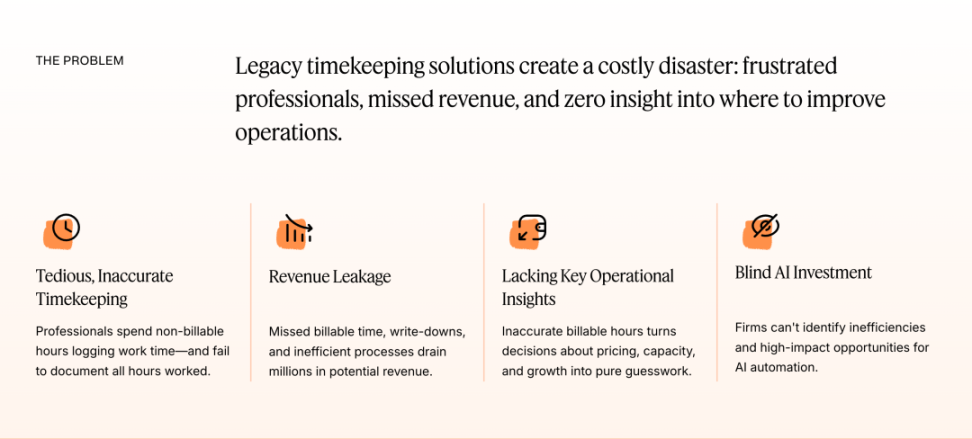
This pain is far more widespread than I imagined. According to Laurel’s data, professionals recover an average of over 28 billable minutes per day—time previously lost due to logging gaps. At an average billing rate of $375/hour, that translates into $175 in additional daily revenue per professional. For large firms with hundreds of employees, the financial impact is staggering.
Four Keys to AI Redefining Time Tracking
Laurel’s solution sounds straightforward, but executing it is an extremely complex technical challenge. I discovered that achieving true end-to-end timesheet automation requires solving four key technical hurdles, each with a high barrier to entry.
The first challenge is digital footprint tracking. Laurel must integrate with every digital tool professionals use—Slack, Microsoft Outlook, Zoom, and others. Only when AI can “see” all work activities across platforms can it accurately reconstruct work patterns. It’s like installing an omnipresent yet invisible monitoring system across a user’s digital workspace, capturing every click, document edit, and phone call.
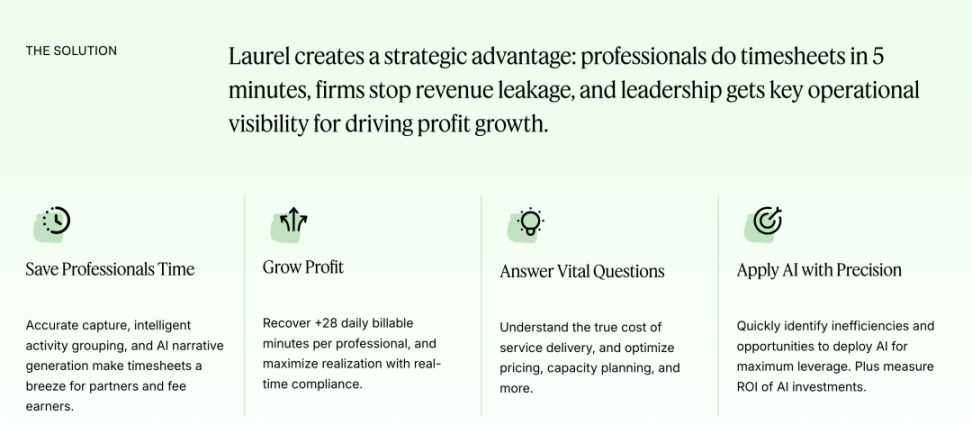
The second layer involves deep integration of AI applications. Laurel uses multiple AI technologies: clustering algorithms group related tasks, machine learning assigns work to clients and projects, generative AI drafts descriptions, and further ML models classify and code activities. This isn’t simply plugging in ChatGPT—it’s building a specialized AI system optimized for professional service workflows.
The third component is the delicate balance of human-AI collaboration. The system generates a draft timesheet, which users can edit, add to, or delete from. This “human-in-the-loop” design ensures accuracy while enabling continuous learning. Every user interaction makes the system smarter—an upward spiral of improvement.
The fourth step is seamless integration with existing billing systems. Once users approve the timesheet, data flows automatically into the firm’s billing software, preserving backend operations. This transforms the professional’s experience from “filling out timesheets” to “reviewing timesheets,” dramatically reducing psychological burden.
The elegance lies in not forcing behavior change. The system works silently in the background, requiring only final confirmation. This reflects profound product thinking: the best technology is invisible—it simplifies complexity without adding new cognitive load.
From Legal Tech Failure to AI Pioneer
Laurel’s success wasn’t immediate. In fact, the company underwent a complete rebirth. Founded in 2016 as “Time by Ping,” it struggled for years. Alshak candidly admits two core issues: over-focusing on the narrow legal market and immature NLP technology at the time.
The turning point came in 2022, when Alshak gained early access to OpenAI’s GPT-3. He made a bold decision: halt everything and rebuild the product from scratch. This is exceptionally rare in startups—most advice says “never rebuild, iterate continuously.” But Alshak defied conventional wisdom, demonstrating true entrepreneurial courage: willingness to take massive risks for a larger vision.
When ChatGPT launched in November 2022, market perception of AI transformed overnight. As Alshak puts it: “I went from being seen as crazy to having companies calling me for help.” This dramatic shift fueled explosive growth—$0 to $26 million in contract value within 24 months.

Rebranding to Laurel wasn’t just cosmetic—it reflected a full reset of company culture and values. The name itself is meaningful: Alshak wanted something timeless, not typical startup-sounding—something that could fit in 1600, 2000, or 4000 AD. “Laurel” symbolized achievement in ancient Greece, in poetry and sports. He wants people to feel proud—not anxious or ashamed—when reviewing their time logs.
This rebirth story deeply resonates. It shows that in fast-moving tech environments, sometimes the bravest move isn’t persistence, but admitting failure and changing direction entirely. Laurel proves real innovation often demands the courage to tear things down and start over.
Why Now Is the Perfect Moment for AI Time Management
I’ve been reflecting on why Laurel is succeeding now. I believe it’s the convergence of three forces: technological maturity, market readiness, and business urgency.
Technological breakthroughs are foundational. Over the past few years, large language models have reached the capability to understand complex work contexts—not just language, but the ability to decompose high-level intent into executable steps. When I say “prepare due diligence checklist for ABC’s M&A deal,” the AI must grasp relevant legal domains, document types, estimated effort, etc. This granular understanding was impossible just years ago.
Market education is equally crucial. ChatGPT’s mass adoption has made even conservative professional firms open to AI. Interestingly, when Alshak pitched AI to law firms in 2018–2019, they’d say, “We’re not sure cloud computing is the future, let alone AI.” Today, those same firms call him asking how to deploy AI. This mindset shift created an unprecedented opportunity window for companies like Laurel.
Business urgency stems from economic conditions. In tighter markets, professional firms face intense pressure to improve efficiency. Clients no longer pay for inefficiency. Fixed-fee pricing is rising, demanding precise cost visibility. As IVP’s Ajay Vashee notes: “When you’re selling money in a downturn, you cut through the noise.” Laurel isn’t selling features—it’s selling tangible profit growth, compelling in any economy.
Another overlooked factor: the need to measure AI ROI. Companies plan to spend over $1 trillion on AI in the next five years, but measuring its impact remains a black box. Most rely on surveys or usage metrics—poor proxies. Laurel’s time data platform offers quantifiable, verifiable measurement of AI effectiveness—extremely valuable for enterprises needing to justify AI investments to stakeholders.
This confluence of factors created ideal conditions for Laurel’s rapid rise. Data shows 300% year-over-year growth in annual recurring revenue, 500% increase in usage, and partnerships with over 100 top-tier legal, accounting, and consulting firms across the U.S., U.K., EU, Australia, and Canada. These numbers reflect an industry-wide awakening under transformative pressure.
The Deeper Value Behind Customer Success Stories
I believe the strongest product validation comes from real customer feedback—and Laurel delivers impressively here. According to investor IVP, it’s the only company they’ve evaluated where every single client gave a perfect 10/10 satisfaction score. But I’m more interested in the stories behind these numbers.
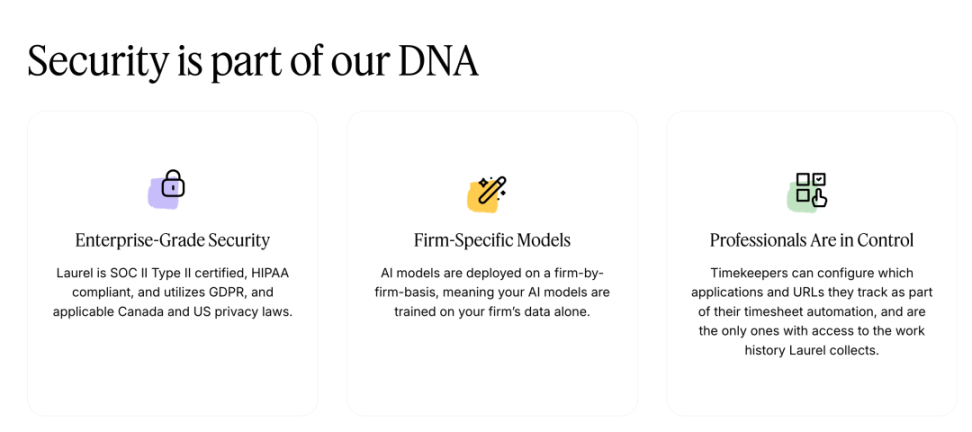
Ernst & Young partner and Tax Transformation Lead Matt Newnes shared a powerful insight: “I’ve personally experienced how Laurel transforms our approach to time intelligence. The manual process of logging and entering time has become highly technologized. Laurel not only helps our people record time more completely, but also gives us deeper insights into how teams work—enabling us to identify best practices and ensure superior client outcomes. It’s proven one of our most impactful AI investments.”
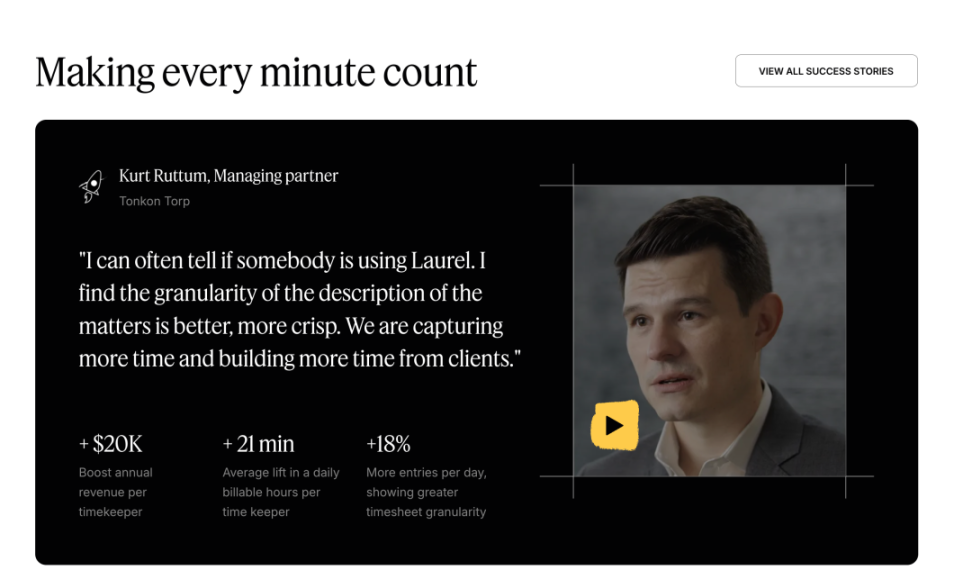
This highlights a deeper truth: time tracking’s value isn’t just accurate billing, but insight into work patterns. When companies can clearly see the difference between high- and low-efficiency work, they can standardize best practices and elevate team performance. This organizational learning may be more valuable than direct revenue gains.
David Cunningham, Reed Smith’s Chief Innovation Officer, adds: “As law firms evaluate AI and fixed fees, gaining fine-grained intelligence with less effort is critical to redefining value—both internally and for clients.” Key phrase: “fine-grained intelligence”—not crude time stats, but strategic, decision-driving insights.
Tom Barry, Managing Partner at accounting firm GHJ, said something striking: “Do you know how much business intelligence we gain from this platform? We’re playing the long game now. This isn’t just a time-tracking tool.” This shift—from tool to platform thinking—is, I believe, Laurel’s true competitive edge.
Financially, customers report 4–11% profit growth, driven by 28 extra billable minutes per professional per day and 1–4% higher realization rates. These figures have been independently audited by Big Four accounting firms. More importantly, professionals save 80% of the time previously spent on manual time entry—freeing them to focus on high-value work like business development, relationship management, and strategic thinking.
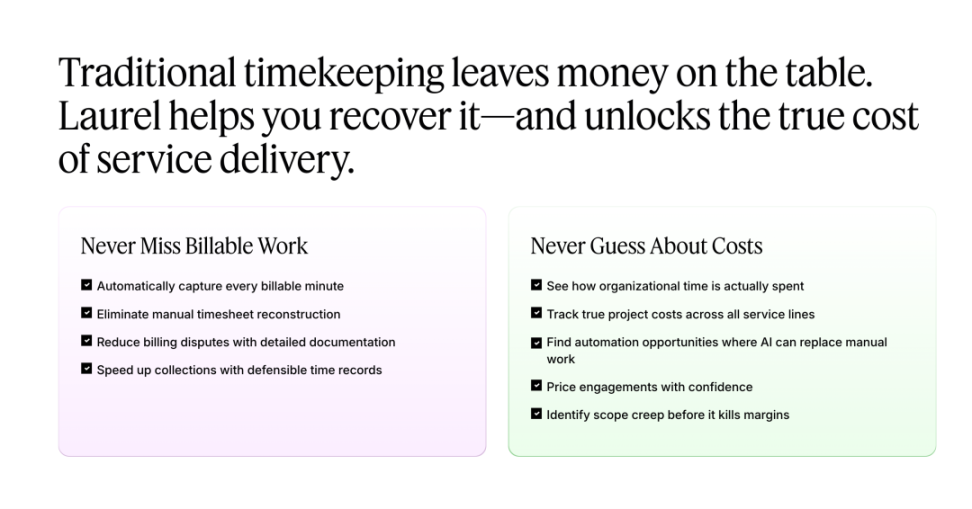
These case studies reveal a bigger picture: Laurel isn’t just fixing time tracking—it’s redefining how professional services work. When time becomes visible and optimizable, the entire industry’s efficiency and value creation potential rises fundamentally.
A Three-Stage Vision: From Time Tracking to Time Intelligence
Studying Laurel, I discovered Alshak’s clear three-stage strategic vision—a level of long-term thinking that impressed me deeply. This isn’t just a product roadmap; it’s a profound reflection on the future of knowledge work.
Stage One: Prove machines can record time more effectively and accurately than humans. The key here is targeting the right market—industries where time tracking directly impacts revenue, like law, accounting, and consulting. These sectors have established workflows, high execution pressure (no time tracking = job loss), and clear ROI once automation is achieved. That’s why Laurel started with professional services, not all knowledge workers.
Stage Two: Use machine-generated time data to help these industries move from hourly billing to outcome-based pricing. Alshak quotes Charlie Munger: “Show me the incentive, and I’ll show you the behavior.” He believes we can redesign incentives for industries representing 20% of U.S. GDP—shifting from activity-driven to results-driven models. This transformation could redefine the entire business model of professional services.
Stage Three: Even in an outcome-based world, people still need to understand time investment to ask: “Am I spending time on high-leverage activities?” The goal here is expanding time data’s value across all organizations, helping every knowledge worker understand and optimize their time allocation.
The core statistic is thought-provoking: the average knowledge worker spends 9 hours a day working, but only 3 hours creating leveraged value. That means 6 hours are wasted—3 hours on tasks that should be done by AI agents, and another 3 on tasks that no one should do. Globally, this amounts to 6.4 billion years of human time wasted on obsolete tasks. That’s Laurel’s opportunity space.
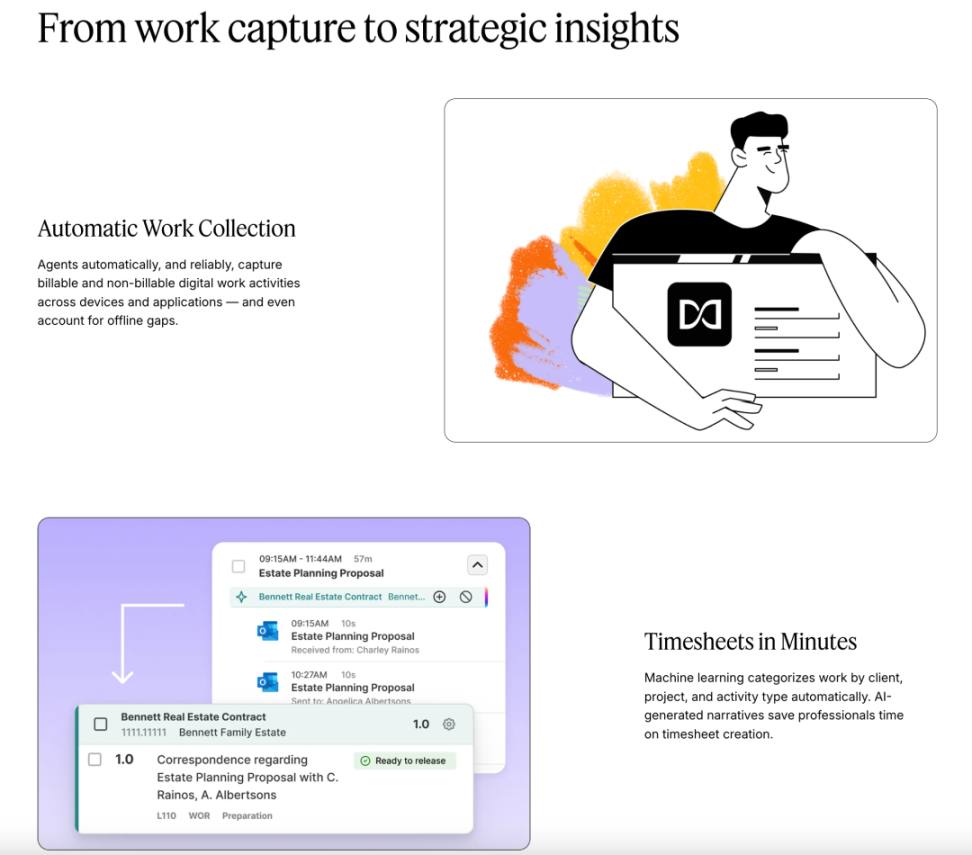
This thinking is enlightening. Many startups solve existing problems, but Laurel is building infrastructure for future possibilities. Time data isn’t just for better billing—it’s the foundation for understanding and optimizing human work. In the AI era, this understanding is even more vital, as we must determine which tasks belong to machines and which require uniquely human value.
Supply Chain Revolution for Professional Services in the AI Era
In my deep dive into Laurel, I found a fascinating analogy: they’re essentially building “supply chain visibility” for knowledge work. This concept reshaped my view of the entire industry.
Alshak makes a compelling point: “No one has truly mapped time input to output results. Industries like law and accounting excel at understanding inputs (time), but struggle to price value. On the other hand, consulting and financial services understand value but are blind to actual costs.” This cognitive gap was solved in other industries long ago—but in knowledge work, which represents over 50% of global GDP, the supply chain has never been revealed.
This reminds me of manufacturing’s evolution. Toyota’s lean production revolutionized manufacturing by making waste and inefficiency visible at every stage. Yet in knowledge work, we’re still pre-industrial: vast “inventory” (backlogged tasks), “wait times” (unproductive meetings), and “defects” (rework) remain hidden, unmeasured, and unoptimized.
Laurel’s time intelligence platform is creating the first real “supply chain management system” for knowledge work. It doesn’t just track time—it analyzes workflows, identifies bottlenecks, forecasts resource needs, and suggests optimizations. This capability is especially crucial in the age of AI, where companies need to measure AI tools’ true ROI, not rely on vague satisfaction scores.
I believe this supply chain mindset will have far-reaching implications. When professional firms start managing knowledge work like manufacturing lines, they’ll be able to: accurately predict project costs and timelines, identify which tasks are ripe for automation, optimize team composition and task assignment, and monitor project health in real time.
This also explains how Laurel delivers 4–11% profit growth. It’s not just more accurate time tracking—it’s systemic efficiency gains through supply chain optimization. When you can see the entire “production process” of knowledge work, optimization opportunities become obvious.
From an investment standpoint, the market opportunity is enormous. As IVP’s Ajay Vashee notes: “Professional services represent trillions in global economic activity, yet operate without basic visibility into their core resource—time. By solving the time intelligence challenge, Laurel creates a platform for broader AI transformation.” This isn’t just software—it’s foundational infrastructure for the industry’s digital evolution.
The Founder’s Time Philosophy and Mission-Driven Vision
Learning about Alshak’s personal journey gave me deeper insight into Laurel’s mission. This isn’t just a business—it’s a mission rooted in personal experience.
Alshak often contemplates mortality—a heavy topic, but one that shaped Laurel’s core philosophy. The company’s AI chat interface is even named “Mori,” a nod to the Latin phrase “memento mori” (“remember you must die”). This isn’t morbid—it’s a reminder to cherish every minute.
Most moving is Alshak’s story about his mother. Laurel’s founding coincided with her passing—she died of cancer weeks after the company’s seed round in 2018. “In her final moments,” he says, “one minute with her was worth a million minutes doing anything else. I realized I wasn’t building a time-tracking company—I was building one to help people answer: ‘Am I spending my time the way I want to?’”
This personal mission became the company’s core value. Alshak wants to be the world’s “mirror,” teaching a fundamental lesson: “We care so deeply about our money, yet treat our time so casually. That’s a complete inversion.” He chooses to live as if he has 78 years, 4,000 weeks—making every minute count.
This time philosophy deeply influences product design. The Greek wordplay is telling: Alshak notes Greek has two words for time—“chronos” (clock time) and “kairos” (meaningful, qualitative time). Laurel tracks more than chronos; it helps people optimize kairos—feeling fulfilled in meaningful work, not drained by meaningless tasks.
This mission-driven approach also shapes the long-term vision. Alshak hopes Laurel will help eliminate the concept of “9-to-5, Monday-to-Friday” from English vocabulary. He envisions a future where people work 3–4 hours daily but create 2–3x more value. This isn’t utopian fantasy—it’s a plausible outcome of AI advancement.
I believe this mission is Laurel’s real competitive advantage. In an increasingly homogenized tech landscape, true differentiation often comes from a founder’s deep motivation and values. When your company exists not just to make money, but to solve a problem you deeply care about, that passion permeates every aspect—product, team, and customer experience.
Redefining the Future of Work and Value Creation
Throughout my research, I kept asking: what does this time intelligence revolution mean for society? I believe we’re on the brink of a fundamental shift in how we work.
Historically, every major technological revolution redefined work. The Industrial Revolution moved us from agriculture to manufacturing; the Information Revolution birthed knowledge work. Now, the AI Revolution is redefining what constitutes valuable human work. Laurel’s data insights will help us navigate this transition: what should be automated, and what requires uniquely human skills.
The future of work might look like this: professionals no longer spend time on repetitive tasks—drafting standard contracts, compiling financial reports, or preparing routine summaries. Instead, they focus on high-value work requiring creativity, emotional intelligence, and strategic judgment. AI handles information gathering and initial analysis; humans focus on interpretation, decision-making, and relationship-building.
This shift will transform professional service business models. Fixed-fee pricing will replace hourly billing as clients prioritize outcomes over process. Laurel’s time data will help firms accurately predict project costs, allowing confident fixed-price offerings.
I also see broader social implications. As work becomes more efficient, people will have more time for personal growth, family, and community. This isn’t just productivity gain—it’s quality-of-life improvement. As Alshak says, the goal is to enable people to create more value in less time, then reinvest the saved time in what truly matters.

Of course, challenges remain. Some traditional roles may be automated, requiring the industry to rethink talent development and career paths. But I believe this shift will ultimately create more meaningful, valuable jobs. The key is proactive adaptation, not passive resistance.
From an investment perspective, Laurel represents more than a successful software company—it’s a pioneer in the digital transformation of knowledge work. Its time intelligence infrastructure will become essential for enterprise operations in the AI era. As GV’s Frederique Dame puts it: “Laurel is creating an enterprise intelligence layer for knowledge work, using time tracking as the wedge. By capturing and organizing the full lifecycle of how professionals spend their time, Laurel unlocks a new class of data—making work itself measurable, optimizable, and automatable.”
The value of this infrastructure will grow as AI advances. As more companies deploy AI agents and automation tools, Laurel’s time data will become the gold standard for measuring ROI. This isn’t just a product play—it’s a platform play.
I’m excited about Laurel’s future—not just because it addresses a massive market need, but because it raises profound questions about time, work, and life’s purpose. In an increasingly fast-paced world, companies that help people better understand and use their time will create value far beyond financial returns.
In the end, Laurel’s story reminds us that the best startups often emerge from a founder’s personal pain and deep mission. When technological progress meets genuine passion, world-changing companies can emerge. In an era where AI is reshaping everything, companies like Laurel—technically sophisticated and human-centered—are exactly the kind of innovation we need.
Join TechFlow official community to stay tuned
Telegram:https://t.me/TechFlowDaily
X (Twitter):https://x.com/TechFlowPost
X (Twitter) EN:https://x.com/BlockFlow_News