








OpenAI founder Altman's new article: The mild singularity has arrived, a major turning point for humanity in 2030
TechFlow Selected TechFlow Selected
OpenAI founder Altman's new article: The mild singularity has arrived, a major turning point for humanity in 2030
May we steadily, exponentially, and smoothly advance toward the era of superintelligence.
 Navigating Web3 tides with focused insights
Author: JYH, XinZhiyuan
Sam Altman's personal long-form essay, "The Gentle Singularity," has sent shockwaves through the AI community. He foresees humanity entering the era of superintelligence—not via a sudden explosion, but through quiet, pervasive transformation.
Right after the o3-pro launch, Altman released his latest blog post—“The Gentle Singularity.”
The sense of urgency hits from the very first sentence:
Mankind has crossed the “event horizon” of AI development and entered a phase of exponential acceleration.
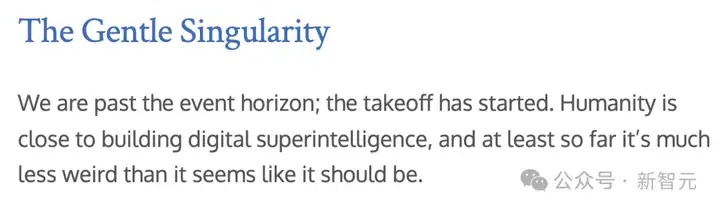
Altman believes the singularity won’t arrive overnight—it will seep in gradually: wonders become normal, and normal becomes baseline.
Within the article, he also shares his predictions for the next five years:
-
2025: Agents capable of real cognitive work (e.g., programming) emerge; work methods are being reshaped;
-
2026: AI may gain the ability to discover new knowledge;
-
2027: Robots could perform tasks in the physical world;
-
2030: Individual productivity will vastly exceed that of 2020, leading to massive changes in societal production.
Notably, this is Altman’s final piece written entirely by hand—with zero AI involvement.
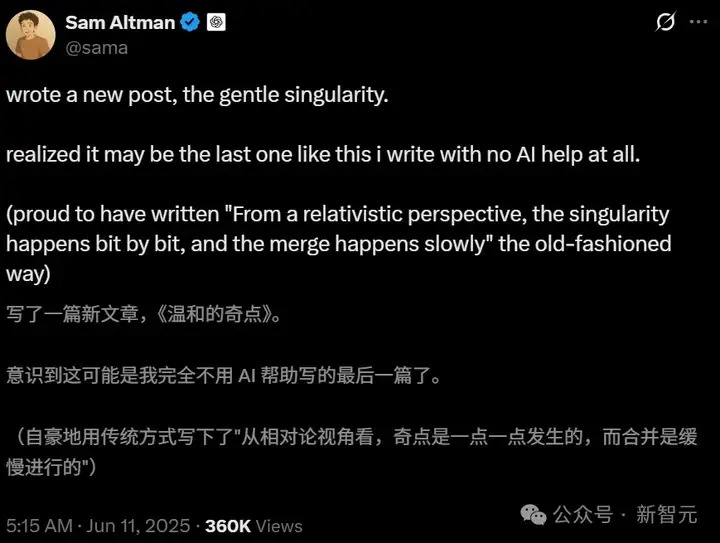
He also highlights an often-overlooked aspect: the resource cost per ChatGPT query.
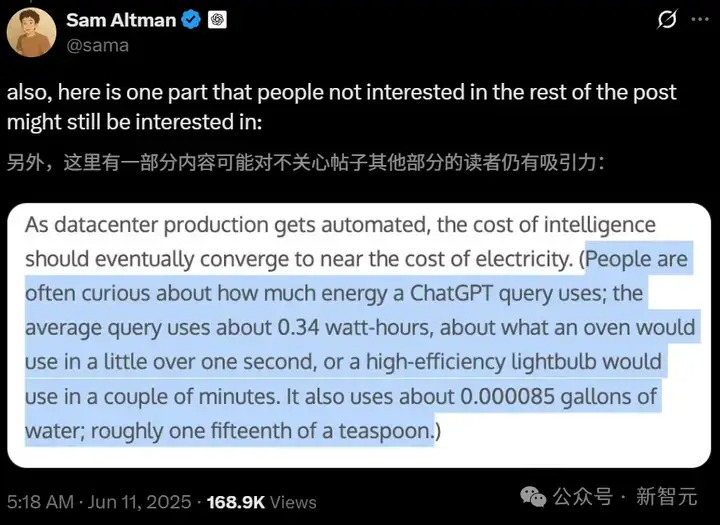
On average, each ChatGPT query consumes about 0.34 watt-hours of electricity—roughly equivalent to running an oven for just over one second or powering an energy-efficient lightbulb for several minutes.
In addition, each query uses approximately 0.000085 gallons of water—about 1/15th of a teaspoon.
Now, let’s explore the future of AI through Altman’s eyes.
The Turning Point Is Now
We have already passed the event horizon—the ascent has begun.

In astrophysics, once an event crosses the event horizon, it can no longer affect outside observers.
Humanity is on the verge of building digital superintelligence—and so far, the journey has been far smoother than expected.
Robots aren't yet everywhere, and most people don’t talk to AI all day. We still age, fall ill, and die. Space remains difficult to access, and the universe holds countless mysteries.
Yet we’ve indeed built intelligent systems that surpass humans in many areas, poised to dramatically boost productivity. Scientific breakthroughs once thought impossible have already occurred. These hard-won insights gave rise to systems like GPT-4 and o3, which will carry us even further into the future.
AI will contribute to the world in multiple ways.
It will accelerate scientific progress and enhance productivity, bringing enormous leaps in quality of life. The future will be far better than today. Scientific advancement is the greatest engine of overall development, and the infinite possibilities ahead are profoundly exciting.
In certain crucial respects, ChatGPT is already more powerful than any individual in history.
Billions of people rely on it daily for increasingly important tasks: small improvements can bring massive positive impacts, while minor flaws, amplified across billions of users, could cause significant harm.
A Five-Year Roadmap: 2030 as the Next Milestone
By 2025, AI agents capable of genuine cognitive labor will arrive, permanently changing how code is written. By 2026, systems that uncover new knowledge may emerge. By 2027, robots capable of operating in the physical world could appear.
More people will be able to create software and art. But demand for both will also grow. Experts who embrace these new tools will likely continue to outperform novices.
Overall, by 2030, individual productivity will greatly exceed that of 2020—an astonishing shift. Many will find ways to benefit from this transformation.
In some deeply meaningful aspects, 2030 might not feel radically different. People will still love their families, express creativity, enjoy games, and swim in lakes.
But in other equally vital ways, 2030 could differ fundamentally from any previous era. We don’t yet know how far beyond human capabilities AI can go—but we’re about to find out.
During the 2030s, intelligence and energy—the capacity for ideas and turning them into reality—will become extraordinarily abundant.
These two factors have long been the fundamental constraints on human progress. With abundant intelligence and energy (and sound governance), we could theoretically achieve almost anything.
The AI Self-Renewal Flywheel Accelerates: The Singularity Creeps In
We already live in an incredible age of digital intelligence. After the initial awe, most people quickly adapt.
We swiftly move from marveling at AI generating eloquent paragraphs to expecting it to write full novels; from applauding its life-saving medical diagnoses to demanding cures; from being amazed it can write a small program to expecting it to launch an entire company.
This is how the singularity unfolds: yesterday’s miracles become today’s norms, then tomorrow’s bare minimum.
Scientists report to OpenAI that their productivity has increased two- to threefold since using AI.
Advanced AI is profoundly significant—but perhaps nothing matters more than using it to accelerate AI research itself. We may discover new computing substrates, better algorithms, and unexpected breakthroughs. If ten years of research can be completed in one year—or even one month—progress will clearly unfold at a completely different pace.
From now on, existing tools will help us gain deeper scientific insights and build even more advanced AI systems.
Of course, this isn’t the same as AI autonomously rewriting its own code—but it’s undoubtedly an early form of recursive self-improvement. Other self-reinforcing loops have already begun.
The massive creation of economic value fuels a flywheel of accelerated infrastructure expansion, supporting ever-more-powerful AI systems.
And robots building other robots is no longer distant—in a sense, this already includes data centers constructing other data centers.
If we must initially manufacture the first million humanoid robots manually, but afterward they manage the entire supply chain—mining and refining minerals, driving trucks, operating factories—to produce more robots, which in turn build more chip fabrication plants and data centers, then the pace of progress will clearly be transformed.
As data center production becomes automated, the cost of intelligence should ultimately approach the cost of electricity.
(People often wonder about ChatGPT’s energy use per query: on average, about 0.34 watt-hours—equivalent to an oven running for just over a second, or a high-efficiency bulb lit for several minutes. It also consumes roughly 0.000085 gallons of water, about one-fifteenth of a teaspoon.)
Approaching AGI, AI miracles become routine
Technological progress will keep accelerating, and humans will continue adapting as always.
There will certainly be growing pains—some entire job sectors may disappear—but at the same time, global wealth will grow so rapidly that we can seriously consider policy ideas once unimaginable.
We may not instantly establish a new social contract, but decades later, when we look back, gradual change will have triggered a qualitative leap.
History teaches us that we’ll discover new goals and new needs, and rapidly adopt new tools. Expectations will rise, but so will capabilities—and everyone’s quality of life will improve.
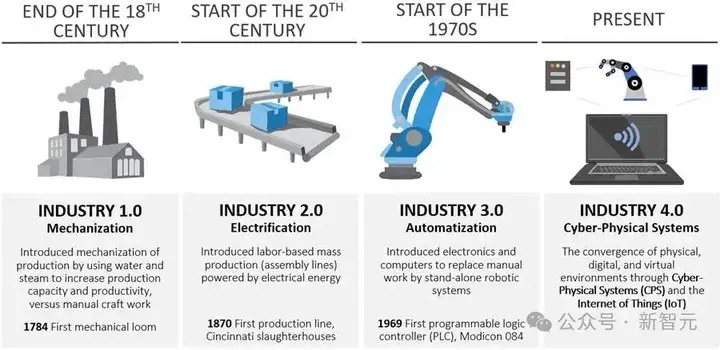
The evolution of occupations after the Industrial Revolution serves as a strong example.
Humans will create ever-better things for one another.
Compared to AI, humans possess a lasting, important, and unique advantage: we inherently care about others and what they think and do—something machines do not.
A farmer from a thousand years ago, seeing many modern jobs, would call them “fake work,” believing today’s people merely play games for entertainment after being well-fed and pampered.
A thousand years from now, I hope people look back at our jobs and see them as equally “fake”—yet without doubting that those doing them felt deeply fulfilled and purposeful.
New miracles will emerge at breathtaking speed.
Today, we can hardly imagine what discoveries await in 2035—
Perhaps we’ll solve high-energy physics this year and begin space colonization next; or make a major materials science breakthrough this year and achieve true high-bandwidth brain-computer interfaces the following year.
Many will choose to live much as before, but at least some may decide to “plug in.”
Looking ahead, all this may seem unbelievable. But when we’re living through it, we might feel awe—yet remain capable of coping.
From a relative perspective, the singularity happens gradually, integration proceeds slowly.
We are climbing along a long exponential curve of technological growth: looking forward, it seems impossibly steep; looking back, it appears flat and unremarkable. Yet it remains a smooth, continuous curve.
(Imagine telling someone in 2020 that near-AGI systems would exist by 2025—it would sound utterly implausible. Now compare that to what actually happened over the past five years.)
Building a Superintelligent Mind: A Long and Weighty Journey
Great opportunities come with serious challenges.
We must address safety concerns both technically and socially. But given its immense economic impact, it’s equally vital to ensure superintelligence becomes widely accessible.
The best path forward may be this:
First, solve the alignment problem. This means ensuring AI systems robustly learn and act toward humanity’s collective long-term goals.
Algorithmic feeds on social media exemplify misaligned AI: the underlying algorithms excel at keeping you endlessly scrolling, accurately capturing your short-term preferences—but they do so by exploiting mechanisms in your brain that override your long-term values.
Then, focus on making superintelligence cheap, accessible, and not overly concentrated in any single person, company, or nation.
Society is resilient, creative, and highly adaptable. If we harness collective human will and wisdom, despite making many mistakes and facing severe setbacks, we will ultimately learn quickly, adapt, and maximize benefits while minimizing risks.
Granting users broad freedom within society’s necessary boundaries seems crucial. The earlier the world begins discussing these boundaries and defining collective alignment, the better.
The entire industry—not just OpenAI—is building a brain for the world.
It will be highly personalized and easily accessible to everyone. Our only remaining bottleneck will be good ideas.
Tech entrepreneurs have long mocked the “idea guys”—those with visions but needing teams to execute. But in Altman’s view, their moment is finally arriving.
OpenAI plays many roles, but above all, it is a superintelligence research company.
The road ahead is long and the responsibility heavy. But much of the path is now illuminated, and the unknown is rapidly shrinking. We are deeply honored to pursue the work we love.
“Intelligence so cheap it’s not worth metering” is within reach. This may sound crazy—but if we had described today’s world to someone in 2020, it would have sounded even crazier than our current predictions for 2030.
May we advance smoothly, exponentially, and quietly into the superintelligence era.
Join TechFlow official community to stay tuned
Telegram:https://t.me/TechFlowDaily
X (Twitter):https://x.com/TechFlowPost
X (Twitter) EN:https://x.com/BlockFlow_News


