








Binance Alpha Airdrop Threshold Soars — Are the Good Days Over for Retail Investors?
TechFlow Selected TechFlow Selected
Binance Alpha Airdrop Threshold Soars — Are the Good Days Over for Retail Investors?
As long as airdrop yields exceed wear-and-tear costs, arbitrageurs will continue to pour in.
 Navigating Web3 tides with focused insights
By 1912212.eth, Foresight News
On June 8, Binance Alpha launched Open Loot (OL). The airdrop's eligibility requirement demands users hold at least 233 points—the highest threshold since Binance Alpha adopted its point-based system. Since June this year, participation requirements on Binance Alpha have continuously risen—from just over 200 points to 223, and now to 233. While scores and barriers climb higher, market participants are left with increasingly numb and exhausted mindsets.
Since its launch in December 2024, Binance Alpha has drawn countless users with its low entry barrier and high-return airdrops and TGEs. Yet the ongoing rise in point thresholds raises pressing questions: Is this points frenzy nearing its end? Will the cycle continue to intensify?
High-Cost Game: Why It’s Getting Harder
The appeal of Binance Alpha lies in its return potential. According to airdrops.io, in May 2025, the platform’s five airdrops delivered an average first-day value of $270 per user; if calculated at historical peaks, total value could reach $656. For example, the SIGN airdrop granted 1,500 tokens worth approximately $177, while BOOP and NXPC airdrops also generated substantial returns. Compared to the uncertainty of traditional on-chain airdrops, Binance Alpha’s transparent rules and fast redemption mechanism have attracted massive interest.
However, high returns come with high costs. Points are primarily earned through asset holdings and token purchases. Under trading volume points rules, buying $2 worth of Alpha tokens earns 1 point, with an additional point awarded for each doubling amount (e.g., $8 earns 3 points, $1,024 earns 10 points).
Assume an average retail trader holds between $10,000 and $100,000 on the exchange, earning 3 daily balance points. To gain 15 trading volume points, they would need to trade around $32,000—this is only for buy orders (sell trades do not count). A new user starting from zero would need to maintain full-volume trading for at least 13 consecutive days to qualify for a Binance Alpha airdrop. This poses significant challenges regarding both capital scale and patience for ordinary retail investors.
Moreover, Binance Alpha imposes additional point deductions during airdrop claiming. Typically, claiming an airdrop or participating in a wallet TGE event consumes 15 points. This means that if a user barely meets the threshold, after claiming one airdrop, they will no longer qualify for the next. This tests users’ judgment severely—if the current airdrop offers poor project quality and yields only tens of dollars, but skipping it meant missing out on a future airdrop or TGE worth hundreds of dollars—the time and opportunity cost becomes enormous.
Transaction-related "wear and tear" costs cannot be ignored either. Foresight News observed that when trading certain tokens, even immediate buy-and-sell actions may result in losses of up to dozens of dollars. Therefore, players must comprehensively consider factors like trading volume and price volatility when selecting tokens; otherwise, despite aggressive maneuvers, post-airdrop profits might still fail to cover costs.
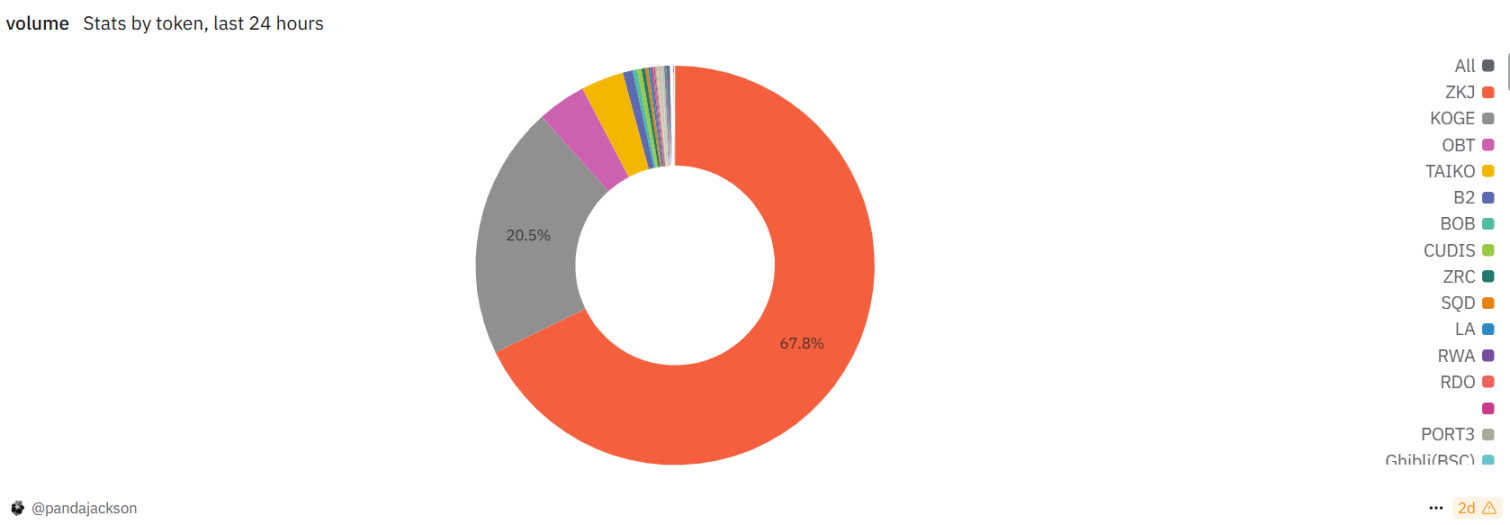
MEV risks are also notable. Without MEV protection enabled, bad luck can lead to severe losses. According to monitoring by “Aunt AI,” on June 8, a user conducting volume trades on KOGE/USDT was sandwiched on a single transaction, spending 47,000 USDT to buy merely 0.009 KOGE—resulting in a per-token cost as high as $5.18 million.
Nevertheless, as long as airdrop gains exceed wear-and-tear costs, arbitrageurs will keep pouring in.
A Workshop Bonanza?
Binance Alpha officially launched on December 17, 2024, positioning itself as a discovery platform for early-stage Web3 projects, aiming to provide users with early access to high-potential tokens. Its core mechanism is the Alpha Points system, which determines eligibility for TGEs and airdrops based on users’ asset holdings (Balance Points) on Binance Exchange and Wallet ecosystems and their purchase volume of Alpha tokens (Volume Points). Points update daily based on 15-day snapshots of assets and trading behavior, with a validity period of 15 days.
Initially, Alpha Point thresholds were relatively low. For instance, participation in the SIGN airdrop in April 2025 required only minimal points. However, as more users flocked to the platform, the required thresholds steadily increased. In May 2025, the BOOP airdrop demanded 137 points, while Privasea’s TGE required 198 points. By June, Bondex (BDXN) raised the bar to 213 points, and Open Loot pushed it even higher—to 233 points. Some community members note that thresholds above 220 have become the norm, and falling slightly behind could mean being shut out completely.
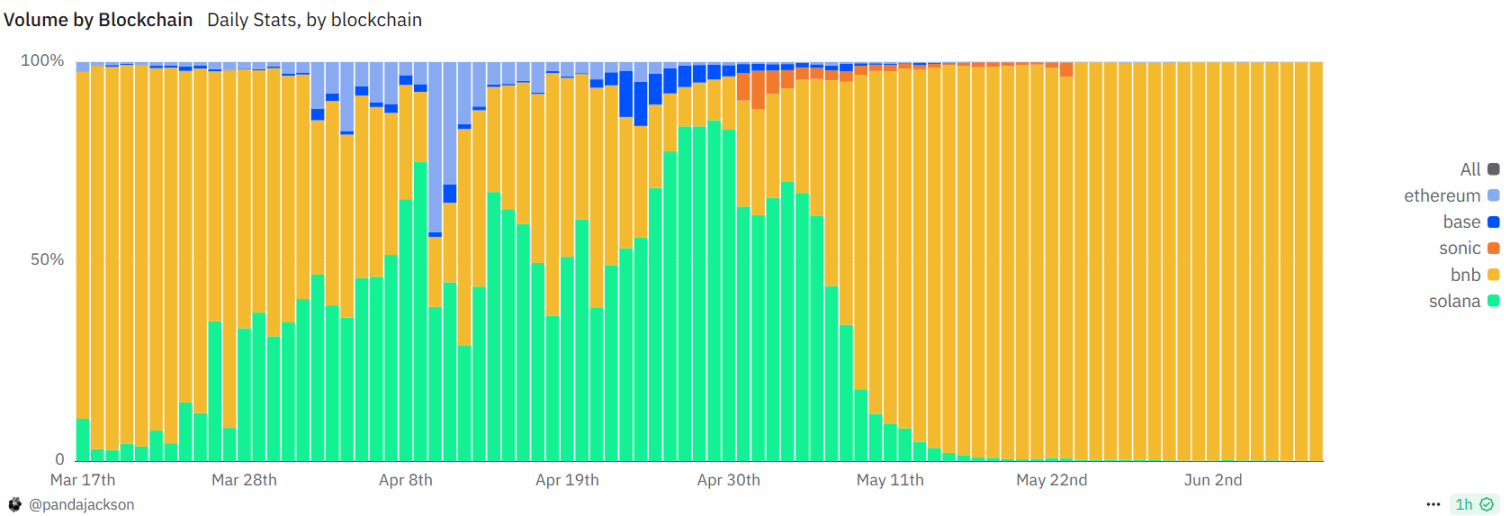
According to Dune analytics dashboards, Binance Alpha recorded a record-high trading volume of $2.04 billion on June 8, significantly surpassing competitors such as the Solana chain.
The root cause of this "rat race" phenomenon lies in supply-demand imbalance. With limited airdrop and TGE opportunities on Binance Alpha, rising participant numbers have driven thresholds upward. Estimates suggest about 10,000 users qualified for the Open Loot airdrop, each receiving 1,836 OL tokens. As arbitrageurs flood in, the platform raises point thresholds to filter genuinely active users and curb bot farming. In June 2025, Binance announced an upgrade to its risk control system: any use of bots—including scripts, automation tools, or other non-manual methods—would be deemed a violation.
From Thousands to Hundreds: The End of Binance Alpha?
In the early days, due to fewer participants and several high-return projects, retail investors who fully claimed airdrops could net over $1,000 after deducting costs. However, as user numbers grow and thresholds rise, monthly earnings have dropped from over $1,000 to around $600. Mid-May saw one project’s airdrop yield as low as $25—far below user expectations—indicating that the Alpha Points game is shifting from “low barrier, high return” to “high barrier, low return,” diminishing its appeal to average players.
Binance Alpha’s popularity has not only reshaped user behavior but also profoundly impacted the broader industry ecosystem. On one hand, Alpha’s massive traffic has created an “overflow effect” for other public chains. Since May, Solana’s DEX trading volume has surged from $2.2 billion to $4.59 billion, partly fueled by the hype around tokens like $MOODENG on Alpha. Similarly, NAVX, a token in the Sui ecosystem, experienced explosive trading volume growth after listing on Alpha—demonstrating how Alpha’s point-driven activities have injected vitality into emerging public chains.
On the other hand, Alpha’s success has prompted imitation by other exchanges. Twitter KOL @_FORAB revealed that Kraken, Bithumb, and others have recognized Alpha’s model and may launch similar initiatives. As competition intensifies, airdrop thresholds and participation costs will likely rise further, creating higher barriers for users. Binance itself continues refining strategies—for example, introducing double-point campaigns (users earn double points when purchasing Alpha tokens via BSC or limit orders) to boost trading volume. Yet these incentives further inflate point thresholds, exacerbating the rat race.
Facing soaring point requirements and ever-tighter competition, is Binance Alpha approaching its end? The answer may not be a simple yes or no. Signs of user fatigue are evident—high thresholds and costs are deterring newcomers. If returns keep declining, regular users may choose to exit. Bots and arbitrageurs continue occupying space: despite Binance upgrading its anti-bot systems, automated farming remains unresolved. This undermines fairness and increases operational burdens. Market saturation is another downside—high-quality Alpha project supply may dwindle. Long-term, the platform may struggle to sustain frequent, high-value airdrop activities.
Join TechFlow official community to stay tuned
Telegram:https://t.me/TechFlowDaily
X (Twitter):https://x.com/TechFlowPost
X (Twitter) EN:https://x.com/BlockFlow_News
 Foresight News






