Mira Network: Making crypto research simple — here's how our AI does it
TechFlow Selected TechFlow Selected
Mira Network: Making crypto research simple — here's how our AI does it
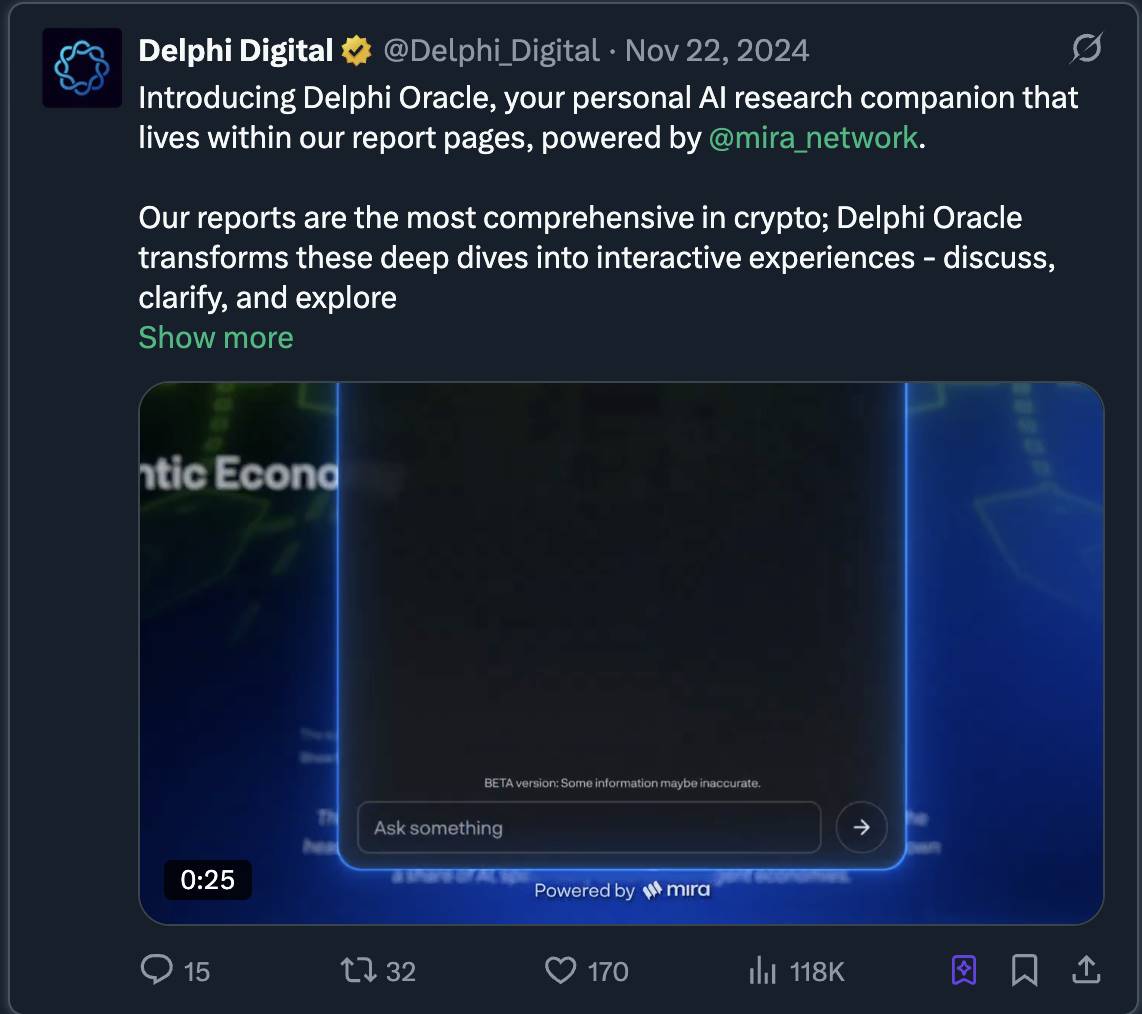
Within weeks of its launch, Delphi Oracle became an essential tool for accessing crypto research content.
 Navigating Web3 tides with focused insights
Author: Mira
Translation: TechFlow
The Research Paradox
Delphi's research reports are legendary in the crypto space. When they publish analyses on new token mechanisms or DeFi protocols, project founders take notes, venture capitalists (VCs) adjust their investment theses, and traders rebalance their portfolios. Their research has profoundly influenced billions of dollars in capital allocation across Web3.
But there’s a problem: being the gold standard for institutional research comes with an unexpected dilemma. The very depth and rigor that make their analyses invaluable also render them intimidating. A typical Delphi report might cite a dozen other studies, involve technical concepts requiring background knowledge, and assume familiarity with market dynamics in the evolving crypto landscape.
"We have this incredible body of research, but we kept hearing people say it’s hard to navigate," explains Carter Lundy, Senior Vice President of Operations at Delphi Digital. "Someone might stumble upon a report about MEV (Maximal Extractable Value) and get completely lost because they don’t understand the underlying concepts. We’re missing out on so much potential value."
The obvious solution seemed to be an AI assistant—an always-available tool capable of explaining concepts, summarizing lengthy analyses, and guiding readers through Delphi’s vast research library. In 2023, as ChatGPT swept the globe, this path appeared clear.
The First Failure
When Delphi first experimented with an AI assistant, they discovered the challenge was far more complex than expected. The team integrated a state-of-the-art language model into their platform and began testing—only to encounter alarming results. The AI confidently misexplained concepts and even fabricated plausible-sounding yet entirely false token metrics. At times, it even misrepresented Delphi’s own published viewpoints.
"We couldn’t launch a product that might spread misinformation under our brand," Lundy recalls. "Our credibility is everything."
Even when using the most advanced models available at the time, the economic cost was prohibitive. Each complex query about tokenomics or DeFi mechanisms could cost several dollars to process. For a platform serving thousands of users daily, such expenses were clearly unsustainable.
After months of frustration, they ultimately shelved the project. Realizing that AI assistance would have to wait for more advanced technology, they paused development.
A Web3-Native Solution
The breakthrough came from an unexpected source. While researching the intersection of AI and crypto for an upcoming report, the Delphi team discovered Mira Network. What caught their attention wasn’t just another AI API, but Mira’s fundamentally different approach to making AI both trustworthy and economically viable.
"Most AI companies focus on building bigger models or optimizing prompts," Lundy explains. "Mira asks different questions: How do we make AI responses reliable? How can high-quality AI become economically feasible at scale?"
The two teams decided to collaborate and push the boundaries together. If they could make Delphi Oracle work, it would prove that AI could handle even the most complex, accuracy-critical content.
A Threefold Innovative Approach
Through collaboration with Mira and its ecosystem application Klok, the team developed three key innovations that transformed Delphi Oracle from “impossible” to “indispensable.”
-
Smart Query Routing
In hindsight, the first insight was embarrassingly simple: not every question needs to be answered by an AI model. Why send a query about the current price of ETH to an expensive language model when you could simply call a pricing API?
The team built a high-speed router that instantly classifies incoming queries:
-
Price requests are directed straight to market data feeds
-
Simple definitions are pulled from a structured knowledge base
-
Only complex analytical questions are routed to full AI models
This routing system dramatically reduced costs while significantly speeding up responses to common queries.
-
Intelligent Caching
The second innovation emerged from studying user behavior. They found that many user questions were merely rephrased versions of each other—such as “summarize this report,” “explain this concept,” or “what are the key takeaways?”
The system now pre-generates high-quality answers to frequently asked questions and serves them via caching instead of regenerating responses each time. The key lies in knowing what to cache: report summaries remain static, while queries about “latest developments” require real-time updates.
-
Validation Layer
The third innovation addressed reliability. By integrating Mira’s validation API, the system checks the accuracy of AI-generated responses before delivering them to users. This gives the Delphi team confidence in letting AI handle their most intricate and nuanced content.
The Power of Transformation
Within weeks of launch, Delphi Oracle became an essential gateway to crypto research. Today, the average user interacts with Oracle at least once per day—and that number continues to grow.
"What surprised us most was how it changed reading behaviors," Lundy shares. "Previously, users would abandon a report when hitting a complex section. Now, they pause, ask Oracle for clarification, then continue reading instead of giving up."
The impact goes beyond comprehension. Readers began discovering connections between reports they’d previously overlooked. They asked Oracle to surface all research related to specific topics. Some users even started using it to generate summaries for teams or investment committees.
Most importantly, the economics finally worked. By combining smart routing, intelligent caching, and Mira’s API, the effective cost per query dropped by approximately 90%. What was once prohibitively expensive is now sustainable—even at scale.
Beyond Cost Optimization
The real victory isn’t just lower costs, but the possibilities unlocked by those savings. Delphi no longer needs to restrict AI features to premium subscribers—Oracle is now open to everyone. Instead of worrying about per-query costs, they can focus on making the product genuinely useful.
Today, the system handles everything from basic questions (“What is an AMM?”) to sophisticated synthesis (“How does Delphi’s view on L2 scaling differ from its earlier research on sidechains?”). It has become a bridge between Delphi’s expert analysts and the broader crypto community.
"We thought we were building a helper tool," Lundy reflects. "But we actually created a whole new way for people to interact with research. Now some users start with Oracle, then dive into specific reports based on what they’ve learned. It’s completely reshaped the user journey."
Roadmap Ahead
Delphi Oracle has become a benchmark for other platforms facing similar challenges. Whether financial research firms, technical documentation sites, or educational platforms—all grapple with the same core problem: how to make complex content accessible without sacrificing accuracy, all while managing costs.
The lesson isn’t that every platform needs Mira’s exact technical architecture. Rather, it’s recognizing that making AI truly useful requires thinking beyond the model itself. You need efficient query routing, strategies for cost management at scale, and robust methods to ensure reliability when accuracy matters most.
Looking Forward
Today, Delphi Oracle processes thousands of queries daily, serving everyone from institutional investors seeking deep analysis to newcomers trying to grasp foundational concepts. The system can explain what a liquidity pool is—and also synthesize cross-chain interoperability perspectives across multiple research reports.
The Delphi team continues expanding Oracle’s capabilities, exploring features that were impossible under previous cost structures. They’re experimenting with personalized research pathways, multimodal analysis combining text and charts, and even AI-generated research briefings customized for individual portfolios.
For an industry often criticized as inaccessible, Delphi Oracle represents a pivotal breakthrough—proving that AI can democratize expert knowledge without diluting depth. When you solve the twin challenges of reliability and economics, you don’t just improve an existing product—you create entirely new ways for people to learn, analyze, and make decisions.
The future of AI in research isn’t about replacing human experts. It’s about ensuring that anyone who needs expert knowledge can access it, whenever they need it, in a way they can understand. Delphi Oracle shows that this future is already here.
Join TechFlow official community to stay tuned
Telegram:https://t.me/TechFlowDaily
X (Twitter):https://x.com/TechFlowPost
X (Twitter) EN:https://x.com/BlockFlow_News
 @Mira_Network