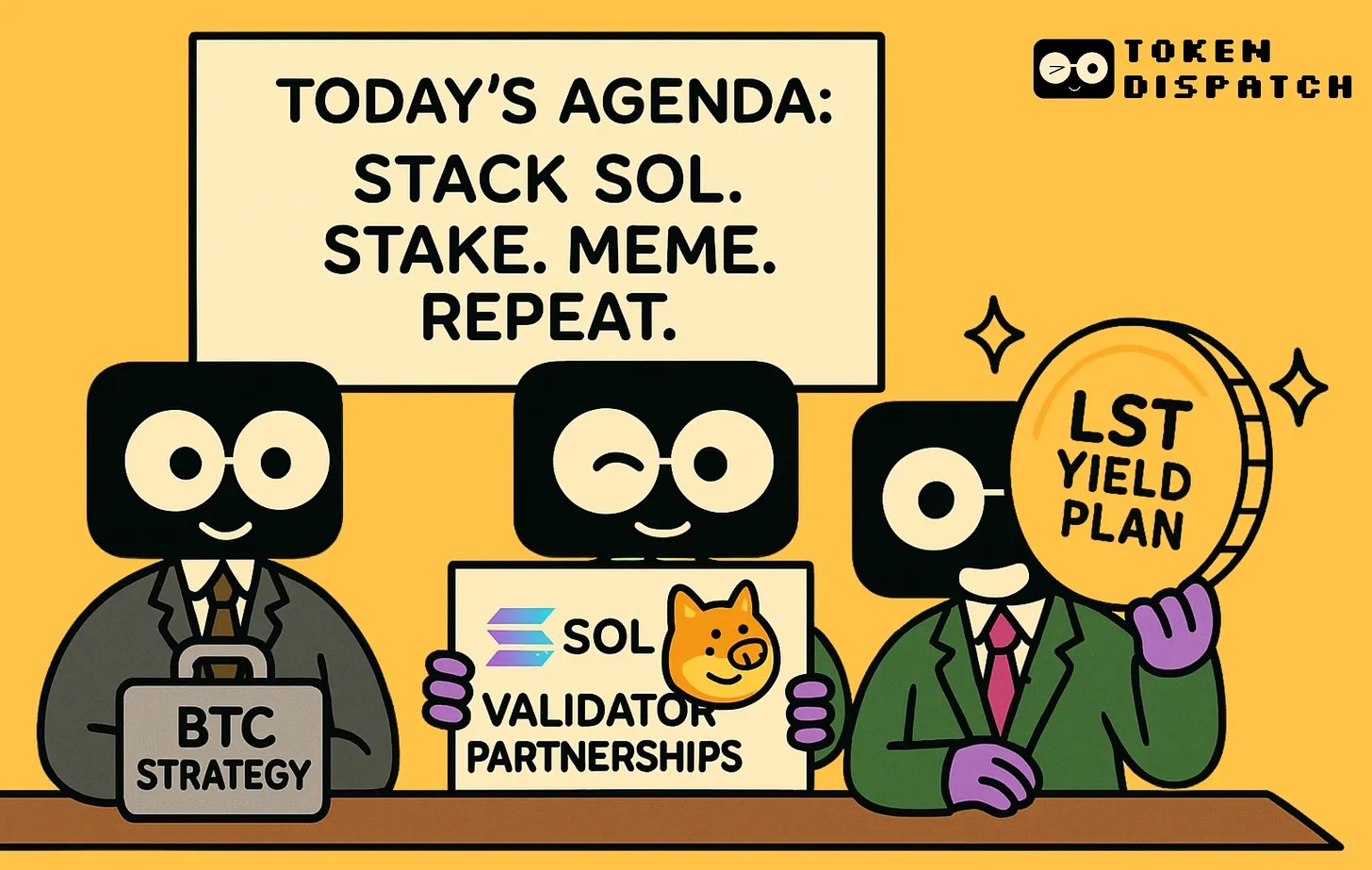
Why are companies stockpiling SOL?
TechFlow Selected TechFlow Selected
Why are companies stockpiling SOL?
A deep dive into what it means to hold Solana as most other companies rush into Bitcoin.
 Navigating Web3 tides with focused insights
Author: Token Dispatch, Prathik Desai
Translation: Block unicorn
Introduction
The Solana treasury movement has evolved from a trickle into a full-blown flood.
About four months ago, we reported that Sol Strategies was building a Solana asset management firm. Now, the competition is heating up—and it’s getting quite memey.
In the annals of "unexpected things," it's striking to see a public company collaborating with a meme coin to operate blockchain infrastructure. Yet just under two weeks ago, another Solana-focused asset manager, DeFi Development Corp (DFDV), partnered with the Solana meme coin Bonk.
This isn’t a joke.
Just days ago, DFDV announced allocating part of its SOL holdings into liquid staking tokens (LSTs), which can be used across DeFi applications or transferred while still earning yield and staking rewards.
Corporate treasury management has gone fully crypto-native: from companies buying Bitcoin, to operating validator nodes, partnering with meme coins, and now pioneering liquid staking strategies.
In this article, we’ll dive deep into what holding Solana actually means at a time when most other firms—including those tied to former U.S. President Donald Trump—are rushing into Bitcoin.
The Hype
DeFi Development Corporation—a real estate company rebranded as Janover in April 2025—made its largest Solana purchase on May 12, adding 172,670 SOL to its treasury. This brought its total holdings to 609,233 SOL, worth over $100 million.
That represents one-third of the company’s market capitalization.
The stock market responded enthusiastically.
Since the rebranding, DFDV’s share price has surged 30x over the past two months—driven largely by its strategic pivot toward Solana investment.
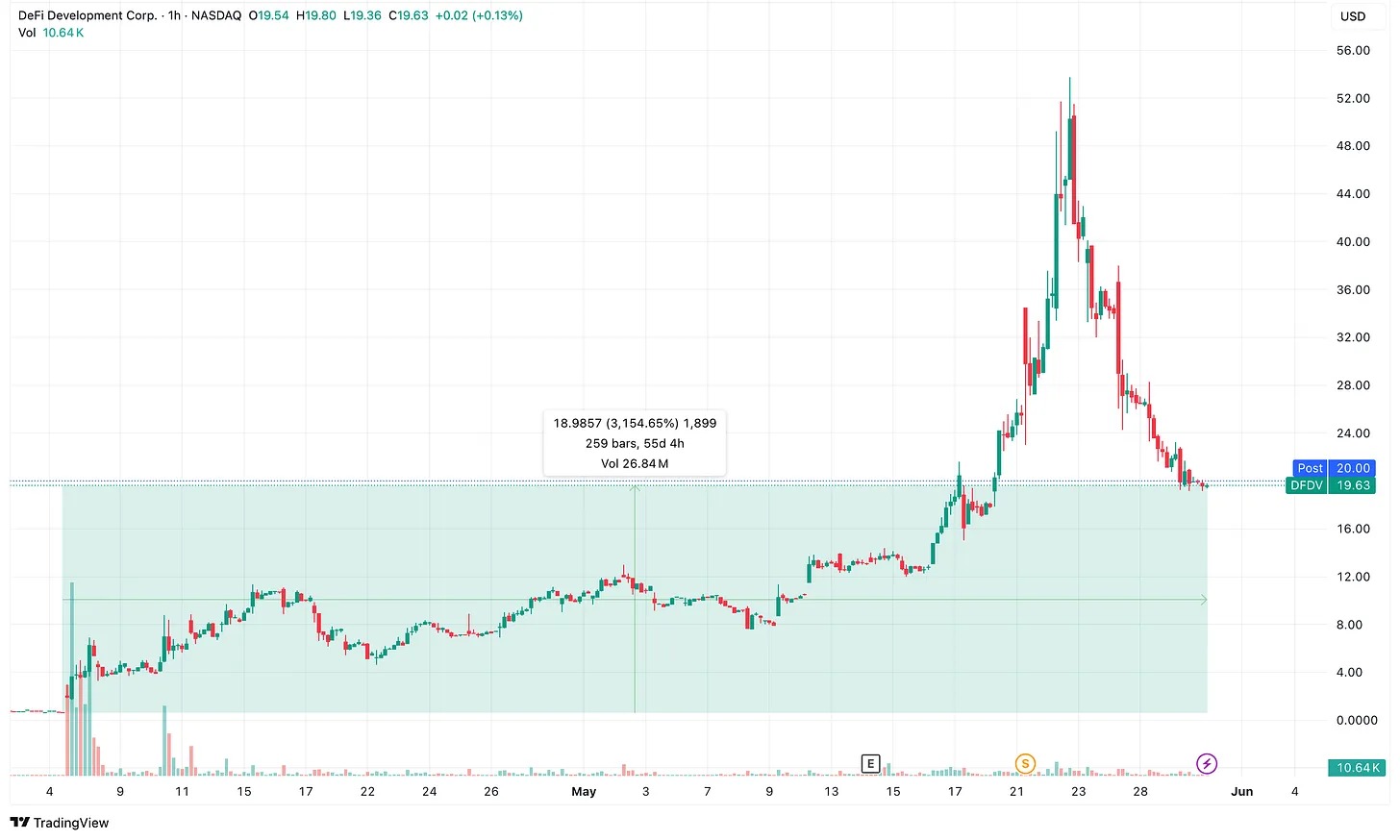
Image source: @TradingView
Canadian firm Sol Strategies is no slouch either, having filed a preliminary prospectus with local securities regulators to raise up to $1 billion for further investments in the Solana ecosystem.
New players keep entering.
Nasdaq-listed edtech company Classover Holdings has outlined a Solana-centric strategy and secured $400 million in financing; DIGITALX has increased its SOL holdings to accelerate staking yields.
Why all the excitement? There are several reasons.
Does a SOL Treasury Actually Make Sense?
The Yield Game
The key difference between Solana treasuries and Bitcoin strategies is simple: they actually generate yield.
DIGITALX highlights an annual staking yield of 7–9%, projecting an additional $800,000 AUD in revenue per year. Compared to Bitcoin’s 0% yield, the appeal becomes clear.
But these companies aren’t stopping at basic staking. They’re building infrastructure. DeFi Development’s move into liquid staking marks the next phase of evolution: earning yield without sacrificing liquidity—a true win-win.
With this step, the company became the first publicly listed entity to hold Solana liquid staking tokens.
The partnership with BONK? It allows both parties to jointly increase delegated stake—the amount of SOL committed to their validator nodes—and share in the rewards. It’s community engagement meets treasury management.
“DFDV and BONK are leaders in their respective spaces. By working together, we benefit from each other’s unique positioning and brand recognition,” Parker White, CIO and COO of DeFi Development, told Decrypt.
Validators and Governance Roles
These firms aren’t just buying and holding SOL—they’re becoming infrastructure providers.
On May 5, DeFi Development Corp announced a definitive agreement to acquire a Solana validator business with an average delegated stake of approximately 500,000 SOL ($75.5 million).
This creates a flywheel effect: reinvesting yields to accumulate more SOL, thereby expanding validator capacity further. A stark contrast to Michael Saylor’s playbook.
By operating validator nodes, companies can:
-
Influence network governance
-
Build relationships with projects
-
Potentially incubate or invest in Solana-based startups
-
Create additional revenue streams beyond treasury appreciation
The Speed and Scale Narrative
Solana offers faster transaction processing and significantly lower fees than competing blockchains like Ethereum. For companies looking beyond mere balance sheet value, this opens possibilities Bitcoin simply cannot match.
Unlike Bitcoin, primarily used for transferring value across networks, Solana supports decentralized finance applications, consumer apps, gaming, and more.
Different Playbooks
Each company approaches this game differently:
DeFi Development Corp is the aggressive innovator.
Beyond amassing 609,233 SOL, it’s pioneering liquid staking and meme coin partnerships. Joseph Onorati, CEO of DeFi Development Corp, told Decrypt: “Crossing $100 million in Solana purchases is a major milestone—but this is only the beginning.”
Sol Strategies takes an institutional approach, aiming to become a top-tier staking platform with mature asset management frameworks. Their $1 billion prospectus filing signals ambitions far beyond simple accumulation.
DIGITALX exemplifies yield optimization—meticulously calculating staking returns and emphasizing income potential to shareholders. To them, SOL is like a dividend-paying stock.
Risk Profile
Still, it’s not all smooth sailing. Let’s inject some reality.
First, macro traps: These strategies depend on cheap capital. Most SOL buyers raise funds through convertible bonds or equity-linked instruments. When liquidity dries up—as it inevitably does—the game ends.
Second, regulatory time bomb: As Marco Santori notes, corporate Solana treasury strategies allow operations that “simple, passive” funds cannot achieve. Great—until regulators decide your “treasury management” looks suspiciously like an unregistered investment fund.
Third, yield compression is coming. As more validators join, that attractive 7–9% yield will shrink. Basic economics: increased validator supply means lower returns per validator.
Infrastructure burden is also real. Running a validator isn’t passive income—it’s an operational business requiring technical overhead, regular upgrades, and exposure to significant slashing risks. Miss an update window? That’s money lost.
Dan Kang noted on the Lightspeed podcast that DeFi Development Corp’s trading volatility reached 700%. Suddenly, Bitcoin starts looking like a stablecoin. Given Solana’s history of network outages, you're betting not just on price, but on reliability.
The MEV (Maximal Extractable Value) game will ultimately favor the largest players—just as it has on Ethereum.
And then there’s competition. As of May 21, the SEC hasn't approved any Solana spot ETF. But once it does, these asset management firms lose their unique selling proposition. If you can buy a Solana ETF, why buy DFDV? Then again, isn’t that the same argument against Saylor-style Bitcoin plays?
Our Take
The ongoing wave of Solana treasury activity shows this has moved beyond passive balance sheet allocation. These are now active infrastructure investments capable of generating real yield.
The innovation lies in packaging sophisticated DeFi operations into familiar corporate structures.
But let’s be clear: this is tightrope walking. These companies are simultaneously betting on Solana’s price, network stability, validator economics, and their own operational excellence. When it works, it’s beautiful—one asset generating multiple income streams. When it fails, you’ll have to explain to shareholders why your “treasury” needs a DevOps team.
Firms that can efficiently scale validator operations while navigating the coming yield compression will benefit most. Those expecting today’s high yields to last indefinitely are making a critical mistake.
When you compare Bitcoin’s 50% annual return with Solana’s near-zero return over the past 12 months, it reminds us: yield isn’t everything. But for companies willing to embrace operational complexity for incremental returns, Solana treasuries offer something Bitcoin never will: cash flow from day one.
This is Treasury 2.0—a strategy where your balance sheet runs code, earns yield, and occasionally partners with dog-themed cryptocurrencies.
Join TechFlow official community to stay tuned
Telegram:https://t.me/TechFlowDaily
X (Twitter):https://x.com/TechFlowPost
X (Twitter) EN:https://x.com/BlockFlow_News