Will Your Brain Shrink from Using AI for Reading and Learning?
TechFlow Selected TechFlow Selected
Will Your Brain Shrink from Using AI for Reading and Learning?
The most ironic part is that students using AI now may result in their inability to use AI more effectively in the future.
 Navigating Web3 tides with focused insights
Author: Xinxin
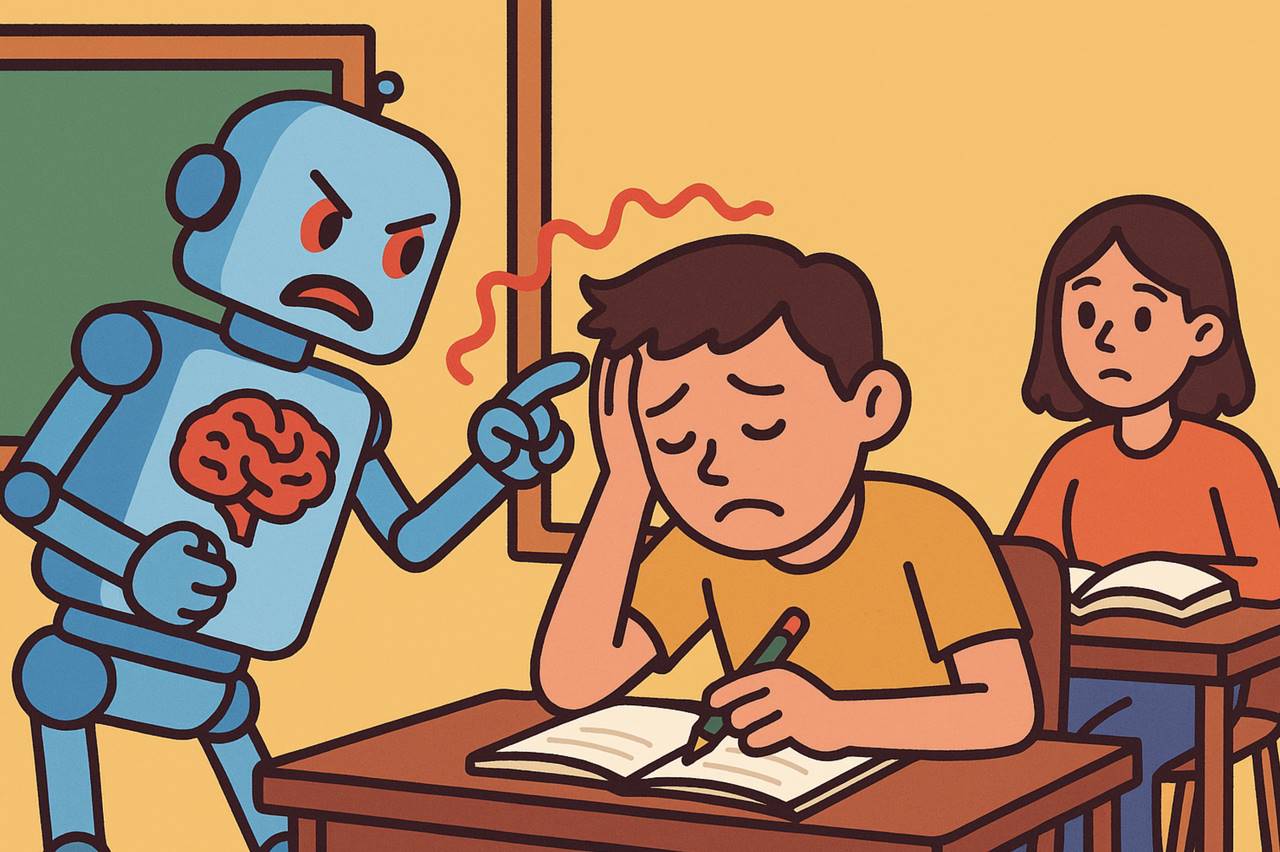
The biggest beneficiaries of AI tools powered by large models entering everyday life may not be office workers in skyscrapers, but students in schools—because generating an essay or short paper with ChatGPT is just too easy.
For this reason, one of the fastest reactions from many teachers after the emergence of large models has been to "ban AI," or redefine what constitutes academic cheating.
But some people quickly realized: the real danger might not be cheating, but that students are fully outsourcing the very process of "learning" in their brains to AI.
On the surface, homework becomes easier and grades improve. But a troubling question arises simultaneously: when students increasingly rely on AI for writing, answering questions, summarizing, and thinking, are they still actually "learning"?
Or, in the age of AI, do students even need to "learn" anymore?
01 Appearing to Learn, Without Actually Learning
Since ChatGPT's launch at the end of 2022, OpenAI may have had to acknowledge that some of its most loyal users are students.
Looking back over the past two years, media reports once suggested OpenAI's user growth had stalled—yet every September, user numbers surged dramatically. The reason was simple: students returned to school and summer vacation ended.
The first impact of AI on education has been making "completing homework" exceptionally easy—just ask AI when stuck.
A survey found that by the end of 2024, about 70% of American teenagers had used generative AI tools, with more than half using AI to help complete homework assignments.
Domestic surveys also indicate widespread use of AI on campuses. Before DeepSeek emerged, students commonly used local AI tools like Wenxin Yiyan and Doubao.
Writing essays and book reports, solving math problems—students appear to complete assignments better and better. But here’s the problem: have they actually learned anything?
In 2024, a research team from the University of Pennsylvania conducted a real-world experiment:
High school students learning math were divided into three groups: one allowed unrestricted access to a GPT-4-based AI chatbot, another used a “GPT Tutor” (which provided guidance but no direct answers), and a third group used no AI at all.
In practice sessions, the group freely using AI performed best—nearly dominating.
But during final exams where AI assistance was prohibited, the AI group scored on average 17% lower than the group that didn’t use AI at all.
The “GPT Tutor” group showed a 127% improvement during practice, yet their final exam scores were roughly equivalent to those who didn’t use AI.
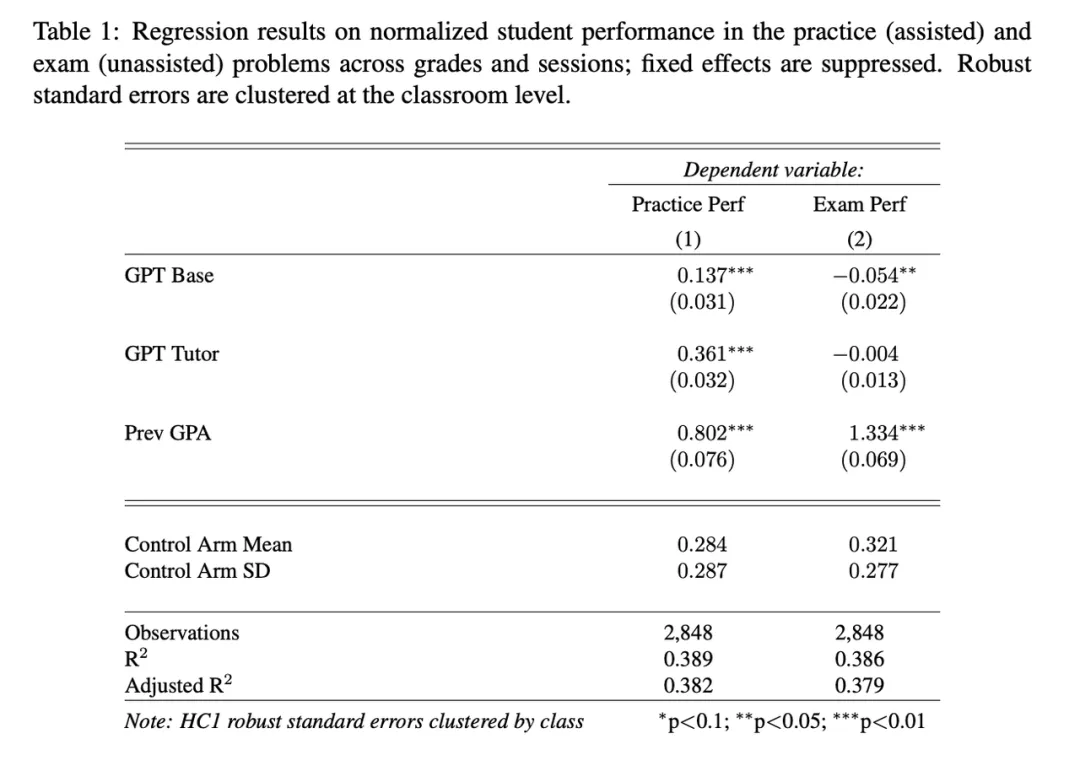
Image source: University of Pennsylvania research paper results
The researchers concluded that unrestricted AI had become a "crutch": students relied on chatbots to handle demanding tasks during practice, and thus "did not learn underlying mathematical concepts deeply enough" to solve similar problems independently.
They argued that while AI provides support during homework, creating an illusion of mastery, it ultimately exposes gaps in knowledge during exams. With AI as a "crutch," students’ intellectual agility weakens.
This creates the "AI Paradox" in education:
AI makes you appear smarter, but you may actually be learning less.
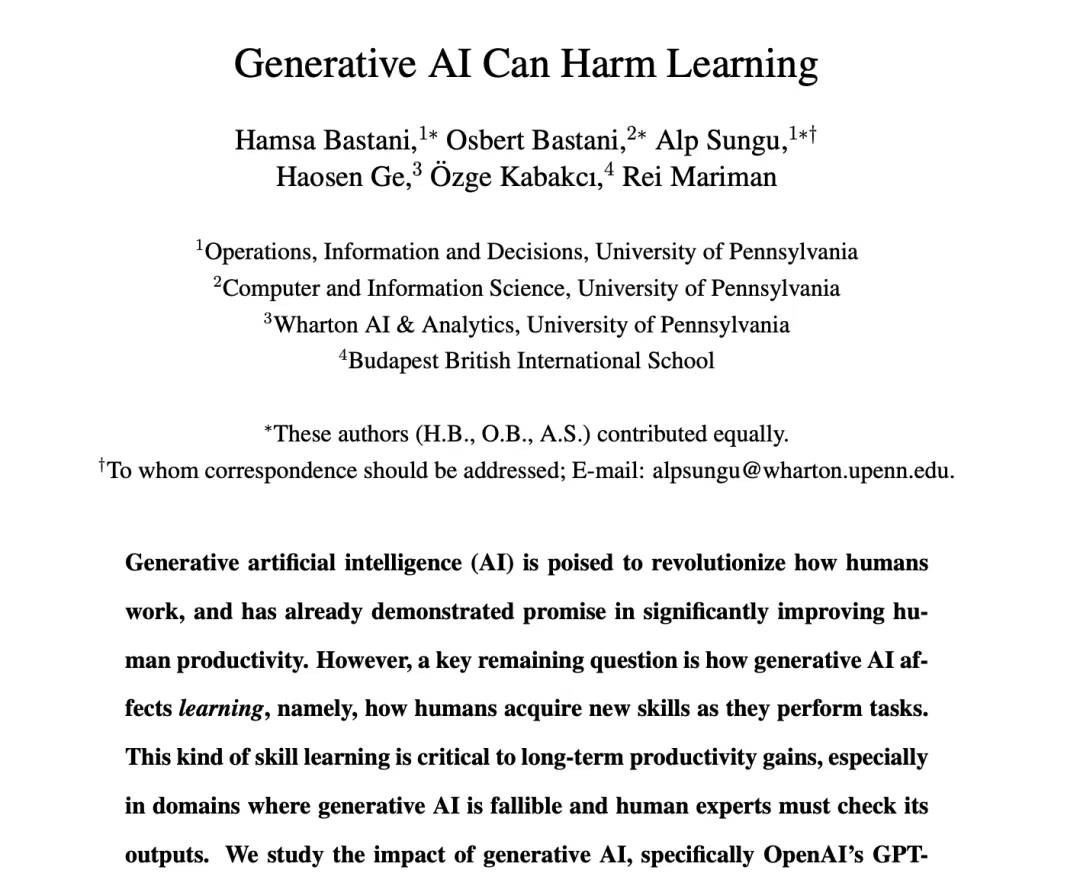
Image source: University of Pennsylvania research team
02 Does AI Reduce Cognitive Ability?
It’s not just about solving problems—research on AI’s impact on cognitive abilities has increased significantly in recent years.
A study published this year by researchers from Carnegie Mellon University and Microsoft states that if generative AI tools are "used improperly... they can lead to a decline in cognitive abilities that should otherwise be preserved."
A study published in the journal Nature suggests that AI may reduce independent decision-making ability among both students and teachers, causing students to rely on technology and think less autonomously. This could foster laziness and negatively affect learning quality.
Cognitive scientists generally argue that the essence of learning lies in the new neural connections formed through mental struggle. Educators worry that AI eliminates the "struggle," thereby erasing student growth.
Likewise, a study published this year in the journal Societies stated: "Frequent use of AI tools is significantly negatively correlated with critical thinking skills, mediated by increased cognitive offloading. Younger participants show higher dependency on AI tools and lower critical thinking scores compared to older participants."
"Cognitive offloading" refers to delegating cognitive tasks to AI. Researchers noted this effect is particularly pronounced among youth, while individuals with higher education levels tend to maintain stronger critical thinking regardless of AI usage.
Of course, it's important to note that this study emphasizes correlation rather than direct causation.
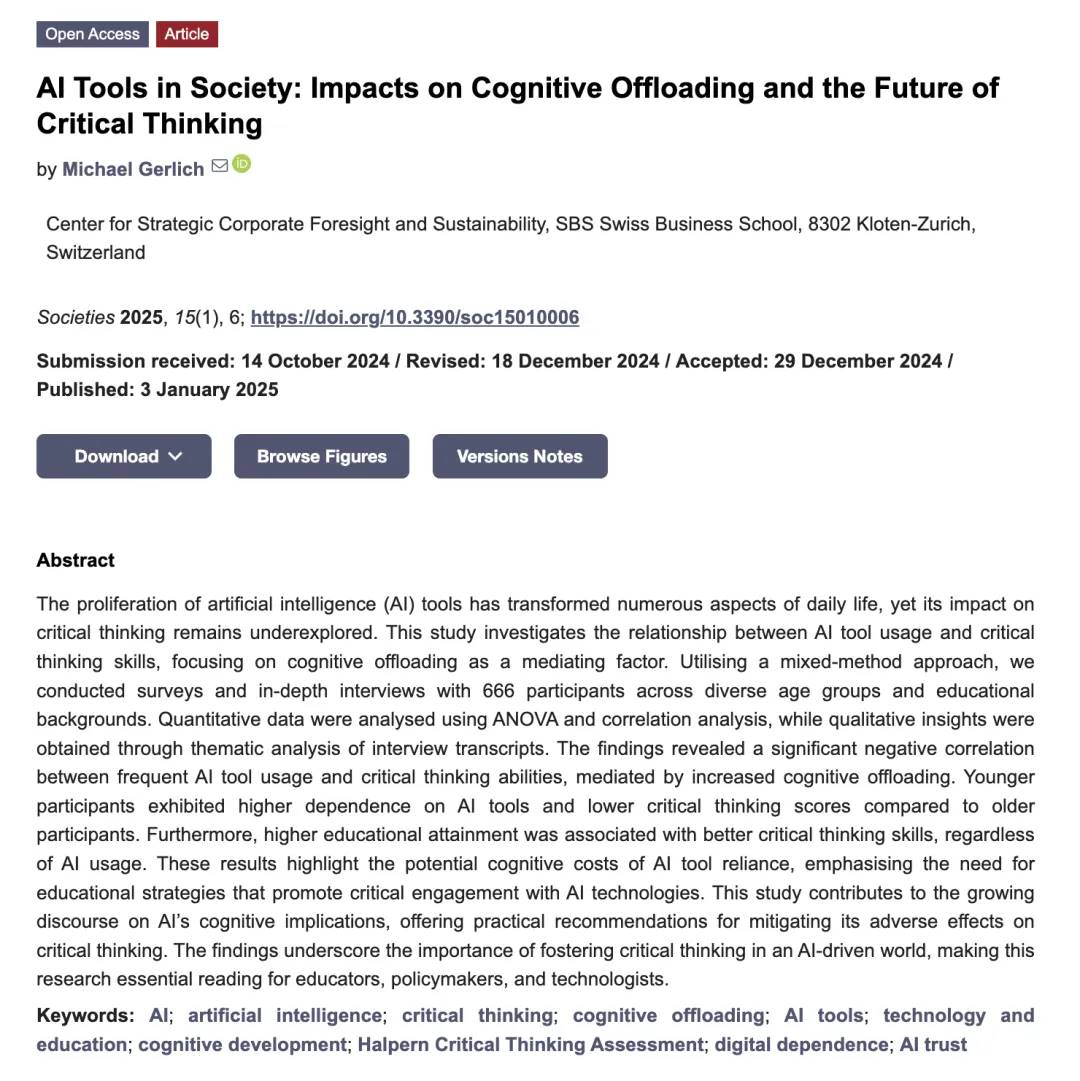
Image source: Societies Journal
Beyond academia, concerns about AI in education have frequently appeared in news reports in recent years. Besides teachers complaining about cheating, another common phenomenon is that teachers observe students who frequently use AI often see sudden grade improvements and produce excellent papers—but once removed from AI, they revert completely.
For example: "An average student uses ChatGPT or DeepSeek to submit a high-scoring paper, yet during class discussions cannot answer even the most basic conceptual questions."
AI-powered automatic summarization, essay generation, translation, and argument structuring directly replace four essential learning processes: reading, understanding, thinking, and expressing.
While some celebrate AI as a blessing for learning, doubling efficiency, others fear excessive reliance is causing a decline in fundamental capabilities. As quoted in The Chronicle of Higher Education, some undergraduates say: "I’ve become lazy. AI made reading easier, but slowly robbed my brain of the ability to critically think and comprehend each word."
"When doing homework, I literally can't go ten seconds without ChatGPT. I hate myself now because I know I’m learning nothing—but I’ve fallen so far behind that I can’t keep up without it… My motivation is gone."
Similar complaints appear on social platforms. A user in a Reddit psychology community wrote: "It’s getting worse. I’m a teacher at an applied sciences university, and I’ve noticed a sharp decline in my students’ problem-solving and critical thinking abilities."
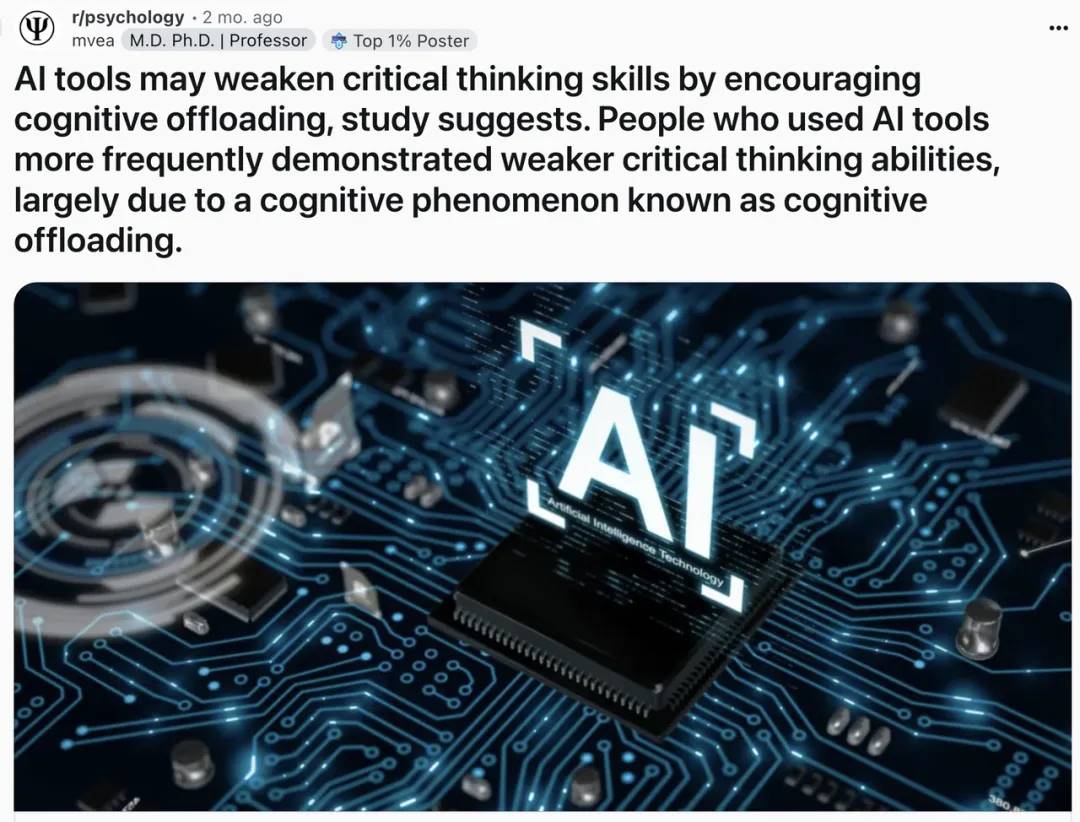
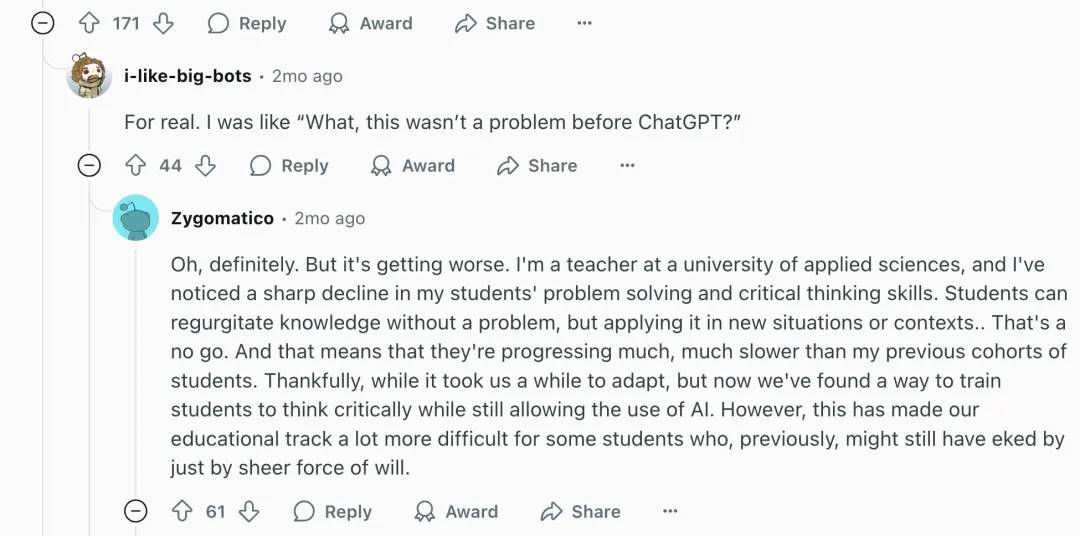
Image source: reddit
03 "Never Learned in the First Place"
Another concern has been raised: AI may place students in a state of having "never learned"—a condition far more dangerous than simply "forgetting how."
Technology writer Nicholas Carr published a long essay in May titled "The Myth of Automated Learning," arguing that when a skill is taken over by machines before a person learns it, they may never acquire it at all.
He described three possible scenarios in task automation: First, if the user is already an expert, AI tools can enhance their skills; second, if the skill requires continuous practice, AI automation may lead to skill degradation; third, if the user is a beginner and AI takes over the task from the start, the person may never truly master the skill.
Education falls precisely into the third category. Carr argues that students are inherently in the process of acquiring new skills they haven’t yet mastered. If AI takes over tasks—whether solving math problems or writing essays—before students gain experience, genuine skill development is hindered.
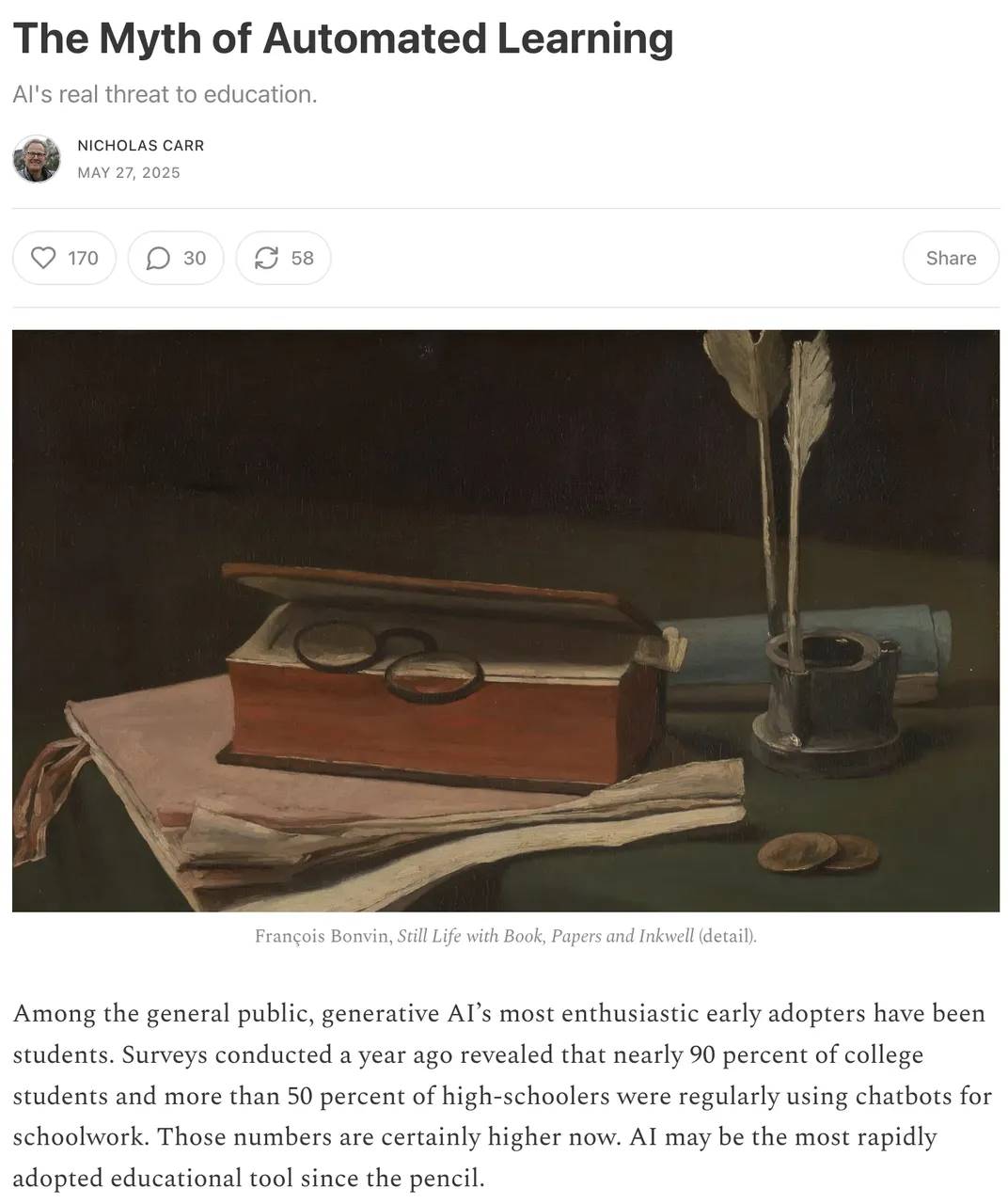
Image source: substack
Furthermore, when someone rarely "thinks for themselves," they may even struggle to write a good prompt in an AI chat window, let alone verify or refine AI outputs. These meta-skills depend on the user’s underlying understanding of the subject.
Timothy Burke, a history professor at Swarthmore College, wrote: "For current and near-future AI generation tools to be truly effective in research and expression, you yourself must already know a lot."
"Just like if you don’t know what you’re looking for or how a card catalog works, you can’t use it to find information; or like in the golden age of Google search, if you didn’t know how to adjust keywords, narrow down queries, or extract useful insights from prior results to optimize future searches, you couldn’t use it effectively."
Education is such a domain. Elementary students are just beginning to read, and AI can already write book reports for them; middle schoolers are learning argumentation, and AI can instantly generate well-structured essays; college students begin research, and AI can automatically provide outlines, analysis, summaries, and citations.
These skills get replaced before they’re even acquired. As a result, students don’t merely "forget how"—they "never learned how" in the first place, sometimes not even realizing the copied content is AI-generated "hallucination."
Take AI coding, for instance: if students skip actual programming and always let AI write code, they may lack sufficient knowledge to debug or improve faulty AI outputs.
Carr likened it to a generation of pilots who only know how to use autopilot—they can manage routine flights, but become helpless in emergencies requiring manual control.
"We’ve been focused on how students use AI to cheat. We should instead focus on how AI betrays students," said Carr.
"With generative AI, a formerly B-level student can produce A-level work while becoming a C-level student."
04 The Paradox of Learning and Education
Traditional education operates on a basic assumption: if a student submits a good essay, they can write; if they solve a difficult problem, they understand the formula; high scores mean knowledge mastery.
Now, AI seems to disrupt this logic. In non-strictly-proctored settings, writing well no longer necessarily means one can write, and high scores don’t imply understanding—the outcome no longer reflects the process.
Today, a perfect assignment might be written by ChatGPT; a logically rigorous paper could be based on a draft from DeepSeek; a high grade may simply reflect skill in crafting prompts. Often, true understanding isn’t needed—just knowing how to use tools, outsourcing the learning process to LLMs.
Schools worldwide have responded in various ways: banning AI in classrooms, deploying AI detection systems like GPTZero and Turnitin. Yet these measures fail to fully contain the issue and sometimes wrongly penalize diligent students. Some students have even learned to make AI "dumb down" its output, so assignments "look more like something a student would write," knowing many teachers believe "no student could write this perfectly."
In Asia, China’s Ministry of Education released the Guidelines for K-12 Generative AI Use in May this year, warning against over-reliance on AI tools. It prohibits elementary students from independently using open-ended content generation features, while allowing certain assistive educational uses, emphasizing balance across different educational stages.
At the university level, Fudan University issued rules banning AI involvement in six originality- and innovation-related sections of undergraduate thesis work, though permitting its use for literature searches and code debugging. Other universities have similar policies—one professor at Nanjing University’s School of Liberal Arts gave a student zero points for using AI to summarize Dream of the Red Chamber.
Japan emphasizes caution for younger users, mandating "prohibition of using AI to complete homework on behalf" and warning against stifling thought. Officials caution that premature or unregulated AI adoption could "stifle students’ creativity and motivation to learn."
In Africa, where educational resources are scarcer, some educators initially saw AI as an opportunity for "leapfrogging." Yet concerns remain. An article in an African education journal posed the question: "ChatGPT—cheating tool or learning enhancer?"
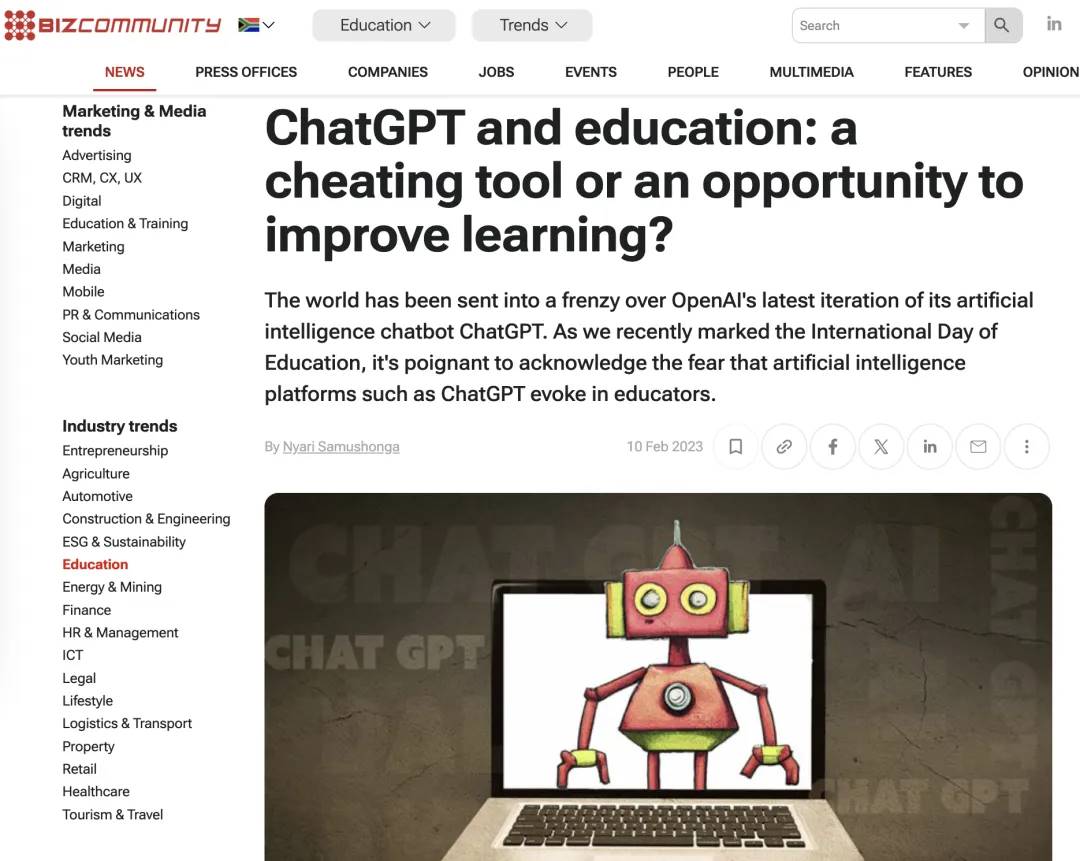
Image source: bizcommunity
In North America, initial reactions were intense. Early in 2023, due to fears of AI misuse, some U.S. regions blocked ChatGPT on school devices. A Pew Research Center survey found only 6% of American K–12 teachers believed AI did more good than harm in education, while a quarter thought it did more harm than good. Most teachers remain观望—both anxious and confused.
But this wave cannot be stopped. Bans are gradually shifting toward guidance, and now North American universities are partnering with tech companies like OpenAI and Anthropic to proactively introduce "education-specific AI."
Europe shows similar trends. Estonia launched a national program called "AI Leap," providing AI tools to students and teachers. Some UK universities have established principles encouraging responsible AI use, and schools in England are piloting AI classroom assistants.
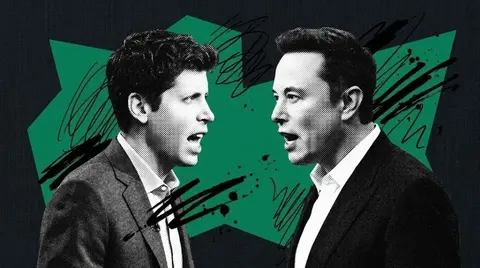
This year, as evidence mounts of AI’s disruptive impact on education, OpenAI CEO Sam Altman announced offering free access to ChatGPT Plus for North American students for a limited time.
To which Nicholas Carr responded:
"In the eyes of AI companies, students are not learners—they are customers."
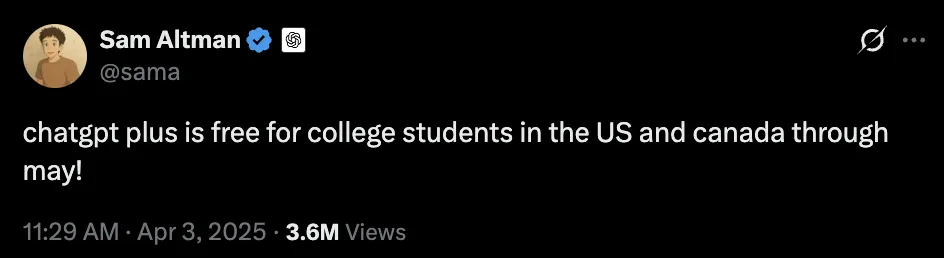
Image source: X
In facing this AI vs. education challenge, institutions worldwide are trying various approaches: redesigning assignments, requiring oral defenses, conducting in-class writing exercises, restoring more paper-and-pencil exams—to ensure assessments test students, not "students plus AI."
Some educators now recognize the crisis isn't just rampant cheating, but the potential collective atrophy of "thinking muscles" under AI assistance. And skeptics of change might pose an even deeper question:
When AI can do it for you, what exactly do students still need to learn?
Join TechFlow official community to stay tuned
Telegram:https://t.me/TechFlowDaily
X (Twitter):https://x.com/TechFlowPost
X (Twitter) EN:https://x.com/BlockFlow_News
 极客公园
极客公园