Michael Saylor's Speech: 21 Keys to Unlocking Trillion-Dollar Bitcoin Wealth
TechFlow Selected TechFlow Selected
Michael Saylor's Speech: 21 Keys to Unlocking Trillion-Dollar Bitcoin Wealth
BTC is the only hard asset destined to outperform gold, U.S. stocks, and real estate over the century.
 Navigating Web3 tides with focused insights
Original author: Michael Saylor, Founder of Strategy
Translation: CryptoLeo, Odaily Planet News
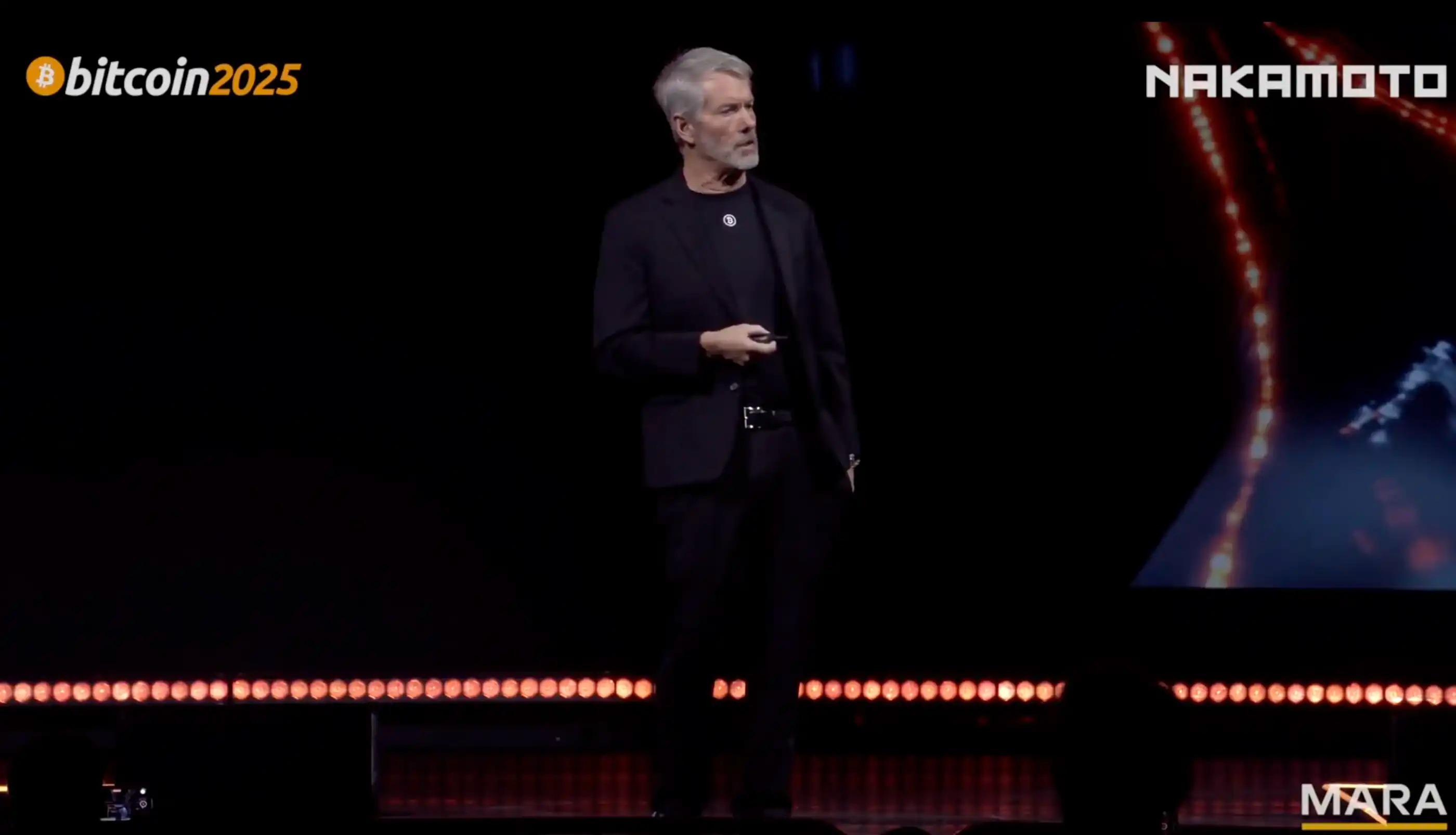
Michael Saylor delivered a speech titled "21 Ways to Wealth" at the Bitcoin Conference, ostensibly outlining 21 paths to wealth but in reality emphasizing the critical importance of buying Bitcoin now. The content also touches on Bitcoin inheritance, simplified enterprise-level Bitcoin operations, and its wealth effects.
Saylor uses 21 words to describe what it takes today to access wealth, with his core thesis being corporate Bitcoin reserves and compounding capital raised under enhanced corporate valuations—an approach slightly aggressive, yet leaving Bitcoin as an inheritance for future generations is also presented as an excellent strategy.
Full transcript translated by Odaily Planet News
I'm delighted to be here with you all today at Bitcoin 2025. I'm especially glad because this talk is meant for everyone. Over the past few years, I've traveled around the world discussing Bitcoin, explaining to many nations why they need Bitcoin, and advising institutional investors, boards, companies, and CEOs about the necessity of Bitcoin.
I’ve even spoken to souls—exploring why our descendants will need Bitcoin (a rhetorical expression with quasi-religious overtones, highlighting Bitcoin’s significance in a surreal context). But today my message is directed at Earth's 8 billion people. This is a path to prosperity for every individual, family, business, and entrepreneur. Bitcoin isn't just suitable for multibillion-dollar public companies—it benefits everyone. Having focused on Bitcoin for so long, I’m delivering this talk specifically for you: “21 Ways To Wealth.”
1. Clarity
Bitcoin offers clarity through transparency and immutability—the code is 'transparent,' everything is clear. Bitcoin is perfect capital, programmable capital, corruption-resistant (immune to human manipulation) capital. When you realize this, your mind becomes clear. Every intelligent, thoughtful person, no matter where they are, wants perfect capital. All your adversaries need anti-corruption capital, and all AIs will want programmable capital. The demand is enormous. How much is Bitcoin worth? Half of the global economy.
2. Conviction
Bitcoin will appreciate faster than any other asset because it was designed to outperform all others. It will grow faster than the S&P, faster than gold. Sorry, Peter (Peter Schiff)—it must outpace gold, real estate, collectibles, or anything else you can imagine, simply because that's how it was engineered.
3. Courage
This leads us to the third way to wealth. If you’re going to get rich from Bitcoin, you’ll need courage—wealth favors those who embrace cryptocurrency risk. Satoshi lit a fire on the internet (Bitcoin). The fearful stay away; fools play around it without acting. Only the loyal fan the flames, dreaming of a better world in its light. Many who watch Bitcoin fear it—they’ll never buy it or benefit. They fall behind. They create derivatives around the fire, make fireworks, craft trinkets.
But those who truly understand it ignite the fire—how? By buying Bitcoin. By selling fiat currency, long-term bonds, inferior equities, real estate—using those proceeds to purchase Bitcoin. Use them to light the fire. What happens then? Under the explosive, viral power of the network, you gain a ticket to prosperity.
4. Cooperation
Cooperation is crucial. You become stronger with the support of your family. You may act alone if you understand Bitcoin—but when your entire family understands it, you're far stronger. Your parents have credit and capital; you have capability and belief, perhaps courage too. Your children have time and potential. Your 80-year-old grandfather can pull funds from retirement accounts, borrow from banks, manage portfolios. The secret is transferring capital into the hands of younger generations. Let the next generation access wealth earlier than the last. Moving capital from the past into future funding—that’s generational work. Think family. Work together.
5. Capability
I could list many technologies here, but the most important one today is mastering artificial intelligence. If you want to get rich in 2025, you want access to accountants, lawyers, professors, historians—the collective intelligence. You want the knowledge every great entrepreneur needs—go to AI. Put it into deep thinking mode. Share your situation, hopes, vision, questions—and begin interacting.
I tell all my executives: before asking lawyers, bankers, or any expert, ask AI first. Let it think. Break through technological barriers through effort.
This is vital because many of the suggestions I’ll give exceed the capabilities of ordinary employees—even mid-level managers.
You might say, “Yes, complex trusts or legal structures sound great, but I don’t have money. I can’t afford to pay hundreds of thousands in legal fees.” Here’s a secret: I employ dozens of lawyers, who themselves hire other lawyers. When I face a problem, I go to AI first. I argue with it. When it says No, I threaten it—demand a solution. I find 95% of answers myself. Then I finalize the plan and send the link to my management team and lawyers: “Look, I solved it. This is what I want to do.” I give them 2 to 5 days to develop an execution plan. If they fail, they leave my team—lawyers replaced, everything changed.
The road to wealth depends on capability. In 2025, no one needs to be a super genius—because each of us can be the composite of 100 geniuses. AI has read everything ever published. If you humbly seek help from AI—not putting ego first, but interests first—your family will thank you in the years ahead.
6. Composition
Create legal entities for scalable strategies and asset protection. For example, you could borrow against your 401(k), invest in an IRA, design an effective insurance policy, or establish a dynasty trust in Florida—benefiting your descendants for the next 300 years. You might discover South Dakota’s “perpetual dynasty trust” is ideal, as it can exist forever, protecting family wealth across generations.
Odaily Note: Section 401(k) of the U.S. Internal Revenue Code refers to an employer-sponsored retirement savings plan allowing employees to contribute part of their salary into a tax-advantaged account for future retirement.
Your natural reaction might be confusion—“I don’t know how to do this.” Ask AI. Figure out the process. By the way, I won’t give exact answers because it varies completely if you live in Dubai or Singapore, or North Dakota. You get different answers based on who you are. But I can tell you this: go online, launch AI, and start asking. It will give you customized answers so you can work hard—and work smart.
This is far easier than before. Ten years ago, someone would say it’s too difficult, takes a year, lawyers are too slow and expensive. Today, everyone can be as smart as the most complex billionaire families. You can access the same legal advice, achieve the same efficiency.
7. Citizenship
Citizenship matters. Choose a jurisdiction aligned with your economic life—a place whose sovereignty respects your freedom. What does this mean for you? Everyone’s situation differs. But here’s a simple tip: ask AI—what are the top 10 U.S. states most friendly to Bitcoin holders?
Now go ask any AI: “Why not rank every country in the world based on their friendliness toward Bitcoin ownership or investment?” Describe your case—it will give you an answer. I encourage you to think deeply, because living in Florida is different from other states. We like Wyoming—we have Senator Cynthia from Wyoming who supports Bitcoin.
But you must investigate: what are the state, county, city, and national stances on Bitcoin? Think deeply. This isn’t about this year—it’s about the century. What will you and your family become over the next 100 years? Your descendants will thank you.
8. Civility
The eighth point is civility—respecting the natural power structures of the world. For instance, in a wildlife park, don’t fight the lion. Don’t battle market trends or economic realities. Don’t take selfies while hiking off cliffs. Respect natural forces. I think everyone understands this.
Additionally, if you want to build wealth in the Bitcoin universe, consider how the world is structured. Remember, you don’t need to overthrow governments you dislike, change others’ religious beliefs, or dismantle existing systems.
You must choose your battlefield. Respect social norms. Avoid unnecessary conflicts—they only drain energy. Whenever I look at the world, I see 100 things I’d like to change. But I realize the world only cares about my opinion on one of them. The chance of successfully changing the other 99 is near zero. If you want to create wealth, figure out what you’ll do—focus and stay civil.
You’ll often meet people with different religious, political, economic, and cultural beliefs. Seek common ground and move forward. Provoking conflict and distraction only slows your journey into the future. So civility serves you well.
9. Corporation
The ninth path to wealth is through corporations. A properly structured company is the most powerful wealth creation engine on Earth. As an individual, I recommend you ask AI how to form a company—whether a single entity or multiple ones. Companies have special access to banking systems and unique rights in every business. They enjoy legal immunities.
Companies can scale sustainably, achieve tax efficiency, operate with various efficiencies, and command greater credibility. They can sell equity and finance the future. A company can envision a 30-year project, bring its economics into the present, and invest now. Individuals cannot do this. So while being an individual is admirable, there’s no shame in becoming a one-person company or family enterprise.
If we examine the world’s hierarchy and rank it: individuals sit at the bottom. Family businesses and partnerships hold more power. Small and medium private enterprises rank higher. Then large private firms. Next, small public companies listed on OTC markets.
Larger capital market players surpass Nasdaq or NYSE-listed firms. Then come seasoned issuers in the U.S. capital markets. At the pyramid’s peak are the globally recognized, veteran issuers—only a few hundred worldwide. When you reach the top—filing registration statements and selling $1 billion in securities within six hours—you achieve true scale. This is possible for each of you. I hope you all fulfill your potential. Founding a company is the first step.
10. Focus
The tenth point is focus. The road to wealth lies in focus. Just because you *can* do something doesn’t mean you *should*. I’ve done many things. I’m 60 years old.
One reason I embrace Bitcoin with religious fervor and ideological passion is that I had opportunities in my 20s, 30s, 40s, and 50s. You’ll find it extremely challenging to operationally change the world. I once believed my brilliant ideas were flawless—but outcomes didn’t match expectations.
In fact, if you invent a new product, service, or concept, there’s a 90% chance it fails within five years. But if you invest in Bitcoin on your balance sheet, you have a 90% chance of success over five years. Over 30–40 years, the success probability rises to 99%. Nearly every operational idea has a 99% failure rate, while nearly every Bitcoin-based financial idea has a 99% success rate.
Don’t confuse ambition with achievement. Remember, companies holding Bitcoin achieve annual asset returns between 30% and 60%. You grow at 30%, 40%, 50% per year. If you do nothing, consider every operating business—your restaurant, hotel, or shop opened this year—then aim to grow it 30% annually over the next 20 years. Only seven companies have achieved this—we call them the “Magnificent Seven.” Many tried. So when building strategy, stay focused. Avoid distractions.
11. Equity
The eleventh point is equity—sharing your opportunity with investors willing to share risk. Companies can do this; individuals cannot. Metaplanet did exactly this—growing from a $10 million to a $5 billion market cap through equity investors. Without them, they’d be nothing. My company grew from $1 billion to $100 billion in value—achieved with the help of our equity investors.
If you’re a dentist earning $200,000 in annual cash flow, you could buy $200,000 worth of Bitcoin every year for 20 years. Not a bad idea—you’d become the richest dentist in your neighborhood. But incorporate your dental practice, value it at five times cash flow—$1 million—and sell 33% for $500,000. Invest that $500,000 in Bitcoin. One year later, raise another $500,000 at 2x, 3x, or 4x valuation to reinvest. A year after that, raise $3 million to invest. You’ll become the first billionaire dentist on your block. What did you do differently? You collaborated and shared upside. That’s what Strategy did. That’s what Metaplanet did. That’s what many successful companies do.
12. Credit
The twelfth point is credit. What does this mean? Many people fear the future. Many want to protect their money or earn modest yields. Japanese corporate bonds yield 50 basis points; U.S. investment-grade bonds yield 400–500 bps. As a company, offer creditors certainty—fixed coupons, fixed dividends, seniority in your capital structure—and you convert risk into return. You give them secure, predictable income, and in return, you gain capital.
There are countless such people. “I’m retired—I want a guaranteed 8% return. I don’t want to lose my money.” If you offer this, you can access capital. And if that capital compounds at 30% to 60%, worst case you capture a 22% spread—all capital deployed upfront. Credit sometimes gets a bad name.
But ultimately, as an individual forming a company, you can create credit. Want to be the billionaire dentist on your block? Form a company, sell some equity. Sell part of your future cash flows to drive stock appreciation, then borrow money, issue preferred shares, or sell financial instruments to those wanting lower risk, lower return, and more certainty. Repeat. The goal isn’t to invest $200,000 or $50,000 in cash flow annually over 20 years. The goal is to use proper financing to obtain 100x capital immediately and deploy it into Bitcoin.
13. Compliance
13 isn’t always lucky—I use the word “compliance.” Operate within the rules of your market to build the best possible company. Each market differs. Public companies have special rights—they can issue stocks and bonds. Trust companies have other advantages—greater tax efficiency. Insurers have special rights—they can reinvest annuities, assume risk, and build highly efficient tax tools. Broker-dealers have special rights. Exchanges have special rights. Banks have special rights—using $1 million in capital to create $20 million in fiat currency, leveraging 20x. That’s power.
Though compliance sounds complex, if you form a company and understand market rules, you can operate efficiently and build a highly productive enterprise. Then use that entity’s strength to raise capital, invest in Bitcoin, and generate wealth. It’s more complex—but if you have the talent, you’ll move faster and farther.
14. Capitalization
The fourteenth point is capitalization—relentlessly raise and redeploy capital quickly and at scale to compound wealth. For example, start a small hotel, sell 10% equity, buy Bitcoin.
Bitcoin rises—so does your hotel’s value. Sell another 20% equity to buy more Bitcoin. Enterprise value grows—borrow more to buy Bitcoin. Value keeps rising—raise capital via cash flow, government bonds, buy Bitcoin. You own a house free of mortgage—if you can borrow at 6% to invest in Bitcoin, which rose 80% last year—even if annualized returns are 30% or 20%, borrowing at 6% and investing at 20% captures a spread. That’s compounding.
This is a race using Bitcoin—the winner is whoever holds the most Bitcoin when the game ends.
15. Communication
The fifteenth point is communication. If people don’t trust you, no one gives you money—creditors won’t lend. They won’t accept your loans, buy your bonds or preferred shares. Equity investors won’t buy your stock.
No one does business with your employees, suppliers won’t trust you. You must speak honestly, act transparently, and repeat this frequently across all modern digital channels. In the Bitcoin world, wealth accumulation doesn’t require complex strategies. Just a simple, clear strategy. Once others understand what you’re doing, they’ll support you—and you’ll succeed.
16. Commitment
The sixteenth point is commitment—don’t let yourself get distracted.
Many discovered Bitcoin before me. Between 2011 and 2014, people found it—then chased other coins, other concepts, played with Bitcoin. Then wrote books boasting how smart they were to discover it.
They founded companies, sat on boards—then the board made them sell their Bitcoin. So stay committed to Bitcoin. The idea is strong. When people online mock you as foolish, ignore the trolls. Don’t argue. By the way, don’t get distracted by your own good ideas—don’t chase your own brilliance. Satoshi gave you something worth half the Earth’s economy.
The most common mistake entrepreneurs make is falling in love with their own idea and trying to execute it. You already possess the greatest thing in human history—Bitcoin. You live in an era when most people on Earth don’t understand it. All you need to do is figure out how to use it right now. Countless other ideas may emerge later—don’t waste time on things destined to fail. Choose your battlefield wisely. Don’t try solving problems beyond your capacity. You may have opinions on many issues—feel angry, think things are terrible. I agree. But the truth is, the world likely doesn’t care what you think. Unless you can personally stop the “war,” then go do it. But if you can’t, don’t take your success for granted—avoid energy-draining distractions.
17. Competence
Execute consistently, precisely, reliably. Never take customers for granted, security for granted, success for granted. Stay laser-focused. The world demands perfection. When I joined DuPont (where Saylor worked as an internal consultant), they said: “You’re allowed one mistake—but never a second.”
You might think you can multitask, but your competitors stay laser-focused. Ultimately, markets shift toward those with singular focus.
18. Adaptation
Over a long enough timeline, every counterparty fails—including you. Within 100 years, everyone—including every bank, company, and structure you trust today—will collapse. You must adapt. Wise people prepare throughout life to shed burdens repeatedly. Be ready. Make a plan. Start executing now. Monitor quarterly, annually. When the path no longer works, don’t hesitate to change direction. Have succession plans. Keep everything organized.
19. Evolution
Leverage your core strengths—use your strongest assets. Aim for graceful evolution, not radical mutation. If you excel in a particular culture, capital market, or domain, build your business upon that expertise. When you lose balance or enter a completely unfamiliar field, execution risk increases a hundredfold.
20. Advocacy
Advocacy is vital—encourage others to engage with Bitcoin. Become a missionary for economic freedom. The more individuals, businesses, governments, institutions, cities, and leaders adopt Bitcoin, the greater your chances of success—and theirs—and Bitcoin’s—and humanity’s.
21. Generosity
The final point is generosity. When you succeed, wake up each morning spreading joy and hope. For those less fortunate, you walked the path first. Spread goodwill. Ensure you pass it on to your employees, family, friends, clients, investors, and community. They’ll see your light, respect and support you. They’ll be inspired and follow you. This helps you, helps business, helps Bitcoin, helps the world.
Conclusion
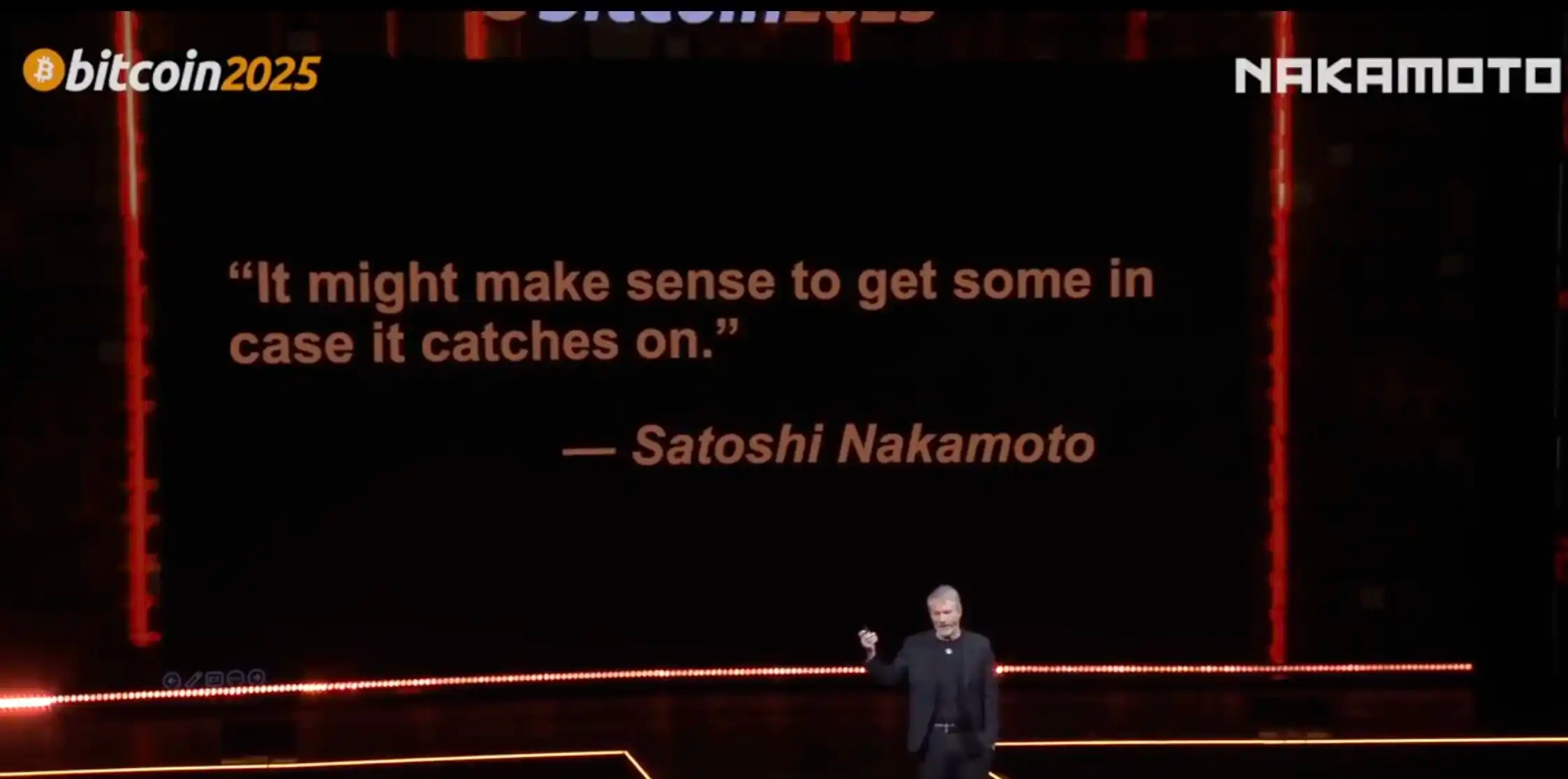
I’ll end my speech with this:
“It’s been 16 years since Bitcoin was born in 2009. Two trillion dollars have proven its value. Who knows how much wisdom has been passed to the world? I stand here able to give this talk—but far greater than me, Satoshi, many years ago, with none of this information, proof, or time, spoke just 12 essential English words: It might make sense to get some in case it catches on.”
Join TechFlow official community to stay tuned
Telegram:https://t.me/TechFlowDaily
X (Twitter):https://x.com/TechFlowPost
X (Twitter) EN:https://x.com/BlockFlow_News
 Odaily