Tencent's AI "Landing Battle"
TechFlow Selected TechFlow Selected
Tencent's AI "Landing Battle"
From "building models" to "using models effectively," Tencent wants to be the hands that bring AI to life.
 Navigating Web3 tides with focused insights
Author: Lian Ran
Over the past year of rapid evolution in the AI industry, "large models" have almost become the centerpiece of every discussion. From parameter scale and inference speed to multimodal capabilities, technical benchmarks are constantly being refreshed. But from a more sober perspective, the real competition around large models has long transcended the question of "whose model is bigger or stronger." Standing at the 2025 vantage point, the key determinants of success lie in whether one can continuously build valuable model capabilities, truly understand complex user scenarios, and ultimately transform these capabilities into usable products.
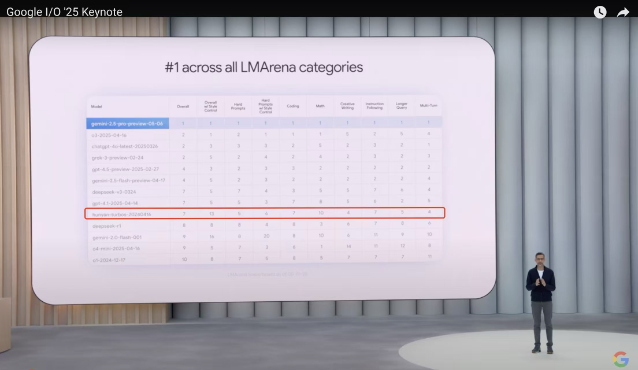
When it comes to "product building" in the internet industry, many people first think of Tencent. Yet during this wave of large AI models, Tencent remained extremely "low-key" for a long time. So much so that many only realized Tencent's Hunyuan had joined the global top-tier model ranks after seeing it referenced at Google’s I/O developer conference. At the May event, Google CEO Sundar Pichai cited the Chatbot Arena leaderboard, casually revealing Tencent's Hunyuan large model: seventh globally, second in China, just behind DeepSeek.
Tencent AI's moment of surprise came at the beginning of this year. After DeepSeek went viral, Tencent acted unusually—quickly and publicly integrating it. Its AI-native app "Yuanbao" iterated at a daily update pace, with its DAU rapidly climbing to domestic top-tier levels within two to three months—a stark contrast to its previously laid-back approach. What kind of strategic game is Tencent really playing with its mix of fast and slow moves?
On May 21, at the Tencent Cloud AI Industry Application Summit, Martin Lau, Senior Executive Vice President of Tencent Group and CEO of Cloud & Smart Industries Group, summed up Tencent's AI development direction in one sentence: "Make AI accessible to everyone, make value instantly reachable." Behind this statement lies Tencent's overall mindset in AI: not obsessed with "who will first achieve AGI," not chasing "buzzwords or new concepts," but committed to building a structurally sound, continuously evolving, and robust AI capability system.
The core of this system does not lie in excelling at any single technical metric, but in the co-evolution of models and products. Tencent doesn't downplay the importance of models—in fact, it consistently emphasizes that models are the foundation of all AI capabilities. As recently as April this year, Tencent formally established its "Large Language Model Department" and "Multimodal Model Department," further strengthening its self-developed model capabilities in a systematic way. This reflects Tencent's continued adherence to a long-term philosophy of "small steps, fast iterations" at the foundational technology level.
Tencent’s advantage extends beyond the model itself—it lies in how technological capabilities are accumulated over time and ultimately materialized into tools that users can actually use and that continuously create value. This reflects both technical patience and product-oriented realism.
01 Tencent's AI Strategy Core: Not Chasing 'Biggest,' But Building 'Usable'
Before DeepSeek R1 emerged, the mainstream strategy among Chinese tech giants was to build large models with massive parameters and an "AI closed loop"—achieving self-sufficiency across models, tools, and application scenarios.
In contrast, Tencent's approach appears more pragmatic: instead of blindly racing in parameter scale, it focuses on transforming large model capabilities into accessible, serviceable, and sustainable product forms. From Yuanbao's explosive comeback at the start of the year to the recent declaration that "all Tencent businesses fully embrace AI," Tencent's determination to nail product execution is evident. Today, building "usable" AI products is becoming an industry-wide consensus.
According to Lau, this shift stems from the "milestone-level" change brought by DeepSeek—an evolution from quantity to quality. "In actual usage, users have clearly felt AI's usability improving further. AI is now crossing the threshold of industrial deployment and standing at a new node of widespread adoption."
At the recent Tencent Cloud AI Industry Application Summit, he further pointed out that generative AI must evolve from "usable" to "good to use." This leap requires a new round of acceleration across four layers: large models, agents, knowledge bases, and infrastructure.
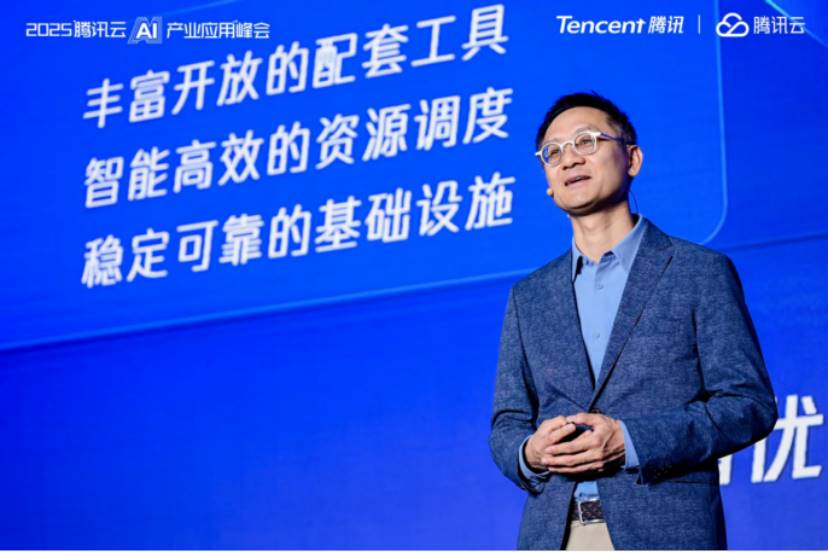
Martin Lau, Senior Executive Vice President of Tencent Group and CEO of Cloud & Smart Industries Group | Source: Tencent Cloud
Specifically, continuous optimization of model capabilities leads to better performance and interaction experiences; intelligent agents can autonomously think, decide, and execute tasks based on models; knowledge base systems help reduce hallucinations and enhance contextual understanding, making models "understand enterprises and users better"; and continuous iteration of underlying infrastructure significantly reduces training and inference costs while boosting system response speed. This structure reflects Tencent's accumulated understanding of "usability" throughout the productization and servitization process.
This "use-driven development" approach is particularly clear in the evolution of Tencent's self-developed Hunyuan model family. Since its first release in 2023, Hunyuan has continuously iterated, with technical capabilities steadily rising. This year, it launched the fast-thinking Turbo S model and the deep-thinking T1 model, both achieving leading industry levels in public benchmark tests.
Beyond language models, Tencent continues to invest heavily in multimodal capabilities, advancing research in image, video, and 3D generation, as well as image understanding and end-to-end speech models, aiming to provide comprehensive AI support for broader commercial scenarios. The continuous expansion of this capability system enriches supported interaction modes and significantly lowers user entry barriers for applications.
Besides deepening its self-developed systems, Tencent actively integrates external high-quality model capabilities with the goal of "usability," aiming for optimal combinations. This strategy was first evident in "Yuanbao," its general AI assistant. Yuanbao adopts a dual-engine architecture combining Hunyuan and DeepSeek, making it one of the earliest major products to integrate DeepSeek. This architecture represents Tencent’s strategic integration choice based on performance comparison, scenario fit, and user needs.
Since launch, Yuanbao has maintained high-frequency iteration, gradually integrating features such as WeChat file access, official account content, voice input, and document processing, while supporting web search and image understanding. These may appear as minor refinements, but they form the foundational pillars of product experience stability and sustainability. In its financial report, Tencent disclosed that Yuanbao’s DAU grew over 20 times within a month starting from February 13.
This isn’t a victory of model parameters—it’s a demonstration of systemic capability centered on delivery.
Tencent also continues validating this system’s effectiveness across multiple internal scenarios: the AI assistant in Tencent Meeting generates meeting summaries and suggestions based on real-time and historical content; Tencent Cloud’s code assistant CodeBuddy covers over 85% of the company’s developers, significantly boosting efficiency and reducing overall coding time by more than 40%; the AI health assistant launched by Tencent Health automatically interprets medical check-up reports and generates personalized follow-up recommendations.
In essence, Tencent’s AI strategy has never been merely about creating the "smartest brain," but consistently focused on building a "truly useful assistant."
02 From 'Functional' to 'User-Friendly': Building a Complete Deliverable AI System
Moving from "functional" to "user-friendly" relies not on breakthroughs in isolated components, but on accumulated capabilities across an entire technology stack.
Rather than defining AI capability boundaries by parameter count, Tencent systematically builds a deliverable path—from underlying architecture to final user experience. This involves a highly coordinated technical ecosystem encompassing multimodal interaction, inference optimization, knowledge enhancement (RAG), multi-source data support, high-concurrency processing, cloud security mechanisms, agile development methods, user insight systems, and an open ecosystem for partners.
High-quality content and data are core elements for large model usability. As model capabilities converge, this domain will become the central battleground for future AI product competitiveness—and it’s precisely where Tencent can best leverage its unique advantages.
Tencent possesses rich content resources: official accounts, Tencent News, and WeRead in text and images; Channels and Tencent Video in video; and authoritative professional content like Tencent Medical Encyclopedia. These serve as high-quality sources for models to draw upon, enabling high-quality responses. Yuanbao, for example, leverages WeChat official account content and powerful web search capabilities to ensure the quality and timeliness of retrieval and generation results. According to SuperCLUE evaluation reports, among 10 platforms integrating DeepSeek-R1, Yuanbao ranked first in web search capability, topping the overall score, basic retrieval ability, and analytical reasoning ability.
This high-quality content ecosystem also strongly attracts many domestic model, content, and hardware vendors. For instance, OPPO smartphones and Xiaomi smart speakers are integrating model capabilities powered by QQ Music and other resources into their music Q&A modules to meet user needs.
Multimodal capabilities were once seen as essential for AGI; today, they have become a critical differentiator in product competition. It’s also a key battlefield where Tencent, leveraging years of accumulation, is determined to take the lead.
Starting from early labs like Youtu and Tianlai, Tencent has amassed extensive patents in image and audio-video technologies. Today’s Tencent Meeting is a culmination of these multimedia strengths. In the AI era, Tencent continues enhancing its multimodal edge. On May 21, Tencent announced a series of new multimodal models: Hunyuan Image 2.0 achieved real-time, commercially viable image generation; the visual deep-reasoning model T1-Vision supports multi-image input with native chain-of-thought reasoning, enabling seamless "thinking while viewing"; Hunyuan 3D, using an industry-first sparse 3D native architecture, made generational leaps in controllability and ultra-high-definition generation; the end-to-end voice calling model Hunyuan Voice delivers low-latency calls with improved human-likeness and emotional expressiveness.
Lau has repeatedly emphasized the importance of multimodality. He believes the real world is a complex system composed of multidimensional information. "In the future, AI must possess vision and hearing like humans to fully and accurately understand the world. Beyond text, it should convey information completely and authentically through tone and gestures."
From this perspective, developing multimodal models is not just technical expansion, but a redefinition of user experience. By unifying the input and output of images, speech, video, and text within a single model framework, users can interact with AI more simply and receive richer results, significantly lowering usage barriers. This makes AI no longer just a "geek’s toy," but truly accessible to a broad user base.
Besides being low-barrier and interactive, AI must also be accurate and reliable when deployed. As Lau previously stated, "What enterprises need is solving a specific problem effectively in real scenarios—not achieving 80% performance across 100 scenarios."
On the front of "making AI more reliable," RAG (Retrieval-Augmented Generation) is widely seen as an effective short-term path to improve accuracy and contextual understanding. Tencent is one of the earliest cloud providers to advocate and adopt the "large model + RAG" approach. Leveraging long-term expertise in document parsing and vectorization, Tencent has built a structured knowledge enhancement system that seamlessly integrates enterprise private knowledge bases with general models, effectively reducing hallucination rates and deepening business comprehension. This provides foundational support for enterprises building customized AI assistants.
Tencent’s RAG capability stems from years of technical accumulation and massive application practices. As early as 2019, Tencent applied vector data retrieval capabilities across over 40 internal business scenarios including Tencent Video, QQ Browser, and QQ Music, handling more than 160 billion requests daily. With vector retrieval, QQ Browser reduced search costs by 37.9%, while per-user listening time on QQ Music and effective exposure duration on Tencent Video saw significant increases.
To support smooth front-end experiences, backend infrastructure becomes the invisible barrier to scalable deployment. AI model training and inference place extreme demands on computing resource scheduling, data flow efficiency, and system responsiveness. Tencent addresses this by building an integrated software-hardware infrastructure—including the Tencent Cloud TI platform, high-performance HCC clusters, GooseFS high-speed storage, and Xingmai Network—greatly improving training efficiency and inference performance while significantly reducing latency and cost.
Once AI systems enter real business environments, data privacy, permission control, and traceability become critical underlying risks for clients. Drawing on its experience serving billions of users, Tencent has built a comprehensive security system covering identity authentication, data isolation, hierarchical permissions, and encrypted transmission. Compared to emerging players focused solely on algorithmic performance, this "system experience from legacy businesses" forms the foundational moat allowing Tencent AI to penetrate complex industry scenarios.
Thus, the core logic of Tencent's AI capability system isn't just about achieving the "strongest" model, but ensuring the model can truly be "delivered." From functional technical capabilities to usable system capabilities, and finally to user-friendly product experiences, Tencent drives the transformation of cutting-edge AI into universally applicable tools. This explains why, when DeepSeek emerged, Tencent was among the first large companies to complete integration, rapid deployment, and stable operation—not because it ran the fastest, but because it had always been preparing to run the longest.
03 From Internal Use to Co-Creation: How Tencent Cloud Drives AI Adoption in the B2B Market
Tencent’s AI strategy is not about working in isolation. It始终坚持 (adheres to) accumulating capabilities within its own scenarios and expanding markets through practical validation. What truly enables its move into the B2B market is not a breakthrough in a single-point model capability, but the construction of an entire "deliverable" system—one that not only "builds AI" but also "turns AI into services" and delivers them stably and conveniently to customers.
At this year’s Tencent Cloud AI Application Summit, the newly upgraded agent development platform and knowledge base products attracted attention from enterprises and developers. These tools greatly lower the threshold for AI deployment and expand application coverage.
As the entire industry focuses on AI agents, Tencent Cloud’s upgraded "Agent Development Platform" offers enterprises various agent-building modes and supporting tools. It achieves zero-code support for multi-agent handoff collaboration for the first time, dramatically lowering the barrier to agent creation. Meanwhile, the platform provides a complete set of agent tools, supports the MCP protocol, and aligns with key definitions of OpenAI Agents SDK, helping agents better utilize tools and expand services.
Building enterprise knowledge bases has become a must-have for AI adoption. Tencent Lexiang Enterprise AI Knowledge Base breaks down departmental and hierarchical silos, managing knowledge validity, update timing, and access permissions. It also supports multi-user collaboration and co-creation, accelerating internal knowledge flow and enabling AI to better manage and apply enterprise knowledge for higher-quality content production.
Beyond this, as model applications spread, demand for computing power is shifting from training to inference. Optimizing large-scale inference costs has become a core competitive edge for cloud providers. Tencent Cloud improves model response speed, latency, and cost-effectiveness in inference scenarios through coordinated optimization at both the IaaS and tool layers.
In a recent speech, Lau specifically mentioned their successful case helping Honor efficiently deploy DeepSeek. Honor wanted to integrate DeepSeek-R1, but as more AI features were added to phones, frequent and high-concurrent model calls led to high response delays, severely impacting user experience. Tencent Cloud used its acceleration capabilities to help Honor deploy the full-featured version of DeepSeek-R1, increasing model inference throughput by up to 54%, significantly speeding up responses and ensuring faster, more stable model operation and smoother system scheduling.
Tencent’s B2B strength goes beyond infrastructure—it lies in its deep understanding of industries and use cases.
Take the automotive industry: FAW Toyota introduced Tencent Cloud’s Agent Development Platform into its customer service system to systematically tackle the industry-wide issues of traditional chatbots—"inaccurate, incomplete, and slow responses." Previously, companies often faced technical bottlenecks like difficulty retrieving proprietary knowledge and generating overly generic content, preventing true AI deployment. Based on its self-developed large model and integrating RAG, proprietary long-text embedding, OCR, and multimodal components, Tencent Cloud helped FAW Toyota build an integrated intelligent customer service system across official websites, apps, mini-programs, and official accounts.
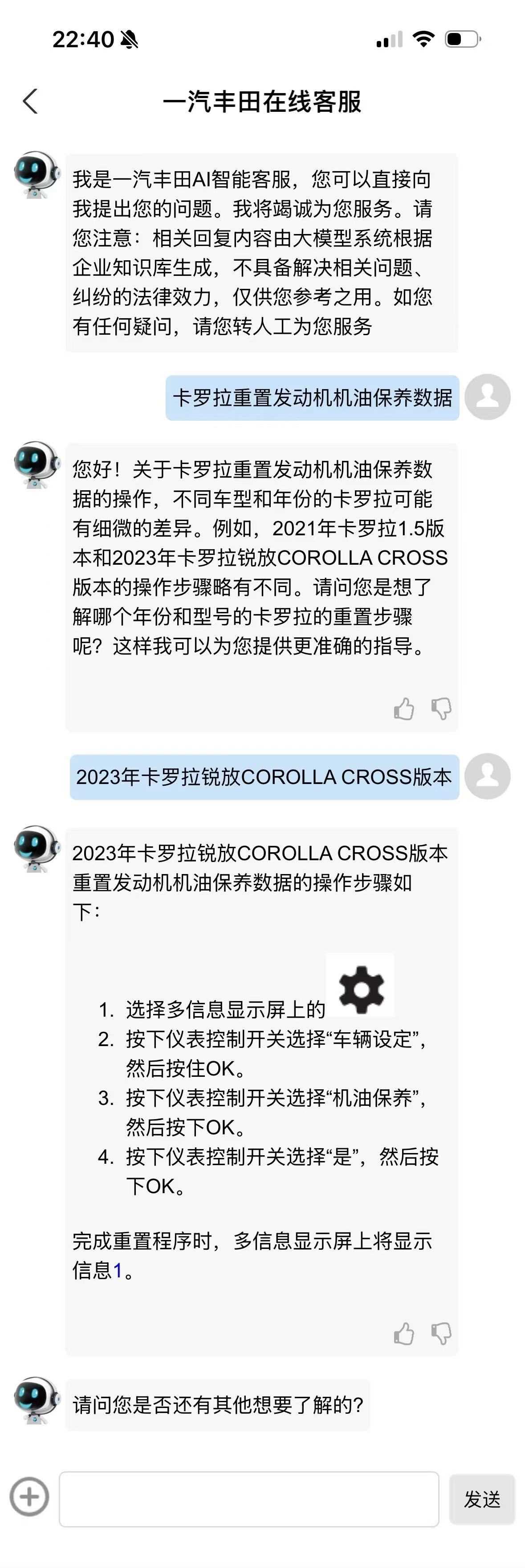
Conversation with FAW Toyota's intelligent online customer service bot | Source: Tencent Cloud
After launching the system in January this year, the intelligent customer service’s independent resolution rate rose from 37% to 84%. It now automatically answers over 17,000 user queries monthly, effectively relieving pressure on human agents and improving customer satisfaction. More importantly, FAW Toyota used Tencent Cloud tools to extract structured knowledge from historical customer service logs, expanding its enterprise knowledge base and laying the groundwork for long-term, stable operation of the customer service system.
For an automaker selling nearly a million units annually with nationwide service touchpoints, this upgrade is more than a technical overhaul—it marks the transition of AI "from experimentation to production." It validates Tencent Cloud AI’s "deliverable capability" with tangible results—every step, from model integration and system access to knowledge orchestration and experience closure, is measurable, deployable, and iterative, achieving true alignment between technological and business value.
This reflects not just "experimental AI adoption" in a single industry, but Tencent’s path toward transforming AI into a new form of productivity that is "deliverable, evolvable, and collaborative" through platformized tools, structured knowledge, and natural interactions.
As the AI industry gradually enters the "practical phase," players who once gained attention through "technical hype" are cooling down, while companies like Tencent—with long-term investment in capability accumulation and system services—are beginning to show structural advantages.
Tencent’s ability to quickly seize the DeepSeek opportunity and steadily expand its B2B market reach does not stem from a model windfall or a lucky strategy, but from a systemic understanding of "how to use models well, stably, and effectively."
Its approach does not rely on a single "core algorithm" or a strategic slogan. What has propelled Tencent AI forward is a sustained understanding of user needs, long-term refinement of system capabilities, and respect for the logic of real-world deployment.
This, perhaps, is the true long-term moat Tencent has built in the AI era.
Join TechFlow official community to stay tuned
Telegram:https://t.me/TechFlowDaily
X (Twitter):https://x.com/TechFlowPost
X (Twitter) EN:https://x.com/BlockFlow_News