Stablecoin's 10-year journey through trials and tribulations, finally crowned by U.S. authorities as "peer-to-peer electronic cash"
TechFlow Selected TechFlow Selected
Stablecoin's 10-year journey through trials and tribulations, finally crowned by U.S. authorities as "peer-to-peer electronic cash"
In the future, independent payment solutions for niche industries based on the real world may become possible.
 Navigating Web3 tides with focused insights
Author: Wenser, Odaily Planet Daily
As BTC price approaches a new high near $112,000 and the U.S. stablecoin regulatory bill, the "Genius Act," prepares for launch, the crypto industry and the global economic system are becoming increasingly intertwined. It is now clear that the payment system is the crown jewel of the crypto industry, with BTC being the gemstone atop that crown. This is also why PayFi, U cards, and RWA have become contested battlegrounds where exchanges and crypto projects are heavily converging, amid the accelerating mainstream adoption of crypto assets. In the future, independent payment solutions tailored to specific real-world industries may become feasible.
In this article, Odaily Planet Daily provides a brief overview and discussion of the stablecoin industry's historical development and future trajectory.
Stablecoin Revolution: The Crypto Era Defined by USDT (2014–2024)
In 2008, a paper titled Bitcoin: A Peer-to-Peer Electronic Cash System appeared on the P2P Foundation website, authored by Satoshi Nakamoto—the figure later revered as the founding father of the crypto industry. This occurred shortly after the conclusion of the 2008 subprime mortgage crisis triggered by severe U.S. dollar inflation, during which the global economy was slowly rebuilding. Undoubtedly, BTC was originally created to address the deep-rooted flaws of centralized monetary supply systems and the lengthy, rigid, and inflexible global financial payment infrastructure.
Yet, contrary to the expectations of many early crypto pioneers including Satoshi Nakamoto, it was not BTC—championing decentralization—that ultimately fulfilled "BTC’s peer-to-peer payment legacy," but rather various stablecoins tightly pegged to the U.S. dollar and U.S. Treasuries.
The Rise of USDT: Encircling the City from the Countryside, Capturing Market Share Through Use Cases
Reviewing Tether's rise, we can roughly categorize its strategy into three phases:
(1) From Crypto Blood to Crypto Oil
In October 2014, Tether was founded, with its core product being the stablecoin USDT issued on Bitcoin’s Omni protocol;
In February 2015, USDT launched on Bitfinex, then the largest Bitcoin trading platform. Tether CEO Paolo Ardoino also served as CTO of Bitfinex, and due to significant team overlap, the two companies have long been viewed externally as “sister companies”;
In 2018, Tether issued USDT on Ethereum using the ERC-20 standard. This version remained compatible with the original protocol, further enhancing usability. Riding the wave of Ethereum’s ecosystem growth, Tether and USDT began permeating the crypto ecosystem like vital blood vessels.
In 2019, TRON successfully partnered with Tether, propelling TRON forward as a leading stablecoin network. TRON became a heavyweight issuer responsible for over one-third of all USDT issuance, while TRON founder Justin Sun leveraged an aggressive token-distribution strategy to elevate TRON into a foundational piece of crypto infrastructure.
Clearly, after validating its early redemption fee-based profit model, Tether had already established competitive moats and a viable business model through USDT, gradually evolving into a petroleum-like base commodity serving as a transactional equivalent across the crypto ecosystem.
(2) From Within Crypto to Beyond Crypto
By 2020, the DeFi Summer explosion drove stablecoin market capitalization higher than ever. Naturally, Tether and USDT seized first-mover advantages. Yet Tether’s ambitions extended far beyond the crypto world, reaching into broader economic domains.
As previously detailed in our article “'Top Stablecoin' USDT Hits Record Market Cap: Unveiling Tether’s Billion-Dollar Empire,” USDT use cases include serving as a general cryptocurrency equivalent, alternative currency in high-inflation regions, and primary tool for cross-border trade. After earning massive profits, Tether expanded its reach into the wider global economy via investments, acquisitions, U.S. Treasury holdings, gold reserves, and BTC reserves—deepening ties outside the crypto sphere. This is also a key reason why USDT has faced criticism as an alleged “money laundering accomplice.” After all, money never sleeps—and neither does USDT.
(3) From Payment Medium to Value Storage
In 2021, after settling with the New York Attorney General's Office (NYAG) and paying a $41 million penalty to the U.S. Commodity Futures Trading Commission (CFTC), Tether cleared its most significant developmental hurdle. From then on, USDT’s role evolved from a mere payment tool toward value storage. Despite prior de-pegging incidents and FUD around reserve assets, USDT emerged as one of the few assets hoarded in the volatile crypto market—the other being BTC. Notably, continuous purchases of U.S. Treasuries, its strict 1:1 dollar peg, strong brand recognition, and annual profits reaching tens or even hundreds of billions of dollars gave USDT the confidence to claim its title as the “twin dollar.”
From a once-wild crypto project to today’s dominant stablecoin force, Tether and USDT have staged a remarkable campaign of “encircling the city from the countryside, capturing market share through real-world use cases.”
USDC’s Alternative Path: Centralized Development, Crypto IPO
Unlike Tether’s USDT, Circle—the company behind USDC, backed by Coinbase—chose a completely different path: building entirely for compliance.
Beyond standard U.S. Treasury reserves, Circle’s profit model is significantly more fragile compared to Tether’s, as partners like Coinbase and Binance consume a large portion of its revenue. This fragility partly explains why Circle pushed hard for a crypto IPO following Trump’s return to power—only by leveraging existing compliance advantages and promptly expanding its foundation from crypto into traditional finance could it gain stronger bargaining power and secure greater financial, resource, and policy support in future competition.
Besides giants USDT and USDC, numerous other stablecoin projects—from early entrants like TrueUSD (TUSD), Circle Coin (USDC), Gemini Dollar (GUSD), Paxos (PAX)—to current players such as DAI (MakerDAO), USDS (Sky), USDe (Ethena), PYUSD (PayPal), RLUSD (Ripple), USD1 (WLFI)—are fiercely competing for this highly profitable market. Who will ultimately prevail remains subject to regulatory scrutiny and the test of time.
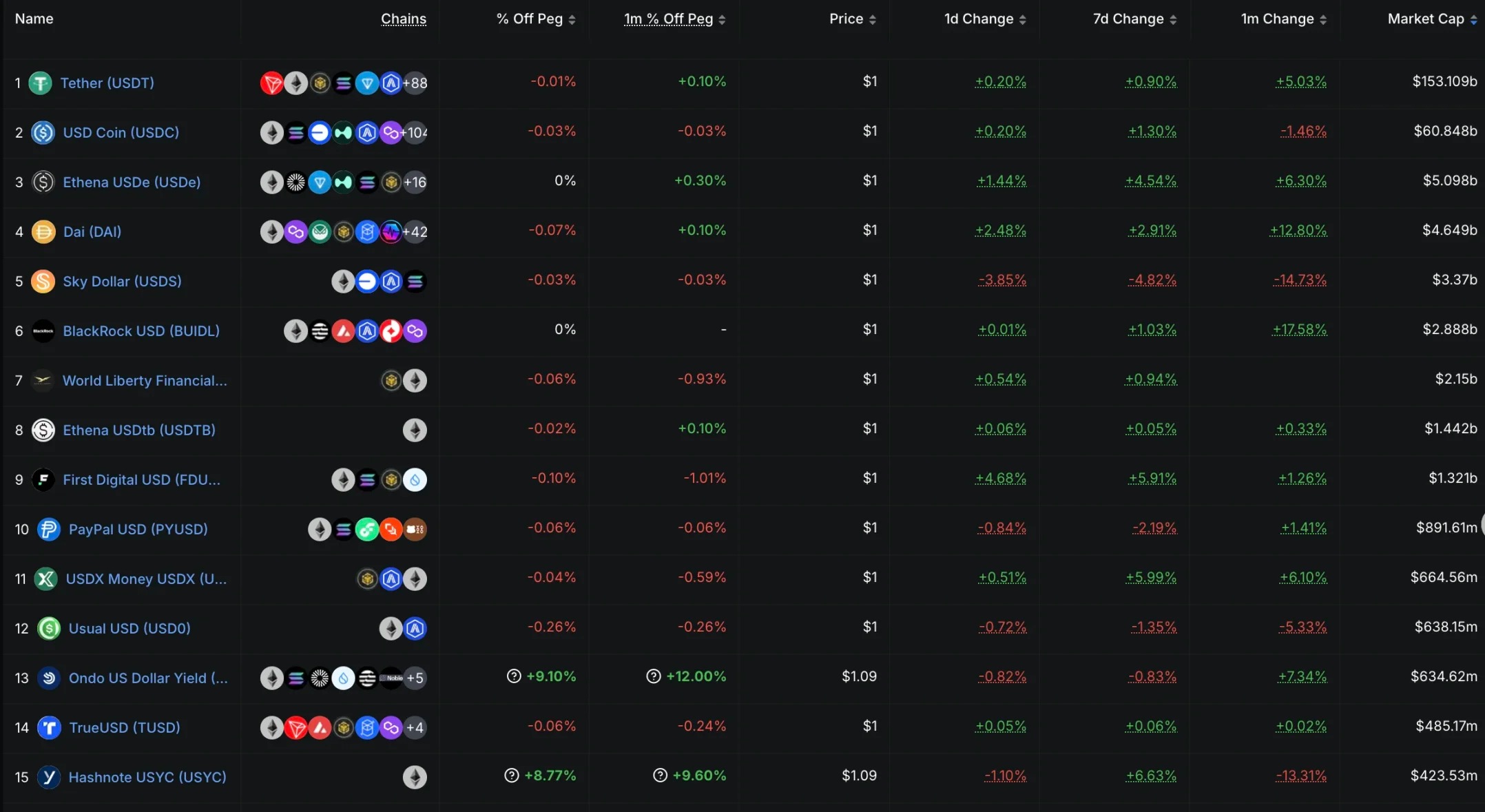
https://defillama.com/stablecoins
The U.S. "Genius Act" Sparks Stablecoin Regulation: Completing the Final Piece of Crypto Oversight
For all stablecoin projects, the recent U.S. Senate vote to advance the stablecoin regulation bill—the "Genius Act"—is the proverbial sword of Damocles hanging overhead. With spot Bitcoin ETFs and spot Ethereum ETFs now part of traditional institutional portfolios, this bill completes the final piece of the Trump administration’s crypto regulatory framework.
Specifically, in the author’s view, the main objectives of the Genius Act are:
1. Safeguarding dollar dominance. As staunch believers in “America First,” both Trump and his administration—including members of the Democratic Party—aim fundamentally to preserve U.S. political and economic hegemony, with the U.S. dollar serving as the primary vehicle. Stablecoins pegged 1:1 to the dollar are thus ideal instruments.
2. Ensuring stablecoin operations remain under U.S. jurisdiction. With the U.S. firmly establishing itself as crypto-friendly, it is reemerging as a crypto hub, enabling it to lead in shaping stablecoin operational frameworks and regulatory policies. Just as past foreign trade regulations empowered U.S. global influence, the U.S. will leverage the stablecoin system to exert comprehensive control over global crypto economies and cross-border commerce.
3. Enhancing partial security within the crypto financial system. This is a key reason why the Genius Act has received positive feedback from many industry and traditional finance representatives. Mandatory 1:1 full asset backing, strict prohibitions against fund misuse and re-pledging, frequent public disclosures requiring monthly reserve reports with third-party audits, banking-grade licenses for stablecoins exceeding $100 billion in circulation, and custodial requirements collectively add multiple layers of safeguards to the stablecoin sector. Of course, whether the door behind these locks is truly secure remains another matter.
4. Greatly expanding the potential of the RWA sector, tightening integration between on-chain and off-chain worlds. Indeed, stablecoins were among the earliest RWA products, with their underlying real-world asset being the U.S. dollar. As the Genius Act progresses, related RWA legislation is likely not far behind. Compared to today’s crypto market valued at over $3 trillion, the RWA market could reach tens of trillions of dollars.
Thus, the Genius Act will generate policy-driven benefits for the U.S. government and economy, fostering digital economic development, unlocking digital asset potential, and encouraging innovation in crypto projects—spawning a new generation of promising ventures and teams. The genius carrying crypto’s future may well be among them.
The Next Crypto Decade: Finance Remains Central, Crypto Stocks and Tokenized Equities Hold Immense Promise
Looking from 2025, crypto adoption has likely peaked as a percentage of the global population, and crypto investment remains a niche activity. However, within commercial society, every individual inherently participates in exchange—whether tangible goods, labor, virtual assets, or digital IPs. Therefore, driven by this fundamental need, more convenient, low-cost, and secure crypto payments will eventually penetrate everyday life.
Over the next decade (2025–2035), the crypto industry’s central narrative may narrow from the multitude of previously unproven sectors down to finance. Consequently, crypto stocks born from crypto IPOs and equity tokenization will emerge as the new frontiers of the industry.
In some respects, stocks of listed companies such as Strategy, Sol Strategy, and Metaplanet have already become “dual-nature carriers” of crypto stocks and tokenized equities. And as BTC’s value gains broader and higher recognition, their latent potential will be further unleashed.
Of course, in the visible landscape, ETH and Solana ecosystems remain the dominant industry choices today.
Conclusion: Satoshi’s Legacy Achieved, But Through an Unexpected Path
In closing, we cannot overlook Satoshi Nakamoto, the cryptographer who vanished from public view, whose vision of a “BTC peer-to-peer payment system” finds its ultimate realization unquestionably in stablecoins.
Ironically, however, he—who embodied the spirit of crypto punk to resist unchecked and ever-expanding state minting power—may never have anticipated that BTC would instead give rise to a stablecoin system even more centered on the U.S. dollar and backed by U.S. Treasuries.
Join TechFlow official community to stay tuned
Telegram:https://t.me/TechFlowDaily
X (Twitter):https://x.com/TechFlowPost
X (Twitter) EN:https://x.com/BlockFlow_News
 Odaily