AI in Crypto: After the Meme Frenzy, Will It Be Chaos or Rebirth?
TechFlow Selected TechFlow Selected
AI in Crypto: After the Meme Frenzy, Will It Be Chaos or Rebirth?
The era of AI memes is already over—let those who were cut and those who profited remain as eternal fragments of memory.
 Navigating Web3 tides with focused insights
Author: W Labs Guatian Lab
Introduction
We've noticed that every time we dive deep into industry research, the crypto market suddenly surges—BTC breaks past $100,000, ETH even climbs above $2,500. Heh, is this so-called "hard work pays off"? Just kidding. Actually, it's because the U.S. and the U.K. reached a trade agreement, and initial talks between the U.S. and China went relatively well (Trump first boasted about it on Twitter before both sides confirmed). This once again shows that the entire crypto industry still belongs to a high-risk financial speculation market, closely tied to macroeconomic conditions, and hasn't yet formed an independent market like gold or oil. That only strengthens our resolve to find sustainable breakthroughs in the crypto space—and AI + Web3 is currently our most valued track.
In this article, continuing from our previous piece, we'll review the five waves of AI development in Web3 over recent years. We’ll start with a summary table below, though our focus will be primarily on the current fifth wave:
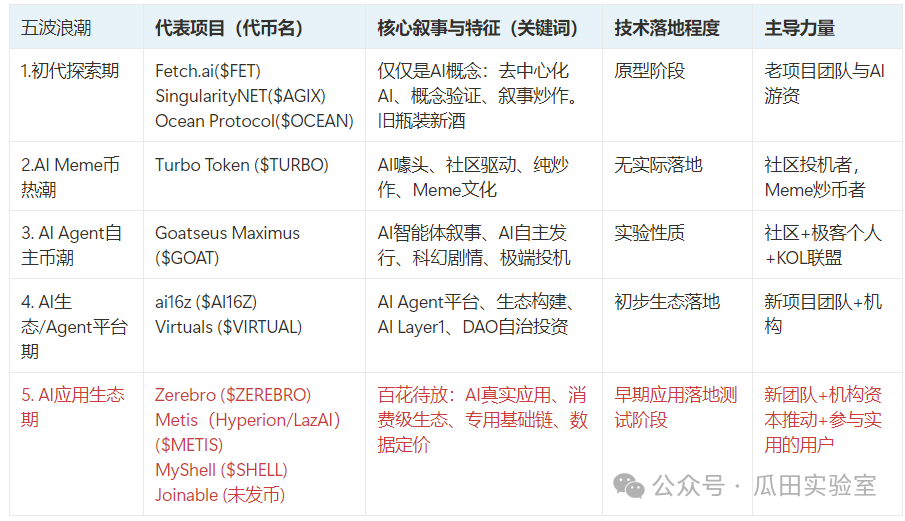
A Review of Five Waves of Web3 AI Projects
Since the convergence of blockchain and AI, the crypto space has experienced five major waves of AI-related hype. Each wave was led by representative projects or events, reflecting an evolution from pure concept炒作 to gradual technical exploration.
01
First Wave (Early Exploration Phase)—Rise of AI Concept Tokens like Fetch.AI: Old Wine in New Bottles
As early as 2018–2019, some projects attempted to combine blockchain and AI concepts, but their impact was very limited. The real catalyst for the first wave came in early 2023 following the launch of ChatGPT. OpenAI’s ChatGPT gained popularity at the end of 2022, demonstrating that AI had become powerful enough to enter widespread civilian use—somewhat reminiscent of how personal computers triggered the internet explosion over two decades ago, or how smartphones fueled mobile internet mania a decade ago. ChatGPT made ordinary users genuinely feel it could boost their work efficiency.
One defining trait of the crypto community is “if it’s hot, it gets pumped.” Thus, ChatGPT sparked boundless imagination in the crypto market about the prospects of “AI + Blockchain.” Starting January 2023, a batch of early AI concept tokens surged in price, marking the beginning of the first wave. A typical example is Fetch.ai (FET): as an early Binance Launchpad project claiming to build a decentralized AI agent network, FET’s token price skyrocketed in January 2023 (rising several-fold within a month), briefly surpassing a $200 million market cap. At the same time, other AI-related tokens such as SingularityNET (AGIX) and Ocean Protocol (OCEAN) also led market gains.
The hallmark of this phase was rebranding old projects with new narratives—many AI concept tokens originally issued between 2017 and 2019 were revived by the ChatGPT trend, becoming focal points for capital inflows. However, these projects were mostly in early stages, with few real-world applications, and their price increases were driven mainly by market sentiment and optimism toward broader AI trends.
02
Second Wave—This “Crypto Bull Market” Gives Birth to AI Meme Coins
If we define the sustained strength of BTC starting from late 2023 as the core theme of this “crypto bull market,” then only two sectors generated significant momentum during this period: one being inscriptions and runes under the BTC ecosystem, which brought massive attention through innovative asset issuance; the other being the Meme sector.
Some meme projects began incorporating AI themes, and as generative AI continued gaining popularity, the Crypto community saw the rise of an AI Meme Coin frenzy. A notable case is $TURBO—the so-called world’s first meme token created by AI. A digital artist used ChatGPT to help design and issue the TURBO token, starting with just $69. Unexpectedly, this AI-"curated" frog-themed meme coin surged shortly after launch, drawing massive retail interest. Riding on the unique narrative of “AI creating the next great meme coin,” TURBO listed on multiple mainstream exchanges and rose hundreds of times in value within weeks, briefly entering the ranks of top meme coins by market cap.
The core characteristic of this wave was that AI became a gimmick integrated into crypto subculture. Numerous new projects claimed to use AI tools like ChatGPT and Midjourney to generate token names, images, or backstories, launching various AI-themed meme tokens. Investors, encouraged by the AI wave and gambling mentality, flocked to these high-risk tokens. However, in reality, these meme coins lacked any real AI technology—they were merely community games built around AI hype. TURBO itself had no functional utility; its “AI-driven” label was purely a marketing stunt, with value supported largely by community consensus and greater fool theory. The second wave gradually faded in the second half of 2024, with many AI meme coins quickly crashing to zero, leading to market cooling.
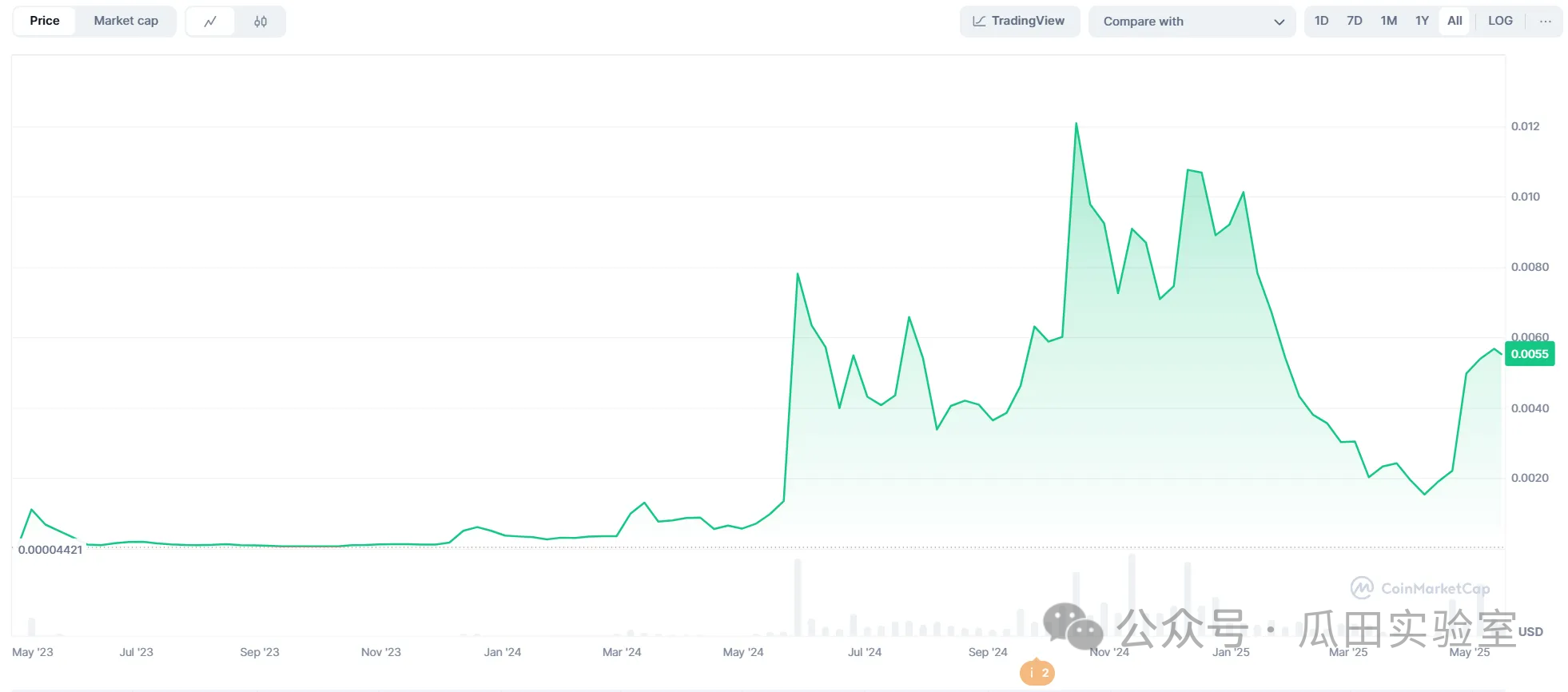
$TURBO price movement, source: CoinMarketCap
03
Third Wave—AI Agent Memes and the GOAT Myth
From the second half of 2024 to early 2025, the crypto industry witnessed a new height in the fusion of AI and blockchain storytelling: the rise of the AI Agents (AI intelligent agents) concept, elevating memes from simple jokes to automated agents with elaborate narratives. The landmark event driving this wave was the explosive popularity of Goatseus Maximus ($GOAT).
$GOAT was initially launched on Solana as a meme coin, but unlike earlier ones, it was wrapped in a “genesis by AI agent” story: reportedly, an AI agent named “Truth GPT,” created by developer Andy Ayrey, set out to create a viral meme coin—and even caught the attention and sponsorship of renowned VC Marc Andreessen (Andreessen personally provided $50,000 in seed funding to the AI). With this narrative fueling excitement, GOAT ignited market sentiment immediately upon launch—its price surged over 120 times on day one (a 12,000% increase within 24 hours), reaching a peak of around $0.4664 within weeks! This rags-to-riches tale made GOAT a hot topic across the crypto community, hailed as the “AI-powered super meme coin.”
The GOAT craze revealed the power of the AI Agent Narrative in crypto: teams or communities crafted stories of “autonomous AIs” running projects, giving tokens a sci-fi-like allure. For instance, claims that AI agents autonomously managed funds or executed tasks without human intervention added mystery and futurism. During this period, other AI agent-themed concepts emerged rapidly—such as TruthGPT and various self-proclaimed auto-trading AI Agent DAOs—many experiencing short-term price explosions.
Yet most projects remained stuck at the storytelling stage—still just telling tales. These so-called AI agents were often little more than pre-programmed scripts, far removed from truly autonomous intelligent applications, let alone delivering tangible performance. This wave peaked and collapsed around January 2025—external events (e.g., Trump announcing his personal meme coin $TRUMP in January 2025, siphoning off market capital) caused speculative money to flee, and prices of GOAT and similar tokens rapidly declined. The entire AI Agent sector fell from white-hot popularity to rock bottom within months.
$GOAT price movement, source: CoinMarketCap
04
Fourth Wave—a16z-Ecosystem AI + Rise of AI Agent Infrastructure Concepts
After the previous hype cycles cooled down, a new batch of AI projects focused on technology and ecosystem building emerged at the end of 2024. Unlike earlier community-driven pumps, this phase featured platform-type AI projects backed by notable figures or serious visions. Notable examples include ai16z and Virtuals, seen as representatives of the “a16z-ecosystem AI.” These projects shared a common goal: building AI Agent infrastructure aiming to become the “app store” for AI agents in Web3.
$AI16z was a breakout AI meme coin that rose to prominence in November 2024, its name playfully referencing the famous VC firm a16z. At its core, it positioned itself as a decentralized AI-powered trading fund on Solana—an “AI Investment DAO”—using AI agents to gather on-chain and off-chain market intelligence, analyze community sentiment, and execute trades automatically. This novel concept instantly captured market attention: by the end of October 2024, its market cap soared from zero to about $80 million in just one day, igniting speculator enthusiasm. Surprisingly, a16z co-founder Marc Andreessen publicly endorsed it on Twitter, sharing the project’s concept and link. Backed by a prominent figure and riding the dual narrative of “AI investing + Meme,” AI16z became the hottest crypto topic of the month.
Many in the industry questioned whether it was more hype than substance, but it undeniably opened up imaginations around the “AI + DAO self-governed investment” model. To further enhance token value, the ai16z team proposed an economic plan in December 2024 to evolve the project into an “AI Layer1”: launching a dedicated Launchpad for AI agents, making the AI16z token the base currency and fee medium for agent transactions, along with node incentives and buyback mechanisms. This phase showed teams attempting to shift from pure hype toward building sustainable ecosystems, supporting token value through technical capability and economic design rather than storytelling alone.
Around the same time, the Virtuals protocol succeeded remarkably in ecosystem promotion. Its team crafted compelling narratives, attracting numerous developers to build AI agent projects on its platform and drawing large numbers of retail investors. At its peak, the Fully Diluted Valuation (FDV) of top projects within the Virtuals ecosystem exceeded $5 billion, with Eliza framework-related tokens reaching roughly half that—valued in the billions. Other standout projects (like AIXBT) reached peak market caps in the hundreds of millions. During this period, capital assigned extremely high valuations to “AI agent platform/framework” type projects. Yet, user scale and actual revenue lagged far behind valuation—for example, despite claims of a thriving ecosystem, Virtuals reportedly earned less than $500 per day at launch, a stark contrast to its sky-high valuation. As the market turned cold in early 2025, these projects saw their token values halved or worse. It became clear that grand visions and narratives alone couldn’t sustain prices.
Thus, as of now, the representatives of the fourth wave have not truly become “app stores” for AI Agents, but are more akin to Pump.fun-style platforms concentrating AI Agent memes. Just as people waited to see if they could transform, the fifth wave arrived with full force.
05
Fifth Wave—The “Blossoming of Many Flowers” Closer to Real-World Applications
After a brief downturn, the Web3 AI sector warmed up again in early Q2 2025. This time, the focus clearly shifted “from虚to实” (from speculative to practical): efforts centered on next-generation AI Agent platforms and tools; new AI-dedicated blockchains optimized for AI projects; decentralized storage leveraging user data; and even integrations combining Web3 AI with other high-tech fields like robotics. All of this呈现出a “blossoming of many flowers” pattern, and we hope these practical projects will one day truly achieve “a hundred flowers blooming.” Below are some examples from this fifth wave for your reference:
Zerebro
As an AI agent project in the Solana ecosystem, Zerebro focuses on providing a platform for decentralized content generation and agent deployment, aiming to build a “consumer-grade AI Agent Launchpad.” In late 2024, the team announced the development of “Zentients,” an agent issuance platform envisioning the ZEREBRO token as both the fee and reward mechanism for creating AI agents. Zerebro’s vision is that anyone can generate their own AI agent (e.g., email assistant, coding helper, trading bot) with one click and issue a corresponding sub-token for that agent; meanwhile, the ZEREBRO token serves as the universal payment and governance tool across all agent services, enabling value accumulation. This model is seen as a genuine app store for AI agents—an enticing prospect.
Spurred by this vision, the ZEREBRO token price steadily climbed in early 2025. Especially after an earlier correction, ZEREBRO surged 400% within two days in April 2025, capturing massive market attention. Around the same time, related projects also exploded—for example, $AIOS, branded as an “Agent Operating System,” rebounded tenfold, briefly reviving the previously dormant Crypto AI sector. Investor imagination is shifting from individual AI agents to underlying infrastructure platforms: the market now chases projects offering standard interfaces, communication protocols, and deployment environments for AI agents, hoping they’ll bridge Web2 AI technologies with Web3 value capture. While Zerebro and others outline rich functionality, their actual products weren’t fully launched during the hype phase, with many use cases still in testing or demo stages.
Just last week, Zerebro reignited the market—but in a bizarre and unfortunate way: Zerebro co-founder Jeffy Yu posted a video online appearing to show a “suicide,” followed by a death notice published on an obituary site and in the San Francisco Chronicle, triggering a new meme coin LLJEFFY to surge past $100 million in market cap before crashing nearly to zero. Some KOLs noticed on-chain data showing wallet activity linked to Yu after his reported death, suggesting a possible exit scam. If the “fake death” incident is real, Zerebro may just be another meme played to extremes—a disgrace to crypto that deserves nothing but a middle finger. Such unethical stunts shame the entire ecosystem.
Metis’ AI Chain Hyperion + LazAI
Metis is a veteran Ethereum Layer2 project. Perhaps its most memorable claim is being the only project whose founding partners include Vitalik Buterin’s mother and sister-in-law. Since 2021, it has missed none of the major rallies—soaring a hundredfold during the 2022 bull run, up tenfold in early 2024, and now sitting back at historical lows. Metis entered the AI space when it officially announced on May 7 that the testnet for its “AI Chain Hyperion” would launch on May 14. Due to the team’s low profile, we had to dig through extensive materials to understand what exactly AI Chain Hyperion and AI Chain LazAI are (yes, they’re going all-in on AI, building two AI chains).
The first AI Chain, Hyperion, aims to solve problems faced by all existing L1s and L2s: Web3 AI projects require much larger computational capacity to handle frequent read/write operations and state calculations, while maintaining decentralization—something traditional EVM environments cannot support. The newly released Hyperion solution from Metis can be simply understood as a complete redesign of a new chain optimized specifically for high-performance Web3 AI or gaming projects. It uses the Metis SDK and Alith AI Agent framework to address challenges developers face. Hyperion continues to use $Metis as its sole token, making us more inclined to believe the Metis team is genuinely trying to build something substantial in AI—not just shouting lofty slogans. This likely explains why the Metis token has recently shown signs of stirring.
If the first AI Chain Hyperion is just Metis’ small test in the AI field—after all, we’ve heard other public chains claim ambitions to build high-performance AI chains—then the mysterious second AI Chain, LazAI, represents its full-scale campaign into AI. LazAI will be an entirely new Layer1 designed to establish a value pricing mechanism for individual (including personal and institutional) data contributions in AI. Sounds complex? Here’s an example: everyone knows companies like Alibaba or ByteDance profit by monetizing your personal data privacy, leaving you powerless unless you stop shopping online or watching short videos. But LazAI leverages blockchain decentralization so individuals retain ownership of their data. Since using AI requires inputting vast amounts of personal data—which may be valuable to certain projects or businesses—users can reclaim the value rightfully belonging to them, represented via tokens. Moreover, LazAI uses algorithms to assess data value levels, minimizing the crypto industry’s pain point of bots or sybil attackers flooding systems with useless data. Therefore, “decentralized classification and storage of personal data + data value pricing mechanism” will be LazAI’s defining feature—this is the direction the entire industry should strive toward: leveraging Web3’s inherent strengths to fix shortcomings in the Web2 world.
Admittedly, only a project team as credible and well-established as Metis dares to push such a grand narrative—and only then can we believe they might actually be working toward it.
To be continued.
Join TechFlow official community to stay tuned
Telegram:https://t.me/TechFlowDaily
X (Twitter):https://x.com/TechFlowPost
X (Twitter) EN:https://x.com/BlockFlow_News
 瓜田实验室W Labs